PUBLISHER: Mordor Intelligence | PRODUCT CODE: 2196592

PUBLISHER: Mordor Intelligence | PRODUCT CODE: 2196592
Super Fruit Juices - Market Share Analysis, Industry Trends & Statistics, Growth Forecasts (2027 - 2032)
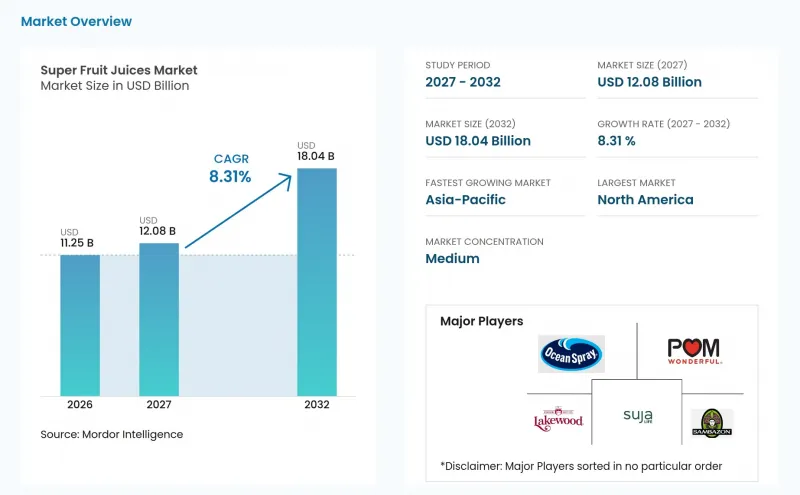
According to Mordor Intelligence, the super fruit juices market size is expected to increase from USD 11.25 billion in 2026 to USD 12.08 billion in 2027 and reach USD 18.04 billion by 2032, growing at a CAGR of 8.31% over 2027-2032.
Global Super Fruit Juices Market Trends and Insights
Rising Consumer Preference for Antioxidant-Rich and Nutrient-Dense Beverages
Consumer interest in beverages associated with nutritional value is creating opportunities for juices made from fruits such as acai, acerola, cranberry, blueberry, pomegranate, and goji berry. These fruits are commonly positioned as superfruits because of their antioxidant and other bioactive compound content. The Centre for the Promotion of Imports from developing countries (CBI) identifies antioxidants and anthocyanins as characteristics commonly associated with superfruits and notes that specific compounds, including vitamin C, proanthocyanidins, and polyphenols, are important quality parameters for certain superfruit juice ingredients . For manufacturers, these nutritional attributes provide opportunities to differentiate superfruit juices from conventional fruit beverages and develop products with clearly communicated ingredient and nutritional propositions. However, nutritional positioning needs to be supported by accurate product information and substantiated claims to maintain consumer confidence.
Growing Demand for Natural, Organic and Clean-Label Juice Products
Consumer interest in products with identifiable ingredients, natural positioning, and organic credentials is creating opportunities for differentiated fruit juice products. In its March 2026 review of the European processed fruit and vegetable market, CBI reported renewed growth in imports of organic processed products and identified tropical and citrus juices among the product categories showing increasing organic import volumes. The report also noted that organic certification schemes are becoming more popular in Europe, with organic products moving beyond their earlier niche-market positioning . For superfruit juice manufacturers, organic sourcing and clear ingredient declarations can strengthen product differentiation among consumers seeking alternatives to conventional beverages. However, certification requirements and the cost of maintaining compliant supply chains can increase production expenses, making sourcing efficiency and transparent product labelling important.
High Production Costs and Premium Retail Pricing
Superfruit juice production can involve higher raw-material and processing costs than conventional fruit juice, particularly when manufacturers use exotic fruits, organic ingredients, or specialised processing methods. Many superfruit varieties are sourced from specific growing regions, while their conversion into juice, puree, or concentrate can require additional handling, quality control, and transportation. Cold-pressed and not-from-concentrate products may also carry higher production and distribution costs than concentrate-based alternatives. These expenses can translate into premium retail prices, limiting accessibility among price-sensitive consumers and making frequent purchases more difficult. Manufacturers therefore need to balance ingredient quality and product differentiation with sourcing efficiency, processing scale, and pack-price strategies.
Other drivers and restraints analyzed in the detailed report include:
- Increasing Popularity of Exotic and Tropical Superfruit Varieties
- Product Innovation in Functional and Blended Superfruit Beverages
- Expansion of Premium and Cold-Pressed Superfruit Juice Offerings
- Limited Availability and Seasonal Supply of Exotic Superfruits
For complete list of drivers and restraints, kindly check the Table Of Contents.
Segment Analysis
In 2026, 100% superfruit juice accounted for an estimated 46.80% of the Super Fruit Juices Market, making it the leading product type. Its position reflects demand for beverages that provide a direct fruit-based proposition, with products made from ingredients such as pomegranate, cranberry, acai, blueberry, and other superfruit varieties. Meanwhile, superfruit juice blends are projected to record the fastest growth, at an estimated CAGR of 9.25% through 2032. Blended formulations allow manufacturers to combine different superfruit ingredients, balance distinctive flavour profiles, and develop products with broader sensory appeal. They also provide opportunities to incorporate complementary fruit ingredients and create differentiated beverage propositions.
Superfruit juice concentrates serve a separate role by providing concentrated ingredients for beverage formulation and further processing. Their use can support manufacturers developing blended beverages and other juice applications. However, producers across all three product categories need to manage ingredient quality, flavour consistency, and processing requirements. The ability to balance nutritional positioning, taste, and product affordability will remain important for expanding consumption.
In 2026, conventional superfruit juices accounted for an estimated 76.40% of the market, reflecting their wider availability and established position across retail beverage categories. Conventional products allow manufacturers to source and process a broad range of superfruit ingredients without the additional certification requirements associated with organic production. Meanwhile, organic superfruit juices are projected to register the fastest growth, at an estimated CAGR of 10.20% through 2032. Growing interest in organic ingredients, production transparency, and clean-label beverage formulations creates opportunities for manufacturers to develop certified organic superfruit products.
Organic formulations can help brands differentiate their offerings among consumers seeking products made with certified agricultural ingredients. However, organic certification requirements, sourcing limitations, and higher procurement costs can affect product pricing and availability. Manufacturers therefore need to maintain reliable certified supply chains while communicating organic credentials clearly and keeping premium pricing aligned with consumer expectations.
Complete Report Scope:
- By Product Type
- 100% Superfruit Juice
- Superfruit Juice Blends
- Superfruit Juice Concentrates
- By Nature
- Conventional
- Organic
- By Packaging Type
- Bottles
- Cartons
- Cans
- Pouches
- Other Packaging Types
- By Distribution Channel
- Off-Trade
- Supermarkets/Hypermarkets
- Convenience Stores
- Specialty and Health Food Stores
- Online Retail
- Other Distribution Channels
- On-Trade
- Off-Trade
- By Geography
- North America
- United States
- Canada
- Mexico
- Rest of North America
- Europe
- United Kingdom
- Germany
- France
- Italy
- Spain
- Sweden
- Belgium
- Poland
- Netherlands
- Rest of Europe
- Asia-Pacific
- China
- Japan
- India
- Thailand
- Singapore
- Indonesia
- South Korea
- Australia
- Rest of Asia-Pacific
- South America
- Brazil
- Argentina
- Colombia
- Peru
- Chile
- Rest of South America
- Middle East and Africa
- South Africa
- Saudi Arabia
- United Arab Emirates
- Nigeria
- Egypt
- Morocco
- Turkey
- Rest of Middle East and Africa
- North America
Geography Analysis
North America accounted for an estimated 32.40% of the Super Fruit Juices Market in 2026, making it the largest regional market. The United States is an important destination for international superfruit ingredients, particularly acai. According to USDA Foreign Agricultural Service data, Brazil exported 55,798 metric tons of acai products in 2025, with 30,531 metric tons shipped to the United States. This established sourcing relationship supports opportunities for manufacturers to develop acai-based juices, blends, and other specialty beverages.
Asia-Pacific is projected to be the fastest-growing regional market, with an estimated CAGR of 9.60% over 2027-2032. Brazil's acai exports to Australia reached 7,238 metric tons in 2025, while Japan was also among the leading destinations for Brazilian acai products. These trade connections create opportunities for regional beverage manufacturers to develop superfruit-based juices and blended formulations. Local fruit availability and established processing industries further support product diversification, although manufacturers need to adapt flavours and pricing to country-level preferences.
Europe offers opportunities through demand for exotic fruit ingredients, including acai, acerola, pomegranate, and berry-based products. South America benefits from Brazil's substantial acai production, which supports domestic processing and international ingredient supply. In the Middle East and Africa, demand for premium and differentiated fruit beverages creates opportunities for superfruit-based formulations, particularly pomegranate juice products. Across these regions, manufacturers must manage raw-material sourcing, processing requirements, import costs, and local consumer preferences.
- The Coca-Cola Company
- PepsiCo Inc.
- Ocean Spray Cranberries Inc.
- POM Wonderful LLC
- Sambazon Inc.
- Bolthouse Farms Inc.
- Suja Life LLC
- Lakewood Organic
- Dole Food Company Inc.
- Del Monte Foods Inc.
- Welch Foods Inc.
- The Hain Celestial Group Inc.
- SunOpta Inc.
- Genesis Today Inc.
- Dabur India Ltd.
- Ceres Fruit Juices (Pty) Ltd.
- Rauch Fruchtsafte GmbH & Co OG
- The J.M. Smucker Company (R.W. Knudsen)
- Tropicana Brands Group
- Nestle S.A.
Additional Benefits:
- The market estimate (ME) sheet in Excel format
- 3 months of analyst support
TABLE OF CONTENTS
1 INTRODUCTION
- 1.1 Study Assumptions and Market Definition
- 1.2 Scope of the Study
2 RESEARCH METHODOLOGY
3 EXECUTIVE SUMMARY
4 MARKET LANDSCAPE
- 4.1 Market Overview
- 4.2 Market Drivers
- 4.2.1 Rising consumer preference for antioxidant-rich and nutrient-dense beverages
- 4.2.2 Growing demand for natural, organic and clean-label juice products
- 4.2.3 Increasing popularity of exotic and tropical superfruit varieties
- 4.2.4 Product innovation in functional and blended superfruit beverages
- 4.2.5 Expansion of premium and cold-pressed superfruit juice offerings
- 4.2.6 Rising demand for convenient ready-to-drink superfruit formats
- 4.3 Market Restraints
- 4.3.1 High production costs and premium retail pricing
- 4.3.2 Limited availability and seasonal supply of exotic superfruits
- 4.3.3 Nutrient degradation during juice processing and extended storage
- 4.3.4 Taste and sensory challenges associated with certain superfruit varieties
- 4.4 Consumer Behaviour Analysis
- 4.5 Regulatory Landscape
- 4.6 Technological Outlook
- 4.7 Porter's Five Forces Analysis
- 4.7.1 Threat of New Entrants
- 4.7.2 Bargaining Power of Buyers
- 4.7.3 Bargaining Power of Suppliers
- 4.7.4 Threat of Substitutes
- 4.7.5 Intensity of Competitive Rivalry
5 MARKET SIZE AND GROWTH FORECASTS (ONLY VALUE)
- 5.1 By Product Type
- 5.1.1 100% Superfruit Juice
- 5.1.2 Superfruit Juice Blends
- 5.1.3 Superfruit Juice Concentrates
- 5.2 By Nature
- 5.2.1 Conventional
- 5.2.2 Organic
- 5.3 By Packaging Type
- 5.3.1 Bottles
- 5.3.2 Cartons
- 5.3.3 Cans
- 5.3.4 Pouches
- 5.3.5 Other Packaging Types
- 5.4 By Distribution Channel
- 5.4.1 Off-Trade
- 5.4.1.1 Supermarkets/Hypermarkets
- 5.4.1.2 Convenience Stores
- 5.4.1.3 Specialty and Health Food Stores
- 5.4.1.4 Online Retail
- 5.4.1.5 Other Distribution Channels
- 5.4.2 On-Trade
- 5.4.1 Off-Trade
- 5.5 By Geography
- 5.5.1 North America
- 5.5.1.1 United States
- 5.5.1.2 Canada
- 5.5.1.3 Mexico
- 5.5.1.4 Rest of North America
- 5.5.2 Europe
- 5.5.2.1 United Kingdom
- 5.5.2.2 Germany
- 5.5.2.3 France
- 5.5.2.4 Italy
- 5.5.2.5 Spain
- 5.5.2.6 Sweden
- 5.5.2.7 Belgium
- 5.5.2.8 Poland
- 5.5.2.9 Netherlands
- 5.5.2.10 Rest of Europe
- 5.5.3 Asia-Pacific
- 5.5.3.1 China
- 5.5.3.2 Japan
- 5.5.3.3 India
- 5.5.3.4 Thailand
- 5.5.3.5 Singapore
- 5.5.3.6 Indonesia
- 5.5.3.7 South Korea
- 5.5.3.8 Australia
- 5.5.3.9 Rest of Asia-Pacific
- 5.5.4 South America
- 5.5.4.1 Brazil
- 5.5.4.2 Argentina
- 5.5.4.3 Colombia
- 5.5.4.4 Peru
- 5.5.4.5 Chile
- 5.5.4.6 Rest of South America
- 5.5.5 Middle East and Africa
- 5.5.5.1 South Africa
- 5.5.5.2 Saudi Arabia
- 5.5.5.3 United Arab Emirates
- 5.5.5.4 Nigeria
- 5.5.5.5 Egypt
- 5.5.5.6 Morocco
- 5.5.5.7 Turkey
- 5.5.5.8 Rest of Middle East and Africa
- 5.5.1 North America
6 COMPETITIVE LANDSCAPE
- 6.1 Market Concentration
- 6.2 Strategic Moves
- 6.3 Market Share Analysis
- 6.4 Company Profiles (includes Global level Overview, Market level overview, Core Business Segments, Financials, Headcount, Key Information, Market Rank, Market Share, Products and Services, and analysis of Recent Developments)
- 6.4.1 The Coca-Cola Company
- 6.4.2 PepsiCo Inc.
- 6.4.3 Ocean Spray Cranberries Inc.
- 6.4.4 POM Wonderful LLC
- 6.4.5 Sambazon Inc.
- 6.4.6 Bolthouse Farms Inc.
- 6.4.7 Suja Life LLC
- 6.4.8 Lakewood Organic
- 6.4.9 Dole Food Company Inc.
- 6.4.10 Del Monte Foods Inc.
- 6.4.11 Welch Foods Inc.
- 6.4.12 The Hain Celestial Group Inc.
- 6.4.13 SunOpta Inc.
- 6.4.14 Genesis Today Inc.
- 6.4.15 Dabur India Ltd.
- 6.4.16 Ceres Fruit Juices (Pty) Ltd.
- 6.4.17 Rauch Fruchtsafte GmbH & Co OG
- 6.4.18 The J.M. Smucker Company (R.W. Knudsen)
- 6.4.19 Tropicana Brands Group
- 6.4.20 Nestle S.A.
7 MARKET OPPORTUNITIES AND FUTURE OUTLOOK

