PUBLISHER: Mordor Intelligence | PRODUCT CODE: 2196771

PUBLISHER: Mordor Intelligence | PRODUCT CODE: 2196771
Aneurysm Clips - Market Share Analysis, Industry Trends & Statistics, Growth Forecasts (2027 - 2032)
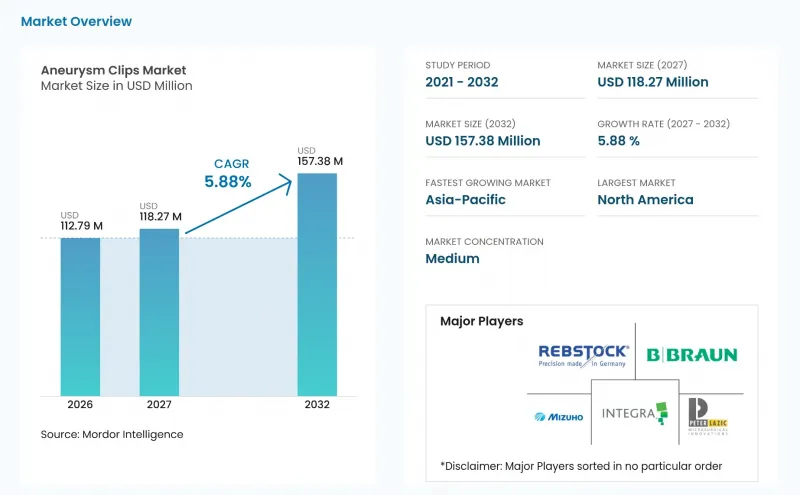
According to Mordor Intelligence, the aneurysm clips market size is projected to be USD 112.79 million in 2026, USD 118.27 million in 2027, and reach USD 157.38 million by 2032, growing at a CAGR of 5.88% from 2027 to 2032.
Global Aneurysm Clips Market Trends and Insights
Rising Detection of Intracranial Aneurysms Through CTA, MRA, and DSA
Expanding access to CTA and MRA is increasing the number of diagnosed aneurysms that reach clinical assessment. A 2025 review of 304,848 subjects reported a 5.4% prevalence of unruptured intracranial aneurysms and identified age, female sex, hypertension, and smoking as independent predictors.These factors are relevant to screening and referral programs in countries with established brain-health services. Silent MRA reduces radiation and contrast exposure, and a 2025 study reported its diagnostic value for unruptured intracranial aneurysms. Earlier identification can bring patients to surgical consultations before aneurysms become more difficult to manage. The aneurysm clips market gains from this broader treatment pipeline, especially when imaging identifies anatomy that needs microsurgical review.
Titanium and MRI-Compatible Clip Adoption
ASTM F2503 MR-conditional labeling supports postoperative imaging protocols where MRI is required. Aesculap's YASARGIL system includes more than 320 clip designs and 55 applier configurations in titanium and Phynox, allowing hospitals to match materials and geometry to case requirements. The aneurysm clips market is also shaped by planning tools that help surgeons prepare for difficult vascular anatomy. A 2025 mixed-reality simulator study distinguished levels of clipping skill among 40 participating neurosurgeons at international courses. These tools can support training and more deliberate use of temporary clips during complex procedures.
Shift Toward Endovascular Coiling, Flow Diversion, and Intrasaccular Devices
The shift toward endovascular therapy is the main structural restraint on the aneurysm clips market. In a propensity-matched analysis of centers in Eastern China, endovascular treatment was used for 90% of unruptured aneurysm patients between 2018 and 2022. However, the available evidence does not show that newer endovascular options replace clipping in every complex presentation. In mature settings, purchasing rules and compliance costs can also limit unit revenue even when procedure volumes remain stable. The aneurysm clips market consequently faces a case mix that favors fewer but more complex procedures with more specialized clip configurations.
Other drivers and restraints analyzed in the detailed report include:
- Persistent Clipping Demand for Complex and Wide-Neck Aneurysms
- Expansion of Neurosurgical Infrastructure in Asia-Pacific
- High Procedural Complexity and Dependence on Specialist Neurosurgeons
For complete list of drivers and restraints, kindly check the Table Of Contents.
Segment Analysis
Titanium accounted for 40.14% of the aneurysm clips market by material in 2026. Its position reflects non-ferromagnetic properties, established surgical use, and MR-conditional classification under ASTM F2503. Stainless steel remains relevant where MRI follow-up is less frequent. Phynox and cobalt-alloy options continue to serve cases that require resilient geometry or complex fenestration.
Polymer-based clips are forecasted to grow at a 6.21% CAGR through 2032. The aneurysm clips market size for this material category is tied to the aim of eliminating MRI artifacts rather than making a minor improvement to metal performance. Biocompatibility requirements under ISO 10993 add development work for new polymer products. Those requirements may also raise barriers for suppliers that enter this category later.
Permanent clips accounted for 52.53% of the aneurysm clip revenue share by device modality in 2026. Every clipping procedure requires permanent closure of the aneurysm neck, and difficult cases can require several clips. The permanent category benefits from this requirement for definitive occlusion. It also benefits from minimally invasive microsurgical approaches that remain relevant in selected cases.
Temporary clips are expected to grow at a 7.25% CAGR through 2032. Their use during parent artery control is associated with difficult dissection, risk of intraoperative rupture, and surgeon preference. The aneurysm clips market may see higher temporary clip use per procedure as referrals move toward specialty programs.
Complete Report Scope:
- By Material
- Titanium Clips
- Polymer-Based Clips
- Stainless Steel Clips
- Other Materials
- By Device Modality
- Permanent Aneurysm Clips
- Temporary Aneurysm Clips
- By Aneurysm Type
- Cerebral Aneurysms
- Abdominal Aneurysms
- Thoracic Aneurysms
- Peripheral Aneurysms
- By End-User
- Hospitals
- Specialty Neurosurgery Centers/Clinics
- Ambulatory Surgical Centers
- Other End Users (Research Institutes and Academic Institutes, among others)
- By Geography
- North America
- United States
- Canada
- Mexico
- Europe
- Germany
- United Kingdom
- France
- Italy
- Spain
- Rest of Europe
- Asia-Pacific
- China
- Japan
- India
- Australia
- South Korea
- Rest of Asia-Pacific
- Middle East and Africa
- GCC
- South Africa
- Rest of Middle East and Africa
- South America
- Brazil
- Argentina
- Rest of South America
- North America
Geography Analysis
North America held 47.42% of the aneurysm clip revenue share in 2026. The region benefits from dense neurovascular center networks, reimbursement for microsurgical procedures, and replacement demand for MRI-compatible systems. The U.S. regulatory classification for aneurysm clips is Class II under 21 CFR 882.5200. North American demand is expected to remain substantial through 2032, although its global weight may decline as Asia-Pacific expands.
Europe remains significant because Germany, the United Kingdom, and France maintain established neurovascular programs. German hospitals continue to provide clipping alongside endovascular therapy as part of broader vascular neurosurgery services. The aneurysm clips market in the region is influenced by the EU MDR 2017/745 framework. This framework favors suppliers with well-documented materials and post-market evidence. It can also speed the replacement of legacy clips without MR-conditional documentation. A 2024 Germany-wide analysis found that endovascular and surgical approaches continued to coexist at the national scale.
Asia-Pacific is projected to grow at an 8.26% CAGR through 2032, the fastest regional rate in the aneurysm clips market. China combines a large clinical base with changing procurement conditions and a need for local manufacturing strategies. Japan's JR-NET 4 registry included 60,354 neuroendovascular procedures and 24,037 cerebral aneurysm treatments. These figures show a high-density treatment setting where complex anatomy can still support surgical clipping. South Korea is adding treatment options, which reinforces a mixed-modality approach to aneurysm care. The Middle East, Africa, and South America remain earlier-stage opportunities that depend on workforce development and specialist infrastructure.
- Abbott Laboratories
- Acandis
- adeor medical AG
- B. Braun
- Boston Scientific
- Cerenovus
- Evonos
- Inomed Medizintechnik
- Integra LifeSciences
- KLS Martin Group
- Medtronic
- MicroVention
- MIZUHO Corporation
- Penumbra
- Peter Lazic GmbH
- RauMedic
- Rebstock Instruments GmbH
- Stryker
- Terumo
- YKD Medical
Additional Benefits:
- The market estimate (ME) sheet in Excel format
- 3 months of analyst support
TABLE OF CONTENTS
1 Introduction
- 1.1 Study Assumptions and Market Definition
- 1.2 Scope of the Study
2 Research Methodology
3 Executive Summary
4 Market Landscape
- 4.1 Market Overview
- 4.2 Market Drivers
- 4.2.1 Rising Detection of Intracranial Aneurysms Through CTA, MRA, and DSA
- 4.2.2 Titanium and MRI-Compatible Clip Adoption
- 4.2.3 Persistent Clipping Demand for Complex and Wide-Neck Aneurysms
- 4.2.4 Expansion of Neurosurgical Infrastructure in Asia-Pacific
- 4.2.5 Growth in Microsurgical Training and High-Volume Neurovascular Centers
- 4.2.6 Patient-Specific Clip Planning Using Three-Dimensional Imaging and Mixed Reality
- 4.3 Market Restraints
- 4.3.1 Shift Toward Endovascular Coiling, Flow Diversion, and Intrasaccular Devices
- 4.3.2 High Procedural Complexity and Dependence on Specialist Neurosurgeons
- 4.3.3 MRI Documentation Risk for Legacy and Unidentified Clips
- 4.3.4 Procurement Pressure and Declining Unit Volumes in Mature Markets
- 4.4 Supply Chain Analysis
- 4.5 Regulatory Landscape
- 4.6 Technological Outlook
- 4.7 Porter's Five Forces Analysis
- 4.7.1 Threat of New Entrants
- 4.7.2 Bargaining Power of Suppliers
- 4.7.3 Bargaining Power of Buyers
- 4.7.4 Threat of Substitutes
- 4.7.5 Competitive Rivalry
5 Market Size & Growth Forecasts (Value, USD)
- 5.1 By Material
- 5.1.1 Titanium Clips
- 5.1.2 Polymer-Based Clips
- 5.1.3 Stainless Steel Clips
- 5.1.4 Other Materials
- 5.2 By Device Modality
- 5.2.1 Permanent Aneurysm Clips
- 5.2.2 Temporary Aneurysm Clips
- 5.3 By Aneurysm Type
- 5.3.1 Cerebral Aneurysms
- 5.3.2 Abdominal Aneurysms
- 5.3.3 Thoracic Aneurysms
- 5.3.4 Peripheral Aneurysms
- 5.4 By End-User
- 5.4.1 Hospitals
- 5.4.2 Specialty Neurosurgery Centers/Clinics
- 5.4.3 Ambulatory Surgical Centers
- 5.4.4 Other End Users (Research Institutes and Academic Institutes, among others)
- 5.5 By Geography
- 5.5.1 North America
- 5.5.1.1 United States
- 5.5.1.2 Canada
- 5.5.1.3 Mexico
- 5.5.2 Europe
- 5.5.2.1 Germany
- 5.5.2.2 United Kingdom
- 5.5.2.3 France
- 5.5.2.4 Italy
- 5.5.2.5 Spain
- 5.5.2.6 Rest of Europe
- 5.5.3 Asia-Pacific
- 5.5.3.1 China
- 5.5.3.2 Japan
- 5.5.3.3 India
- 5.5.3.4 Australia
- 5.5.3.5 South Korea
- 5.5.3.6 Rest of Asia-Pacific
- 5.5.4 Middle East and Africa
- 5.5.4.1 GCC
- 5.5.4.2 South Africa
- 5.5.4.3 Rest of Middle East and Africa
- 5.5.5 South America
- 5.5.5.1 Brazil
- 5.5.5.2 Argentina
- 5.5.5.3 Rest of South America
- 5.5.1 North America
6 Competitive Landscape
- 6.1 Market Concentration
- 6.2 Market Share Analysis
- 6.3 Company Profiles (includes Global level Overview, Market level overview, Core Segments, Financials as available, Strategic Information, Market Rank/Share for key companies, Products & Services, Recent Developments)
- 6.3.1 Abbott Laboratories
- 6.3.2 Acandis GmbH
- 6.3.3 adeor medical AG
- 6.3.4 B. Braun SE
- 6.3.5 Boston Scientific Corporation
- 6.3.6 Cerenovus
- 6.3.7 evonos GmbH & Co. KG
- 6.3.8 Inomed Medizintechnik GmbH
- 6.3.9 Integra LifeSciences Corporation
- 6.3.10 KLS Martin Group
- 6.3.11 Medtronic plc
- 6.3.12 MicroVention, Inc.
- 6.3.13 MIZUHO Corporation
- 6.3.14 Penumbra, Inc.
- 6.3.15 Peter Lazic GmbH
- 6.3.16 RauMedic
- 6.3.17 Rebstock Instruments GmbH
- 6.3.18 Stryker Corporation
- 6.3.19 Terumo Corporation
- 6.3.20 YKD Medical
7 Market Opportunities & Future Outlook
- 7.1 White-space & Unmet-need Assessment

