PUBLISHER: Mordor Intelligence | PRODUCT CODE: 2196823

PUBLISHER: Mordor Intelligence | PRODUCT CODE: 2196823
Europe Data Center Sustainable Cooling - Market Share Analysis, Industry Trends & Statistics, Growth Forecasts (2027 - 2032)
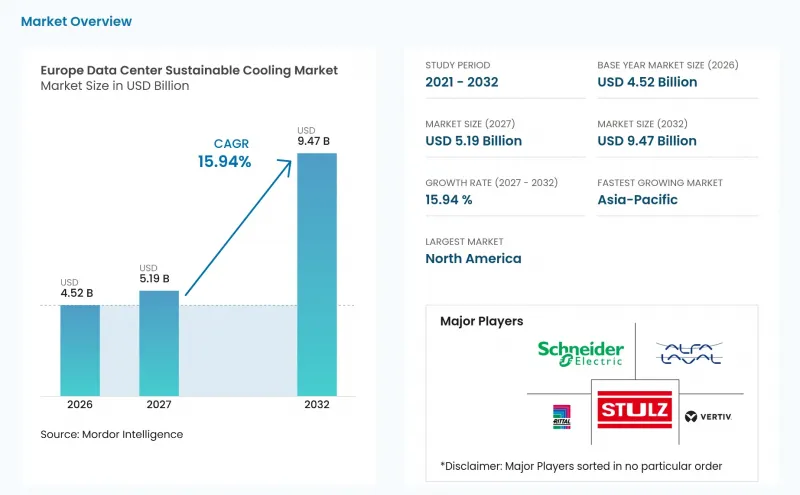
According to Mordor Intelligence, the Europe data center sustainable cooling market size is USD 4.52 billion in 2026 and is projected to reach USD 9.47 billion by 2032, expanding at a CAGR of 15.94% from 2027 to 2032.
Europe Data Center Sustainable Cooling Market Trends and Insights
AI and High-Performance Computing Rack Density Expansion
The Europe data center sustainable cooling market is responding to AI training and inference systems that have changed the heat loads facilities must manage. Purpose-built AI deployments are being designed for very high per-rack power densities, while advanced AI platforms operate at exceptionally high thermal design power and can reach even higher levels at peak load. Conventional hall air cooling becomes constrained at high rack densities, so new high-density projects increasingly require direct-to-chip liquid cooling. A single direct-to-chip loop, including cold plates, cooling distribution units, and piping, can involve substantial costs. This places cooling equipment in the initial capital plan for each AI cluster. A peer-reviewed review found that direct-to-chip cooling and rear-door heat exchangers were commercially mature options for near-term AI deployments, while immersion and two-phase systems remained in the earlier stages of commercial rollout. Continuous inference workloads add to the need for stable thermal management because they can maintain high utilization beyond a discrete training cycle.
Hyperscale and Colocation Capacity Build-Outs
The Europe data center sustainable cooling market benefits from new hyperscale and colocation construction across established and emerging locations. Greenfield projects allow operators to specify liquid loops, cooling distribution units, and heat rejection systems at the design stage rather than adapt legacy layouts. Cloud providers and colocation operators also need liquid-cooling-ready shells when serving GPU-as-a-service tenants. New sites outside established hubs face different choices on climate, water availability, grid access, and district heating connections. These conditions favor modular systems that can be tuned to individual sites. The growing number of sovereign AI and EuroHPC projects adds another procurement stream for cooling vendors because high-density compute must be built with reliable heat removal from the outset.
High Upfront Cost of Liquid-Cooling Retrofits
Retrofitting a live facility with liquid cooling can delay adoption, as operators cannot absorb construction work and service disruption. A direct-to-chip loop can require significant upfront investment before accounting for building changes, operating procedures, and downtime. Existing facilities may also need new piping routes, flush-and-fill rooms, reinforced floors, and revised insurance arrangements for dense AI hardware. Rear-door heat exchangers can serve as an interim step because they capture heat at the cabinet boundary without a full-facility liquid loop. This approach lowers near-term disruption but can defer the deeper efficiency improvements expected from a full upgrade. The restraint is strongest among medium and small operators, which generally have less purchasing leverage and fewer opportunities to redesign live space in phases.
Other drivers and restraints analyzed in the detailed report include:
- EU Energy Efficiency and Sustainability Compliance
- Northern Europe Free-Cooling and Renewable Energy Advantages
- F-Gas Phase-Down and Refrigerant Transition Complexity
For complete list of drivers and restraints, kindly check the Table Of Contents.
Segment Analysis
Air-based cooling held 34.07% of the Europe data center sustainable cooling market share in 2026, supported by the installed base of conventional facilities. It remains suitable for many existing workloads that run at lower power density. Its position is increasingly linked to compatibility with legacy layouts rather than the requirements of new AI halls. Direct-to-chip liquid cooling is projected to expand at a 16.23% CAGR through 2032 as new GPU platforms require heat removal far beyond the practical range of conventional airflow. NVIDIA's high-density AI reference designs support closed-loop direct-to-chip cooling and dry-cooler heat rejection for large deployments. This makes liquid cooling a core infrastructure choice for purpose-built AI campuses.
Rear-door heat exchangers offer colocation operators a less disruptive path for supporting higher-density racks in existing rooms. They remove heat at the cabinet boundary and can be introduced without fully rebuilding a facility loop. Free cooling and economizer systems remain important in northern greenfield locations where weather conditions support long operating periods with limited mechanical cooling. A peer-reviewed review found that direct-to-chip cooling and rear-door heat exchangers were the most mature choices for near-term deployments. The same review identified immersion and two-phase cooling as high-potential technologies at an earlier stage of commercial adoption. The Europe data center sustainable cooling industry is likely to use several cooling approaches because retrofit needs differ from those of greenfield AI sites.
Air-cooled systems held 40.49% of the heat rejection technology segment in 2026, reflecting prior investment in dry coolers and air-handling equipment. Hybrid heat rejection systems are projected to expand at a 16.52% CAGR through 2032. They allow operators to balance air and water use across Europe's different climate conditions. A hybrid configuration can also limit dependence on evaporative cooling in places with water constraints. NVIDIA's DSX design pairs direct-to-chip liquid cooling with outdoor dry coolers that reject heat without evaporation. The approach supports high-density infrastructure while addressing water-use concerns.
Water-cooled systems and evaporative rejection remain relevant at campuses with existing chilled-water equipment. Dry coolers are more attractive in the Nordics because weather conditions limit the need for supplemental refrigeration through much of the year. In warmer locations, hybrid systems can manage short periods of elevated ambient temperature without relying on water-intensive operation year-round. Cooling decisions also affect reporting under the Energy Efficiency Directive because operators must document energy and water performance. This makes hybrid heat rejection useful for operators seeking both operational resilience and better measured efficiency. The Europe data center sustainable cooling industry is therefore moving toward site-specific heat rejection rather than a single standard design.
Complete Report Scope:
- By Cooling Technology
- Air-Based Cooling
- Direct-to-Chip Liquid Cooling
- Immersion Cooling
- Rear-Door Heat Exchangers
- Evaporative and Adiabatic Cooling
- Free Cooling and Economizer Systems
- Other Sustainable Cooling Technologies
- By Heat Rejection Technology
- Air-Cooled Systems
- Water-Cooled Systems
- Evaporative Heat Rejection
- Dry Coolers
- Hybrid Heat Rejection Systems
- By Cooling System Component
- Cooling Distribution Units (CDUs)
- Chillers
- Cooling Towers
- Heat Exchangers
- Pumps and Fluid Distribution Systems
- Fans and Air Handling Equipment
- Cooling Controls and Monitoring Systems
- By Sustainability Approach
- Energy-Efficient Cooling
- Water-Efficient Cooling
- Low-Global-Warming-Potential Refrigerant Solutions
- Heat Recovery-Enabled Cooling
- Integrated Cooling Optimization and Controls
- By Data Center Size
- Small
- Medium
- Large
- Hyperscale
- By Data Center Type
- Colocation
- Cloud Service Providers (CSPs)
- Enterprise and Edge
- By Geography
- United Kingdom
- Germany
- France
- Netherlands
- Ireland
- Spain
- Italy
- Nordics
- Rest of Europe
List of Companies Covered in this Report:
- Vertiv Group Corp.
- Schneider Electric SE
- STULZ GmbH
- Rittal GmbH & Co. KG
- Alfa Laval AB
- Asetek A/S
- Iceotope Technologies Ltd.
- Green Revolution Cooling Inc.
- Chilldyne Inc.
- Airedale International Air Conditioning Ltd.
- Johnson Controls International plc
- Daikin Europe NV
- Munters Group AB
- Submer Technologies SL
- CoolIT Systems Inc.
- Danfoss A/S
- Parker Hannifin Corp.
- Trane Technologies plc
- Sensata Technologies Inc.
- Asperitas BV
Additional Benefits:
- The market estimate (ME) sheet in Excel format
- 3 months of analyst support
TABLE OF CONTENTS
1 INTRODUCTION
- 1.1 Study Assumptions and Market Definition
- 1.2 Scope of the Study
2 RESEARCH METHODOLOGY
3 EXECUTIVE SUMMARY
4 MARKET LANDSCAPE
- 4.1 Market Overview
- 4.2 Impact of Macroeconomic Factors on the Market
- 4.3 Market Drivers
- 4.3.1 AI and High-Performance Computing Rack Density Expansion
- 4.3.2 Hyperscale and Colocation Capacity Build-Outs
- 4.3.3 EU Energy Efficiency and Sustainability Compliance
- 4.3.4 Northern Europe Free-Cooling and Renewable Energy Advantages
- 4.3.5 Waste Heat Reuse and District Energy Integration
- 4.3.6 Sovereign AI and Digital Infrastructure Investment
- 4.4 Market Restraints
- 4.4.1 High Upfront Cost of Liquid-Cooling Retrofits
- 4.4.2 F-Gas Phase-Down and Refrigerant Transition Complexity
- 4.4.3 Limited Local Heat Off-Takers for Recovered Heat
- 4.4.4 Cooling Water Trade-Offs and Site-Specific Water Stress
- 4.5 Industry Value Chain Analysis
- 4.6 Regulatory Landscape
- 4.7 Technological Outlook
- 4.8 Porter's Five Forces Analysis
- 4.8.1 Bargaining Power of Suppliers
- 4.8.2 Bargaining Power of Buyers
- 4.8.3 Threat of New Entrants
- 4.8.4 Threat of Substitutes
- 4.8.5 Competitive Rivalry
5 MARKET SIZE AND GROWTH FORECASTS (VALUE)
- 5.1 By Cooling Technology
- 5.1.1 Air-Based Cooling
- 5.1.2 Direct-to-Chip Liquid Cooling
- 5.1.3 Immersion Cooling
- 5.1.4 Rear-Door Heat Exchangers
- 5.1.5 Evaporative and Adiabatic Cooling
- 5.1.6 Free Cooling and Economizer Systems
- 5.1.7 Other Sustainable Cooling Technologies
- 5.2 By Heat Rejection Technology
- 5.2.1 Air-Cooled Systems
- 5.2.2 Water-Cooled Systems
- 5.2.3 Evaporative Heat Rejection
- 5.2.4 Dry Coolers
- 5.2.5 Hybrid Heat Rejection Systems
- 5.3 By Cooling System Component
- 5.3.1 Cooling Distribution Units (CDUs)
- 5.3.2 Chillers
- 5.3.3 Cooling Towers
- 5.3.4 Heat Exchangers
- 5.3.5 Pumps and Fluid Distribution Systems
- 5.3.6 Fans and Air Handling Equipment
- 5.3.7 Cooling Controls and Monitoring Systems
- 5.4 By Sustainability Approach
- 5.4.1 Energy-Efficient Cooling
- 5.4.2 Water-Efficient Cooling
- 5.4.3 Low-Global-Warming-Potential Refrigerant Solutions
- 5.4.4 Heat Recovery-Enabled Cooling
- 5.4.5 Integrated Cooling Optimization and Controls
- 5.5 By Data Center Size
- 5.5.1 Small
- 5.5.2 Medium
- 5.5.3 Large
- 5.5.4 Hyperscale
- 5.6 By Data Center Type
- 5.6.1 Colocation
- 5.6.2 Cloud Service Providers (CSPs)
- 5.6.3 Enterprise and Edge
- 5.7 By Geography
- 5.7.1 United Kingdom
- 5.7.2 Germany
- 5.7.3 France
- 5.7.4 Netherlands
- 5.7.5 Ireland
- 5.7.6 Spain
- 5.7.7 Italy
- 5.7.8 Nordics
- 5.7.9 Rest of Europe
6 COMPETITIVE LANDSCAPE
- 6.1 Market Concentration
- 6.2 Strategic Moves
- 6.3 Market Share Analysis
- 6.4 Company Profiles (includes Global Level Overview, Market Level Overview, Core Segments, Financials as available, Strategic Information, Market Rank/Share, Products and Services, Recent Developments)
- 6.4.1 Vertiv Group Corp.
- 6.4.2 Schneider Electric SE
- 6.4.3 STULZ GmbH
- 6.4.4 Rittal GmbH & Co. KG
- 6.4.5 Alfa Laval AB
- 6.4.6 Asetek A/S
- 6.4.7 Iceotope Technologies Ltd.
- 6.4.8 Green Revolution Cooling Inc.
- 6.4.9 Chilldyne Inc.
- 6.4.10 Airedale International Air Conditioning Ltd.
- 6.4.11 Johnson Controls International plc
- 6.4.12 Daikin Europe NV
- 6.4.13 Munters Group AB
- 6.4.14 Submer Technologies SL
- 6.4.15 CoolIT Systems Inc.
- 6.4.16 Danfoss A/S
- 6.4.17 Parker Hannifin Corp.
- 6.4.18 Trane Technologies plc
- 6.4.19 Sensata Technologies Inc.
- 6.4.20 Asperitas BV
7 MARKET OPPORTUNITIES AND FUTURE OUTLOOK
- 7.1 White-Space and Unmet-Need Assessment

