PUBLISHER: Mordor Intelligence | PRODUCT CODE: 2196827

PUBLISHER: Mordor Intelligence | PRODUCT CODE: 2196827
Middle East and Africa Data Center Sustainable Cooling - Market Share Analysis, Industry Trends & Statistics, Growth Forecasts (2027 - 2032)
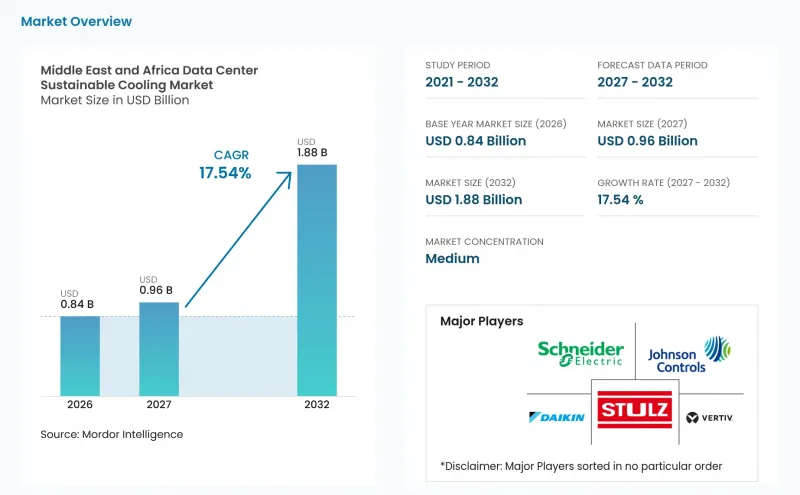
According to Mordor Intelligence, the Middle East and Africa data center sustainable cooling market size is projected to expand from USD 0.84 billion in 2026 to USD 1.88 billion by 2032, registering a CAGR of 17.54% between 2027 to 2032.
Middle East and Africa Data Center Sustainable Cooling Market Trends and Insights
Hyperscale and Sovereign AI Capacity Expansion
Sovereign-backed investment is concentrating data center construction into a limited number of large projects across the Gulf. The Middle East had 1.1 GW of commissioned data center capacity, 760 MW under construction, and a pipeline exceeding 5.5 GW in early 2026. This construction pattern gives cooling suppliers a chance to participate before facility specifications are finalized. Saudi Arabia's data center strategy targeted 1.5 GW of capacity by 2030, which supported planning for larger thermal systems and liquid-cooling-ready facilities. The UAE also advanced large AI campus plans, creating demand for equipment that can accommodate high-density computing. The Middle East and Africa data center sustainable cooling market benefits because cooling is specified as part of national digital infrastructure rather than added after a facility opens.
Rising Rack Power Density From AI and HPC Workloads
AI and high-performance computing workloads are raising the heat load that each rack must reject. The U.S. Department of Energy reported that high-end AI and HPC installations can operate at up to 250 kW per rack, well above the range traditionally served by room-level air cooling. Air cooling becomes difficult to apply once rack densities move beyond the 40-50 kW range described in the supplied research. This changes cooling design from an efficiency decision into a technical requirement for GPU clusters. Direct-to-chip systems, liquid-to-liquid loops, and rear-door heat exchangers give operators more options for managing concentrated heat. The Middle East and Africa data center sustainable cooling market is gaining support from new campuses that need to prepare for higher rack density before the hardware is installed.
High Retrofit Cost and Facility-Design Incompatibility
Existing air-cooled facilities are more difficult to convert than purpose-built AI campuses. A retrofit requires changes to pipework, floor layouts, electrical distribution, rack arrangements, and operational procedures. Work can also disrupt customers that have long-term colocation contracts and limited tolerance for downtime. The result is a divide between new campuses that can include liquid cooling in their original design and older facilities that continue using air cooling for moderate-density workloads. Operators must compare the cost of conversion with the revenue potential from hosting dense AI infrastructure. This constraint can slow the Middle East and Africa data center sustainable cooling market in the installed base even when demand for new capacity remains strong.
Other drivers and restraints analyzed in the detailed report include:
- Data Localization and Cloud-Region Expansion
- Water-Scarcity-Led Shift to Closed-Loop and Low-Water Cooling
- Shortage of Liquid-Cooling Operations and Maintenance Skills
For complete list of drivers and restraints, kindly check the Table Of Contents.
Segment Analysis
Air-based cooling held 49.24% of the regional market in 2026, supported by the large installed base of legacy facilities. It remains appropriate for workloads that have not reached liquid-critical power density. Many existing sites are improving fans, air handling, and controls rather than replacing their full cooling architecture. This approach can extend the usable life of established equipment while reducing energy use. New AI-oriented projects are taking a different route by planning hybrid or fully liquid systems from the start. Immersion cooling is gaining early traction in AI training environments where heat is concentrated in a smaller footprint. Rear-door heat exchangers provide an intermediate option for sites that host a mix of conventional servers and denser equipment. Free cooling and economizer configurations are also being considered in North African and sub-Saharan projects where local climate conditions permit their use.
Direct-to-chip liquid cooling is projected to expand at a 17.88% CAGR through 2032, making it the fastest-moving cooling technology segment. GPU clusters in Gulf campuses can exceed 80-100 kW per rack, a range that makes direct liquid cooling technically relevant. The technology transfers heat close to the processor rather than relying only on room air. This can make thermal management more predictable in dense deployments. The U.S. Department of Energy identified the continued rise in AI and HPC power density as a major planning issue for digital infrastructure. Facility designers are increasingly assessing cooling technology alongside power delivery, rack layout, and network design. ASHRAE TC9.9 guidance and Open Compute Project rack standards offer useful reference points for system design. The Middle East and Africa data center sustainable cooling market is consequently shifting toward cooling systems that are ready for high-density hardware before it arrives.
Air-cooled systems represented 40.17% of the market in 2026 because they are straightforward to deploy and align with lower-water operating models. Their performance can be affected by high ambient temperatures, especially during Gulf summers. Open-circuit evaporative towers can improve heat rejection but create water-use concerns in water-stressed locations. Operators are therefore balancing power use, water availability, and local climate in the same design decision. Khazna reported that recycled water met 19.8% of its cooling water needs in 2025. Dry coolers are also relevant in African markets where grid variability can make energy-intensive chiller operation more difficult. These conditions favor heat rejection solutions that do not depend on a single operating mode.
Hybrid heat rejection systems are projected to expand at an 18.21% CAGR through 2032. They combine operating modes and can switch configurations as outdoor conditions change. This gives facilities more flexibility during extreme temperature peaks without depending continuously on evaporative water use. The approach is well suited to new Saudi Arabian and UAE projects, where daily and seasonal temperature changes affect cooling performance. Hybrid systems can also help operators meet sustainability targets while maintaining the thermal capacity required for AI workloads. Their adoption depends on controls that can select the appropriate operating mode without interrupting critical equipment. The Middle East and Africa data center sustainable cooling market is seeing interest in these systems because the regional operating environment rarely favors one heat-rejection method throughout the year. Local engineering support is important because site conditions affect the balance between dry, mechanical, and water-assisted operation.
Complete Report Scope:
- By Cooling Technology
- Air-Based Cooling
- Direct-to-Chip Liquid Cooling
- Immersion Cooling
- Rear-Door Heat Exchangers
- Evaporative and Adiabatic Cooling
- Free Cooling and Economizer Systems
- Other Sustainable Cooling Technologies
- By Heat Rejection Technology
- Air-Cooled Systems
- Water-Cooled Systems
- Evaporative Heat Rejection
- Dry Coolers
- Hybrid Heat Rejection Systems
- By Cooling System Component
- Cooling Distribution Units (CDUs)
- Chillers
- Cooling Towers
- Heat Exchangers
- Pumps and Fluid Distribution Systems
- Fans and Air Handling Equipment
- Cooling Controls and Monitoring Systems
- By Sustainability Approach
- Energy-Efficient Cooling
- Water-Efficient Cooling
- Low-Global-Warming-Potential Refrigerant Solutions
- Heat Recovery-Enabled Cooling
- Integrated Cooling Optimization and Controls
- By Data Center Size
- Small
- Medium
- Large
- Hyperscale
- By Data Center Type
- Colocation
- Cloud Service Providers (CSPs)
- Enterprise and Edge
- By Geography
- Saudi Arabia
- United Arab Emirates
- Israel
- Qatar
- South Africa
- Egypt
- Rest of Middle East and Africa
- Saudi Arabia
List of Companies Covered in this Report:
- Schneider Electric SE
- Vertiv Group Corp.
- STULZ GmbH
- Johnson Controls International plc
- Daikin Industries, Ltd.
- Mitsubishi Electric Corporation
- Munters Group AB
- Rittal GmbH & Co. KG
- Trane Technologies plc
- Eaton Corporation plc
- Airedale International Air Conditioning Ltd.
- Fujitsu General Limited
- Emerson Electric Co.
- Super Micro Computer, Inc.
- Shell plc
- Chemours Company
- Iceotope Technologies Limited
- Submer Technologies S.L.
- Asperitas Technologies B.V.
- Digital Realty Trust, Inc.
- Teraco Data Environments (Pty) Ltd
- Khazna Data Centers Limited
- Africa Data Centres (Pty) Ltd
- Open Access Data Centres (Pty) Ltd
Additional Benefits:
- The market estimate (ME) sheet in Excel format
- 3 months of analyst support
TABLE OF CONTENTS
1 INTRODUCTION
- 1.1 Study Assumptions and Market Definition
- 1.2 Scope of the Study
2 RESEARCH METHODOLOGY
3 EXECUTIVE SUMMARY
4 MARKET LANDSCAPE
- 4.1 Market Overview
- 4.2 Market Drivers
- 4.2.1 Hyperscale and Sovereign AI Capacity Expansion
- 4.2.2 Rising Rack Power Density from AI and HPC Workloads
- 4.2.3 Data Localization and Cloud-Region Expansion
- 4.2.4 Water-Scarcity-Led Shift to Closed-Loop and Low-Water Cooling
- 4.2.5 GCC Sustainability and Energy-Efficiency Mandates
- 4.2.6 Liquid-Cooling Adoption in African Water- and Grid-Constrained Hubs
- 4.3 Market Restraints
- 4.3.1 High Retrofit Cost and Facility-Design Incompatibility
- 4.3.2 Shortage of Liquid-Cooling Operations and Maintenance Skills
- 4.3.3 Water-Energy Trade-Offs in Hot, Water-Stressed Climates
- 4.3.4 Regional CDU, Coolant, and Qualified-Service Supply Bottlenecks
- 4.4 Industry Value Chain Analysis
- 4.5 Impact of Macroeconomic Factors on the Market
- 4.6 Regulatory Landscape
- 4.7 Technological Outlook
- 4.8 Porter's Five Forces Analysis
- 4.8.1 Threat of New Entrants
- 4.8.2 Bargaining Power of Suppliers
- 4.8.3 Bargaining Power of Buyers
- 4.8.4 Threat of Substitutes
- 4.8.5 Competitive Rivalry
5 MARKET SIZE AND GROWTH FORECASTS (VALUE)
- 5.1 By Cooling Technology
- 5.1.1 Air-Based Cooling
- 5.1.2 Direct-to-Chip Liquid Cooling
- 5.1.3 Immersion Cooling
- 5.1.4 Rear-Door Heat Exchangers
- 5.1.5 Evaporative and Adiabatic Cooling
- 5.1.6 Free Cooling and Economizer Systems
- 5.1.7 Other Sustainable Cooling Technologies
- 5.2 By Heat Rejection Technology
- 5.2.1 Air-Cooled Systems
- 5.2.2 Water-Cooled Systems
- 5.2.3 Evaporative Heat Rejection
- 5.2.4 Dry Coolers
- 5.2.5 Hybrid Heat Rejection Systems
- 5.3 By Cooling System Component
- 5.3.1 Cooling Distribution Units (CDUs)
- 5.3.2 Chillers
- 5.3.3 Cooling Towers
- 5.3.4 Heat Exchangers
- 5.3.5 Pumps and Fluid Distribution Systems
- 5.3.6 Fans and Air Handling Equipment
- 5.3.7 Cooling Controls and Monitoring Systems
- 5.4 By Sustainability Approach
- 5.4.1 Energy-Efficient Cooling
- 5.4.2 Water-Efficient Cooling
- 5.4.3 Low-Global-Warming-Potential Refrigerant Solutions
- 5.4.4 Heat Recovery-Enabled Cooling
- 5.4.5 Integrated Cooling Optimization and Controls
- 5.5 By Data Center Size
- 5.5.1 Small
- 5.5.2 Medium
- 5.5.3 Large
- 5.5.4 Hyperscale
- 5.6 By Data Center Type
- 5.6.1 Colocation
- 5.6.2 Cloud Service Providers (CSPs)
- 5.6.3 Enterprise and Edge
- 5.7 By Geography
- 5.7.1 Saudi Arabia
- 5.7.1.1 United Arab Emirates
- 5.7.1.2 Israel
- 5.7.1.3 Qatar
- 5.7.1.4 South Africa
- 5.7.1.5 Egypt
- 5.7.1.6 Rest of Middle East and Africa
- 5.7.1 Saudi Arabia
6 COMPETITIVE LANDSCAPE
- 6.1 Market Concentration
- 6.2 Strategic Moves
- 6.3 Market Share Analysis
- 6.4 Company Profiles (includes Global Level Overview, Market Level Overview, Core Segments, Financials as available, Strategic Information, Market Rank/Share, Products and Services, Recent Developments)
- 6.4.1 Schneider Electric SE
- 6.4.2 Vertiv Group Corp.
- 6.4.3 STULZ GmbH
- 6.4.4 Johnson Controls International plc
- 6.4.5 Daikin Industries, Ltd.
- 6.4.6 Mitsubishi Electric Corporation
- 6.4.7 Munters Group AB
- 6.4.8 Rittal GmbH & Co. KG
- 6.4.9 Trane Technologies plc
- 6.4.10 Eaton Corporation plc
- 6.4.11 Airedale International Air Conditioning Ltd.
- 6.4.12 Fujitsu General Limited
- 6.4.13 Emerson Electric Co.
- 6.4.14 Super Micro Computer, Inc.
- 6.4.15 Shell plc
- 6.4.16 Chemours Company
- 6.4.17 Iceotope Technologies Limited
- 6.4.18 Submer Technologies S.L.
- 6.4.19 Asperitas Technologies B.V.
- 6.4.20 Digital Realty Trust, Inc.
- 6.4.21 Teraco Data Environments (Pty) Ltd
- 6.4.22 Khazna Data Centers Limited
- 6.4.23 Africa Data Centres (Pty) Ltd
- 6.4.24 Open Access Data Centres (Pty) Ltd
7 MARKET OPPORTUNITIES AND FUTURE OUTLOOK
- 7.1 White-Space and Unmet-Need Assessment

