PUBLISHER: Mordor Intelligence | PRODUCT CODE: 2196850

PUBLISHER: Mordor Intelligence | PRODUCT CODE: 2196850
Aminophenol - Market Share Analysis, Industry Trends & Statistics, Growth Forecasts (2027 - 2032)
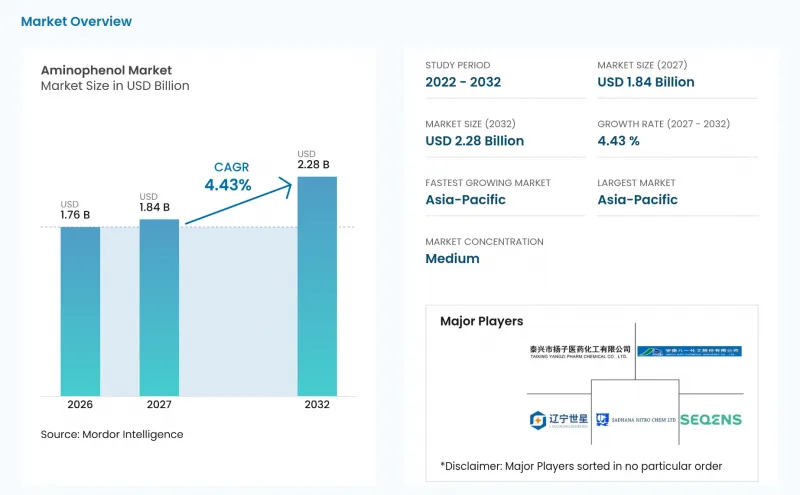
According to Mordor Intelligence, the aminophenol market size was valued at USD 1.76 billion in 2026 and is estimated to grow from USD 1.84 billion in 2027 to reach USD 2.28 billion by 2032, at a CAGR of 4.43% during the forecast period (2027-2032).
Global Aminophenol Market Trends and Insights
Paracetamol and Acetaminophen Intermediate Demand
Demand for p-aminophenol remains the main driver in the aminophenol market because it is used to make paracetamol and acetaminophen. The established commercial route to paracetamol requires p-aminophenol, which ties upstream demand to the production plans of drug manufacturers. Farmson Basic Drugs Private Limited has stated that its integrated operations cover p-aminophenol, paracetamol active pharmaceutical ingredients, and downstream products. Its November 2025 acetic anhydride unit supported further backward integration at its Nandesari site. This structure helps suppliers reduce dependence on external inputs when paracetamol demand rises. It also makes production efficiency more important when finished-drug prices weaken.
Expansion of Pharmaceutical Manufacturing in Asia-Pacific
Pharmaceutical manufacturing expansion in Asia-Pacific is increasing demand in the aminophenol market. India's Production Linked Incentive Scheme supports domestic manufacturing of key starting materials, drug intermediates, and active pharmaceutical ingredients. Granules India Limited's Bonthapally facility received a Voluntary Action Indicated classification after a 2025 inspection by the U.S. Food and Drug Administration. Such inspections matter because regulated customers require suppliers to meet defined manufacturing standards. The expansion of compliant paracetamol capacity creates additional demand for pharmaceutical-grade p-aminophenol. World Health Organization (WHO) Good Manufacturing Practices (GMP) and U.S. Food and Drug Administration requirements continue to shape approved sourcing decisions.
China-Centric Supply Exposure
Aminophenol supply remains exposed to China because large p-aminophenol capacity is concentrated there. This concentration can create procurement risks when export requirements, environmental reviews, or operating disruptions affect major plants. China introduced export-license controls for specified precursor chemicals shipped to the United States, Mexico, and Canada in November 2025. The policy did not name aminophenol, but it increased attention on controls affecting chemical supply chains. India is increasing local output through policy-supported projects, yet new capacity will take time to reduce dependence on Chinese material. The aminophenol market will remain sensitive to the reliability of Chinese supply during the forecast period.
Other drivers and restraints analyzed in the detailed report include:
- Rising Use in Oxidative Hair Dyes and Specialty Colorants
- Seasonal Cold-and-Flu Procurement Cycles
- Environmental and Purity Compliance Burden
For complete list of drivers and restraints, kindly check the Table Of Contents.
Segment Analysis
p-aminophenol held 58.12% of the aminophenol market share in 2026 because it is a direct precursor for paracetamol. Its established role in pharmaceutical production gives the segment a stable demand base. Chinese producers have substantial p-aminophenol output, while Indian suppliers are expanding to serve domestic and export pharmaceutical supply chains. Farmson Basic Drugs Private Limited has described an integrated route from p-aminophenol to paracetamol active pharmaceutical ingredients. The segment also benefits from buyers seeking material with reliable purity and traceability. High-quality documentation is important for manufacturers supplying regulated medicine markets.
m-aminophenol is projected to grow at a 4.87% CAGR through 2032. It is used in hair colorants, dye chemistry, and specialty pharmaceutical synthesis. The aminophenol market size for m-aminophenol is supported by the need for controlled quality in cosmetics applications. European chemical evaluation and cosmetics compliance rules are increasing scrutiny of safety documentation. This can limit suppliers that cannot meet labeling and safety requirements. o-aminophenol remains a smaller specialty material used in stabilizers, rubber chemicals, and heterocyclic chemistry.
Complete Report Scope:
- By Type
- p-Aminophenol
- m-Aminophenol
- o-Aminophenol
- By Application
- Synthesis Precursors
- Dye Intermediates
- Fluorescent Stabilizers
- Other Applications
- By End-Use Industry
- Pharmaceuticals
- Chemicals
- Cosmetics and Personal Care
- Other End-Use Industries
- By Geography
- Asia-Pacific
- China
- India
- Japan
- South Korea
- ASEAN Countries
- Rest of Asia-Pacific
- North America
- United States
- Canada
- Mexico
- Europe
- Germany
- United Kingdom
- France
- Italy
- NORDIC Countries
- Rest of Europe
- South America
- Brazil
- Argentina
- Rest of South America
- Middle East and Africa
- Saudi Arabia
- South Africa
- Rest of Middle East and Africa
- Asia-Pacific
Geography Analysis
Asia-Pacific held 39.28% of the aminophenol market share in 2026 and is projected to advance at a 5.45% CAGR through 2032. China remains a major production center for p-aminophenol and related chemical intermediates, while India is expanding pharmaceutical intermediate capacity. Ningbo Customs reported growth in basic organic chemical exports during the first 9 months of 2025, with the European Union, India, and ASEAN among key destinations. India's Production Linked Incentive program is supporting domestic drug-intermediate manufacturing. U.S. Food and Drug Administration inspection outcomes are also important for Indian plants that supply regulated export markets. The region's scale, integrated manufacturing base, and growing compliance capabilities continue to support regional leadership.
Europe is increasing its focus on supply resilience for essential medicines and their upstream ingredients. Seqens is developing a domestic paracetamol production facility in Roussillon under France 2030, which can support demand in the aminophenol market for documented European or audited p-aminophenol supply. The European Medicines Agency and Registration, Evaluation, Authorisation and Restriction of Chemicals (REACH)compliance framework influence sourcing decisions through quality, safety, and traceability requirements. Seqens also partnered with Brenntag in December 2025 to commercialize non-Good Manufacturing Practice pharmaceutical intermediates in Europe. This adds distribution coverage for smaller customers. European buyers are likely to value suppliers that can combine reliable documentation with resilient logistics.
North America has strong consumption of paracetamol-based medicines but limited domestic p-aminophenol production. China's 2025 export-license policy has prompted buyers to review alternative sources from India and Europe. BASF announced an investment to expand aminic antioxidant capacity in Puebla, Mexico, with completion planned for 2026. South America remains more dependent on imported aminophenol and finished paracetamol products than on local upstream capacity. The Middle East and Africa offer early-stage demand opportunities as pharmaceutical manufacturing develops in selected countries. Across these regions, supplier qualification, import logistics, and product documentation will shape the aminophenol market more strongly than local commodity production.
- Aarti Industries Ltd.
- Anhui Bayi Chemical Industry Co., Ltd.
- Atul Ltd.
- BASF
- CDH Fine Chemicals
- Eastman Chemical Company
- EMCO Dyestuff Pvt. Ltd.
- Farmson Basic Drugs Private Limited
- Glentham Life Sciences Limited.
- Granules India Limited
- Hebei Xingyu Chemical Co., Ltd.
- Jay Organics Pvt. Ltd.
- Liaoning Shixing Pharmaceutical and Chemical Co., Ltd.
- Loba Chemie Pvt. Ltd.
- Sadhana Nitro Chem Ltd.
- Seqens
- Taixing Yangzi Pharm Chemical Co., Ltd.
Additional Benefits:
- The market estimate (ME) sheet in Excel format
- 3 months of analyst support
TABLE OF CONTENTS
1 Introduction
- 1.1 Study Assumptions and Market Definition
- 1.2 Scope of the Study
2 Research Methodology
3 Executive Summary
4 Market Landscape
- 4.1 Market Overview
- 4.2 Market Drivers
- 4.2.1 Paracetamol and Acetaminophen Intermediate Demand
- 4.2.2 Expansion of Pharmaceutical Manufacturing in Asia-Pacific
- 4.2.3 Rising Use in Oxidative Hair Dyes and Specialty Colorants
- 4.2.4 Growth in High-Purity API and Specialty Chemical Sourcing
- 4.2.5 Seasonal Cold-and-Flu Procurement Cycles
- 4.3 Market Restraints
- 4.3.1 China-Centric Supply Exposure
- 4.3.2 Environmental and Purity Compliance Burden
- 4.3.3 Feedstock and Energy Cost Pass-Through Volatility
- 4.4 Value Chain Analysis
- 4.5 Porter's Five Forces Analysis
- 4.5.1 Bargaining Power of Suppliers
- 4.5.2 Bargaining Power of Buyers
- 4.5.3 Threat of New Entrants
- 4.5.4 Threat of Substitutes
- 4.5.5 Competitive Rivalry
- 4.6 Regulatory Landscape
5 Market Size and Growth Forecasts (Value)
- 5.1 By Type
- 5.1.1 p-Aminophenol
- 5.1.2 m-Aminophenol
- 5.1.3 o-Aminophenol
- 5.2 By Application
- 5.2.1 Synthesis Precursors
- 5.2.2 Dye Intermediates
- 5.2.3 Fluorescent Stabilizers
- 5.2.4 Other Applications
- 5.3 By End-Use Industry
- 5.3.1 Pharmaceuticals
- 5.3.2 Chemicals
- 5.3.3 Cosmetics and Personal Care
- 5.3.4 Other End-Use Industries
- 5.4 By Geography
- 5.4.1 Asia-Pacific
- 5.4.1.1 China
- 5.4.1.2 India
- 5.4.1.3 Japan
- 5.4.1.4 South Korea
- 5.4.1.5 ASEAN Countries
- 5.4.1.6 Rest of Asia-Pacific
- 5.4.2 North America
- 5.4.2.1 United States
- 5.4.2.2 Canada
- 5.4.2.3 Mexico
- 5.4.3 Europe
- 5.4.3.1 Germany
- 5.4.3.2 United Kingdom
- 5.4.3.3 France
- 5.4.3.4 Italy
- 5.4.3.5 NORDIC Countries
- 5.4.3.6 Rest of Europe
- 5.4.4 South America
- 5.4.4.1 Brazil
- 5.4.4.2 Argentina
- 5.4.4.3 Rest of South America
- 5.4.5 Middle East and Africa
- 5.4.5.1 Saudi Arabia
- 5.4.5.2 South Africa
- 5.4.5.3 Rest of Middle East and Africa
- 5.4.1 Asia-Pacific
6 Competitive Landscape
- 6.1 Market Concentration
- 6.2 Strategic Moves
- 6.3 Market Share (%)/Ranking Analysis
- 6.4 Company Profiles (includes Global Overview, Market Overview, Core Segments, Financials as available, Strategic Information, Products and Services, and Recent Developments)
- 6.4.1 Aarti Industries Ltd.
- 6.4.2 Anhui Bayi Chemical Industry Co., Ltd.
- 6.4.3 Atul Ltd.
- 6.4.4 BASF
- 6.4.5 CDH Fine Chemicals
- 6.4.6 Eastman Chemical Company
- 6.4.7 EMCO Dyestuff Pvt. Ltd.
- 6.4.8 Farmson Basic Drugs Private Limited
- 6.4.9 Glentham Life Sciences Limited.
- 6.4.10 Granules India Limited
- 6.4.11 Hebei Xingyu Chemical Co., Ltd.
- 6.4.12 Jay Organics Pvt. Ltd.
- 6.4.13 Liaoning Shixing Pharmaceutical and Chemical Co., Ltd.
- 6.4.14 Loba Chemie Pvt. Ltd.
- 6.4.15 Sadhana Nitro Chem Ltd.
- 6.4.16 Seqens
- 6.4.17 Taixing Yangzi Pharm Chemical Co., Ltd.
7 Market Opportunities and Future Outlook
- 7.1 White-Space and Unmet-Need Assessment

