PUBLISHER: Mordor Intelligence | PRODUCT CODE: 2196890

PUBLISHER: Mordor Intelligence | PRODUCT CODE: 2196890
North America Perfume - Market Share Analysis, Industry Trends & Statistics, Growth Forecasts (2027 - 2032)
According to Mordor Intelligence, the North America perfume market size is expected to increase from USD 27.66 billion in 2026 to USD 30.10 billion in 2027 and reach USD 45.79 billion by 2032, growing at a CAGR of 8.91% over 2026-2032.
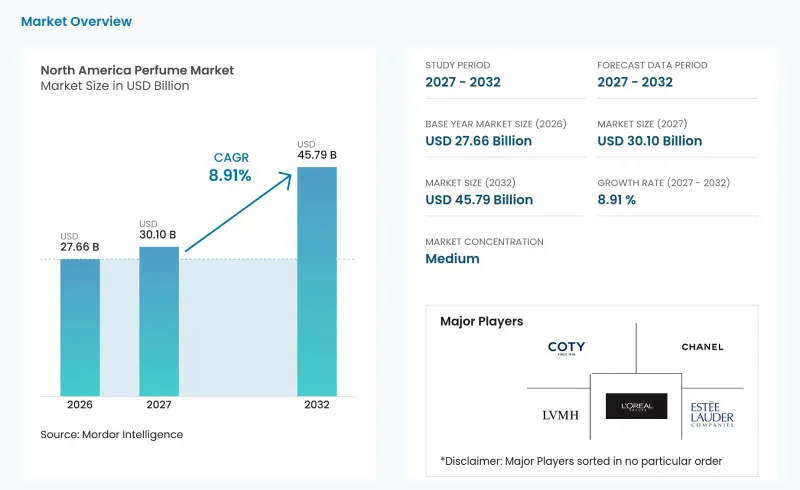
North America Perfume Market Trends and Insights
Shift Toward Natural, Clean-Label, and Sustainable Fragrance Formulations
Consumer interest in ingredient transparency and environmentally responsible product positioning is encouraging perfume manufacturers to review fragrance ingredients, sourcing practices, and product claims. Natural fragrance ingredients, including essential oils and botanical extracts, provide opportunities to develop differentiated scent profiles and appeal to consumers seeking plant-derived formulations. However, natural ingredients are not automatically safer or more sustainable than synthetic alternatives. Health Canada notes that natural and synthetic cosmetic ingredients can be equally suitable, while the US Federal Trade Commission (FTC) requires environmental marketing claims to be specific and adequately substantiated. These considerations encourage manufacturers to communicate ingredient origins and sustainability attributes accurately while maintaining fragrance quality and formulation stability.
Growing Demand for Niche, Artisanal, and Bespoke Fragrances
Demand for distinctive fragrance experiences creates opportunities for niche and artisanal perfume brands to compete through specialized scent compositions, limited product collections, and personalized offerings. Unlike mass-market fragrances that generally target broad consumer preferences, niche brands can differentiate themselves through distinctive ingredient combinations, fragrance storytelling, and smaller product collections. Personalized fragrance development and bespoke scent consultations can also strengthen customer engagement and encourage brand loyalty. The US Bureau of Labor Statistics reported that average annual household expenditure on personal care products and services increased by 2.9% in 2024, indicating continued consumer spending in the broader personal-care category. This environment provides a commercial opportunity for specialist fragrance brands, particularly those targeting consumers seeking differentiated products and premium experiences.
Rising Penetration of Counterfeit and Grey-Market Fragrances
The availability of counterfeit and unauthorized fragrances through informal retail outlets and online marketplaces can undermine consumer confidence and affect legitimate perfume sales. Counterfeit products may imitate established fragrance brands through similar packaging, branding, and product descriptions, making authenticity difficult for consumers to assess before purchase. These products can also create concerns regarding ingredient quality, product safety, and consistency of fragrance performance. Grey-market distribution, involving genuine products sold outside authorized distribution networks, can further complicate pricing strategies and brand control. Such activities may weaken brand reputation, reduce the effectiveness of authorized retail partnerships, and discourage consumers from purchasing premium fragrances. Manufacturers therefore need to strengthen product authentication, monitor unauthorized distribution channels, and maintain reliable retail networks.
Other drivers and restraints analyzed in the detailed report include:
- Social Media Influence and Celebrity-Led Brand Collaborations
- Premiumization and Rising Demand for Luxury Fragrance Offerings
- Heightened Consumer Concerns Over Synthetic and Allergenic Ingredient
For complete list of drivers and restraints, kindly check the Table Of Contents.
Segment Analysis
In 2026, the premium category accounted for an estimated 66.05% of the North America Perfume Market, making it the leading category. Its position reflects consumer demand for luxury fragrance offerings, distinctive scent compositions, established brand identities, and premium product experiences. Premium perfumes benefit from brand heritage, exclusive collections, sophisticated packaging, and positioning around personal grooming and self-expression. The segment is also supported by demand for fragrances purchased for gifting and special occasions.
The premium category is projected to record a CAGR of 9.61% through 2031, supported by continued premiumization and interest in differentiated fragrance products. Manufacturers are expanding luxury collections, niche offerings, and exclusive fragrance lines to attract consumers seeking distinctive scent experiences. However, brands need to balance product differentiation and premium positioning with pricing accessibility and consistent product quality.
In 2026, synthetic ingredients accounted for an estimated 72.48% of the North America Perfume Market, making them the leading ingredient source. Their position reflects their broad application in fragrance formulations, consistent availability, formulation flexibility, and ability to deliver specific scent profiles. Synthetic aroma chemicals also allow manufacturers to maintain fragrance consistency across production batches and develop compositions that may be difficult to reproduce using natural materials alone.
Meanwhile, natural ingredients are projected to record the fastest growth, at a CAGR of 9.56% through 2031. Growing interest in botanical extracts, essential oils, and ingredient transparency is creating opportunities for fragrances featuring naturally derived components. Manufacturers are incorporating natural ingredients into differentiated fragrance collections while managing sourcing costs, raw-material availability, and formulation stability. The ability to balance natural ingredient positioning with fragrance performance and affordability will remain important.
Complete Report Scope:
- By Category
- Mass
- Premium
- Mass
- By Ingredient Source
- Synthetic Ingredients
- Natural Ingredients
- Synthetic Ingredients
- By End User
- Men
- Women
- Unisex
- Men
- By Distribution Channel
- Supermarkets/Hypermarkets
- Specialty Stores
- Online Retail Stores
- Other Distribution Channels
- Supermarkets/Hypermarkets
- By Country
- United States
- Canada
- Mexico
- Rest of North America
List of Companies Covered in this Report:
- The Estee Lauder Companies Inc.
- Coty Inc.
- L'Oreal S.A.
- Chanel Limited
- LVMH Moet Hennessy Louis Vuitton SE
- Interparfums, Inc.
- Bath & Body Works, Inc.
- Revlon, Inc.
- Shiseido Company, Limited
- Puig Brands, S.A.
- Hermes International S.A.
- Kering S.A.
- Avon Products, Inc.
- Procter & Gamble Company
- Natura Cosmeticos S.A.
- Givaudan SA
- International Flavors & Fragrances Inc.
- Alpha Aromatics
- Elizabeth Arden, Inc.
- The 7 Virtues Beauty Inc.
Additional Benefits:
- The market estimate (ME) sheet in Excel format
- 3 months of analyst support
TABLE OF CONTENTS
1 INTRODUCTION
- 1.1 Study Assumptions and Market Definition
- 1.2 Scope of the Study
2 RESEARCH METHODOLOGY
3 EXECUTIVE SUMMARY
4 MARKET LANDSCAPE
- 4.1 Market Overview
- 4.2 Market Drivers
- 4.2.1 Shift toward natural, clean-label, and sustainable fragrance formulations
- 4.2.1.1 Growing demand for niche, artisanal, and bespoke fragrances
- 4.2.1.2 Social media influence and celebrity-led brand collaborations
- 4.2.1.3 Premiumization and rising demand for luxury fragrance offerings
- 4.2.1.4 Expansion of e-commerce and direct-to-consumer fragrance platforms
- 4.2.1.5 Increasing focus on personal grooming, self-expression, and experiential consumption
- 4.2.1 Shift toward natural, clean-label, and sustainable fragrance formulations
- 4.3 Market Restraints
- 4.3.1 Rising penetration of counterfeit and grey-market fragrances
- 4.3.1.1 Heightened consumer concerns over synthetic and allergenic ingredients
- 4.3.1.2 Supply chain volatility impacting availability of key aroma chemicals and naturals
- 4.3.1.3 Increasingly stringent ingredient safety, disclosure, and labeling regulations
- 4.3.1 Rising penetration of counterfeit and grey-market fragrances
- 4.4 Consumer Behaviour Analysis
- 4.5 Regulatory Landscape
- 4.6 Technological Outlook
- 4.7 Porter's Five Forces Analysis
- 4.7.1 Threat of New Entrants
- 4.7.1.1 Bargaining Power of Buyers
- 4.7.1.2 Bargaining Power of Suppliers
- 4.7.1.3 Threat of Substitutes
- 4.7.1.4 Intensity of Competitive Rivalry
- 4.7.1 Threat of New Entrants
5 MARKET SIZE AND GROWTH FORECASTS (ONLY VALUE)
- 5.1 By Category
- 5.1.1 Mass
- 5.1.1.1 Premium
- 5.1.1 Mass
- 5.2 By Ingredient Source
- 5.2.1 Synthetic Ingredients
- 5.2.1.1 Natural Ingredients
- 5.2.1 Synthetic Ingredients
- 5.3 By End User
- 5.3.1 Men
- 5.3.1.1 Women
- 5.3.1.2 Unisex
- 5.3.1 Men
- 5.4 By Distribution Channel
- 5.4.1 Supermarkets/Hypermarkets
- 5.4.1.1 Specialty Stores
- 5.4.1.2 Online Retail Stores
- 5.4.1.3 Other Distribution Channels
- 5.4.1 Supermarkets/Hypermarkets
- 5.5 By Country
- 5.5.1 United States
- 5.5.2 Canada
- 5.5.3 Mexico
- 5.5.4 Rest of North America
6 COMPETITIVE LANDSCAPE
- 6.1 Market Concentration
- 6.2 Strategic Moves
- 6.3 Market Share Analysis
- 6.4 Company Profiles (includes Global Level Overview, Market Level Overview, Core Business Segments, Financials as available, Strategic Information, Market Rank/Share for Key Companies, Products and Services, and Recent Developments)
- 6.4.1 The Estee Lauder Companies Inc.
- 6.4.2 Coty Inc.
- 6.4.3 L'Oreal S.A.
- 6.4.4 Chanel Limited
- 6.4.5 LVMH Moet Hennessy Louis Vuitton SE
- 6.4.6 Interparfums, Inc.
- 6.4.7 Bath & Body Works, Inc.
- 6.4.8 Revlon, Inc.
- 6.4.9 Shiseido Company, Limited
- 6.4.10 Puig Brands, S.A.
- 6.4.11 Hermes International S.A.
- 6.4.12 Kering S.A.
- 6.4.13 Avon Products, Inc.
- 6.4.14 Procter & Gamble Company
- 6.4.15 Natura Cosmeticos S.A.
- 6.4.16 Givaudan SA
- 6.4.17 International Flavors & Fragrances Inc.
- 6.4.18 Alpha Aromatics
- 6.4.19 Elizabeth Arden, Inc.
- 6.4.20 The 7 Virtues Beauty Inc.
7 MARKET OPPORTUNITIES AND FUTURE OUTLOOK

