PUBLISHER: Mordor Intelligence | PRODUCT CODE: 2196952

PUBLISHER: Mordor Intelligence | PRODUCT CODE: 2196952
Seborrheic Keratosis Treatment - Market Share Analysis, Industry Trends & Statistics, Growth Forecasts (2027 - 2032)
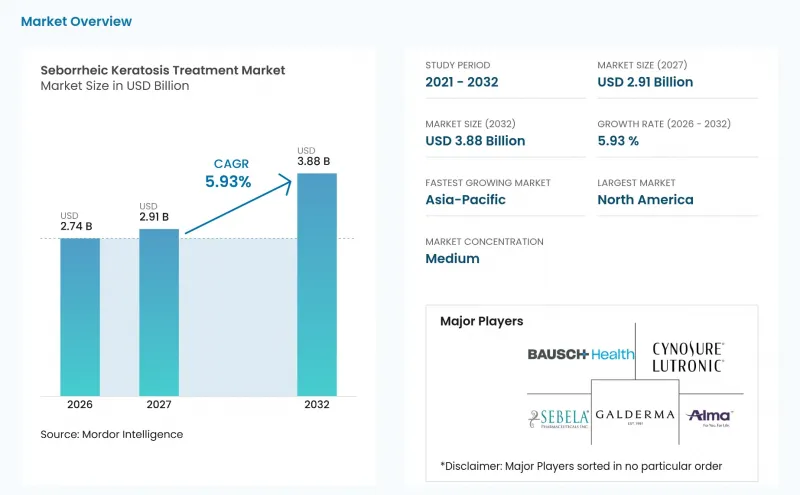
According to Mordor Intelligence, the seborrheic keratosis treatment market size is projected to expand from USD 2.74 billion in 2026 to USD 3.88 billion by 2032, registering a CAGR of 5.93% between 2027 and 2032.
Global Seborrheic Keratosis Treatment Market Trends and Insights
Rising Prevalence of Seborrheic Keratosis in Aging Populations
The seborrheic keratosis treatment market draws support from the high frequency of lesions among older adults. Published epidemiological evidence reports that seborrheic keratosis can occur in virtually all adults older than 50 years, while median lesion counts rise from 6 among people aged 15 to 25 years to 69 among those older than 75 years. A 2025 population-based study found benign skin tumors in up to 78.7% of adults aged 70 to 93 years, with seborrheic keratosis as the most common lesion type and more than 50 lesions in 15.6% of cases. A 2025 review of 1,169 cases also linked rising incidence with population aging and greater public awareness, while the 40 to 59 age group had the highest concentration of diagnoses. This pattern makes midlife patients commercially important because they may have both cosmetic motivation and a lower reluctance to undergo a procedure. Practices need efficient multiple-lesion workflows because lesion count can lengthen the visit, increase discomfort, and raise the cost of a cosmetic session.
Growing Preference for Cosmetic and Aesthetic Lesion Removal
The seborrheic keratosis treatment market also benefits from demand that is not tied to payer approval. Cosmetic removal gives dermatology practices a direct-pay revenue stream when a lesion does not meet medical necessity criteria. Schweiger Dermatology Group reported more than 2.5 million patient visits in 2025, showing the scale of demand for in-office dermatology services. This demand supports the inclusion of seborrheic keratosis removal in treatment programs that also address resurfacing and pigment correction. Such programs can increase revenue per visit and help justify investment in multimodality equipment. The model is most established in higher-income urban areas, where cash-pay aesthetic care is more accessible.
Limited Reimbursement for Cosmetic or Non-Medically Necessary Removal
Reimbursement remains a sustained constraint on the seborrheic keratosis treatment market. Medicare coverage depends on medical necessity, and the applicable local coverage framework requires documentation when removal is performed for symptoms or diagnostic uncertainty. Cosmetic requests are generally not reimbursed, which leaves many patients to fund care directly. Similar coverage approaches are used by major private carriers, separating cash-pay cosmetic care from treatment that meets medical criteria. Documentation and Advance Beneficiary Notice requirements can add administrative work when coverage is uncertain. These limits restrict treatment volumes among price-sensitive patients and favor higher-income urban patient groups.
Other drivers and restraints analyzed in the detailed report include:
- Adoption of Minimally Invasive and Office-Based Procedures
- AI-Assisted Lesion Triage and Diagnostic Confidence
- High Out-of-Pocket Cost of Advanced Energy-Based Treatments
For complete list of drivers and restraints, kindly check the Table Of Contents.
Segment Analysis
Skin biopsy accounted for 52.37% of the seborrheic keratosis treatment market size within diagnosis in 2026. Its position reflects continued reliance on histopathological confirmation when lesion morphology raises concern about malignancy. Most markets do not yet have a broadly adopted and reimbursed noninvasive diagnostic standard for seborrheic keratosis. Biopsy can therefore remain necessary before a destructive procedure when the diagnosis is uncertain. This clinical caution supports its large share of diagnostic activity.
Within the seborrheic keratosis treatment market, skin tests are forecast to expand at a 6.51% CAGR through 2032. These tests include dermoscopy and AI-supported image assessment, which are being incorporated into dermatology workflows. A 2026 review found that dermoscopy, reflectance confocal microscopy, and optical coherence tomography improve differentiation between seborrheic keratosis and malignant lesions. Better noninvasive assessment can reduce biopsies for selected lesions and allow same-session destructive treatment. Clinical visual inspection without instrumental assistance is losing relative relevance, particularly for sun-exposed facial lesions where lentigo maligna must be considered.
Complete Report Scope:
- By Diagnosis
- Skin Biopsy
- Skin Test
- Others
- By Treatment Type
- Cryotherapy
- Curettage and Shave Excision
- Electrosurgery and Electrocautery
- Ablative Laser Surgery
- Focal Chemical Peel
- Others
- By End User
- Hospitals
- Dermatology Clinics
- Ambulatory Surgical Centers
- Others
- By Geography
- North America
- United States
- Canada
- Mexico
- Europe
- Germany
- United Kingdom
- France
- Italy
- Spain
- Rest of Europe
- Asia-Pacific
- China
- India
- Japan
- Australia
- South Korea
- Rest of Asia-Pacific
- Middle East and Africa
- GCC
- South Africa
- Rest of Middle East and Africa
- South America
- Brazil
- Argentina
- Rest of South America
- North America
Geography Analysis
North America held 39.27% of the seborrheic keratosis treatment market share in 2026. High skin-health awareness, dense dermatology coverage, and direct-pay demand for cosmetic care support the regional position. The United States has more than 6,400 Medicare-certified ambulatory surgical centers, alongside additional cash-pay centers focused on plastic surgery and aesthetic dermatology. Medicare's 2025 Part B deductible was USD 257, after which Medicare covers 80% of medically necessary dermatology services. FDA 510(k) clearance acts as an important compliance filter for device adoption in this setting.
Asia-Pacific is forecast to expand at an 8.53% CAGR from 2027 to 2032. Japan, South Korea, and Australia have established dermatology systems and patients willing to pay for laser-based aesthetic treatment. In Japan, cryotherapy can be eligible under public coverage, while CO2 and picosecond laser protocols used by private aesthetic clinics are self-funded. In South Korea, a 2025 study reported sensitivity of 78.2% and specificity of 88% for AI skin lesion classification in real-world hospital deployment. China and India offer volume potential, although rural recognition and the concentration of specialist care in Tier 1 cities limit access.
Europe is a mature but varied part of the seborrheic keratosis treatment market. Germany, the United Kingdom, and France have advanced dermatology infrastructure and widespread use of dermoscopy. NICE's conditional approval of AI-supported lesion triage may improve differentiation of seborrheic keratosis from suspected skin cancer in United Kingdom teledermatology services. GCC countries support premium laser procedures, while access is limited in much of sub-Saharan Africa and North Africa and cosmetic reimbursement is fragmented in South Africa and Brazil.
- Aclaris Therapeutics
- Alma Lasers
- Bausch Health
- Brymill Cryogenic Systems
- Candela Medical
- Cutera
- Cynosure LLC
- Erbe Elektromedizin
- Galderma
- Lumenis
- Metrum Cryoflex Sp. z o.o.
- Quanta System SpA
- Sciton
- Sebela Pharmaceuticals Inc.
- Wallach Surgical Devices Inc.
Additional Benefits:
- The market estimate (ME) sheet in Excel format
- 3 months of analyst support
TABLE OF CONTENTS
1 Introduction
- 1.1 Study Assumptions and Market Definition
- 1.2 Scope of the Study
2 Research Methodology
3 Executive Summary
4 Market Landscape
- 4.1 Market Overview
- 4.2 Market Drivers
- 4.2.1 Rising Prevalence of Seborrheic Keratosis in Aging Populations
- 4.2.2 Growing Preference for Cosmetic and Aesthetic Lesion Removal
- 4.2.3 Wider Availability of Dermatology and Ambulatory Care Services
- 4.2.4 Adoption of Minimally Invasive and Office-Based Procedures
- 4.2.5 AI-Assisted Lesion Triage and Diagnostic Confidence
- 4.2.6 Demand for Lower-Burden Treatment of Multiple Lesions
- 4.3 Market Restraints
- 4.3.1 Limited Reimbursement for Cosmetic or Non-Medically Necessary Removal
- 4.3.2 High Out-of-Pocket Cost of Advanced Energy-Based Treatments
- 4.3.3 Pigmentary Changes, Scarring, Pain, and Recurrence Risk
- 4.3.4 Limited Long-Term Evidence for Emerging Topical and Energy-Based Therapies
- 4.4 Value and Supply-Chain Analysis
- 4.5 Regulatory Landscape
- 4.6 Technological Outlook
- 4.7 Porter's Five Forces Analysis
- 4.7.1 Threat of New Entrants
- 4.7.2 Bargaining Power of Buyers
- 4.7.3 Bargaining Power of Suppliers
- 4.7.4 Threat of Substitutes
- 4.7.5 Competitive Rivalry
5 Market Size & Growth Forecasts (Value, USD)
- 5.1 By Diagnosis
- 5.1.1 Skin Biopsy
- 5.1.2 Skin Test
- 5.1.3 Others
- 5.2 By Treatment Type
- 5.2.1 Cryotherapy
- 5.2.2 Curettage and Shave Excision
- 5.2.3 Electrosurgery and Electrocautery
- 5.2.4 Ablative Laser Surgery
- 5.2.5 Focal Chemical Peel
- 5.2.6 Others
- 5.3 By End User
- 5.3.1 Hospitals
- 5.3.2 Dermatology Clinics
- 5.3.3 Ambulatory Surgical Centers
- 5.3.4 Others
- 5.4 By Geography
- 5.4.1 North America
- 5.4.1.1 United States
- 5.4.1.2 Canada
- 5.4.1.3 Mexico
- 5.4.2 Europe
- 5.4.2.1 Germany
- 5.4.2.2 United Kingdom
- 5.4.2.3 France
- 5.4.2.4 Italy
- 5.4.2.5 Spain
- 5.4.2.6 Rest of Europe
- 5.4.3 Asia-Pacific
- 5.4.3.1 China
- 5.4.3.2 India
- 5.4.3.3 Japan
- 5.4.3.4 Australia
- 5.4.3.5 South Korea
- 5.4.3.6 Rest of Asia-Pacific
- 5.4.4 Middle East and Africa
- 5.4.4.1 GCC
- 5.4.4.2 South Africa
- 5.4.4.3 Rest of Middle East and Africa
- 5.4.5 South America
- 5.4.5.1 Brazil
- 5.4.5.2 Argentina
- 5.4.5.3 Rest of South America
- 5.4.1 North America
6 Competitive Landscape
- 6.1 Market Concentration
- 6.2 Market Share Analysis
- 6.3 Company Profiles (includes Global Level Overview, Market Level Overview, Core Segments, Financials as available, Strategic Information, Market Rank/Share, Products and Services, Recent Developments)
- 6.3.1 Aclaris Therapeutics Inc.
- 6.3.2 Alma Lasers Ltd
- 6.3.3 Bausch Health Companies Inc.
- 6.3.4 Brymill Cryogenic Systems
- 6.3.5 Candela Medical
- 6.3.6 Cutera Inc.
- 6.3.7 Cynosure LLC
- 6.3.8 Erbe Elektromedizin GmbH
- 6.3.9 Galderma SA
- 6.3.10 Lumenis Be Ltd
- 6.3.11 Metrum Cryoflex Sp. z o.o.
- 6.3.12 Quanta System SpA
- 6.3.13 Sciton Inc.
- 6.3.14 Sebela Pharmaceuticals Inc.
- 6.3.15 Wallach Surgical Devices Inc.
7 Market Opportunities and Future Outlook
- 7.1 White-Space and Unmet-Need Assessment

