PUBLISHER: Mordor Intelligence | PRODUCT CODE: 2197038

PUBLISHER: Mordor Intelligence | PRODUCT CODE: 2197038
France Robotic Lawn Mower - Market Share Analysis, Industry Trends & Statistics, Growth Forecasts (2026 - 2031)
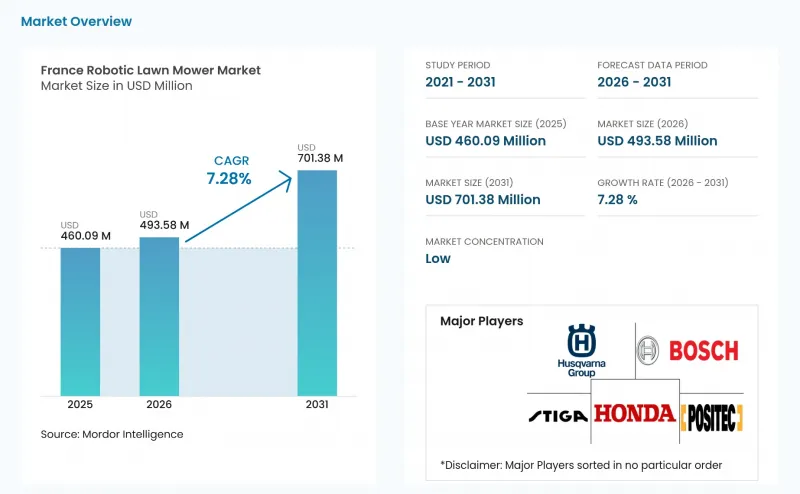
According to Mordor Intelligence, the France robotic lawn mower market size was valued at USD 460.09 million in 2025 and is projected to grow from USD 493.58 million in 2026 to USD 701.38 million by 2031, registering a CAGR of 7.28% from 2026 to 2031.
France Robotic Lawn Mower Market Trends and Insights
Smart-Home Integration and Remote Lawn Management
France's established use of connected home devices supports the adoption of robotic lawn mowers with remote scheduling, monitoring, and app-based control. According to the National Institute of Statistics and Economic Studies (INSEE), 36% of internet users in France used connected devices at home in 2024. This represents a substantial user base already familiar with connected household equipment, making smart-home-compatible robotic mowers relevant to consumers seeking integrated home automation. As connectivity becomes a standard feature of household equipment, manufacturers can drive adoption of robotic mowers by incorporating remote management and smart-home functionality, supporting growth in the France robotic lawn mower market.
Rising Landscaping Labor Costs
French landscaping businesses are facing a growing payroll burden, which is strengthening the incentive to automate labor-intensive maintenance activities. According to VALHOR (2026), payroll costs accounted for 28% of revenue among landscaping companies analyzed by CER France in 2024, with the payroll share increasing each year since 2021. This rising labor-cost burden is encouraging professional landscaping operators to adopt robotic lawn mowers for repetitive mowing tasks, thereby reducing reliance on manual labor and improving workforce productivity. As a result, increasing payroll costs are supporting demand for robotic lawn mowers in France and contributing to growth in the France robotic lawn mower market.
High Initial Acquisition Cost
High initial acquisition costs can restrain the adoption of robotic lawn mowers in France by increasing the upfront financial commitment required from consumers. According to Que Choisir (2026), prices for robotic lawn mowers ranged from EUR 249 (USD 291) to EUR 3,000 (USD 3,510), depending on the level of technological sophistication. This wide price range indicates that advanced robotic lawn mower models can involve substantial upfront costs, which may delay purchasing decisions among price-sensitive consumers, thereby restraining the growth of the French robotic lawn mower market.
Other drivers and restraints analyzed in the detailed report include:
- Demand for Low-Emission and Low-Noise Equipment
- Wire-Free Navigation Cost Compression
- Complex Terrain and Irregular Lawn Layouts
For complete list of drivers and restraints, kindly check the Table Of Contents.
Segment Analysis
The medium (501-2,000 m2) segment accounted for the largest share, 44.1%, of the France robotic lawn mower market in 2025. This segment benefits from the broad applicability of robotic mowers for residential properties requiring regular lawn maintenance. Equipment designed for medium-sized areas provides automated mowing without the higher capacity requirements of larger properties. Product availability across different navigation technologies allows buyers to select systems based on lawn configuration and installation preferences. These factors support continued demand for robotic lawn mowers in the Medium (501-2,000 m2) segment across France.
The high (more than 2,000 m2) segment is projected to grow at the fastest CAGR of 15.6% from 2026 to 2031. Larger lawns require equipment capable of covering extensive areas while maintaining consistent mowing schedules. This creates opportunities across residential estates and professional applications where recurring lawn maintenance demands greater operating capacity. Manufacturers are expanding their product portfolios to include higher-capacity robotic mowers and navigation systems designed for larger areas, thereby improving the suitability of autonomous mowing for extensive properties. As a result, increasing automation across large lawn applications is projected to support faster growth of this segment.
In the France robotic lawn mower market, the boundary-wire segment accounted for the largest share at 52.7% in 2025, making it the largest navigation technology category. Boundary-wire systems remain established because they provide a defined mowing perimeter and a familiar operating approach for consumers and installers. Physical boundary installation offers predictable navigation across lawns with clearly defined boundaries. The technology is also supported by established product portfolios and installation practices across residential applications. These characteristics continue to support demand for boundary-wire robotic lawn mowers as alternative navigation technologies develop additional solutions for different lawn configurations and installation requirements.
The France robotic lawn mower market size for the vision/camera segment is projected to grow at the fastest CAGR of 14.7% from 2026 to 2031. Vision-based navigation can reduce reliance on physical boundary installation by using cameras and software to identify lawn areas, obstacles, and mowing paths. This approach can simplify deployment for consumers seeking reduced installation requirements and greater flexibility. Vision systems can also support automated obstacle recognition and route management, enabling robotic mowers to operate across changing lawn environments. Continued development of camera-based navigation and artificial intelligence capabilities can broaden the applications of autonomous mowing, supporting faster growth of the Vision/Camera segment.
Complete Report Scope:
- By Range
- Low (Less Than 500 m2)
- Medium (501-2,000 m2)
- High (More Than 2,000 m2)
- By Navigation Technology
- Boundary-Wire
- Vision/Camera
- GNSS/RTK-GPS
- By End-User
- Residential
- Commercial
- By Distribution Channel
- Online (Direct, Marketplaces)
- Offline (DIY Stores, Specialty Dealers)
List of Companies Covered in this Report:
- Husqvarna AB
- Robert Bosch GmbH
- STIGA S.p.A.
- Honda Motor Co., Ltd.
- Deere and Company
- Positec Group Limited
- ANDREAS STIHL AG & Co. KG
- Navimow B.V. (Segway-Ninebot)
- Shenzhen Mammotion Technology Co., Ltd.
- Zucchetti Centro Sistemi S.p.A.
- Dreame Innovation Technology (Suzhou) Co., Ltd.
- Globe Technologies Group
Additional Benefits:
- The market estimate (ME) sheet in Excel format
- 3 months of analyst support
TABLE OF CONTENTS
1 INTRODUCTION
- 1.1 Study Assumptions and Market Definition
- 1.2 Scope of the Study
2 RESEARCH METHODOLOGY
3 EXECUTIVE SUMMARY
4 MARKET LANDSCAPE
- 4.1 Market Overview
- 4.2 Market Drivers
- 4.2.1 Smart-Home Integration and Remote Lawn Management
- 4.2.2 Rising Landscaping Labor Costs
- 4.2.3 Demand for Low-Emission and Low-Noise Equipment
- 4.2.4 Wire-Free Navigation Cost Compression
- 4.2.5 French Demand for Dealer-Assisted Outdoor Equipment
- 4.2.6 PV-Park and Managed-Green-Space Mowing Applications
- 4.3 Market Restraints
- 4.3.1 High Initial Acquisition Cost
- 4.3.2 Complex Terrain and Irregular Lawn Layouts
- 4.3.3 Theft, Vandalism, and Device-Security Concerns
- 4.3.4 Connectivity, Data-Privacy, and Firmware-Dependence Risks
- 4.4 Regulatory Landscape
- 4.5 Technological Outlook
- 4.6 Porter's Five Forces Analysis
- 4.6.1 Threat of New Entrants
- 4.6.2 Bargaining Power of Suppliers
- 4.6.3 Bargaining Power of Buyers
- 4.6.4 Threat of Substitutes
- 4.6.5 Intensity of Competitive Rivalry
5 MARKET SIZE AND GROWTH FORECASTS (VALUE)
- 5.1 By Range
- 5.1.1 Low (Less Than 500 m2)
- 5.1.2 Medium (501-2,000 m2)
- 5.1.3 High (More Than 2,000 m2)
- 5.2 By Navigation Technology
- 5.2.1 Boundary-Wire
- 5.2.2 Vision/Camera
- 5.2.3 GNSS/RTK-GPS
- 5.3 By End-User
- 5.3.1 Residential
- 5.3.2 Commercial
- 5.4 By Distribution Channel
- 5.4.1 Online (Direct, Marketplaces)
- 5.4.2 Offline (DIY Stores, Specialty Dealers)
6 COMPETITIVE LANDSCAPE
- 6.1 Market Concentration
- 6.2 Strategic Moves
- 6.3 Market Share Analysis
- 6.4 Company Profiles (Includes Global Level Overview, Market Level Overview, Core Segments, Financials as Available, Strategic Information, Market Rank/Share for Key Companies, Products and Services, and Recent Developments)
- 6.4.1 Husqvarna AB
- 6.4.2 Robert Bosch GmbH
- 6.4.3 STIGA S.p.A.
- 6.4.4 Honda Motor Co., Ltd.
- 6.4.5 Deere and Company
- 6.4.6 Positec Group Limited
- 6.4.7 ANDREAS STIHL AG & Co. KG
- 6.4.8 Navimow B.V. (Segway-Ninebot)
- 6.4.9 Shenzhen Mammotion Technology Co., Ltd.
- 6.4.10 Zucchetti Centro Sistemi S.p.A.
- 6.4.11 Dreame Innovation Technology (Suzhou) Co., Ltd.
- 6.4.12 Globe Technologies Group
7 MARKET OPPORTUNITIES AND FUTURE OUTLOOK

