PUBLISHER: Mordor Intelligence | PRODUCT CODE: 2197086

PUBLISHER: Mordor Intelligence | PRODUCT CODE: 2197086
Rooftop Solar Photovoltaic (PV) Module - Market Share Analysis, Industry Trends & Statistics, Growth Forecasts (2027 - 2032)
According to Mordor Intelligence, the rooftop solar photovoltaic module market size is expected to grow from USD 66.12 billion in 2026 to USD 71.48 billion in 2027 and is forecast to reach USD 107.67 billion by 2032 at 8.54% CAGR over 2027-2032.
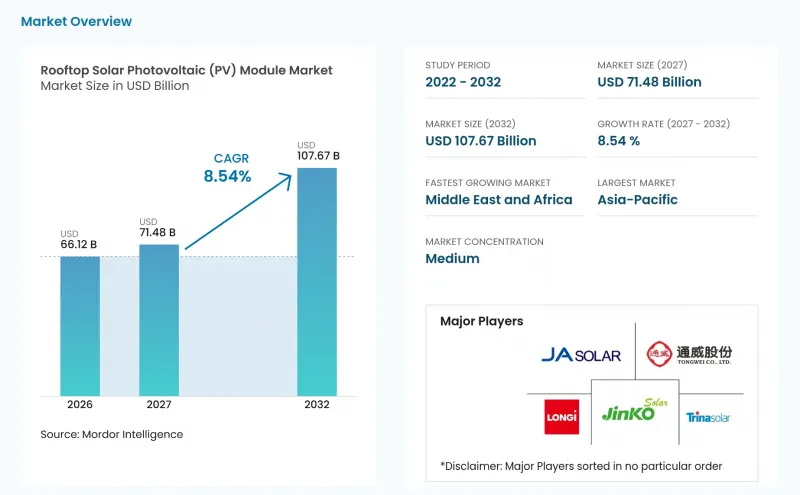
Global Rooftop Solar Photovoltaic (PV) Module Market Trends and Insights
Falling Module Prices and Shorter Payback Periods
Lower crystalline silicon module prices are improving the economics of the Global rooftop solar photovoltaic (PV) module market, especially for customers with consistent daytime electricity demand. Commercial systems that needed 8-10 years to recover their cost in 2022 can now deliver payback within 4-6 years in Germany and within 5 years in India. Lower hardware costs are shifting more project value toward installation, monitoring, energy management services, and the engineering needed to adapt systems to individual roofs. This favors installers that can manage system performance, provide reliable after-sales service, and combine solar assets with virtual power plant functions. China's 2025 efficiency standards set Grade 1 thresholds at 23.6% for TOPCon modules and 23.9% for Heterojunction Technology (HJT) modules, which supports higher-performing equipment across price tiers. The use of existing roof space also avoids land conversion, reduces site acquisition needs, and strengthens the case for rooftop projects in dense cities.
Rooftop Mandates, Incentives, and Self-Consumption Policies
Policy support is changing how demand develops in the Global rooftop solar photovoltaic (PV) module market and is giving property owners clearer reasons to include solar in planned construction work. The revised European Energy Performance of Buildings Directive requires solar installations on new public and commercial buildings above 250 m2 by December 31, 2026, subject to the directive's conditions. China's 2025 distributed PV rules require general commercial projects to use at least 20% of annual generation themselves, directing development toward sites with matching electricity demand. India's PM Surya Ghar program increased the reach of residential rooftop solar through financial assistance and installation support. Japan is moving support toward rooftop systems as it ends Feed-in Tariff (FIT) and Feed-in Premium (FIP) support for new ground-mounted commercial solar from FY2027. Together, these policy changes provide a more durable installation base than short-term export incentives alone and favor projects built around local electricity use.
Interconnection Queues and Distribution-Grid Hosting Limits
Grid hosting capacity is a central constraint for the Global rooftop solar photovoltaic (PV) module market in mature locations, particularly where distributed generation has grown faster than network investment. The U.S. Department of Energy aims to reduce median interconnection time for systems from 50 kW to 5 MW to fewer than 75 days by 2030. Existing processes can take 12-18 months in congested utility territories. China's 2025 rules require provinces to disclose hosting capacity and manage development queues, recognizing constraints in areas such as Shandong, Zhejiang, and Henan. Distribution grids were built mainly for one-way electricity flow, so upgrades for bidirectional power need new investment, digital controls, and clear cost recovery. Storage-backed self-consumption systems can reduce exports and local congestion, but they cannot fully replace grid modernization.
Other drivers and restraints analyzed in the detailed report include:
- Rising Commercial Electricity Costs and Energy Resilience Demand
- N-type Efficiency Gains in Space-Constrained Rooftops
- Lower Export Compensation Under Net Billing
For complete list of drivers and restraints, kindly check the Table Of Contents.
Segment Analysis
TOPCon held 41.6% in 2026. Its position reflects a rapid shift from Passivated Emitter and Rear Cell (PERC) technology since 2022 and a balance of efficiency, cost, and manufacturing requirements. Heterojunction Technology (HJT) is forecast to grow at a 10.2% CAGR through 2032. Its lower temperature coefficient of -0.24% per degree Celsius compares with -0.35% for Tunnel Oxide Passivated Contact (TOPCon) modules, which can improve energy output on hot roofs. PERC retains a large installed base in cost-sensitive markets, but manufacturers are moving new capacity toward N-type production.
The International Energy Agency Photovoltaic Power Systems Programme identified UV-induced degradation in TOPCon modules as an emerging reliability issue in 2025. That finding may favor suppliers with stronger degradation performance as buyers place more weight on long-term output. Bifacial designs are gaining use on commercial roofs with reflective membranes because they can capture albedo gains. Back-contact products are also gaining use in appearance-sensitive residential projects in Europe and Japan. China's 2025 Grade 1 efficiency thresholds differentiate TOPCon, Heterojunction Technology (HJT), and back-contact products and are influencing procurement specifications.
Complete Report Scope:
- By Module Type
- Passivated Emitter and Rear Cell (PERC) Modules
- Tunnel Oxide Passivated Contact (TOPCon) Modules
- Heterojunction Technology (HJT) Modules
- Bifacial Solar PV Modules
- Monofacial Solar PV Modules
- Other Module Types
- By End User
- Residential
- Commercial
- Industrial
- By Grid Connectivity
- On-Grid Systems
- Off-Grid Systems
- By Geography
- North America
- United States
- Canada
- Mexico
- Europe
- Germany
- France
- Italy
- Spain
- United Kingdom
- Netherlands
- Norway
- Russia
- Rest of Europe
- Asia-Pacific
- China
- India
- Japan
- Australia
- Indonesia
- Malaysia
- Thailand
- Rest of Asia-Pacific
- South America
- Brazil
- Argentina
- Colombia
- Rest of South America
- Middle East and Africa
- Saudi Arabia
- United Arab Emirates
- Egypt
- Oman
- Nigeria
- Rest of Middle East and Africa
- North America
Geography Analysis
Asia-Pacific held 35.3% of the global rooftop solar photovoltaic (PV) module market size in 2026. China had 370 GW of cumulative distributed PV capacity at the end of 2024, with rooftop solar forming most of that base. India added a record 7.1 GW of rooftop capacity in 2025, while the PM Surya Ghar program had provided central financial assistance to 2.614 million households by December 2025. Japan's 2025 Strategic Energy Plan prioritizes rooftop PV and targets solar deployment on 50% of installable public-sector buildings by 2030. Australia's International Electrotechnical Commission (IEC) 61215:2021 requirement creates a higher product qualification standard for suppliers.
The Middle East and Africa are forecast to expand at an 8.9% CAGR through 2032. Gulf energy strategies and the needs of people without reliable grid access support commercial, industrial, and off-grid installations. In Nigeria, Kenya, and Ghana, rooftop systems can serve as a primary power source for commercial premises, making heat and humidity performance important purchasing factors. JinkoSolar reported its Saudi Arabia joint venture with Renewable Energy Localization Company and Vision Industries, which indicates a growing focus on local manufacturing.
North America faces long interconnection queues and changing net-billing policies, but the Department of Energy is funding queue-management work through its i2X program. Europe's building compliance cycle is reshaping permit and design requirements in Germany, France, Italy, Spain, and the Netherlands. In South America, Brazil's distributed generation rules under Agencia Nacional de Energia Eletrica (ANEEL) provide a policy base for continued residential and commercial development. Colombia and Argentina are building commercial solar activity, while Indonesia and other lower-base markets benefit from growing project finance access and local installer capability. Across these mixed regions, system design is moving toward self-consumption, storage readiness, and clearer compliance with local grid rules.
- Adani Solar
- AIKO Solar
- Canadian Solar Inc.
- Chint New Energy Technology Co., Ltd.
- DMEGC Solar
- First Solar, Inc.
- GCL System Integration Technology Co., Ltd.
- Hanwha Solutions Corporation
- JA Solar Technology Co., Ltd.
- JinkoSolar Holding Co., Ltd.
- LONGi Green Energy Technology Co., Ltd.
- Premier Energies Limited
- Risen Energy Co., Ltd.
- Suntech Power Holdings Co., Ltd.
- Talesun Solar Technologies Co., Ltd.
- Tongwei Co., Ltd.
- Trina Solar Co., Ltd.
- Vikram Solar Limited
- Waaree Energies Limited
- Yingli Solar
Additional Benefits:
- The market estimate (ME) sheet in Excel format
- 3 months of analyst support
TABLE OF CONTENTS
1 INTRODUCTION
- 1.1 Study Assumptions and Market Definition
- 1.2 Scope of the Study
2 RESEARCH METHODOLOGY
3 EXECUTIVE SUMMARY
4 MARKET LANDSCAPE
- 4.1 Market Overview
- 4.2 Market Drivers
- 4.2.1 Falling Module Prices and Shorter Payback Periods
- 4.2.2 Rooftop Mandates, Incentives and Self-Consumption Policies
- 4.2.3 Rising Commercial Electricity Costs and Energy Resilience Demand
- 4.2.4 N-Type Efficiency Gains in Space-Constrained Rooftops
- 4.2.5 Storage, Smart Inverters and Virtual Power Plant Integration
- 4.2.6 Roof-Area Monetization Without New Land Conversion
- 4.3 Market Restraints
- 4.3.1 Interconnection Queues and Distribution-Grid Hosting Limits
- 4.3.2 Lower Export Compensation Under Net Billing
- 4.3.3 Tariff, Origin-Traceability and Domestic-Content Volatility
- 4.3.4 Weak Roof Structures and Retrofit Engineering Constraints
- 4.4 Supply-Chain Analysis
- 4.5 Porter's Five Forces Analysis
- 4.5.1 Bargaining Power of Suppliers
- 4.5.2 Bargaining Power of Buyers
- 4.5.3 Threat of New Entrants
- 4.5.4 Threat of Substitutes
- 4.5.5 Competitive Rivalry
- 4.6 Technology Outlook
- 4.7 Regulatory Landscape
- 4.8 Investment Analysis
5 MARKET SIZE AND GROWTH FORECASTS
- 5.1 By Module Type
- 5.1.1 Passivated Emitter and Rear Cell (PERC) Modules
- 5.1.2 Tunnel Oxide Passivated Contact (TOPCon) Modules
- 5.1.3 Heterojunction Technology (HJT) Modules
- 5.1.4 Bifacial Solar PV Modules
- 5.1.5 Monofacial Solar PV Modules
- 5.1.6 Other Module Types
- 5.2 By End User
- 5.2.1 Residential
- 5.2.2 Commercial
- 5.2.3 Industrial
- 5.3 By Grid Connectivity
- 5.3.1 On-Grid Systems
- 5.3.2 Off-Grid Systems
- 5.4 By Geography
- 5.4.1 North America
- 5.4.1.1 United States
- 5.4.1.2 Canada
- 5.4.1.3 Mexico
- 5.4.2 Europe
- 5.4.2.1 Germany
- 5.4.2.2 France
- 5.4.2.3 Italy
- 5.4.2.4 Spain
- 5.4.2.5 United Kingdom
- 5.4.2.6 Netherlands
- 5.4.2.7 Norway
- 5.4.2.8 Russia
- 5.4.2.9 Rest of Europe
- 5.4.3 Asia-Pacific
- 5.4.3.1 China
- 5.4.3.2 India
- 5.4.3.3 Japan
- 5.4.3.4 Australia
- 5.4.3.5 Indonesia
- 5.4.3.6 Malaysia
- 5.4.3.7 Thailand
- 5.4.3.8 Rest of Asia-Pacific
- 5.4.4 South America
- 5.4.4.1 Brazil
- 5.4.4.2 Argentina
- 5.4.4.3 Colombia
- 5.4.4.4 Rest of South America
- 5.4.5 Middle East and Africa
- 5.4.5.1 Saudi Arabia
- 5.4.5.2 United Arab Emirates
- 5.4.5.3 Egypt
- 5.4.5.4 Oman
- 5.4.5.5 Nigeria
- 5.4.5.6 Rest of Middle East and Africa
- 5.4.1 North America
6 COMPETITIVE LANDSCAPE
- 6.1 Market Concentration
- 6.2 Strategic Moves
- 6.3 Market Share Analysis
- 6.4 Company Profiles (includes Global Level Overview, Market Level Overview, Core Segments, Financials as available, Strategic Information, Market Rank/Share, Products and Services, Recent Developments)
- 6.4.1 Adani Solar
- 6.4.2 AIKO Solar
- 6.4.3 Canadian Solar Inc.
- 6.4.4 Chint New Energy Technology Co., Ltd.
- 6.4.5 DMEGC Solar
- 6.4.6 First Solar, Inc.
- 6.4.7 GCL System Integration Technology Co., Ltd.
- 6.4.8 Hanwha Solutions Corporation
- 6.4.9 JA Solar Technology Co., Ltd.
- 6.4.10 JinkoSolar Holding Co., Ltd.
- 6.4.11 LONGi Green Energy Technology Co., Ltd.
- 6.4.12 Premier Energies Limited
- 6.4.13 Risen Energy Co., Ltd.
- 6.4.14 Suntech Power Holdings Co., Ltd.
- 6.4.15 Talesun Solar Technologies Co., Ltd.
- 6.4.16 Tongwei Co., Ltd.
- 6.4.17 Trina Solar Co., Ltd.
- 6.4.18 Vikram Solar Limited
- 6.4.19 Waaree Energies Limited
- 6.4.20 Yingli Solar
7 MARKET OPPORTUNITIES AND FUTURE OUTLOOK
- 7.1 White-Space and Unmet-Need Assessment

