PUBLISHER: Mordor Intelligence | PRODUCT CODE: 2121315

PUBLISHER: Mordor Intelligence | PRODUCT CODE: 2121315
HVDC Transmission Systems - Market Share Analysis, Industry Trends & Statistics, Growth Forecasts (2026 - 2031)
According to Mordor Intelligence, the HVDC transmission systems market size is expected to grow from USD 13.38 billion in 2025 to USD 14.62 billion in 2026 and is forecast to reach USD 22.47 billion by 2031 at 8.98% CAGR over 2026-2031.
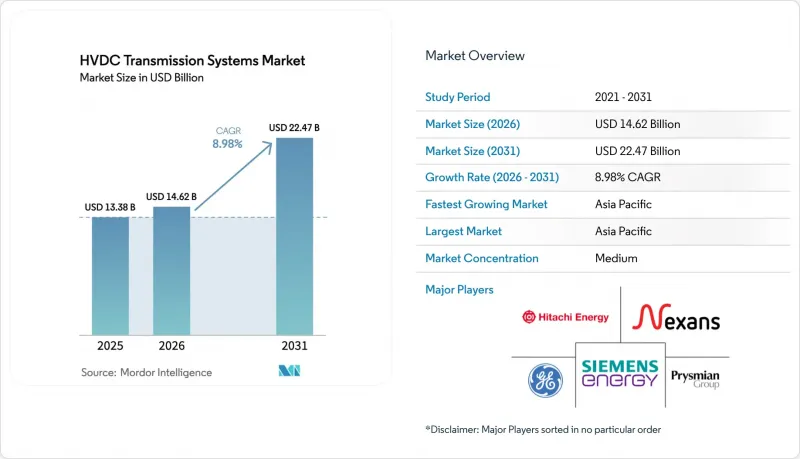
This report is Segmented by Transmission Type (Submarine, Overhead, and Underground), Component (Converter Stations, Transmission Medium, and Others), Voltage Rating (Up To 400 KV, 400 To 800 KV, and Above 800 KV), and Geography (North America, Europe, Asia-Pacific, South America, and Middle East and Africa). The Market Sizes and Forecasts are Provided in Terms of Value (USD).
Global HVDC Transmission Systems Market Trends and Insights
Increasing Integration of Renewable Energy Generation
Utilities are deploying HVDC corridors to relieve curtailment as variable renewables outpace local load absorption. China's desert bases host 120 GW of wind and solar, yet local demand absorbs less than 30% of output; the +-800 kV Gansu-Zhejiang link now moves 8 GW across 2,383 km with only 3.2% losses, roughly half those on a 750 kV AC route. In offshore wind, VSC platforms export power beyond 40 km from shore, where AC export becomes uneconomic; the 3,600 MW Dogger Bank project validated this model in 2024. The United Kingdom, India, and Germany now mandate HVDC for renewable zones over 5 GW, accelerating new project sanctions. National regulators increasingly stipulate synthetic inertia delivery, favoring MMC converters that can modulate power within 50 milliseconds. These factors make renewable integration the single largest driver of the HVDC transmission systems market through 2031.
Aging Grids & T&D Reinvestment Cycles
North American and European utilities are replacing 1960s-era AC lines with HVDC to double capacity on existing rights-of-way. The U.S. Department of Energy reserved USD 2.5 billion in 2025 for HVDC corridors that bypass congested 345 kV interties. Germany's SuedLink, re-scoped from overhead AC to underground +-525 kV HVDC, cut 15 years of local opposition and secured a 2028 go-live date. Brazil's Furnas added modular multilevel converters to its Rio Madeira bipole, boosting transfer capacity by 1 GW without new conductors. Although converter stations cost USD 150 million to USD 300 million per GW, they defer even costlier parallel AC builds that face lengthy environmental reviews. Consequently, reinvestment cycles will prop up the HVDC transmission systems market for at least the next decade.
High Upfront Capital & Permitting Hurdles
Converter stations cost 50%-70% more per MW than comparable AC substations, and permitting often exceeds four years. The 1,250 MW Champlain Hudson Power Express required 14 years of approvals, pushing costs from USD 2.2 billion to USD 3.9 billion. Germany's SuedLink saw its budget triple to EUR 10 billion after 27 route changes mandated by regulators. Emerging-market developers face higher financing costs: Brazil's Belo Monte line needed 70% debt underwriting from BNDES because commercial banks balked at currency risk.
Other drivers and restraints analyzed in the detailed report include:
- Need for Long-Distance, High-Capacity Interconnections
- Electrification of Offshore Oil & Gas Assets
- Distributed & Behind-the-Meter Generation Growth
For complete list of drivers and restraints, kindly check the Table Of Contents.
Segment Analysis
Overhead corridors held 55.1% of the HVDC transmission systems market share in 2025. They remain the least-cost option for long-haul terrestrial transfers; China's +-800 kV lines deliver power at USD 0.012 per kWh per 1,000 km, roughly 40% below comparable AC rates. Yet environmental opposition and urban density are slowing new overhead builds. Germany buried SuedLink underground at a 35% cost premium to avoid a decade of litigation.
Submarine links are forecast to grow at an 11.3% CAGR between 2026 and 2031, the fastest among transmission types. Offshore wind pipelines in the North Sea alone require 60 km-120 km of export cable per gigawatt, keeping factories at Prysmian and Nexans booked well into 2029. Underground HVDC sits between the two, typically chosen where overhead rights-of-way face insurmountable opposition; Italy's 1,000 MW Tyrrhenian Link accepted a 35% premium to preserve UNESCO sites.
Complete Report Scope:
- By Transmission Type
- Submarine HVDC Transmission System
- Overhead HVDC Transmission System
- Underground HVDC Transmission System
- By Component
- Converter Stations
- Transmission Medium (Cables)
- Others (Control & Protection Systems, Reactive Power Equipment, Accessories)
- By Voltage Rating
- Up to 400 kV
- 400 to 800 kV
- Above 800 kV
- By Geography
- North America
- United States
- Canada
- Mexico
- Europe
- United Kingdom
- Germany
- France
- Italy
- NORDIC Countries
- Russia
- Rest of Europe
- Asia-Pacific
- China
- India
- Japan
- South Korea
- ASEAN Countries
- Australia and New Zealand
- Rest of Asia-Pacific
- South America
- Brazil
- Argentina
- Colombia
- Rest of South America
- Middle East and Africa
- United Arab Emirates
- Saudi Arabia
- South Africa
- Egypt
- Rest of Middle East and Africa
- North America
Geography Analysis
Asia-Pacific generated 41.6% of global revenue in 2025 and is expected to post a 9.9% CAGR to 2031. State Grid commissioned the 16 GW Baihetan-Jiangsu and Baihetan-Zhejiang lines in 2025, shrinking east-coast coal burn by 35 million t annually. India's Phase-II Green Energy Corridors add 6 GW via the 1,830 km Raigarh-Pugalur link and three intra-state projects, cutting renewable curtailment from 12% in 2024 to below 3% by 2028. ASEAN's 3 GW power-integration corridor and Australia's 1.5 GW Marinus Link underscore regional momentum.
Europe follows with aggressive offshore mandates. The TEN-E regulation requires HVDC for any wind farm beyond 12 nautical miles, triggering EUR 8 billion of cable and converter orders since 2024. Germany's SuedLink and A-Nord underground projects will send 8 GW southward by 2028, enabling lignite retirements. The UK's Dogger Bank export cables and Eastern Link subsea route add another 7.6 GW of transfer capacity. Nordic hydropower balancing via NordLink and North Sea Link earned Norway EUR 500 million in arbitrage revenue during 2025.
North America remains bifurcated. Atlantic offshore wind requires radial HVDC exports, yet onshore converter permitting stretches three years, delaying Empire Wind to 2028. Cross-border schemes such as the 1.25 GW Champlain Hudson Power Express reached service in 2025, delivering Canadian hydropower into New York. Mexico's Baja-Sonora study and Brazil's long-distance corridors round out the hemisphere's activity.
- ABB Ltd (Hitachi Energy)
- Siemens Energy AG
- GE Vernova, Inc.
- Mitsubishi Electric Corporation
- Toshiba Corporation
- Prysmian Group
- Nexans S.A.
- NKT A/S
- Sumitomo Electric Industries
- LS Cable & System
- TBEA Co., Ltd.
- State Grid Corporation of China
- NR Electric Co., Ltd.
- Bharat Heavy Electricals Ltd.
- CHINT Group
- Trench Group
- Schneider Electric SE
- Hyosung Heavy Industries
- ZTT Group
Additional Benefits:
- The market estimate (ME) sheet in Excel format
- 3 months of analyst support
TABLE OF CONTENTS
1 Introduction
- 1.1 Study Assumptions & Market Definition
- 1.2 Scope of the Study
2 Research Methodology
3 Executive Summary
4 Market Landscape
- 4.1 Market Overview
- 4.2 Market Drivers
- 4.2.1 Increasing integration of renewable energy generation
- 4.2.2 Aging grids & T&D reinvestment cycles
- 4.2.3 Need for long-distance, high-capacity interconnections
- 4.2.4 Electrification of offshore oil & gas assets
- 4.2.5 Multi-vendor offshore wind HVDC hubs
- 4.2.6 Defense-critical islanded power corridors
- 4.3 Market Restraints
- 4.3.1 High upfront capital & permitting hurdles
- 4.3.2 Distributed & behind-the-meter generation growth
- 4.3.3 Global shortage of XLPE/MI HVDC cable core
- 4.3.4 Lack of interoperability standards for multi-vendor MT-HVDC
- 4.4 Supply-Chain Analysis
- 4.5 Regulatory Landscape
- 4.6 Technological Outlook
- 4.7 Porter's Five Forces
- 4.7.1 Bargaining Power of Suppliers
- 4.7.2 Bargaining Power of Buyers
- 4.7.3 Threat of New Entrants
- 4.7.4 Threat of Substitutes
- 4.7.5 Intensity of Competitive Rivalry
5 Market Size & Growth Forecasts
- 5.1 By Transmission Type
- 5.1.1 Submarine HVDC Transmission System
- 5.1.2 Overhead HVDC Transmission System
- 5.1.3 Underground HVDC Transmission System
- 5.2 By Component
- 5.2.1 Converter Stations
- 5.2.2 Transmission Medium (Cables)
- 5.2.3 Others (Control & Protection Systems, Reactive Power Equipment, Accessories)
- 5.3 By Voltage Rating
- 5.3.1 Up to 400 kV
- 5.3.2 400 to 800 kV
- 5.3.3 Above 800 kV
- 5.4 By Geography
- 5.4.1 North America
- 5.4.1.1 United States
- 5.4.1.2 Canada
- 5.4.1.3 Mexico
- 5.4.2 Europe
- 5.4.2.1 United Kingdom
- 5.4.2.2 Germany
- 5.4.2.3 France
- 5.4.2.4 Italy
- 5.4.2.5 NORDIC Countries
- 5.4.2.6 Russia
- 5.4.2.7 Rest of Europe
- 5.4.3 Asia-Pacific
- 5.4.3.1 China
- 5.4.3.2 India
- 5.4.3.3 Japan
- 5.4.3.4 South Korea
- 5.4.3.5 ASEAN Countries
- 5.4.3.6 Australia and New Zealand
- 5.4.3.7 Rest of Asia-Pacific
- 5.4.4 South America
- 5.4.4.1 Brazil
- 5.4.4.2 Argentina
- 5.4.4.3 Colombia
- 5.4.4.4 Rest of South America
- 5.4.5 Middle East and Africa
- 5.4.5.1 United Arab Emirates
- 5.4.5.2 Saudi Arabia
- 5.4.5.3 South Africa
- 5.4.5.4 Egypt
- 5.4.5.5 Rest of Middle East and Africa
- 5.4.1 North America
6 Competitive Landscape
- 6.1 Market Concentration
- 6.2 Strategic Moves (M&A, Partnerships, PPAs)
- 6.3 Market Share Analysis (Market Rank/Share for key companies)
- 6.4 Company Profiles (includes Global level Overview, Market level overview, Core Segments, Financials as available, Strategic Information, Products & Services, and Recent Developments)
- 6.4.1 ABB Ltd (Hitachi Energy)
- 6.4.2 Siemens Energy AG
- 6.4.3 GE Vernova, Inc.
- 6.4.4 Mitsubishi Electric Corporation
- 6.4.5 Toshiba Corporation
- 6.4.6 Prysmian Group
- 6.4.7 Nexans S.A.
- 6.4.8 NKT A/S
- 6.4.9 Sumitomo Electric Industries
- 6.4.10 LS Cable & System
- 6.4.11 TBEA Co., Ltd.
- 6.4.12 State Grid Corporation of China
- 6.4.13 NR Electric Co., Ltd.
- 6.4.14 Bharat Heavy Electricals Ltd.
- 6.4.15 CHINT Group
- 6.4.16 Trench Group
- 6.4.17 Schneider Electric SE
- 6.4.18 Hyosung Heavy Industries
- 6.4.19 ZTT Group
7 Market Opportunities & Future Outlook
- 7.1 White-space & Unmet-Need Assessment

