PUBLISHER: Mordor Intelligence | PRODUCT CODE: 2120338

PUBLISHER: Mordor Intelligence | PRODUCT CODE: 2120338
APAC Membrane Water And Wastewater Treatment - Market Share Analysis, Industry Trends & Statistics, Growth Forecasts (2026 - 2031)
According to Mordor Intelligence, the APAC membrane water and wastewater treatment market size in 2026 is estimated at USD 4.53 billion, growing from 2025 value of USD 4.23 billion with 2031 projections showing USD 6.41 billion, growing at 7.18% CAGR over 2026-2031.
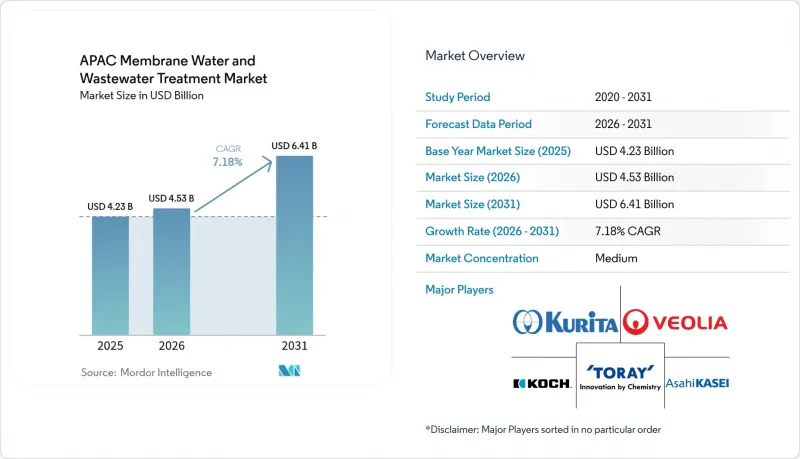
This report is Segmented by Technology (Microfiltration, Ultrafiltration, Nanofiltration, Reverse Osmosis, and Hybrid and Emerging), End-User Industry (Municipal, Pulp and Paper, Chemicals, Food and Beverage, Healthcare, Power, and Others), and Geography (China, India, Japan, South Korea, ASEAN Countries, and More). The Market Forecasts are Provided in Terms of Value (USD).
APAC Membrane Water And Wastewater Treatment Market Trends and Insights
Rapid Urban-Industrial Growth Boosting Wastewater Volumes
Industrial wastewater generation in the Asia-Pacific is expected to exceed 45 billion m3 annually by 2028, with chemicals, textiles, and pulp and paper industries creating nearly two-thirds of the biochemical oxygen demand loads. India's USD 50 billion Jal Jeevan Mission has increased household consumption, but it has also simultaneously strained peri-urban sewage networks that already trail demand by 35-40%. Vietnam's 480,000 m3/d Ho Chi Minh City plant, commissioned in 2025, demonstrates how megacities are leapfrogging to membrane bioreactors to satisfy strict river-discharge norms. Enforcement actions across 18 Chinese provinces that exceeded 2024 discharge quotas illustrate how latent demand quickly converts to signed contracts for ultrafiltration and nanofiltration equipment.
Stringent Effluent-Discharge Regulations
China's revised GB/T 19923-2024 compels 50% industrial wastewater reuse in water-stressed provinces by 2030-31, making membrane polishing mandatory for facilities discharging more than 500 m3/d. India's Liquid Waste Management Rules 2024 mirror the 50% reuse target and escalate penalties up to plant shutdown for repeat offenses. South Korea's 2024 framework steers public-private capital toward high-recovery reverse osmosis, while Singapore lowered the permissible total dissolved solids in trade effluent to 3,000 mg/L, forcing semiconductor fabs to adopt nanofiltration pretreatment. The growing adoption of ISO 20468 certification by 14 utilities between 2024 and 2025 further de-risks large procurements.
High Capex and Replacement Costs
A 10,000 m3/d industrial RO reuse plant still requires an upfront investment of USD 8-12 million, and membrane swaps every 3-5 years add another USD 1.5-2 million. India's tier-2 municipalities face a USD 6.2 billion wastewater funding gap to 2030, and only 18% of eligible ZLD projects tapped National Clean Energy Fund loans in 2024 because collateral rules shut out small firms. Inland Chinese provinces record 25-30% lower adoption rates than their coastal peers, even under identical standards, highlighting fiscal limitations. Build-operate-transfer models shift the burden to end users through tariff hikes, sparking public pushback in secondary ASEAN cities.
Other drivers and restraints analyzed in the detailed report include:
- Government Funding for Zero-Liquid-Discharge
- Rising Adoption of Membrane Bio-Reactors
- Membrane Fouling and Concentrate Disposal Issues
For complete list of drivers and restraints, kindly check the Table Of Contents.
Segment Analysis
Reverse osmosis held 37.72% of APAC Membrane Water And Wastewater Treatment Market share in 2025, underpinned by desalination mega-projects and ZLD mandates. The Daesan plant, which has been online since H1 2025, processes 100,000 t/d using Toray high-rejection elements that achieve over 98% salt removal. Nanofiltration is projected to grow at an 8.05% CAGR, with LG Chem trials demonstrating 95% divalent-ion rejection at 30% lower pressure compared to RO, a key metric for dairy and beverage plants. Nearly 68% of new RO builds specify ultrafiltration pretreatment to control fouling, and ceramic microfiltration variants are entering Japanese municipal plants where chlorine tolerance is valued. Hybrid MBR-RO lines already account for 42% of China's 2025 industrial tenders, reflecting land scarcity and ever-tighter discharge rules.
The forward-looking pipeline emphasizes energy-saving configurations, such as closed-circuit RO and two-stage NF-RO hybrids. In contrast, forward osmosis and membrane distillation remain limited to fewer than 10 commercial sites due to draw-solution and thermal-energy hurdles. Ceramic MBRs, such as K-water's Yeoncho project, demonstrate that higher capital expenditure can pay off if flux doubles and the lifespan extends beyond 10 years. As subsidies offset initial costs, multibarrier trains that integrate UF-RO or MBR-RO will likely dominate new installations through 2031.
Complete Report Scope:
- By Technology
- Microfiltration
- Ultrafiltration
- Nanofiltration
- Reverse Osmosis
- Hybrid and Emerging (MBR, Forward Osmosis, and MD)
- By End-user Industry
- Municipal
- Pulp and Paper
- Chemicals
- Food and Beverage
- Healthcare
- Power
- Others
- By Geography
- China
- India
- Japan
- South Korea
- ASEAN Countries
- Rest of Asia-Pacific
List of Companies Covered in this Report:
- Alfa Laval
- Aquatech International LLC
- Asahi Kasei Corporation
- DuPont
- Evoqua Water Technologies LLC
- Hitachi Ltd
- Hydranautics - A Nitto Group Compan
- Kemira
- Koch Membrane Systems, Inc.
- Kurita Water Industries Ltd.
- Litree Purifying Technology
- Origin Water
- Pentair
- TORAY INDUSTRIES, INC.
- Veolia Water Technologies
- Xylem
Additional Benefits:
- The market estimate (ME) sheet in Excel format
- 3 months of analyst support
TABLE OF CONTENTS
1 Introduction
- 1.1 Study Assumptions & Market Definition
- 1.2 Scope of the Study
2 Research Methodology
3 Executive Summary
4 Market Landscape
- 4.1 Market Overview
- 4.2 Market Drivers
- 4.2.1 Rapid urban-industrial growth boosting wastewater volumes
- 4.2.2 Stringent effluent-discharge regulations
- 4.2.3 Government funding for zero-liquid-discharge
- 4.2.4 Rising adoption of membrane bio-reactors
- 4.2.5 Surging demand for ceramic and smart membranes with AI-enabled OandM
- 4.3 Market Restraints
- 4.3.1 High capex and replacement costs
- 4.3.2 Membrane fouling and concentrate disposal issues
- 4.3.3 Volatile polymer prices disrupting local supply chains
- 4.4 Value Chain Analysis
- 4.5 Porter's Five Forces
- 4.5.1 Bargaining Power of Suppliers
- 4.5.2 Bargaining Power of Consumers
- 4.5.3 Threat of New Entrants
- 4.5.4 Threat of Substitutes
- 4.5.5 Degree of Competition
5 Market Size & Growth Forecasts (Value)
- 5.1 By Technology
- 5.1.1 Microfiltration
- 5.1.2 Ultrafiltration
- 5.1.3 Nanofiltration
- 5.1.4 Reverse Osmosis
- 5.1.5 Hybrid and Emerging (MBR, Forward Osmosis, and MD)
- 5.2 By End-user Industry
- 5.2.1 Municipal
- 5.2.2 Pulp and Paper
- 5.2.3 Chemicals
- 5.2.4 Food and Beverage
- 5.2.5 Healthcare
- 5.2.6 Power
- 5.2.7 Others
- 5.3 By Geography
- 5.3.1 China
- 5.3.2 India
- 5.3.3 Japan
- 5.3.4 South Korea
- 5.3.5 ASEAN Countries
- 5.3.6 Rest of Asia-Pacific
6 Competitive Landscape
- 6.1 Market Concentration
- 6.2 Strategic Moves
- 6.3 Market Share(%)/Ranking Analysis
- 6.4 Company Profiles {(includes Global level Overview, Market level overview, Core Segments, Financials as available, Strategic Information, Market Rank/Share, Products & Services, Recent Developments)}
- 6.4.1 Alfa Laval
- 6.4.2 Aquatech International LLC
- 6.4.3 Asahi Kasei Corporation
- 6.4.4 DuPont
- 6.4.5 Evoqua Water Technologies LLC
- 6.4.6 Hitachi Ltd
- 6.4.7 Hydranautics - A Nitto Group Compan
- 6.4.8 Kemira
- 6.4.9 Koch Membrane Systems, Inc.
- 6.4.10 Kurita Water Industries Ltd.
- 6.4.11 Litree Purifying Technology
- 6.4.12 Origin Water
- 6.4.13 Pentair
- 6.4.14 TORAY INDUSTRIES, INC.
- 6.4.15 Veolia Water Technologies
- 6.4.16 Xylem
7 Market Opportunities and Future Outlook
- 7.1 White-space and Unmet-need Assessment

