PUBLISHER: Mordor Intelligence | PRODUCT CODE: 2122219

PUBLISHER: Mordor Intelligence | PRODUCT CODE: 2122219
Tidal Power - Market Share Analysis, Industry Trends & Statistics, Growth Forecasts (2026 - 2031)
According to Mordor Intelligence, tidal power market size in 2026 is estimated at 0.68 gigawatt, growing from 2025 value of 0.51 gigawatt with 2031 projections showing 2.97 gigawatt, growing at 34.10% CAGR over 2026-2031.
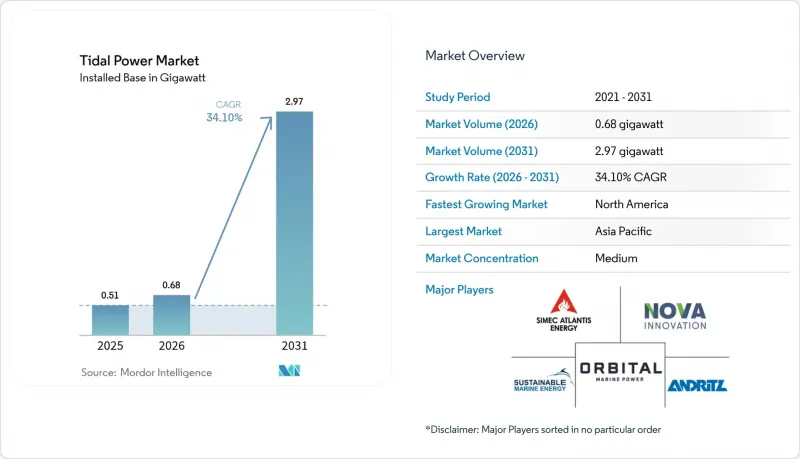
This report is Segmented by Power Generation Method (Tidal Barrage, Floating Tidal Power Platform, Tidal Stream Generation, and Dynamic Tidal Power), Tidal Energy Converters (Horizontal Axis Turbine, and More), Application (Power Generation, Desalination, Marine Propulsion, and More), End-User (Utilities and IPPs, Industrial, and Commercial), and Geography (North America, Europe, Asia Pacific, and More).
Global Tidal Power Market Trends and Insights
Global Decarbonization and Net-Zero Targets
Governments and corporations are chasing more predictable clean-power sources to backfill intermittent wind and solar. China's flagship array in the Zhoushan archipelago signals national intent, while U.S. planners see Cook Inlet covering up to 20% of regional demand by 2035. G-20 data show roughly 10% of renewable-finance packages are now directed to ocean-energy technology. Consistently high capacity factors strengthen the tidal power market value proposition for coastal factories that cannot afford production lapses.
Predictable Generation from High-Tidal-Range Sites
Because tidal cycles can be forecast centuries ahead, operators avoid the forecasting errors that plague wind and solar. Cook Inlet's theoretical 80 TWh resource illustrates the scale; China's eight-gigawatt coastal potential offers similar promise. Such precision slashes reserve-margin requirements, easing grid integration costs and supporting power-plus-desalination projects.
High CAPEX versus Other Renewables
Capital requirements range between USD 6,244/kW and USD 18,700/kW, compared to sub-USD 1,000/kW for utility solar, which restricts financing options despite superior capacity factors. Limited fleets of heavy-lift vessels inflate mobilization expenses, while composite-blade fabrication still depends on bespoke facilities, elongating lead times. Current levelized energy costs sit at USD 0.12-0.40/kWh-well above prevailing market rates. Nonetheless, learning-curve projections show potential cost declines of 29% through modular designs and standardized installation sequences endorsed by the European Commission.
Other drivers and restraints analyzed in the detailed report include:
- Government Subsidies and Feed-in Tariffs
- Advancements in Turbine and Floating-Platform Technology
- Marine-Ecosystem Impact Concerns
For complete list of drivers and restraints, kindly check the Table Of Contents.
Segment Analysis
Tidal-barrage plants held 44.12% of capacity in 2025 thanks to proven dams like La Rance and South Korea's 254 MW Sihwa Lake, which together produce 550 GWh a year. Floating platforms, free of depth limits, are on track for a 35.30% CAGR to 2031. Stream devices such as Scotland's MeyGen array add new megawatts yearly, while dynamic-tidal concepts remain in R&D. Convergence is likely: modular floats equipped with sluice-gate technology could merge barrage efficiency with deep-water flexibility, enriching the tidal power market size even where shorelines lack estuaries.
In parallel, platform OEMs are switching to barge-mounted pre-assembly to cut offshore time by 40%. Such tweaks trim vessel rental costs-one of the steepest expense lines-and should keep the tidal power market competitive as capital costs slide.
Horizontal-axis turbines controlled 62.05% of installations in 2025, largely because they borrow gearboxes, bearings, and SCADA logic from the wind sector. Upgrades now push rotor diameters past 20 m while shaving nacelle weight. Vertical-axis units serve bi-directional channels, minimizing yaw complexity, and underwater kites harvest slower currents to unlock low-head sites. As serial production ramps up, cross-item standardization-cables, connectors, control software-should shrink procurement lead times, helping the tidal power market broaden its converter mix without escalating costs.
Complete Report Scope:
- By Power Generation Method
- Tidal Barrage
- Floating Tidal Power Platform
- Tidal Stream Generation
- Dynamic Tidal Power
- By Tidal Energy Converters
- Horizontal Axis Turbine
- Vertical Axis Turbine
- Other Tidal Energy Converters
- By Application
- Power Generation
- Desalination
- Marine Propulsion
- Data and Telecom Platforms
- By End-User
- Utilities and IPPs
- Industrial
- Commercial
- By Geography
- North America
- United States
- Canada
- Mexico
- Europe
- United Kingdom
- France
- Spain
- Netherlands
- Denmark
- Russia
- Rest of Europe
- Asia Pacific
- China
- India
- Japan
- South Korea
- ASEAN Countries
- Australia and New Zealand
- Rest of Asia Pacific
- South America
- Brazil
- Argentina
- Colombia
- Rest of South America
- Middle East and Africa
- Saudi Arabia
- United Arab Emirates
- South Africa
- Egypt
- Rest of Middle East and Africa
- North America
Geography Analysis
Asia-Pacific held 50.35% of capacity in 2025, led by China's industrial drive and Southeast Asia's first grid-connected plant in South Korea. Japanese and Indonesian programs next focus on upscaling pilot devices, while Australia partners with Minesto to electrify isolated mining hubs.
North America is projected to be the growth champion at 49.80% CAGR. Alaska's Cook Inlet resource could feed 80 TWh a year, and tax-credit parity with offshore wind is drawing project financiers back to the region. Nova Scotia's revised leasing act speeds permitting in the Bay of Fundy, and West Coast grids study subsea cables for future Pacific builds.
Europe remains the policy trend-setter. The U.K.'s latest CfD round reserved a tidal budget, and the 240 MW Morlais zone entered early works in 2025. France's decades-old La Rance barrage still runs at more than 40% capacity factor, anchoring O&M best-practice data. Nordic yards now retrofit anchor-handling tugs into installation craft, adding local content jobs to the tidal power market narrative.
- Andritz AG
- Nova Innovation Ltd
- Orbital Marine Power Ltd
- MAKO Turbines Pty Ltd
- SIMEC Atlantis Energy Ltd
- HydroQuest SAS
- Sustainable Marine Energy Ltd
- Lockheed Martin Corporation
- Verdant Power Inc
- Minesto AB
- Voith Hydro GmbH & Co KG
- Sabella SA
- Carnegie Clean Energy Ltd
- Blue Energy Canada Inc
- Instream Energy Systems Corp
- Kepler Energy Ltd
- Water Wall Turbine Inc
- Seaflow Marine Ltd
- Ocean Renewable Power Company (ORPC)
- GCK Energy SAS
Additional Benefits:
- The market estimate (ME) sheet in Excel format
- 3 months of analyst support
TABLE OF CONTENTS
1 Introduction
- 1.1 Study Assumptions & Market Definition
- 1.2 Scope of the Study
2 Research Methodology
3 Executive Summary
4 Market Landscape
- 4.1 Market Overview
- 4.2 Market Drivers
- 4.2.1 Global decarbonization & net-zero targets
- 4.2.2 Predictable generation from high-tidal-range sites
- 4.2.3 Government subsidies & feed-in tariffs
- 4.2.4 Advancements in turbine & floating-platform tech
- 4.2.5 Co-location with coastal hydrogen hubs
- 4.2.6 Coastal-protection & climate-resilience applications
- 4.3 Market Restraints
- 4.3.1 High CAPEX versus other renewables
- 4.3.2 Marine-ecosystem impact concerns
- 4.3.3 Supply-chain bottlenecks for composite blades
- 4.3.4 Limited grid capacity in remote coastlines
- 4.4 Supply-Chain Analysis
- 4.5 Regulatory Landscape
- 4.6 Technological Outlook
- 4.7 Existing and Key Upcoming Projects
- 4.8 Porter's Five Forces
- 4.8.1 Bargaining Power of Suppliers
- 4.8.2 Bargaining Power of Buyers
- 4.8.3 Threat of New Entrants
- 4.8.4 Threat of Substitute Products
- 4.8.5 Intensity of Competitive Rivalry
5 Market Size & Growth Forecasts
- 5.1 By Power Generation Method
- 5.1.1 Tidal Barrage
- 5.1.2 Floating Tidal Power Platform
- 5.1.3 Tidal Stream Generation
- 5.1.4 Dynamic Tidal Power
- 5.2 By Tidal Energy Converters
- 5.2.1 Horizontal Axis Turbine
- 5.2.2 Vertical Axis Turbine
- 5.2.3 Other Tidal Energy Converters
- 5.3 By Application
- 5.3.1 Power Generation
- 5.3.2 Desalination
- 5.3.3 Marine Propulsion
- 5.3.4 Data and Telecom Platforms
- 5.4 By End-User
- 5.4.1 Utilities and IPPs
- 5.4.2 Industrial
- 5.4.3 Commercial
- 5.5 By Geography
- 5.5.1 North America
- 5.5.1.1 United States
- 5.5.1.2 Canada
- 5.5.1.3 Mexico
- 5.5.2 Europe
- 5.5.2.1 United Kingdom
- 5.5.2.2 France
- 5.5.2.3 Spain
- 5.5.2.4 Netherlands
- 5.5.2.5 Denmark
- 5.5.2.6 Russia
- 5.5.2.7 Rest of Europe
- 5.5.3 Asia Pacific
- 5.5.3.1 China
- 5.5.3.2 India
- 5.5.3.3 Japan
- 5.5.3.4 South Korea
- 5.5.3.5 ASEAN Countries
- 5.5.3.6 Australia and New Zealand
- 5.5.3.7 Rest of Asia Pacific
- 5.5.4 South America
- 5.5.4.1 Brazil
- 5.5.4.2 Argentina
- 5.5.4.3 Colombia
- 5.5.4.4 Rest of South America
- 5.5.5 Middle East and Africa
- 5.5.5.1 Saudi Arabia
- 5.5.5.2 United Arab Emirates
- 5.5.5.3 South Africa
- 5.5.5.4 Egypt
- 5.5.5.5 Rest of Middle East and Africa
- 5.5.1 North America
6 Competitive Landscape
- 6.1 Market Concentration
- 6.2 Strategic Moves (M&A, Partnerships, PPAs)
- 6.3 Market Share Analysis (Market Rank/Share for key companies)
- 6.4 Company Profiles (includes Global level Overview, Market level overview, Core Segments, Financials as available, Strategic Information, Products & Services, and Recent Developments)
- 6.4.1 Andritz AG
- 6.4.2 Nova Innovation Ltd
- 6.4.3 Orbital Marine Power Ltd
- 6.4.4 MAKO Turbines Pty Ltd
- 6.4.5 SIMEC Atlantis Energy Ltd
- 6.4.6 HydroQuest SAS
- 6.4.7 Sustainable Marine Energy Ltd
- 6.4.8 Lockheed Martin Corporation
- 6.4.9 Verdant Power Inc
- 6.4.10 Minesto AB
- 6.4.11 Voith Hydro GmbH & Co KG
- 6.4.12 Sabella SA
- 6.4.13 Carnegie Clean Energy Ltd
- 6.4.14 Blue Energy Canada Inc
- 6.4.15 Instream Energy Systems Corp
- 6.4.16 Kepler Energy Ltd
- 6.4.17 Water Wall Turbine Inc
- 6.4.18 Seaflow Marine Ltd
- 6.4.19 Ocean Renewable Power Company (ORPC)
- 6.4.20 GCK Energy SAS
7 Market Opportunities & Future Outlook
- 7.1 White-space & Unmet-Need Assessment
- 7.2 Emerging Blue-Economy Synergies
- 7.3 Coastal-Infrastructure Integration Projects

