PUBLISHER: Mordor Intelligence | PRODUCT CODE: 2124426

PUBLISHER: Mordor Intelligence | PRODUCT CODE: 2124426
Liquid Crystal Polymer (LCP) Films And Laminates - Market Share Analysis, Industry Trends & Statistics, Growth Forecasts (2026 - 2031)
According to Mordor Intelligence, liquid crystal polymer (LCP) films and laminates market size in 2026 is estimated at 67.85 million square meters, growing from 2025 value of 64.02 million square meters with 2031 projections showing 90.64 million square meters, growing at 5.99% CAGR over 2026-2031.
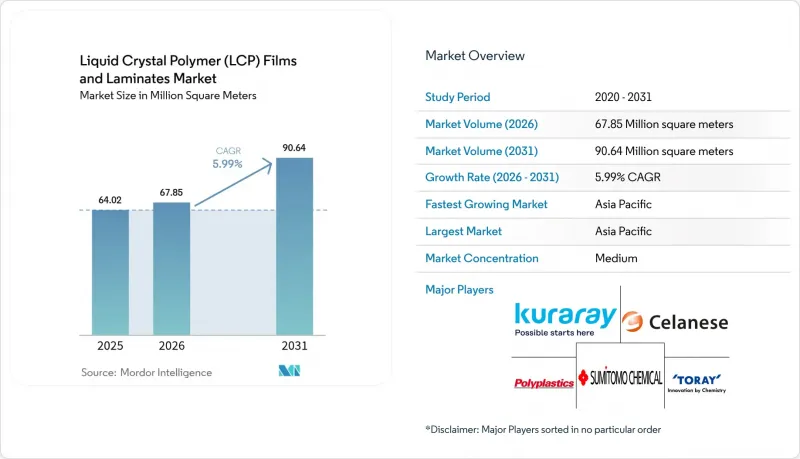
This report is Segmented by Type (LCP Films and LCP Laminates), End-Use Industry (Automotive, Electronics, Medical Devices, and Other Applications), and Geography (Asia-Pacific, North America, Europe, South America, and Middle East and Africa). Market Forecasts are Provided in Terms of Volume (Square Meters).
Global Liquid Crystal Polymer (LCP) Films And Laminates Market Trends and Insights
Miniaturization of Electronic and Electrical Components
Wearables and foldable phones now require interconnect pitches below 50 µm, a threshold at which polyimide flex circuits exhibit copper-adhesion failures under cyclic bending. Liquid Crystal Polymer (LCP) Films and Laminates market substrates dispense with adhesive layers, trimming total stack thickness by up to 20 µm and sustaining more than 100,000 bend cycles. The design win cadence accelerated in 2024 when flagship Android models adopted adhesiveless LCP antennas to fit sub-0.1 mm z-height constraints. Industrial IoT sensors deployed in rail and wind-turbine environments mirror this migration, citing 10-year durability with no delamination events. Suppliers respond by scaling plasma and chemical-etch surface treatments that raise copper-peel strength beyond 1.2 N/mm, closing historical reliability gaps against polyimide.
Surge in 5G / High-Frequency Communication Infrastructure
Millimeter-wave deployments in the 24-29 GHz range reveal the high insertion losses of FR-4 and standard polyimide. Liquid Crystal Polymer (LCP) Films and Laminates market laminates, with <0.003 dissipation factor in the n258 band, enable beam-forming architectures that extend cell radius without heavier ceramic substrates. China Mobile's 2024 procurement of LCP-based flexible transmission modules for pole-mounted microcells highlights volume traction, while open-RAN disaggregation necessitates rugged, low-CTE interconnects that tolerate outdoor temperature swings from -40°C to +70°C. Accelerated spectrum auctions in India and Brazil suggest spill-over demand within two years.
High Manufacturing and Processing Costs
Extruding LCP films requires melt temperatures exceeding 300 °C and corrosion-resistant twin-screw lines, which can cost upwards of USD 5 million, deterring new entrants. Trim waste can reach 12% because low melt viscosity causes edge beading, resulting in twice the scrap compared to polyimide lines. Energy consumption is 40% higher than that of polyimide due to prolonged cooling cycles, and European tariffs exacerbate the gap. Celanese's Zenite 16236(N) lowers processing temperatures to 280°C, reducing utility use; however, the step change still leaves LCP above standard molding ceilings, compelling converters to maintain dedicated cells.
Other drivers and restraints analyzed in the detailed report include:
- Lightweighting and Thermal-Management Needs in EV/ADAS
- Growing Demand for Minimally-Invasive Medical Devices
- Competition from Lower-Cost High-Frequency Polymers (PI, PPE)
For complete list of drivers and restraints, kindly check the Table Of Contents.
Segment Analysis
LCP films claimed 63.92% of the 2025 volume in the Liquid Crystal Polymer (LCP) Films And Laminates Market, underscoring their foundational role in antenna-in-package circuits that dominate flagship smartphone architectures. Stable spot pricing near USD 180/kg throughout 2024 signals that capacity expansions in Japan and South Korea largely matched handset demand cycles. Laminates, although smaller, are forecast to outgrow films at a 6.05% CAGR through 2031, as integrated antenna modules favor copper-clad substrates that simplify assembly flows. Murata's adhesiveless laminate qualification cut module reduced the z-height by 30 µm and improved thermal cycling reliability, illustrating why Liquid Crystal Polymer (LCP) Films and Laminates market customers are pivoting toward laminate solutions. Plasma-etched laminate surfaces now achieve a peel strength of over 1.2 N/mm, solving the surface-energy hurdle that once limited widespread adoption. Geographically, North American orders skew towards laminates for aerospace and defense, where pre-qualified stacks simplify certification, while APAC handset hubs still drive over 70% of film uptake.
Second-order dynamics suggest that thicker laminate formats (75 - 125 µm) are suitable for base-station antenna feeds, while thinner films (<50 µm) are more suitable for foldable devices, enabling regional suppliers to specialize. Chinese entrants such as Shenzhen WOTE tout next-generation grades with elevated glass-transition temperatures to capture local 5G infrastructure business . Concurrently, Japanese incumbents protect premium niches through patent-reinforced monomer syntheses that yield ultra-low ionics required for high-reliability aerospace boards.
Complete Report Scope:
- By Type
- LCP Films
- LCP Laminates
- By End-Use Industry
- Automotive
- Electronics
- Medical Devices
- Other Applications (Industrial Machinery, Packaging)
- By Geography
- Asia-Pacific
- China
- Japan
- South Korea
- India
- Malaysia
- Thailand
- Indonesia
- Vietnam
- Rest of Asia-Pacific
- North America
- United States
- Canada
- Mexico
- Europe
- Germany
- United Kingdom
- France
- Italy
- Spain
- Russia
- Turkey
- NORDIC Countries
- Rest of Europe
- South America
- Brazil
- Argentina
- Rest of South America
- Middle East and Africa
- Saudi Arabia
- South Africa
- Rest of Middle-East and Africa
- Asia-Pacific
Geography Analysis
Asia-Pacific held 63.10% of 2025 volume in Liquid Crystal Polymer (LCP) Films And Laminates Market, a dominance aligned with the region's dense handset assembly clusters and its vertically integrated LCP supply chain. Kuraray, Toray, and Sumitomo Chemical maintain technology leadership in film extrusion, while Celanese's 2024 Nanjing plant added 15% to global resin capacity, bringing resin synthesis closer to Chinese EV and 5G customers. South Korea focuses on laminate conversion for foldable-display antennas, where ultra-thin films enable 1.5 mm bend radius hinges. India's first wave of 5.5 G base-stations, set for 2027, should lift regional demand as spectrum auctions conclude, maintaining a 6.41% CAGR through 2031.
North America's demand is concentrated in aerospace radar arrays, medical implants, and data-center interconnects. Rogers Corporation decided in October 2024 to locate its next power-substrate plant in China, aiming to service Asian EV customers, as it faces cost hurdles on US soil. Still, defense budgets sustain local laminate demand, insulating the region from the cyclicality of consumer electronics. Mexico's emerging electronics assembly corridors may gradually replace some Asia-bound imports if near-shoring incentives deepen.
Europe faces eroded price competitiveness due to high electricity tariffs. German institutes investigate end-of-life LCP recycling under EU circular-economy mandates, potentially offsetting carbon costs and bolstering regional appeal. Eastern-European EMS plants show tentative interest in LCP flex boards for industrial IoT gateways, yet scale remains small. South America and the Middle East & Africa share the remaining <10%, with rollout pace tied directly to sovereign 5G capital-expenditure timetables.
- Celanese Corporation
- Chang Chun Group
- DZT Design & Mfg.
- KGK Chemical Corporation
- Kingfa Sci. & Tech.
- KURARAY CO. LTD.
- Murata Manufacturing Co. Ltd
- Panasonic Industry Co., Ltd.
- Polyplastics Co., Ltd.
- Rogers Corporation
- RTP Company
- Shanghai PRET Composites
- SHENGYI TECHNOLOGY CO., LTD.
- Shenzhen WOTE Advanced Materials Co.,Ltd
- Sumitomo Chemical Advanced Technologies
- Syensqo
- TORAY INDUSTRIES INC.
- UENO FINE CHEMICALS INDUSTRY LTD
- Zeus Company Inc.
Additional Benefits:
- The market estimate (ME) sheet in Excel format
- 3 months of analyst support
TABLE OF CONTENTS
1 Introduction
- 1.1 Study Assumptions & Market Definition
- 1.2 Scope of the Study
2 Research Methodology
3 Executive Summary
4 Market Landscape
- 4.1 Market Overview
- 4.2 Market Drivers
- 4.2.1 Miniaturization of electronic and electrical components
- 4.2.2 Surge in 5G / high-frequency communication infrastructure
- 4.2.3 Lightweighting and thermal-management needs in EV/ADAS
- 4.2.4 Growing demand for minimally-invasive medical devices
- 4.2.5 Flex-CCL adoption for mmWave antenna modules
- 4.3 Market Restraints
- 4.3.1 High manufacturing and processing costs
- 4.3.2 Competition from lower-cost high-freq polymers (PI, PPE)
- 4.3.3 Supply-chain concentration in specialty diacids and biphenols (under-the-radar)
- 4.4 Value Chain Analysis
- 4.5 Porter's Five Forces
- 4.5.1 Bargaining Power of Suppliers
- 4.5.2 Bargaining Power of Buyers
- 4.5.3 Threat of New Entrants
- 4.5.4 Threat of Substitutes
- 4.5.5 Degree of Competition
5 Market Size & Growth Forecasts (Volume)
- 5.1 By Type
- 5.1.1 LCP Films
- 5.1.2 LCP Laminates
- 5.2 By End-Use Industry
- 5.2.1 Automotive
- 5.2.2 Electronics
- 5.2.3 Medical Devices
- 5.2.4 Other Applications (Industrial Machinery, Packaging)
- 5.3 By Geography
- 5.3.1 Asia-Pacific
- 5.3.1.1 China
- 5.3.1.2 Japan
- 5.3.1.3 South Korea
- 5.3.1.4 India
- 5.3.1.5 Malaysia
- 5.3.1.6 Thailand
- 5.3.1.7 Indonesia
- 5.3.1.8 Vietnam
- 5.3.1.9 Rest of Asia-Pacific
- 5.3.2 North America
- 5.3.2.1 United States
- 5.3.2.2 Canada
- 5.3.2.3 Mexico
- 5.3.3 Europe
- 5.3.3.1 Germany
- 5.3.3.2 United Kingdom
- 5.3.3.3 France
- 5.3.3.4 Italy
- 5.3.3.5 Spain
- 5.3.3.6 Russia
- 5.3.3.7 Turkey
- 5.3.3.8 NORDIC Countries
- 5.3.3.9 Rest of Europe
- 5.3.4 South America
- 5.3.4.1 Brazil
- 5.3.4.2 Argentina
- 5.3.4.3 Rest of South America
- 5.3.5 Middle East and Africa
- 5.3.5.1 Saudi Arabia
- 5.3.5.2 South Africa
- 5.3.5.3 Rest of Middle-East and Africa
- 5.3.1 Asia-Pacific
6 Competitive Landscape
- 6.1 Market Concentration
- 6.2 Strategic Moves
- 6.3 Market Share (%)/ Ranking Analysis
- 6.4 Company Profiles (includes Global level Overview, Market level overview, Core Segments, Financials as available, Strategic Information, Market Rank/Share, Products & Services, Recent Developments)
- 6.4.1 Celanese Corporation
- 6.4.2 Chang Chun Group
- 6.4.3 DZT Design & Mfg.
- 6.4.4 KGK Chemical Corporation
- 6.4.5 Kingfa Sci. & Tech.
- 6.4.6 KURARAY CO. LTD.
- 6.4.7 Murata Manufacturing Co. Ltd
- 6.4.8 Panasonic Industry Co., Ltd.
- 6.4.9 Polyplastics Co., Ltd.
- 6.4.10 Rogers Corporation
- 6.4.11 RTP Company
- 6.4.12 Shanghai PRET Composites
- 6.4.13 SHENGYI TECHNOLOGY CO., LTD.
- 6.4.14 Shenzhen WOTE Advanced Materials Co.,Ltd
- 6.4.15 Sumitomo Chemical Advanced Technologies
- 6.4.16 Syensqo
- 6.4.17 TORAY INDUSTRIES INC.
- 6.4.18 UENO FINE CHEMICALS INDUSTRY LTD
- 6.4.19 Zeus Company Inc.
7 Market Opportunities and Future Outlook
- 7.1 White-space and unmet-need assessment

