PUBLISHER: Roots Analysis | PRODUCT CODE: 2015359

PUBLISHER: Roots Analysis | PRODUCT CODE: 2015359
Mobile Robots Market, till 2035: Industry Trends and Global Forecasts
Mobile Robots Market Outlook
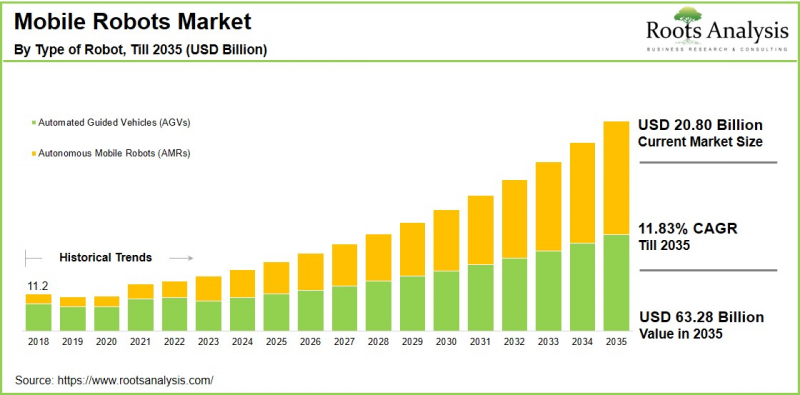
As per Roots Analysis, the global mobile robots market size is estimated to grow from USD 20.79 billion in current year to USD 63.28 billion by 2035, at a CAGR of 11.83% during the forecast period, till 2035.
Mobile robots represent a rapidly evolving segment of advanced automation systems designed to perform tasks autonomously or semi-autonomously while navigating dynamic environments. Unlike fixed robotic systems, mobile robots are equipped with integrated sensors, control systems, and artificial intelligence algorithms that enable movement, spatial awareness, obstacle avoidance, and real-time decision-making. These systems are widely deployed across manufacturing, logistics, healthcare, agriculture, defense, and retail sectors to streamline operations and enhance productivity.
In warehouses and distribution centers, autonomous mobile robots (AMRs) facilitate material handling and inventory movement; in healthcare settings, they support medication delivery and sanitation. Further, in manufacturing environments, they assist with assembly line operations and internal transportation. Their ability to reduce human intervention in repetitive, labor-intensive, or hazardous tasks significantly improves operational efficiency and workplace safety. The mobile robots market is expected to grow significantly during the forecast period. This is due to the growing emphasis on industrial automation and the increasing integration of AI-driven navigation and connectivity technologies.
Strategic Insights for Senior Leaders
Key Drivers Propelling Growth of Mobile Robots Market
The growth of the mobile robots market is primarily driven by the accelerating adoption of industrial automation across manufacturing, logistics, and healthcare sectors. Companies are increasingly deploying autonomous mobile robots (AMRs) to enhance operational efficiency, reduce labor dependency, and optimize workflow management. Additionally, the rapid expansion of e-commerce and warehouse automation has significantly boosted demand for intelligent material handling solutions. Technological advancements, including artificial intelligence, and edge computing have further enhanced the navigation, adaptability, and safety capabilities of mobile robots, making them more reliable in dynamic environments. Moreover, the integration of Industry 4.0 practices and connected infrastructure is enabling seamless coordination between robotic systems and enterprise platforms, thereby accelerating market expansion.
Mobile Robots Market: Competitive Landscape of Companies in this Industry
The mobile robots market is characterized by the presence of numerous small and large players, resulting in intense competition and evolving market dynamics. Both global multinational corporations and regional players are actively working to strengthen their competitive positioning. Currently, major enterprises and established multinational companies hold a dominant share of the market, supported by their extensive distribution networks, technological capabilities, and financial resources. At the same time, small manufacturers are focusing on product innovation and customization to address niche application areas and deliver specialized solutions. To enhance their market presence, industry players are adopting strategic initiatives such as developing advanced robotic technologies, entering into strategic alliances and partnerships to broaden their portfolios and geographic reach.
Mobile Robots Evolution: Emerging Trends in the Industry
The mobile robots industry is witnessing several emerging trends. A key trend is the increasing adoption of autonomous mobile robots (AMRs) equipped with artificial intelligence, machine vision, and advanced sensor technologies such as LiDAR, enabling enhanced navigation, and real-time decision-making in complex environments. The growing integration of Industry 4.0 frameworks and IoT-enabled connectivity is further facilitating seamless communication between robots, enterprise systems, and cloud platforms, improving operational visibility and coordination.
Additionally, there is a notable shift toward collaborative robotics, where mobile robots are designed to safely operate alongside human workers, enhancing productivity while maintaining workplace safety. The expansion of warehouse automation, fueled by the rapid growth of e-commerce, and the rising deployment of edge computing for faster data processing are also shaping the evolution of the mobile robots industry.
Regional Analysis: Asia-Pacific Lead the Mobile Robots Market
According to our analysis, in the current year, the mobile robots market in Asia-Pacific captures the largest share. This is due to its strong manufacturing base, rapid industrial automation, and proactive government support for advanced technologies. Countries such as China, Japan, and South Korea are adopting robotics, driven by high robot density, large-scale production facilities, and significant investments in smart factories. Further, the region's expanding e-commerce sector and the growing demand for warehouse automation have further accelerated the deployment of autonomous mobile robots in logistics and distribution centers.
Additionally, favorable government initiatives promoting Industry 4.0, digital transformation, and domestic robotics manufacturing have strengthened regional competitiveness.
Key Challenges in Mobile Robots Market
Key challenges hindering the adoption of mobile robots include high initial investment required for procurement, system integration, and infrastructure upgrades, which can be particularly challenging for small and medium-sized enterprises. Additionally, the complexity of integrating mobile robots with existing systems and enterprise software often demands significant technical expertise and customization. Concerns related to cybersecurity, data privacy, and system reliability further pose risks, especially as robots become increasingly connected through IoT-enabled platforms.
Further, operational challenges such as navigation in highly dynamic or unstructured environments, battery limitations, and maintenance requirements also impact performance and scalability. Moreover, the shortage of skilled professionals capable of managing and maintaining advanced robotic systems remains a critical constraint for widespread adoption.
Mobile Robots Market: Key Market Segmentation
Type of Offering
- Hardware
- Software and Services
Type of Robot
- Automated Guided Vehicles (AGV)
- Autonomous Mobile Robots (AMR)
Payload
- High Payloads (> 1000 Kgs)
- Medium Payloads (100 to 1000 Kgs)
- Low Payloads (< 100 Kgs)
Navigation Mode
- SLAM
- QR Code
- Magnetic Navigation
- Laser with Reflector
- Others
Form Factor
- Latent Lifts / Conveyors
- Forklifts
- Tow Tractors / Tuggers
- Tote / Bin Robots
- Assembly Robots
- Others
Type of Enterprise
- Large Enterprises
- Small and Medium Enterprises (SMEs)
Distribution Channel
- Direct Sales
- Indirect Sales
- Robot Rental / RaaS
Application Area
- Manufacturing
- Logistics
End-User
- Automotive Industry
- Semiconductor and Electronics Industry
- Logistics and E-commerce Industry
- Manufacturing and Machinery Industry
- FMCG Industry
- Medical Industry
- Others
Geographical Regions
- North America
- Europe
- Asia-Pacific
- Latin America
- Middle East and Africa, and Rest of the World
Example Players in Mobile Robots Market
- ABB Robotics
- Blue Skye Automation
- Boston Dynamics
- E-COBOT
- Geekplus Technology
- Gideon Brothers
- GreyOrange
- Honda Motor
- iRobot
- Kongsberg Maritime
- Kuka
- Locus Robotics
- Mobile Industrial Robots
- Northrop Grumman
- Omron Group
- SoftBank Robotics
- SuperDroid Robots
- Zebra Fetch Robotics
Mobile Robots Market: Report Coverage
The report on the mobile robots market features insights on various sections, including:
- Market Sizing and Opportunity Analysis: An in-depth analysis of the mobile robots market, focusing on key market segments, including [A] type of offering, [B] type of robot, [C] payload, [D] navigation mode, [E] form factor, [F] type of enterprise, [G] distribution channel, [H] application area, [I] end-user, [J] geographical regions and [K] key players.
- Competitive Landscape: A comprehensive analysis of the companies engaged in the mobile robots market, based on several relevant parameters, such as [A] year of establishment, [B] company size, [C] location of headquarters and [D] ownership structure.
- Company Profiles: Elaborate profiles of prominent players engaged in the mobile robots market, providing details on [A] location of headquarters, [B] company size, [C] company mission, [D] company footprint, [E] management team, [F] contact details, [G] financial information, [H] operating business segments, [I] product / technology portfolio, [J] recent developments, and an informed future outlook.
- Patent Analysis: An insightful analysis of patents filed / granted in the mobile robots domain, based on relevant parameters, including [A] type of patent, [B] patent publication year, [C] patent age and [D] leading players.
Key Questions Answered in this Report
- What is the current and future market size?
- Who are the leading companies in this market?
- What are the growth drivers that are likely to influence the evolution of this market?
- What are the key partnership and funding trends shaping this industry?
- Which region is likely to grow at higher CAGR till 2035?
- How is the current and future market opportunity likely to be distributed across key market segments?
Reasons to Buy this Report
- Detailed Market Analysis: The report provides a comprehensive market analysis, offering detailed revenue projections of the overall market and its specific sub-segments. This information is valuable to both established market leaders and emerging entrants.
- In-depth Analysis of Trends: Stakeholders can leverage the report to gain a deeper understanding of the competitive dynamics within the market. Each report maps ecosystem activity across partnerships, funding, and patent landscapes to reveal growth hotspots and white spaces in the industry.
- Opinion of Industry Experts: The report features extensive interviews and surveys with key opinion leaders and industry experts to validate market trends mentioned in the report.
- Decision-ready Deliverables: The report offers stakeholders with strategic frameworks (Porter's Five Forces, value chain, SWOT), and complimentary Excel / slide packs with customization support.
Additional Benefits
- Complimentary Dynamic Excel Dashboards for Analytical Modules
- Exclusive 15% Free Content Customization
- Personalized Interactive Report Walkthrough with Our Expert Research Team
- Free Report Updates for Versions Older than 6-12 Months
TABLE OF CONTENTS
1. PROJECT OVERVIEW
- 1.1. Context
- 1.2. Project Objectives
2. RESEARCH METHODOLOGY
- 2.1. Chapter Overview
- 2.2. Research Assumptions
- 2.2.1. Market Landscape and Market Trends
- 2.2.2. Market Forecast and Opportunity Analysis
- 2.2.3. Comparative Analysis
- 2.3. Database Building
- 2.3.1. Data Collection
- 2.3.2. Data Validation
- 2.3.3. Data Analysis
- 2.4. Project Methodology
- 2.4.1. Secondary Research
- 2.4.1.1. Annual Reports
- 2.4.1.2. Academic Research Papers
- 2.4.1.3. Company Websites
- 2.4.1.4. Investor Presentations
- 2.4.1.5. Regulatory Filings
- 2.4.1.6. White Papers
- 2.4.1.7. Industry Publications
- 2.4.1.8. Conferences and Seminars
- 2.4.1.9. Government Portals
- 2.4.1.10. Media and Press Releases
- 2.4.1.11. Newsletters
- 2.4.1.12. Industry Databases
- 2.4.1.13. Roots Proprietary Databases
- 2.4.1.14. Paid Databases and Sources
- 2.4.1.15. Social Media Portals
- 2.4.1.16. Other Secondary Sources
- 2.4.2. Primary Research
- 2.4.2.1. Types of Primary Research
- 2.4.2.1.1. Qualitative Research
- 2.4.2.1.2. Quantitative Research
- 2.4.2.1.3. Hybrid Approach
- 2.4.2.2. Advantages of Primary Research
- 2.4.2.3. Techniques for Primary Research
- 2.4.2.3.1. Interviews
- 2.4.2.3.2. Surveys
- 2.4.2.3.3. Focus Groups
- 2.4.2.3.4. Observational Research
- 2.4.2.3.5. Social Media Interactions
- 2.4.2.4. Key Opinion Leaders Considered in Primary Research
- 2.4.2.4.1. Company Executives (CXOs)
- 2.4.2.4.2. Board of Directors
- 2.4.2.4.3. Company Presidents and Vice Presidents
- 2.4.2.4.4. Research and Development Heads
- 2.4.2.4.5. Technical Experts
- 2.4.2.4.6. Subject Matter Experts
- 2.4.2.4.7. Scientists
- 2.4.2.4.8. Doctors and Other Healthcare Providers
- 2.4.2.5. Ethics and Integrity
- 2.4.2.5.1. Research Ethics
- 2.4.2.5.2. Data Integrity
- 2.4.2.1. Types of Primary Research
- 2.4.3. Analytical Tools and Databases
- 2.4.1. Secondary Research
- 2.5. Robust Quality Control
3. MARKET DYNAMICS
- 3.1. Chapter Overview
- 3.2. Forecast Methodology
- 3.2.1. Top-down Approach
- 3.2.2. Bottom-up Approach
- 3.2.3. Hybrid Approach
- 3.3. Market Assessment Framework
- 3.3.1. Total Addressable Market (TAM)
- 3.3.2. Serviceable Addressable Market (SAM)
- 3.3.3. Serviceable Obtainable Market (SOM)
- 3.3.4. Currently Acquired Market (CAM)
- 3.4. Forecasting Tools and Techniques
- 3.4.1. Qualitative Forecasting
- 3.4.2. Correlation
- 3.4.3. Regression
- 3.4.4. Extrapolation
- 3.4.5. Convergence
- 3.4.6. Sensitivity Analysis
- 3.4.7. Scenario Planning
- 3.4.8. Data Visualization
- 3.4.9. Time Series Analysis
- 3.4.10. Forecast Error Analysis
- 3.5. Key Considerations
- 3.5.1. Demographics
- 3.5.2. Government Regulations
- 3.5.3. Reimbursement Scenarios
- 3.5.4. Market Access
- 3.5.5. Supply Chain
- 3.5.6. Industry Consolidation
- 3.5.7. Pandemic / Unforeseen Disruptions Impact
- 3.6. Limitations
4. MACRO-ECONOMIC INDICATORS
- 4.1. Chapter Overview
- 4.2. Market Dynamics
- 4.2.1. Time Period
- 4.2.1.1. Historical Trends
- 4.2.1.2. Current and Forecasted Estimates
- 4.2.2. Currency Coverage
- 4.2.2.1. Major Currencies Affecting the Market
- 4.2.2.2. Factors Affecting Currency Fluctuations
- 4.2.2.3. Impact of Currency Fluctuations on the Industry
- 4.2.3. Foreign Currency Exchange Rate
- 4.2.3.1. Impact of Foreign Exchange Rate Volatility on the Market
- 4.2.3.2. Strategies for Mitigating Foreign Exchange Risk
- 4.2.4. Recession
- 4.2.4.1. Assessment of Current Economic Conditions and Potential Impact on the Market
- 4.2.4.2. Historical Analysis of Past Recessions and Lessons Learnt
- 4.2.5. Inflation
- 4.2.5.1. Measurement and Analysis of Inflationary Pressures in the Economy
- 4.2.5.2. Potential Impact of Inflation on the Market Evolution
- 4.2.6. Interest Rates
- 4.2.6.1. Interest Rates and Their Impact on the Market
- 4.2.6.2. Strategies for Managing Interest Rate Risk
- 4.2.7. Commodity Flow Analysis
- 4.2.7.1. Type of Commodity
- 4.2.7.2. Origins and Destinations
- 4.2.7.3. Value and Weights
- 4.2.7.4. Modes of Transportation
- 4.2.8. Global Trade Dynamics
- 4.2.8.1. Import Scenario
- 4.2.8.2. Export Scenario
- 4.2.8.3. Trade Policies
- 4.2.8.4. Strategies for Mitigating the Risks Associated with Trade Barriers
- 4.2.8.5. Impact of Trade Barriers on the Market
- 4.2.9. War Impact Analysis
- 4.2.9.1. Russian-Ukraine War
- 4.2.9.2. Israel-Hamas War
- 4.2.10. COVID Impact / Related Factors
- 4.2.10.1. Global Economic Impact
- 4.2.10.2. Industry-specific Impact
- 4.2.10.3. Government Response and Stimulus Measures
- 4.2.10.4. Future Outlook and Adaptation Strategies
- 4.2.11. Other Indicators
- 4.2.11.1. Fiscal Policy
- 4.2.11.2. Consumer Spending
- 4.2.11.3. Gross Domestic Product (GDP)
- 4.2.11.4. Employment
- 4.2.11.5. Taxes
- 4.2.11.6. Stock Market Performance
- 4.2.11.7. Cross-Border Dynamics
- 4.2.1. Time Period
- 4.3. Conclusion
5. EXECUTIVE SUMMARY
6. INTRODUCTION
- 6.1. Overview of the Mobile Robots
- 6.2. Types of Mobile Robots
- 6.3. Advantages of Mobile Robots
- 6.4. Key Application Areas of Mobile Robots
- 6.5. Future Trends in Mobile Robots
7. MARKET LANDSCAPE: LEADING MOBILE ROBOTS PROVIDERS
- 7.1. Methodology and Key Parameters
- 7.2. Analysis by Year of Establishment
- 7.3. Analysis by Company Size
- 7.4. Analysis by Location of Headquarters
- 7.5. Analysis by Type of Robot
- 7.6. Analysis by Payload Supported
- 7.7. Analysis by Application Area
- 7.8. Analysis by End-User
8. STARTUP ECOSYSTEM IN THE MOBILE ROBOTS MARKET
- 8.1. Methodology and Key Parameters
- 8.2. Analysis by Year of Establishment
- 8.3. Analysis by Company Size
- 8.4. Analysis by Location of Headquarters
- 8.5. Analysis by Type of Robot
- 8.6. Analysis by Number of Robots Offered
- 8.7. Analysis by Payload Capacity
- 8.8. Analysis by Application Area
- 8.9. Analysis by Navigation Sensor
9. COMPANY PROFILES
- 9.1. ABB
- 9.1.1. Company Overview
- 9.1.2. Management Team
- 9.1.3. Mobile Robots Portfolio
- 9.1.4. Recent Developments and Future Outlook
- Similar details are presented for other below mentioned companies based on information in the public domain
- 9.2. FANUC
- 9.3. Geekplus
- 9.4. iRobot
- 9.5. KUKA
- 9.6. Locus Robotics9.11. E-COBOT
- 9.12. Gideon
- 9.13. Honda Motor
- 9.14. Omron
- 9.15. Siasun
- 9.16. SoftBank Robotics
- 9.17. Staubli
- 9.18. Zebra Technologies
10. VALUE CHAIN ANALYSIS
11. MEGA TRENDS ANALYSIS
12. PORTER'S FIVE FORCES ANALYSIS
13. GLOBAL POLICY ANALYSIS
14. MARKET IMPACT ANALYSIS
15. GLOBAL MOBILE ROBOTS MARKET
- 15.1. Key Assumptions and Methodology
- 15.2. Global Mobile Robots Market, Historical Trends (Since 2018) and Forecasted Estimates (Till 2035)
- 15.2.1. Scenario Analysis
- 15.2.1.1. Conservative Scenario
- 15.2.1.2. Optimistic Scenario
- 15.2.1. Scenario Analysis
- 15.3. Key Market Segmentations
16. MARKET OPPORTUNITIES BASED ON TYPE OF OFFERING
- 16.1. Key Assumptions and Methodology
- 16.2. Mobile Robots Market, by Type of Offering
- 16.2.1. Mobile Robots Market for Hardware, Historical Trends (Since 2018) and Forecasted Estimates (Till 2035)
- 16.2.2. Mobile Robots Market for Software and Services, Historical Trends (Since 2018) and Forecasted Estimates (Till 2035)
17. MARKET OPPORTUNITIES BASED ON TYPE OF ROBOT
- 17.1. Key Assumptions and Methodology
- 17.2. Mobile Robots Market, by Type of Robot
- 17.2.1. Mobile Robots Market for Automated Guided Vehicles (AGV), Historical Trends (Since 2018) and Forecasted Estimates (Till 2035)
- 17.2.2. Mobile Robots Market for Autonomous Mobile Robots (AMR), Historical Trends (Since 2018) and Forecasted Estimates (Till 2035)
18. MARKET OPPORTUNITIES BASED ON PAYLOAD
- 18.1. Key Assumptions and Methodology
- 18.2. Mobile Robots Market, by Payload
- 18.2.1. Mobile Robots Market for High Payloads (>1000 Kgs), Historical Trends (Since 2018) and Forecasted Estimates (Till 2035)
- 18.2.2. Mobile Robots Market for Medium Payloads (100 to 1000 Kgs), Historical Trends (Since 2018) and Forecasted Estimates (Till 2035)
- 18.2.3. Mobile Robots Market for Small Payloads (<100 Kgs), Historical Trends (Since 2018) and Forecasted Estimates (Till 2035)
19. MARKET OPPORTUNITIES BASED ON NAVIGATION MODE
- 19.1. Key Assumptions and Methodology
- 19.2. Mobile Robots Market, by Navigation Mode
- 19.2.1. Mobile Robots Market for SLAM, Historical Trends (Since 2018) and Forecasted Estimates (Till 2035)
- 19.2.2. Mobile Robots Market for QR Code, Historical Trends (Since 2018) and Forecasted Estimates (Till 2035)
- 19.2.3. Mobile Robots Market for Magnetic Navigation, Historical Trends (Since 2018) and Forecasted Estimates (Till 2035)
- 19.2.4. Mobile Robots Market for Laser with Reflector, Historical Trends (Since 2018) and Forecasted Estimates (Till 2035)
- 19.2.5. Mobile Robots Market for Others, Historical Trends (Since 2018) and Forecasted Estimates (Till 2035)
20. MARKET OPPORTUNITIES BASED ON FORM FACTOR
- 20.1. Key Assumptions and Methodology
- 20.2. Mobile Robots Market, by Form Factor
- 20.2.1. Mobile Robots Market for Latent Lifts / Conveyors, Historical Trends (Since 2018) and Forecasted Estimates (Till 2035)
- 20.2.2. Mobile Robots Market for Forklifts, Historical Trends (Since 2018) and Forecasted Estimates (Till 2035)
- 20.2.3. Mobile Robots Market for Tow Tractors / Tuggers, Historical Trends (Since 2018) and Forecasted Estimates (Till 2035)
- 20.2.4. Mobile Robots Market for Tote / Bin Robots, Historical Trends (Since 2018) and Forecasted Estimates (Till 2035)
- 20.2.5. Mobile Robots Market for Assembly Robots, Historical Trends (Since 2018) and Forecasted Estimates (Till 2035)
- 20.2.6. Mobile Robots Market for Others, Historical Trends (Since 2018) and Forecasted Estimates (Till 2035)
21. MARKET OPPORTUNITIES BASED ON TYPE OF ENTERPRISE
- 21.1. Key Assumptions and Methodology
- 21.2. Metamaterials Market, by Type of Enterprise
- 21.2.1. Metamaterials Market for Large Enterprises, Historical Trends (Since 2018) and Forecasted Estimates (Till 2035)
- 21.2.2. Metamaterials Market for Small and Medium Enterprises, Historical Trends (Since 2018) and Forecasted Estimates (Till 2035)
22. MARKET OPPORTUNITIES BASED ON DISTRIBUTION CHANNEL
- 22.1. Key Assumptions and Methodology
- 22.2. Metamaterials Market, by Distribution Channel
- 22.2.1. Metamaterials Market for Direct Sales, Historical Trends (Since 2018) and Forecasted Estimates (Till 2035)
- 22.2.2. Metamaterials Market for Indirect Sales, Historical Trends (Since 2018) and Forecasted Estimates (Till 2035)
- 22.2.3. Metamaterials Market for Robot Rental / RaaS, Historical Trends (Since 2018) and Forecasted Estimates (Till 2035)
23. MARKET OPPORTUNITIES BASED ON APPLICATION AREA
- 23.1. Key Assumptions and Methodology
- 23.2. Metamaterials Market, by Application Area
- 23.2.1. Metamaterials Market for Manufacturing, Historical Trends (Since 2018) and Forecasted Estimates (Till 2035)
- 23.2.2. Metamaterials Market for Logistics, Historical Trends (Since 2018) and Forecasted Estimates (Till 2035)
24. MARKET OPPORTUNITIES BASED ON END-USER
- 24.1. Key Assumptions and Methodology
- 24.2. Mobile Robots Market, by End-User
- 24.2.1. Mobile Robots Market for Semiconductor and Electronics Industry, Historical Trends (Since 2018) and Forecasted Estimates (Till 2035)
- 24.2.2. Mobile Robots Market for Logistics and E-commerce Industry, Historical Trends (Since 2018) and Forecasted Estimates (Till 2035)
- 24.2.3. Mobile Robots Market for Automotive Industry, Historical Trends (Since 2018) and Forecasted Estimates (Till 2035)
- 24.2.4. Mobile Robots Market for Manufacturing and Machinery Industry, Historical Trends (Since 2018) and Forecasted Estimates (Till 2035)
- 24.2.5. Mobile Robots Market for FMCG Industry, Historical Trends (Since 2018) and Forecasted Estimates (Till 2035)
- 24.2.6. Mobile Robots Market for Medical Industry, Historical Trends (Since 2018) and Forecasted Estimates (Till 2035)
- 24.2.6. Mobile Robots Market for Others, Historical Trends (Since 2018) and Forecasted Estimates (Till 2035)
25. MARKET OPPORTUNITIES BASED ON KEY GEOGRAPHICAL REGIONS
- 25.1. Key Assumptions and Methodology
- 25.2. Mobile Robots Market, by Key Geographical Regions
- 25.2.1. Mobile Robots Market in North America, Historical Trends (Since 2018) and Forecasted Estimates (Till 2035)
- 25.2.1.1. Mobile Robots Market in the US, Historical Trends (Since 2018) and Forecasted Estimates (Till 2035)
- 25.2.1.2. Mobile Robots Market in Canada, Historical Trends (Since 2018) and Forecasted Estimates (Till 2035)
- 25.2.1.3. Mobile Robots Market in Mexico, Historical Trends (Since 2018) and Forecasted Estimates (Till 2035)
- 25.2.1.4. Mobile Robots Market in Rest of North America, Historical Trends (Since 2018) and Forecasted Estimates (Till 2035)
- 25.2.2. Mobile Robots Market in Europe, Historical Trends (Since 2018) and Forecasted Estimates (Till 2035)
- 25.2.2.1. Mobile Robots Market in Germany, Historical Trends (Since 2018) and Forecasted Estimates (Till 2035)
- 25.2.2.2. Mobile Robots Market in Italy, Historical Trends (Since 2018) and Forecasted Estimates (Till 2035)
- 25.2.2.3. Mobile Robots Market in France, Historical Trends (Since 2018) and Forecasted Estimates (Till 2035)
- 25.2.2.4. Mobile Robots Market in Spain, Historical Trends (Since 2018) and Forecasted Estimates (Till 2035)
- 25.2.2.5. Mobile Robots Market in Turkey, Historical Trends (Since 2018) and Forecasted Estimates (Till 2035)
- 25.2.2.6. Mobile Robots Market in the UK, Historical Trends (Since 2018) and Forecasted Estimates (Till 2035)
- 25.2.2.7. Mobile Robots Market in Rest of Europe, Historical Trends (Since 2018) and Forecasted Estimates (Till 2035)
- 25.2.3. Mobile Robots Market in Asia, Historical Trends (Since 2018) and Forecasted Estimates (Till 2035)
- 25.2.3.1. Mobile Robots Market in China, Historical Trends (Since 2018) and Forecasted Estimates (Till 2035)
- 25.2.3.2. Mobile Robots Market in Japan, Historical Trends (Since 2018) and Forecasted Estimates (Till 2035)
- 25.2.3.3. Mobile Robots Market in South Korea, Historical Trends (Since 2018) and Forecasted Estimates (Till 2035)
- 25.2.3.4. Mobile Robots Market in Taiwan, Historical Trends (Since 2018) and Forecasted Estimates (Till 2035)
- 25.2.3.5. Mobile Robots Market in Singapore, Historical Trends (Since 2018) and Forecasted Estimates (Till 2035)
- 25.2.3.6. Mobile Robots Market in India, Historical Trends (Since 2018) and Forecasted Estimates (Till 2035)
- 25.2.3.7. Mobile Robots Market in Thailand, Historical Trends (Since 2018) and Forecasted Estimates (Till 2035)
- 25.2.3.8. Mobile Robots Market in Rest of Asia, Historical Trends (Since 2018) and Forecasted Estimates (Till 2035)
- 25.2.4. Mobile Robots Market in Latin America, Historical Trends (Since 2018) and Forecasted Estimates (Till 2035)
- 25.2.4.1. Mobile Robots Market in Brazil, Historical Trends (Since 2018) and Forecasted Estimates (Till 2035)
- 25.2.4.2. Mobile Robots Market in Rest of Latin America, Historical Trends (Since 2018) and Forecasted Estimates (Till 2035)
- 25.2.5. Mobile Robots Market in Middle East and Africa and Rest of the World, Historical Trends (Since 2018) and Forecasted Estimates (Till 2035)
- 25.2.5.1. Mobile Robots Market in North Africa, Historical Trends (Since 2018) and Forecasted Estimates (Till 2035)
- 25.2.5.2. Mobile Robots Market in South Africa, Historical Trends (Since 2018) and Forecasted Estimates (Till 2035)
- 25.2.5.3. Mobile Robots Market in Rest of Middle East and Africa, Historical Trends (Since 2018) and Forecasted Estimates (Till 2035)
- 25.2.5.4. Mobile Robots Market in Rest of the World, Historical Trends (Since 2018) and Forecasted Estimates (Till 2035)
- 25.2.1. Mobile Robots Market in North America, Historical Trends (Since 2018) and Forecasted Estimates (Till 2035)
26. APPENDIX 1: TABULATED DATA
27. APPENDIX 2: LIST OF COMPANIES AND ORGANIZATIONS

