PUBLISHER: Roots Analysis | PRODUCT CODE: 2055600

PUBLISHER: Roots Analysis | PRODUCT CODE: 2055600
Cancer Biologics Market: Industry Trends and Global Forecasts Till 2035 - Distribution by Type of Biologic, Target Indication and Geography
Cancer Biologics Market: Overview
As per Roots Analysis, the global cancer biologics market is estimated to grow from USD 169 billion in the current year to USD 189 billion by 2035, at a CAGR of 8.9% during the forecast period, till 2035.
Cancer Biologics Market
The market sizing and opportunity analysis has been segmented across the following parameters:
Type of Biologic
- Antibodies
- Cell and Gene Therapies
- Oncolytic Viral Therapies
- mRNA Therapies and Vaccines
- Nucleotide-based Drugs
- Peptides
- Other Biologics
Target Indication
- Blood Cancer
- Lung Cancer
- Colorectal Cancer
- Breast Cancer
- Prostate Cancer
- Skin Cancer
- Renal Cancer
- Cervical and Gastric Cancer
- Liver Cancer
- Bladder Cancer
- Ovarian Cancer
- Pancreatic Cancer
- Head and Neck Cancer
- Brain Cancer
- Other Type of Cancer
Geography
- North America
- US
- Europe
- Germany
- France
- UK
- Italy
- Spain
- Rest of Europe
- Asia-Pacific
- India
- Japan
- South Korea
- China
- Rest of the World
Cancer Biologics Market: Growth and Trends
According to the World Cancer Congress, cancer ranks as the third most common cause of death worldwide, following cardiovascular diseases and infections. Presently, there are numerous treatment options available, including surgical procedures, radiotherapy, and drug therapies. Among these approaches, surgery is the primary method of treatment, especially for cancers diagnosed at an early stage. Radiotherapy is often used in conjunction with surgery and is administered in a localized manner by medical professionals. Over the years, the development of drug-based treatments (including both biologics and small molecules) has seen significant growth for various cancer types.
Biologic therapies, such as monoclonal antibodies, bispecific antibodies, and cell and gene therapies, aim to target and modify specific biological pathways. It is worth noting that biologics represent nearly 70% of the market for cancer therapeutics. For instance, KEYTRUDA(R) (developed by Merck) and Darzalex(R) (developed by Johnson & Johnson) have received approvals for treating oncological disorders, with reported sales of USD 30 billion and USD 12 billion, respectively, in recent years. This highlights the considerable clinical and commercial significance of these cancer treatments. Simultaneously, small molecule drugs continue to be fundamental in cancer treatment, primarily due to their capability to penetrate cells and influence intracellular signaling pathways.
The cancer biologics market has seen significant advancements in recent years, including next-generation sequencing, CRISPR-Cas9 gene editing, single-cell analysis, bispecific antibodies, antibody-drug conjugates (ADCs), CAR-T cell therapies, and mRNA therapies / vaccines, which enable precise targeting of cancer cells and personalized treatments. Owing to these advancements and the rising incidence of cancer, coupled with the heightened demand for targeted and highly effective personalized treatments, is propelling the growth of the cancer biologics market.
Growth Drivers: Strategic Enablers of Market Expansion
Various drivers are propelling the growth of cancer biologics market including the rising global incidence of cancer, expanding pipelines for cell and gene therapies, growing focus on personalized medicine, and increased R&D investments by pharmaceutical companies in immunotherapy and combination therapies. Further, the heightened attention on the personalized cancer biologics therapy market has attracted numerous pharmaceutical firms to develop innovative treatments, designed to ensure lasting responses while broadening alternative treatments for various cancer types. These rapid advancements in cancer therapies has prompted pharmaceutical firms to invest in modified immune cells, oncolytic viruses, and gene-altered technologies, providing highly targeted, durable treatment options customized to each patient's unique profile. These advancements have demonstrated a considerable influence of biotechnology on the cancer biologics market.
Market Challenges: Critical Barriers Impeding Progress
The cancer biologics sector faces high development and production expenses that discourage smaller companies and hinder innovation, frequently surpassing billions per drug due to complex procedures such as cell line optimization. Regulatory obstacles necessitate stringent clinical trials and safety evaluations, especially for powerful treatments such as ADCs, postponing market introduction by several years. Supply chain weaknesses, such as shortages of resins, vials, and cold chain logistics, worsen production delays in the context of geopolitical tensions. Further, patent expirations allow biosimilars to reduce prices and gain market share from original products, increasing competition. Concerns like immunogenicity, infusion reactions, and serious side effects erode patient confidence and acceptance. Furthermore, expensive therapy expenses, often amounting to tens of thousands each year also restrict access in developing markets. These pressures, along with competition from small molecules and chemotherapy, hinder consistent growth even with increasing demand
Cancer Biologics Market: Key Insights
The report delves into the current state of the cancer biologics market and identifies potential growth opportunities within industry. Some key findings from the report include:
- With the introduction of new medications, it's essential to transition from a "one-size-fits-all" method to tailored dosing strategies to prevent under- or overdosing. The industry has seen the endorsement of antibody drug conjugates for different types; for example, PADVEC(R) for second-line treatment of metastatic urothelial carcinoma, BESPONSA(R) for CD22-positive acute lymphoblastic leukemia, and ZYNLONTA(R) for third-line therapy of diffuse large B-cell lymphoma.
- In individuals with uncommon lymphomas, existing treatments fail to achieve a complete cure, even though they are intended to be curative. In certain instances, the median survival for relapsed / refractory patients ranges from six to ten months. Consequently, current clinical trials are increasingly emphasizing patient-reported outcomes to more accurately reflect real-world experiences. Integrating self-reported information into trial design can assist clinicians in customizing treatment strategies for this uncommon group of patients.
- Urothelial cancer (also known as transitional cell carcinoma) accounts for 80-90% of the bladder cancer cases worldwide and is further segregated based on muscle invasiveness.
- Despite the wide availability of various types of therapies, the bladder cancer segment requires drugs that offer better tolerability and improve progression-free survival (PFS)
- Assessment of the key drivers and barriers in the cancer biologics market provides valuable insights to stakeholders, allowing them to enhance their offerings to adapt to the evolving needs.
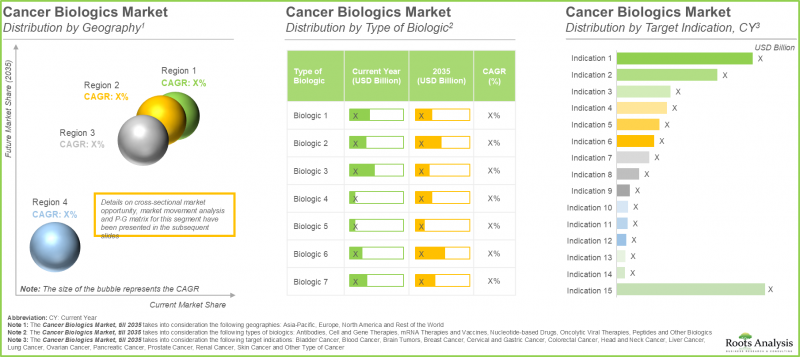
- Presently, the cancer biologics market is more concentrated in North America; however, the market in Asia-Pacific is likely to witness higher growth rate in the coming years.
- The cancer biologics market in North America is expected to capture maximum share in the current year; further, in terms of target indication, breast cancer is likely to grow at a higher CAGR during the forecast period.
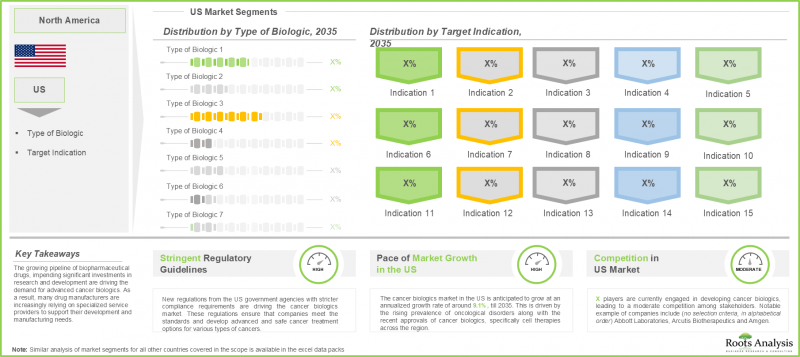
- Driven by the rising prevalence of oncological disorders and focus on targeted therapy development, the cancer biologics market in the US is expected to grow at CAGR of 9.1%, during the forecast period.
Cancer Biologics Market: Key Segments
mRNA Therapies and Vaccines to be the Future of Cancer Treatment
In terms of type of biologic, the market is segmented across antibodies, cell and gene therapies, oncolytic viral therapies, mRNA therapies and vaccines, nucleotide-based drugs, peptides and other biologics. In 2035, the antibodies segment is likely to account for 70% of the total market share. This increase arises from the ability of antibodies to possess high specificity, allowing them to accurately target cancer cells while reducing harm to healthy cells. It is crucial to emphasize that the segment for mRNA therapies and vaccines is expected to experience a greater CAGR. Significantly, the pharmaceutical companies anticipate that the mRNA treatments and vaccines (such as BNT113, mRNA-4157, and GRT-C901 / GRT-R902), which have demonstrated encouraging outcomes in clinical trials, will attain blockbuster status in the near future, signaling substantial industry expansion.
Blood Disorders Dominate the Cancer Biologics Industry
In terms of the target indication, the overall market is segmented across blood cancer, lung cancer, colorectal cancer, breast cancer, prostate cancer, skin cancer, renal cancer, Cervical and Gastric Cancer, liver cancer, bladder cancer, ovarian cancer, pancreatic cancer, head and neck cancer, brain cancer, other types of cancer. As per the forecast for the cancer biologics market, the blood cancer category contributes nearly 20% of total revenue. This largest market share is likely to be a result of improved survival rates attained through different targeted treatments for blood cancer. In the coming years, the breast cancer sector is expected to expand at the highest CAGR throughout the forecast duration. Significantly, breast cancer represents 30% of all cancer cases among women in the US, prompting pharmaceutical firms to push forward with breast oncology studies and drug development that minimize side effects.
North America Generates High Revenue
In terms of geography, the overall market is segmented across North America, Europe and Asia-Pacific. Our analysis of the global cancer biologics market shows that North America leads the market by capturing 45% of the total revenue share. This prevalence is probably due to elevated cancer rates, continuous technological progress, and advantageous regulatory frameworks that aid the advancement of cancer biologics. It is worth highlighting that within North America, The US leads the cancer biologics sector, propelled by advanced healthcare systems, robust research in chronic illnesses, and increasing demand for tailored cancer treatment.
Primary Research Overview
The opinions and insights presented in the market report were also influenced by discussions held with senior stakeholders in the industry. The market report includes transcripts of the following other third-party discussions:
- Director, Public Research University in the US
- Clinical Director, Hospital in the US
- Vice-President, Large Company in the US
- Professor, Public Research University in Sweden
- Professor, Public Research University in the UK
Example Players in Cancer Biologics Market
- Abbott
- AbbVie
- Amgen
- AstraZeneca
- BioNTech
- Bristol Myers Squibb
- Eli Lilly and Company
- Gilead Sciences
- GlaxoSmithKline
- Johnson & Johnson
- Merck
- Novartis
- Pfizer
- Roche
- Sanofi
- Takeda Pharmaceuticals
Cancer Biologics Market: Research Coverage
- Market Sizing and Opportunity Analysis: The report features an in-depth analysis of the cancer biologics market, focusing on key market segments, including [A] type of biologic, [B] target indication, and [C] geography.
- Company Profiles: In-depth profiles of prominent players North America, Europe and Asia-Pacific that are engaged in the development of cancer biologics based on [A] year of establishment, [B] location of headquarters, [C] cancer biologics portfolio, [D] recent developments and [E] an informed future outlook.
- Unmet Needs and Treatment Guidelines: The module presents treatment guidelines across a range of indications, providing a comprehensive overview of current treatment regimen. The guidelines synthesize evidence-based recommendations for therapy, ensuring safe clinical care and assessing the unmet needs in the treatment of a particular indication.
- Market Impact Analysis: An in-depth analysis of the factors that can impact the growth of cancer biologics industry. It also features identification and analysis of [A] key drivers, [B] potential restraints, [C] emerging opportunities, and [D]existing challenges.
Key Questions Answered in this Report
- Which region dominates the cancer biologics market?
- What are the key trends observed in the cancer biologics market?
- What factors are likely to influence the evolution of this market?
- What are the primary challenges faced by cancer biologic developers?
- What is the current and future market size?
- What is the CAGR of this market?
- How is the current and future market opportunity likely to be distributed across key market segments?
Reasons to Buy this Report
- The report provides a comprehensive market analysis, offering detailed revenue projections of the overall market and its specific sub-segments. This information is valuable to both established market leaders and emerging entrants.
- Stakeholders can leverage the report to gain a deeper understanding of the competitive dynamics within the market. By analyzing the competitive landscape, businesses can make informed decisions to optimize their market positioning and develop effective go-to-market strategies.
- The report offers stakeholders a comprehensive overview of the market, including key drivers, barriers, opportunities, and challenges. This information empowers stakeholders to stay abreast of market trends and make data-driven decisions to capitalize on growth prospects.
Additional Benefits
- Complimentary Excel Data Packs for all Analytical Modules in the Report
- 15% Free Content Customization
- Detailed Report Walkthrough Session with Research Team
- Free Updated report if the report is 6-12 months old or older
TABLE OF CONTENTS
1. BACKGROUND
- 1.1. Context
- 1.2. Project Objectives
2. RESEARCH METHODOLOGY
- 2.1. Chapter Overview
- 2.2. Research Assumptions
- 2.2.1. Market Landscape and Market Trends
- 2.2.2. Market Forecast and Opportunity Analysis
- 2.2.3. Comparative Analysis
- 2.3. Database Building
- 2.3.1. Data Collection
- 2.3.2. Data Validation
- 2.3.3. Data Analysis
- 2.4. Project Methodology
- 2.4.1. Secondary Research
- 2.4.1.1. Annual Reports
- 2.4.1.2. Academic Research Papers
- 2.4.1.3. Company Websites
- 2.4.1.4. Investor Presentations
- 2.4.1.5. Regulatory Filings
- 2.4.1.6. White Papers
- 2.4.1.7. Industry Publications
- 2.4.1.8. Conferences and Seminars
- 2.4.1.9. Government Portals
- 2.4.1.10. Media and Press Releases
- 2.4.1.11. Newsletters
- 2.4.1.12. Industry Databases
- 2.4.1.13. Roots Proprietary Databases
- 2.4.1.14. Paid Databases and Sources
- 2.4.1.15. Social Media Portals
- 2.4.1.16. Other Secondary Sources
- 2.4.2. Primary Research
- 2.4.2.1. Types of Primary Research
- 2.4.2.1.1. Qualitative Research
- 2.4.2.1.2. Quantitative Research
- 2.4.2.1.3. Hybrid Approach
- 2.4.2.2. Advantages of Primary Research
- 2.4.2.3. Techniques for Primary Research
- 2.4.2.3.1. Interviews
- 2.4.2.3.2. Surveys
- 2.4.2.3.3. Focus Groups
- 2.4.2.3.4. Observational Research
- 2.4.2.3.5. Social Media Interactions
- 2.4.2.4. Key Opinion Leaders Considered in Primary Research
- 2.4.2.4.1. Company Executives (CXOs)
- 2.4.2.4.2. Board of Directors
- 2.4.2.4.3. Company Presidents and Vice Presidents
- 2.4.2.4.4. Research and Development Heads
- 2.4.2.4.5. Technical Experts
- 2.4.2.4.6. Subject Matter Experts
- 2.4.2.4.7. Scientists
- 2.4.2.4.8. Doctors and Other Healthcare Providers
- 2.4.2.5. Ethics and Integrity
- 2.4.2.5.1. Research Ethics
- 2.4.2.5.2. Data Integrity
- 2.4.2.1. Types of Primary Research
- 2.4.3. Analytical Tools and Databases
- 2.4.1. Secondary Research
- 2.5. Robust Quality Control
3. MARKET DYNAMICS
- 3.1. Chapter Overview
- 3.2. Forecast Methodology
- 3.2.1. Top-down Approach
- 3.2.2. Bottom-up Approach
- 3.2.3. Hybrid Approach
- 3.3. Market Assessment Framework
- 3.3.1. Total Addressable Market (TAM)
- 3.3.2. Serviceable Addressable Market (SAM)
- 3.3.3. Serviceable Obtainable Market (SOM)
- 3.3.4. Currently Acquired Market (CAM)
- 3.4. Forecasting Tools and Techniques
- 3.4.1. Qualitative Forecasting
- 3.4.2. Correlation
- 3.4.3. Regression
- 3.4.4. Extrapolation
- 3.4.5. Convergence
- 3.4.6. Sensitivity Analysis
- 3.4.7. Scenario Planning
- 3.4.8. Data Visualization
- 3.4.9. Time Series Analysis
- 3.4.10. Forecast Error Analysis
- 3.5. Key Considerations
- 3.5.1. Demographics
- 3.5.2. Government Regulations
- 3.5.3. Reimbursement Scenarios
- 3.5.4. Market Access
- 3.5.5. Supply Chain
- 3.5.6. Industry Consolidation
- 3.5.7. Pandemic / Unforeseen Disruptions Impact
- 3.6. Limitations
4. MACRO-ECONOMIC INDICATORS
- 4.1. Chapter Overview
- 4.2. Market Dynamics
- 4.2.1. Time Period
- 4.2.1.1. Historical Trends
- 4.2.1.2. Current and Forecasted Estimates
- 4.2.2. Currency Coverage
- 4.2.2.1. Major Currencies Affecting the Market
- 4.2.2.2. Factors Affecting Currency Fluctuations
- 4.2.2.3. Impact of Currency Fluctuations on the Industry
- 4.2.3. Foreign Currency Exchange Rate
- 4.2.3.1. Impact of Foreign Exchange Rate Volatility on the Market
- 4.2.3.2. Strategies for Mitigating Foreign Exchange Risk
- 4.2.4. Recession
- 4.2.4.1. Assessment of Current Economic Conditions and Potential Impact on the Market
- 4.2.4.2. Historical Analysis of Past Recessions and Lessons Learnt
- 4.2.5. Inflation
- 4.2.5.1. Measurement and Analysis of Inflationary Pressures in the Economy
- 4.2.5.2. Potential Impact of Inflation on the Market Evolution
- 4.2.6. Interest Rates
- 4.2.6.1. Interest Rates and Their Impact on the Market
- 4.2.6.2. Strategies for Managing Interest Rate Risk
- 4.2.7. Commodity Flow Analysis
- 4.2.7.1. Type of Commodity
- 4.2.7.2. Origins and Destinations
- 4.2.7.3. Value and Weights
- 4.2.7.4. Modes of Transportation
- 4.2.8. Global Trade Dynamics
- 4.2.8.1. Import Scenario
- 4.2.8.2. Export Scenario
- 4.2.8.3. Trade Policies
- 4.2.8.4. Strategies for Mitigating the Risks Associated with Trade Barriers
- 4.2.8.5. Impact of Trade Barriers on the Market
- 4.2.9. War Impact Analysis
- 4.2.9.1. Russian-Ukraine War
- 4.2.9.2. Israel-Hamas War
- 4.2.10. COVID Impact / Related Factors
- 4.2.10.1. Global Economic Impact
- 4.2.10.2. Industry-specific Impact
- 4.2.10.3. Government Response and Stimulus Measures
- 4.2.10.4. Future Outlook and Adaptation Strategies
- 4.2.11. Other Indicators
- 4.2.11.1. Fiscal Policy
- 4.2.11.2. Consumer Spending
- 4.2.11.3. Gross Domestic Product (GDP)
- 4.2.11.4. Employment
- 4.2.11.5. Taxes
- 4.2.11.6. Stock Market Performance
- 4.2.11.7. Cross-Border Dynamics
- 4.2.1. Time Period
- 4.3. Concluding Remarks
5. EXECUTIVE SUMMARY
- 5.1. Executive Summary: Market Forecast and Opportunity Analysis
6. INTRODUCTION
- 6.1. Overview of Cancer
- 6.2. Pillars of Cancer Therapy
- 6.3. Types of Cancer Treatments
- 6.4. Key Benefits of Cancer Biologics
- 6.5. Future Perspective
7. COMPANY PROFILES
- 7.1. Chapter Overview
- 7.2. Abbott
- 7.2.1. Company Overview
- 7.2.2. Financial Information
- 7.2.3. Cancer Biologics Portfolio
- 7.2.4. Recent Developments and Future Outlook
- 7.3. AbbVie
- 7.4. Amgen
- 7.5. AstraZeneca
- 7.6. BioNTech
- 7.7. Bristol Myers Squibb
- 7.8. Eli Lilly and Company
- 7.9. Gilead Sciences
- 7.10. GlaxoSmithKline
- 7.11. Johnson & Johnson
- 7.12. Merck
- 7.13. Novartis
- 7.14. Pfizer
- 7.15. Roche
- 7.16. Sanofi
- 7.17. Takeda Pharmaceuticals
8. UNMET NEEDS AND TREATMENT GUIDELINES
- 8.1. Bladder Cancer
- 8.1.1. Treatment Guidelines
- 8.1.2. Unmet Need in Bladder Cancer Treatment
- 8.2. Blood Cancer
- 8.3. Brain Cancer
- 8.4. Breast Cancer
- 8.5. Colorectal Cancer
- 8.6. Head and Neck Cancer
- 8.7. Liver Cancer
- 8.8. Lung Cancer
- 8.9. Prostate Cancer
9. MARKET IMPACT ANALYSIS
- 9.1. Market Drivers
- 9.2. Market Restraints
- 9.3. Market Opportunities
- 9.4. Market Challenges
10. GLOBAL CANCER BIOLOGICS MARKET
- 10.1. Key Assumptions
- 10.2. Forecast Methodology
- 10.3. Global Cancer Biologics Market, Till 2035
- 10.3.1. Multivariate Scenario Analysis
- 10.3.1.1. Conservative Scenario
- 10.3.1.2. Optimistic Scenario
- 10.3.1. Multivariate Scenario Analysis
- 10.5. Key Market Segmentations
11. CANCER BIOLOGICS MARKET, BY TYPE OF BIOLOGIC
- 11.1. Cancer Biologics Market: Distribution by Type of Biologic
- 11.1.1. Cancer Biologics Market for Antibodies, Forecasted Estimates (Till 2035)
- 11.1.2. Cancer Biologics Market for Cell and Gene Therapies, Forecasted Estimates (Till 2035)
- 11.1.3. Cancer Biologics Market for Oncolytic Viral Therapies, Forecasted Estimates (Till 2035)
- 11.1.4. Cancer Biologics Market for mRNA Therapies and Vaccines, Forecasted Estimates (Till 2035)
- 11.1.5. Cancer Biologics Market for Nucleotide-based Drugs, Forecasted Estimates (Till 2035)
- 11.1.6. Cancer Biologics Market for Peptides, Forecasted Estimates (Till 2035)
- 11.2. Data Triangulation and Validation
12. CANCER BIOLOGICS MARKET, BY TARGET INDICATION
- 12.1. Cancer Biologics Market: Distribution by Target Indication
- 12.1.1. Cancer Biologics Market for Blood Cancer, Forecasted Estimates (Till 2035)
- 12.1.2. Cancer Biologics Market for Lung Cancer, Forecasted Estimates (Till 2035)
- 12.1.3. Cancer Biologics Market for Colorectal Cancer, Forecasted Estimates (Till 2035)
- 12.1.4. Cancer Biologics Market for Breast Cancer, Forecasted Estimates (Till 2035)
- 12.1.5. Cancer Biologics Market for Prostate Cancer, Forecasted Estimates (Till 2035)
- 12.1.6. Cancer Biologics Market for Skin Cancer, Forecasted Estimates (Till 2035)
- 12.1.7. Cancer Biologics Market for Renal Cancer, Forecasted Estimates (Till 2035)
- 12.1.8. Cancer Biologics Market for Cervical and Gastric Cancer, Forecasted Estimates (Till 2035)
- 12.1.9. Cancer Biologics Market for Liver Cancer, Forecasted Estimates (Till 2035)
- 12.1.10. Cancer Biologics Market for Bladder Cancer, Forecasted Estimates (Till 2035)
- 12.1.11. Cancer Biologics Market for Ovarian Cancer, Forecasted Estimates (Till 2035)
- 12.1.12. Cancer Biologics Market for Pancreatic Cancer, Forecasted Estimates (Till 2035)
- 12.1.13. Cancer Biologics Market for Head and Neck Cancer, Forecasted Estimates (Till 2035)
- 12.1.14. Cancer Biologics Market for Brain Cancer, Forecasted Estimates (Till 2035)
- 12.1.15. Cancer Biologics Market for Other Type of Cancer, Forecasted Estimates (Till 2035)
- 12.2. Data Triangulation and Validation
13. CANCER BIOLOGICS MARKET, BY GEOGRAPHY
- 13.1. Cancer Biologics Market: Distribution by Geography
- 13.1.1. Cancer Biologics Market in North America, Forecasted Estimates (Till 2035)
- 13.1.2. Cancer Biologics Market in the US, Forecasted Estimates (Till 2035)
- 13.1.2. Cancer Biologics Market in Europe, Forecasted Estimates (Till 2035)
- 13.1.2.1. Cancer Biologics Market in Germany, Forecasted Estimates (Till 2035)
- 13.1.2.2. Cancer Biologics Market in France, Forecasted Estimates (Till 2035)
- 13.1.2.3. Cancer Biologics Market in the UK, Forecasted Estimates (Till 2035)
- 13.1.2.4. Cancer Biologics Market in Spain, Forecasted Estimates (Till 2035)
- 13.1.2.5. Cancer Biologics Market in Rest of Europe, Forecasted Estimates (Till 2035)
- 13.1.3. Cancer Biologics Market in Asia-Pacific, Forecasted Estimates (Till 2035)
- 13.1.3.1. Cancer Biologics Market in India, Forecasted Estimates (Till 2035)
- 13.1.3.2. Cancer Biologics Market in Japan, Forecasted Estimates (Till 2035)
- 13.1.3.3. Cancer Biologics Market in South Korea, Forecasted Estimates (Till 2035)
- 13.1.3.4. Cancer Biologics Market in China, Forecasted Estimates (Till 2035)
- 13.1.4. Cancer Biologics Market in Rest of the World, Forecasted Estimates (Till 2035)
- 13.2. Data Triangulation and Validation
14. MARKET FORECAST OPPORTUNITY ANALYSIS: NORTH AMERICA
- 14.1. Cancer Biologics Market in North America: Distribution by Type of Biologic
- 14.1.1. Cancer Biologics Market in North America for Antibodies, Forecasted Estimates (Till 2035)
- 14.1.2. Cancer Biologics Market in North America for Cell and Gene Therapies Forecasted Estimates (Till 2035)
- 14.1.3. Cancer Biologics Market in North America for Oncolytic Viral Therapies, Forecasted Estimates (Till 2035)
- 14.1.4. Cancer Biologics Market in North America for mRNA Therapies and Vaccines, Forecasted Estimates (Till 2035)
- 14.1.5. Cancer Biologics Market in North America for Nucleotide-based Drugs, Forecasted Estimates (Till 2035)
- 14.1.6. Cancer Biologics Market in North America for Peptides, Forecasted Estimates (Till 2035)
- 14.2. Cancer Biologics Market in North America: Distribution by Target Indication
- 14.2.1. Cancer Biologics Market in North America for Blood Cancer, Forecasted Estimates (Till 2035)
- 14.2.2. Cancer Biologics Market in North America for Lung Cancer, Forecasted Estimates (Till 2035)
- 14.2.3. Cancer Biologics Market in North America for Colorectal Cancer, Forecasted Estimates (Till 2035)
- 14.2.4. Cancer Biologics Market in North America for Breast Cancer, Forecasted Estimates (Till 2035)
- 14.2.5. Cancer Biologics Market in North America for Prostate Cancer, Forecasted Estimates (Till 2035)
- 14.2.6. Cancer Biologics Market in North America for Skin Cancer, Forecasted Estimates (Till 2035)
- 14.2.7. Cancer Biologics Market in North America for Renal Cancer, Forecasted Estimates (Till 2035)
- 14.2.8. Cancer Biologics Market in North America for Cervical and Gastric Cancer, Forecasted Estimates (Till 2035)
- 14.2.9. Cancer Biologics Market in North America for Liver Cancer, Forecasted Estimates (Till 2035)
- 14.2.10. Cancer Biologics Market in North America for Bladder Cancer, Forecasted Estimates (Till 2035)
- 14.2.11. Cancer Biologics Market in North America for Ovarian Cancer, Forecasted Estimates (Till 2035)
- 14.2.12. Cancer Biologics Market in North America for Pancreatic Cancer, Forecasted Estimates (Till 2035)
- 14.2.13. Cancer Biologics Market in North America for Colorectal Cancer, Forecasted Estimates (Till 2035)
- 14.2.14. Cancer Biologics Market in North America for Brain Cancer, Forecasted Estimates (Till 2035)
- 14.2.15. Cancer Biologics Market in North America for Other Type of Cancer, Forecasted Estimates (Till 2035)
15. MARKET FORECAST OPPORTUNITY ANALYSIS: EUROPE
- 15.1. Cancer Biologics Market in Europe: Distribution by Type of Biologic
- 15.1.1. Cancer Biologics Market in Europe for Antibodies, Forecasted Estimates (Till 2035)
- 15.1.2. Cancer Biologics Market in Europe for Cell and Gene Therapies Forecasted Estimates (Till 2035)
- 15.1.3. Cancer Biologics Market in Europe for Oncolytic Viral Therapies, Forecasted Estimates (Till 2035)
- 15.1.4. Cancer Biologics Market in Europe for mRNA Therapies and Vaccines, Forecasted Estimates (Till 2035)
- 15.1.5. Cancer Biologics Market in Europe for Nucleotide-based Drugs, Forecasted Estimates (Till 2035)
- 15.1.6. Cancer Biologics Market in Europe for Peptides, Forecasted Estimates (Till 2035)
- 15.2. Cancer Biologics Market in Europe: Distribution by Target Indication
- 15.2.1. Cancer Biologics Market in Europe for Blood Cancer, Forecasted Estimates (Till 2035)
- 15.2.2. Cancer Biologics Market in Europe for Lung Cancer, Forecasted Estimates (Till 2035)
- 15.2.3. Cancer Biologics Market in Europe for Colorectal Cancer, Forecasted Estimates (Till 2035)
- 15.2.4. Cancer Biologics Market in Europe for Breast Cancer, Forecasted Estimates (Till 2035)
- 15.2.5. Cancer Biologics Market in Europe for Prostate Cancer, Forecasted Estimates (Till 2035)
- 15.2.6. Cancer Biologics Market in Europe for Skin Cancer, Forecasted Estimates (Till 2035)
- 15.2.7. Cancer Biologics Market in Europe for Renal Cancer, Forecasted Estimates (Till 2035)
- 15.2.8. Cancer Biologics Market in Europe for Cervical and Gastric Cancer, Forecasted Estimates (Till 2035)
- 15.2.9. Cancer Biologics Market in Europe for Liver Cancer, Forecasted Estimates (Till 2035)
- 15.2.10. Cancer Biologics Market in Europe for Bladder Cancer, Forecasted Estimates (Till 2035)
- 15.2.11. Cancer Biologics Market in Europe for Ovarian Cancer, Forecasted Estimates (Till 2035)
- 15.2.12. Cancer Biologics Market in Europe for Pancreatic Cancer, Forecasted Estimates (Till 2035)
- 15.2.13. Cancer Biologics Market in Europe for Colorectal Cancer, Forecasted Estimates (Till 2035)
- 15.2.14. Cancer Biologics Market in Europe for Brain Cancer, Forecasted Estimates (Till 2035)
- 15.2.15. Cancer Biologics Market in Europe for Other Type of Cancer, Forecasted Estimates (Till 2035)
16. MARKET FORECAST OPPORTUNITY ANALYSIS: ASIA-PACIFIC
- 16.1. Cancer Biologics Market in Asia-Pacific: Distribution by Type of Biologic
- 16.1.1. Cancer Biologics Market in Asia-Pacific for Antibodies, Forecasted Estimates (Till 2035)
- 16.1.2. Cancer Biologics Market in Asia-Pacific for Cell and Gene Therapies, Forecasted Estimates (Till 2035)
- 16.1.3. Cancer Biologics Market in Asia-Pacific for Oncolytic Viral Therapies, Forecasted Estimates (Till 2035)
- 16.1.4. Cancer Biologics Market in Asia-Pacific for mRNA Therapies and Vaccines, Forecasted Estimates (Till 2035)
- 16.1.5. Cancer Biologics Market in Asia-Pacific for Nucleotide-based Drugs, Forecasted Estimates (Till 2035)
- 16.1.6. Cancer Biologics Market in Asia-Pacific for Peptides, Forecasted Estimates (Till 2035)
- 16.2. Cancer Biologics Market in Asia-Pacific: Distribution by Target Indication
- 16.2.1. Cancer Biologics Market in Asia-Pacific for Blood Cancer, Forecasted Estimates (Till 2035)
- 16.2.2. Cancer Biologics Market in Asia-Pacific for Lung Cancer, Forecasted Estimates (Till 2035)
- 16.2.3. Cancer Biologics Market in Asia-Pacific for Colorectal Cancer, Forecasted Estimates (Till 2035)
- 16.2.4. Cancer Biologics Market in Asia-Pacific for Breast Cancer, Forecasted Estimates (Till 2035)
- 16.2.5. Cancer Biologics Market in Asia-Pacific for Prostate Cancer, Forecasted Estimates (Till 2035)
- 16.2.6. Cancer Biologics Market in Asia-Pacific for Skin Cancer, Forecasted Estimates (Till 2035)
- 16.2.7. Cancer Biologics Market in Asia-Pacific for Renal Cancer, Forecasted Estimates (Till 2035)
- 16.2.8. Cancer Biologics Market in Asia-Pacific for Cervical and Gastric Cancer, Forecasted Estimates (Till 2035)
- 16.2.9. Cancer Biologics Market in Asia-Pacific for Liver Cancer, Forecasted Estimates (Till 2035)
- 16.2.10. Cancer Biologics Market in Asia-Pacific for Bladder Cancer, Forecasted Estimates (Till 2035)
- 16.2.11. Cancer Biologics Market in Asia-Pacific for Ovarian Cancer, Forecasted Estimates (Till 2035)
- 16.2.12. Cancer Biologics Market in Asia-Pacific for Pancreatic Cancer, Forecasted Estimates (Till 2035)
- 16.2.13. Cancer Biologics Market in Asia-Pacific for Colorectal Cancer, Forecasted Estimates (Till 2035)
- 16.2.14. Cancer Biologics Market in Asia-Pacific for Brain Cancer, Forecasted Estimates (Till 2035)
- 16.2.15. Cancer Biologics Market in Asia-Pacific for Other Type of Cancer, Forecasted Estimates (Till 2035)
17. MARKET FORECAST OPPORTUNITY ANALYSIS: REST OF THE WORLD
- 17.1. Cancer Biologics Market in Rest of the World: Distribution by Type of Biologic
- 17.1.1. Cancer Biologics Market in Rest of the World for Antibodies, Forecasted Estimates (Till 2035)
- 17.1.2. Cancer Biologics Market in Rest of the World for Cell and Gene Therapies Forecasted Estimates (Till 2035)
- 17.1.3. Cancer Biologics Market in Rest of the World for Oncolytic Viral Therapies, Forecasted Estimates (Till 2035)
- 17.1.4. Cancer Biologics Market in Rest of the World for mRNA Therapies and Vaccines, Forecasted Estimates (Till 2035)
- 17.1.5. Cancer Biologics Market in Rest of the World for Nucleotide-based Drugs, Forecasted Estimates (Till 2035)
- 17.1.6. Cancer Biologics Market in Rest of the World for Peptides, Forecasted Estimates (Till 2035)
- 17.2. Cancer Biologics Market in Rest of the World: Distribution by Target Indication
- 17.2.1. Cancer Biologics Market in Rest of the World for Blood Cancer, Forecasted Estimates (Till 2035)
- 17.2.2. Cancer Biologics Market in Rest of the World for Lung Cancer, Forecasted Estimates (Till 2035)
- 17.2.3. Cancer Biologics Market in Rest of the World for Colorectal Cancer, Forecasted Estimates (Till 2035)
- 17.2.4. Cancer Biologics Market in Rest of the World for Breast Cancer, Forecasted Estimates (Till 2035)
- 17.2.5. Cancer Biologics Market in Rest of the World for Prostate Cancer, Forecasted Estimates (Till 2035)
- 17.2.6. Cancer Biologics Market in Rest of the World for Skin Cancer, Forecasted Estimates (Till 2035)
- 17.2.7. Cancer Biologics Market in Rest of the World for Renal Cancer, Forecasted Estimates (Till 2035)
- 17.2.8. Cancer Biologics Market in Rest of the World for Cervical and Gastric Cancer, Forecasted Estimates (Till 2035)
- 17.2.9. Cancer Biologics Market in Rest of the World for Liver Cancer, Forecasted Estimates (Till 2035)
- 17.2.10. Cancer Biologics Market in Rest of the World for Bladder Cancer, Forecasted Estimates (Till 2035)
- 17.2.11. Cancer Biologics Market in Rest of the World for Ovarian Cancer, Forecasted Estimates (Till 2035)
- 17.2.12. Cancer Biologics Market in Rest of the World for Pancreatic Cancer, Forecasted Estimates (Till 2035)
- 17.2.13. Cancer Biologics Market in Rest of the World for Colorectal Cancer, Forecasted Estimates (Till 2035)
- 17.2.14. Cancer Biologics Market in Rest of the World for Brain Cancer, Forecasted Estimates (Till 2035)
- 17.2.15. Cancer Biologics Market in Rest of the World for Other Type of Cancer, Forecasted Estimates (Till 2035)
18. CONCLUDING REMARKS
19. APPENDIX I: TABULATED DATA
20. APPENDIX II: LIST OF COMPANIES
List of Tables
- Table 14.1 Cancer Biologics Market in North America: Distribution by Type of Biologic
- Table 14.2 Cancer Biologics Market in North America for Antibodies, Forecasted Estimates (Till 2035)
- Table 14.3 Cancer Biologics Market in North America for Cell and Gene Therapies Forecasted Estimates (Till 2035)
- Table 14.4 Cancer Biologics Market in North America for Oncolytic Viral Therapies, Forecasted Estimates (Till 2035)
- Table 14.5 Cancer Biologics Market in North America for mRNA Therapies and Vaccines, Forecasted Estimates (Till 2035)
- Table 14.6 Cancer Biologics Market in North America for Nucleotide-based Drugs, Forecasted Estimates (Till 2035)
- Table 14.7 Cancer Biologics Market in North America for Peptides, Forecasted Estimates (Till 2035)
- Table 14.8 Cancer Biologics Market in North America: Distribution by Target Indication
- Table 14.9 Cancer Biologics Market in North America for Blood Cancer, Forecasted Estimates (Till 2035)
- Table 14.10 Cancer Biologics Market in North America for Lung Cancer, Forecasted Estimates (Till 2035)
- Table 14.11 Cancer Biologics Market in North America for Colorectal Cancer, Forecasted Estimates (Till 2035)
- Table 14.12 Cancer Biologics Market in North America for Breast Cancer, Forecasted Estimates (Till 2035)
- Table 14.13 Cancer Biologics Market in North America for Prostate Cancer, Forecasted Estimates (Till 2035)
- Table 14.14 Cancer Biologics Market in North America for Skin Cancer, Forecasted Estimates (Till 2035)
- Table 14.15 Cancer Biologics Market in North America for Renal Cancer, Forecasted Estimates (Till 2035)
- Table 14.16 Cancer Biologics Market in North America for Cervical and Gastric Cancer, Forecasted Estimates (Till 2035)
- Table 14.17 Cancer Biologics Market in North America for Liver Cancer, Forecasted Estimates (Till 2035)
- Table 14.18 Cancer Biologics Market in North America for Bladder Cancer, Forecasted Estimates (Till 2035)
- Table 14.19 Cancer Biologics Market in North America for Ovarian Cancer, Forecasted Estimates (Till 2035)
- Table 14.20 Cancer Biologics Market in North America for Pancreatic Cancer, Forecasted Estimates (Till 2035)
- Table 14.21 Cancer Biologics Market in North America for Colorectal Cancer, Forecasted Estimates (Till 2035)
- Table 14.22 Cancer Biologics Market in North America for Brain Cancer, Forecasted Estimates (Till 2035)
- Table 14.23 Cancer Biologics Market in North America for Other Type of Cancer, Forecasted Estimates (Till 2035)
- Table 15.1 Cancer Biologics Market in Europe: Distribution by Type of Biologic
- Table 15.2 Cancer Biologics Market in Europe for Antibodies, Forecasted Estimates (Till 2035)
- Table 15.3 Cancer Biologics Market in Europe for Cell and Gene Therapies Forecasted Estimates (Till 2035)
- Table 15.4 Cancer Biologics Market in Europe for Oncolytic Viral Therapies, Forecasted Estimates (Till 2035)
- Table 15.5 Cancer Biologics Market in Europe for mRNA Therapies and Vaccines, Forecasted Estimates (Till 2035)
- Table 15.6 Cancer Biologics Market in Europe for Nucleotide-based Drugs, Forecasted Estimates (Till 2035)
- Table 15.7 Cancer Biologics Market in Europe for Peptides, Forecasted Estimates (Till 2035)
- Table 15.8 Cancer Biologics Market in Europe: Distribution by Target Indication
- Table 15.9 Cancer Biologics Market in Europe for Blood Cancer, Forecasted Estimates (Till 2035)
- Table 15.10 Cancer Biologics Market in Europe for Lung Cancer, Forecasted Estimates (Till 2035)
- Table 15.11 Cancer Biologics Market in Europe for Colorectal Cancer, Forecasted Estimates (Till 2035)
- Table 15.12 Cancer Biologics Market in Europe for Breast Cancer, Forecasted Estimates (Till 2035)
- Table 15.13 Cancer Biologics Market in Europe for Prostate Cancer, Forecasted Estimates (Till 2035)
- Table 15.14 Cancer Biologics Market in Europe for Skin Cancer, Forecasted Estimates (Till 2035)
- Table 15.15 Cancer Biologics Market in Europe for Renal Cancer, Forecasted Estimates (Till 2035)
- Table 15.16 Cancer Biologics Market in Europe for Cervical and Gastric Cancer, Forecasted Estimates (Till 2035)
- Table 15.17 Cancer Biologics Market in Europe for Liver Cancer, Forecasted Estimates (Till 2035)
- Table 15.18 Cancer Biologics Market in Europe for Bladder Cancer, Forecasted Estimates (Till 2035)
- Table 15.19 Cancer Biologics Market in Europe for Ovarian Cancer, Forecasted Estimates (Till 2035)
- Table 15.20 Cancer Biologics Market in Europe for Pancreatic Cancer, Forecasted Estimates (Till 2035)
- Table 15.21 Cancer Biologics Market in Europe for Colorectal Cancer, Forecasted Estimates (Till 2035)
- Table 15.22 Cancer Biologics Market in Europe for Brain Cancer, Forecasted Estimates (Till 2035)
- Table 15.23 Cancer Biologics Market in Europe for Other Type of Cancer, Forecasted Estimates (Till 2035)
- Table 16.1 Cancer Biologics Market in Asia-Pacific: Distribution by Type of Biologic
- Table 16.2 Cancer Biologics Market in Asia-Pacific for Antibodies, Forecasted Estimates (Till 2035)
- Table 16.3 Cancer Biologics Market in Asia-Pacific for Cell and Gene Therapies Forecasted Estimates (Till 2035)
- Table 16.4 Cancer Biologics Market in Asia-Pacific for Oncolytic Viral Therapies, Forecasted Estimates (Till 2035)
- Table 16.5 Cancer Biologics Market in Asia-Pacific for mRNA Therapies and Vaccines, Forecasted Estimates (Till 2035)
- Table 16.6 Cancer Biologics Market in Asia-Pacific for Nucleotide-based Drugs, Forecasted Estimates (Till 2035)
- Table 16.7 Cancer Biologics Market in Asia-Pacific for Peptides, Forecasted Estimates (Till 2035)
- Table 16.8 Cancer Biologics Market in Asia-Pacific: Distribution by Target Indication
- Table 16.9 Cancer Biologics Market in Asia-Pacific for Blood Cancer, Forecasted Estimates (Till 2035)
- Table 16.10 Cancer Biologics Market in Asia-Pacific for Lung Cancer, Forecasted Estimates (Till 2035)
- Table 16.11 Cancer Biologics Market in Asia-Pacific for Colorectal Cancer, Forecasted Estimates (Till 2035)
- Table 16.12 Cancer Biologics Market in Asia-Pacific for Breast Cancer, Forecasted Estimates (Till 2035)
- Table 16.13 Cancer Biologics Market in Asia-Pacific for Prostate Cancer, Forecasted Estimates (Till 2035)
- Table 16.14 Cancer Biologics Market in Asia-Pacific for Skin Cancer, Forecasted Estimates (Till 2035)
- Table 16.15 Cancer Biologics Market in Asia-Pacific for Renal Cancer, Forecasted Estimates (Till 2035)
- Table 16.16 Cancer Biologics Market in Asia-Pacific for Cervical and Gastric Cancer, Forecasted Estimates (Till 2035)
- Table 16.17 Cancer Biologics Market in Asia-Pacific for Liver Cancer, Forecasted Estimates (Till 2035)
- Table 16.18 Cancer Biologics Market in Asia-Pacific for Bladder Cancer, Forecasted Estimates (Till 2035)
- Table 16.19 Cancer Biologics Market in Asia-Pacific for Ovarian Cancer, Forecasted Estimates (Till 2035)
- Table 16.20 Cancer Biologics Market in Asia-Pacific for Pancreatic Cancer, Forecasted Estimates (Till 2035)
- Table 16.21 Cancer Biologics Market in Asia-Pacific for Colorectal Cancer, Forecasted Estimates (Till 2035)
- Table 16.22 Cancer Biologics Market in Asia-Pacific for Brain Cancer, Forecasted Estimates (Till 2035)
- Table 16.23 Cancer Biologics Market in Asia-Pacific for Other Type of Cancer, Forecasted Estimates (Till 2035)
- Table 17.1 Cancer Biologics Market in Rest of the World: Distribution by Type of Biologic
- Table 17.2 Cancer Biologics Market in Rest of the World for Antibodies, Forecasted Estimates (Till 2035)
- Table 17.3 Cancer Biologics Market in Rest of the World for Cell and Gene Therapies Forecasted Estimates (Till 2035)
- Table 17.4 Cancer Biologics Market in Rest of the World for Oncolytic Viral Therapies, Forecasted Estimates (Till 2035)
- Table 17.5 Cancer Biologics Market in Rest of the World for mRNA Therapies and Vaccines, Forecasted Estimates (Till 2035)
- Table 17.6 Cancer Biologics Market in Rest of the World for Nucleotide-based Drugs, Forecasted Estimates (Till 2035)
- Table 17.7 Cancer Biologics Market in Rest of the World for Peptides, Forecasted Estimates (Till 2035)
- Table 17.8 Cancer Biologics Market in Rest of the World: Distribution by Target Indication
- Table 17.9 Cancer Biologics Market in Rest of the World for Blood Cancer, Forecasted Estimates (Till 2035)
- Table 17.10 Cancer Biologics Market in Rest of the World for Lung Cancer, Forecasted Estimates (Till 2035)
- Table 17.11 Cancer Biologics Market in Rest of the World for Colorectal Cancer, Forecasted Estimates (Till 2035)
- Table 17.12 Cancer Biologics Market in Rest of the World for Breast Cancer, Forecasted Estimates (Till 2035)
- Table 17.13 Cancer Biologics Market in Rest of the World for Prostate Cancer, Forecasted Estimates (Till 2035)
- Table 17.14 Cancer Biologics Market in Rest of the World for Skin Cancer, Forecasted Estimates (Till 2035)
- Table 17.15 Cancer Biologics Market in Rest of the World for Renal Cancer, Forecasted Estimates (Till 2035)
- Table 17.16 Cancer Biologics Market in Rest of the World for Cervical and Gastric Cancer, Forecasted Estimates (Till 2035)
- Table 17.17 Cancer Biologics Market in Rest of the World for Liver Cancer, Forecasted Estimates (Till 2035)
- Table 17.18 Cancer Biologics Market in Rest of the World for Bladder Cancer, Forecasted Estimates (Till 2035)
- Table 17.19 Cancer Biologics Market in Rest of the World for Ovarian Cancer, Forecasted Estimates (Till 2035)
- Table 17.20 Cancer Biologics Market in Rest of the World for Pancreatic Cancer, Forecasted Estimates (Till 2035)
- Table 17.21 Cancer Biologics Market in Rest of the World for Colorectal Cancer, Forecasted Estimates (Till 2035)
- Table 17.22 Cancer Biologics Market in Rest of the World for Brain Cancer, Forecasted Estimates (Till 2035)
- Table 17.23 Cancer Biologics Market in Rest of the World for Other Type of Cancer, Forecasted Estimates (Till 2035)
- Table 19.1 Abbott: Annual Revenues, Since FY 2021 (USD Billion)
- Table 19.2 AbbVie: Annual Revenues, Since FY 2021 (USD Billion)
- Table 19.3 Amgen: Annual Revenues, Since FY 2021 (USD Billion)
- Table 19.4 AstraZeneca: Annual Revenues, Since FY 2021 (USD Billion)
- Table 19.5 BioNTech: Annual Revenues, Since FY 2021 (USD Billion)
- Table 19.6 Bristol Myers Squibb: Annual Revenues, Since FY 2021 (USD Billion)
- Table 19.7 Eli Lilly and Company: Annual Revenues, Since FY 2021 (USD Billion)
- Table 19.8 Gilead Sciences: Annual Revenues, Since FY 2021 (USD Billion)
- Table 19.9 GlaxoSmithKline: Annual Revenues, Since FY 2021 (USD Billion)
- Table 19.10 Johnson & Johnson: Annual Revenues, Since FY 2021 (USD Billion)
- Table 19.11 Merck: Annual Revenues, Since FY 2021 (USD Billion)
- Table 19.12 Novartis: Annual Revenues, Since FY 2021 (USD Billion)
- Table 19.13 Pfizer: Annual Revenues, Since FY 2021 (USD Billion)
- Table 19.14 Roche: Annual Revenues, Since FY 2021 (USD Billion)
- Table 19.15 Sanofi: Annual Revenues, Since FY 2021 (USD Billion)
- Table 19.16 Takeda Pharmaceuticals: Annual Revenues, Since FY 2021 (USD Billion)
- Table 19.17 Cancer Biologics Market, Base Scenario: Forecasted Estimates (Till 2035) (USD Billion)
- Table 19.18 Cancer Biologics Market, Conservative Scenario: Forecasted Estimates (Till 2035) (USD Billion)
- Table 19.19 Cancer Biologics Market, Optimistic Scenario: Forecasted Estimates (Till 2035) (USD Billion)
- Table 19.20 Cancer Biologics Market for Antibodies, Forecasted Estimates (Till 2035)
- Table 19.21 Cancer Biologics Market for Cell and Gene Therapies, Forecasted Estimates (Till 2035)
- Table 19.22 Cancer Biologics Market for Oncolytic Viral Therapies, Forecasted Estimates (Till 2035)
- Table 19.23 Cancer Biologics Market for mRNA Therapies and Vaccines, Forecasted Estimates (Till 2035)
- Table 19.24 Cancer Biologics Market for Nucleotide-based Drugs, Forecasted Estimates (Till 2035)
- Table 19.25 Cancer Biologics Market for Peptides, Forecasted Estimates (Till 2035)
- Table 19.26 Cancer Biologics Market for Blood Cancer, Forecasted Estimates (Till 2035)
- Table 19.27 Cancer Biologics Market for Lung Cancer, Forecasted Estimates (Till 2035)
- Table 19.28 Cancer Biologics Market for Colorectal Cancer, Forecasted Estimates (Till 2035)
- Table 19.29 Cancer Biologics Market for Breast Cancer, Forecasted Estimates (Till 2035)
- Table 19.30 Cancer Biologics Market for Prostate Cancer, Forecasted Estimates (Till 2035)
- Table 19.31 Cancer Biologics Market for Skin Cancer, Forecasted Estimates (Till 2035)
- Table 19.32 Cancer Biologics Market for Renal Cancer, Forecasted Estimates (Till 2035)
- Table 19.33 Cancer Biologics Market for Cervical and Gastric Cancer, Forecasted Estimates (Till 2035)
- Table 19.34 Cancer Biologics Market for Liver Cancer, Forecasted Estimates (Till 2035)
- Table 19.35 Cancer Biologics Market for Bladder Cancer, Forecasted Estimates (Till 2035)
- Table 19.36 Cancer Biologics Market for Ovarian Cancer, Forecasted Estimates (Till 2035)
- Table 19.37 Cancer Biologics Market for Pancreatic Cancer, Forecasted Estimates (Till 2035)
- Table 19.38 Cancer Biologics Market for Head and Neck Cancer, Forecasted Estimates (Till 2035)
- Table 19.39 Cancer Biologics Market for Brain Cancer, Forecasted Estimates (Till 2035)
- Table 19.40 Cancer Biologics Market for Other Type of Cancer, Forecasted Estimates (Till 2035)
- Table 19.41 Cancer Biologics Market in North America, Forecasted Estimates (Till 2035)
- Table 19.42 Cancer Biologics Market in the US, Forecasted Estimates (Till 2035)
- Table 19.43 Cancer Biologics Market in Europe, Forecasted Estimates (Till 2035)
- Table 19.44 Cancer Biologics Market in Germany, Forecasted Estimates (Till 2035)
- Table 19.45 Cancer Biologics Market in France, Forecasted Estimates (Till 2035)
- Table 19.46 Cancer Biologics Market in the UK, Forecasted Estimates (Till 2035)
- Table 19.47 Cancer Biologics Market in Spain, Forecasted Estimates (Till 2035)
- Table 19.48 Cancer Biologics Market in Rest of Europe, Forecasted Estimates (Till 2035)
- Table 19.49 Cancer Biologics Market in Asia-Pacific, Forecasted Estimates (Till 2035)
- Table 19.50 Cancer Biologics Market in India, Forecasted Estimates (Till 2035)
- Table 19.51 Cancer Biologics Market in Japan, Forecasted Estimates (Till 2035)
- Table 19.52 Cancer Biologics Market in South Korea, Forecasted Estimates (Till 2035)
- Table 19.53 Cancer Biologics Market in China, Forecasted Estimates (Till 2035)
- Table 19.54 Cancer Biologics Market in Rest of the World, Forecasted Estimates (Till 2035)
List of Figures
- Figure 2.1 Research Methodology: Project Methodology
- Figure 2.2 Research Methodology: Data Sources for Secondary Research
- Figure 2.3 Research Methodology: Robust Quality Control
- Figure 3.1 Market Dynamics: Forecast Methodology
- Figure 3.2 Market Dynamics: Market Assessment Framework
- Figure 3.3 Market Dynamics: Example List of Parameters
- Figure 4.1 Lessons Learnt from Past Recessions
- Figure 5.1 Executive Summary: Market Forecast and Opportunity Analysis
- Figure 7.1 Abbott: Annual Revenues, Since FY 2021 (USD Billion)
- Figure 7.2 AbbVie: Annual Revenues, Since FY 2021 (USD Billion)
- Figure 7.3 Amgen: Annual Revenues, Since FY 2021 (USD Billion)
- Figure 7.4 AstraZeneca: Annual Revenues, Since FY 2021 (USD Billion)
- Figure 7.5 BioNTech: Annual Revenues, Since FY 2021 (USD Billion)
- Figure 7.6 Bristol Myers Squibb: Annual Revenues, Since FY 2021 (USD Billion)
- Figure 7.7 Eli Lilly and Company: Annual Revenues, Since FY 2021 (USD Billion)
- Figure 7.8 Gilead Sciences: Annual Revenues, Since FY 2021 (USD Billion)
- Figure 7.9 GlaxoSmithKline: Annual Revenues, Since FY 2021 (USD Billion)
- Figure 7.10 Johnson & Johnson: Annual Revenues, Since FY 2021 (USD Billion)
- Figure 7.11 Merck: Annual Revenues, Since FY 2021 (USD Billion)
- Figure 7.12 Novartis: Annual Revenues, Since FY 2021 (USD Billion)
- Figure 7.13 Pfizer: Annual Revenues, Since FY 2021 (USD Billion)
- Figure 7.14 Roche: Annual Revenues, Since FY 2021 (USD Billion)
- Figure 7.15 Sanofi: Annual Revenues, Since FY 2021 (USD Billion)
- Figure 7.16 Takeda Pharmaceuticals: Annual Revenues, Since FY 2021 (USD Billion)
- Figure 10.1 Cancer Biologics Market, Base Scenario: Forecasted Estimates (Till 2035) (USD Billion)
- Figure 10.2 Cancer Biologics Market, Conservative Scenario: Forecasted Estimates (Till 2035) (USD Billion)
- Figure 10.3 Cancer Biologics Market, Optimistic Scenario: Forecasted Estimates (Till 2035) (USD Billion)
- Figure 11.1 Cancer Biologics Market for Antibodies, Forecasted Estimates (Till 2035)
- Figure 11.2 Cancer Biologics Market for Cell and Gene Therapies, Forecasted Estimates (Till 2035)
- Figure 11.3 Cancer Biologics Market for Oncolytic Viral Therapies, Forecasted Estimates (Till 2035)
- Figure 11.4 Cancer Biologics Market for mRNA Therapies and Vaccines, Forecasted Estimates (Till 2035)
- Figure 11.5 Cancer Biologics Market for Nucleotide-based Drugs, Forecasted Estimates (Till 2035)
- Figure 11.6 Cancer Biologics Market for Peptides, Forecasted Estimates (Till 2035)
- Figure 12.1 Cancer Biologics Market for Blood Cancer, Forecasted Estimates (Till 2035)
- Figure 12.2 Cancer Biologics Market for Lung Cancer, Forecasted Estimates (Till 2035)
- Figure 12.3 Cancer Biologics Market for Colorectal Cancer, Forecasted Estimates (Till 2035)
- Figure 12.4 Cancer Biologics Market for Breast Cancer, Forecasted Estimates (Till 2035)
- Figure 12.5 Cancer Biologics Market for Prostate Cancer, Forecasted Estimates (Till 2035)
- Figure 12.6 Cancer Biologics Market for Skin Cancer, Forecasted Estimates (Till 2035)
- Figure 12.7 Cancer Biologics Market for Renal Cancer, Forecasted Estimates (Till 2035)
- Figure 12.8 Cancer Biologics Market for Cervical and Gastric Cancer, Forecasted Estimates (Till 2035)
- Figure 12.9 Cancer Biologics Market for Liver Cancer, Forecasted Estimates (Till 2035)
- Figure 12.10 Cancer Biologics Market for Bladder Cancer, Forecasted Estimates (Till 2035)
- Figure 12.11 Cancer Biologics Market for Ovarian Cancer, Forecasted Estimates (Till 2035)
- Figure 12.12 Cancer Biologics Market for Pancreatic Cancer, Forecasted Estimates (Till 2035)
- Figure 12.13 Cancer Biologics Market for Head and Neck Cancer, Forecasted Estimates (Till 2035)
- Figure 12.14 Cancer Biologics Market for Brain Cancer, Forecasted Estimates (Till 2035)
- Figure 12.15 Cancer Biologics Market for Other Type of Cancer, Forecasted Estimates (Till 2035)
- Figure 13.1 Cancer Biologics Market in North America, Forecasted Estimates (Till 2035)
- Figure 13.2 Cancer Biologics Market in the US, Forecasted Estimates (Till 2035)
- Figure 13.3 Cancer Biologics Market in Europe, Forecasted Estimates (Till 2035)
- Figure 13.4 Cancer Biologics Market in Germany, Forecasted Estimates (Till 2035)
- Figure 13.5 Cancer Biologics Market in France, Forecasted Estimates (Till 2035)
- Figure 13.6 Cancer Biologics Market in the UK, Forecasted Estimates (Till 2035)
- Figure 13.7 Cancer Biologics Market in Spain, Forecasted Estimates (Till 2035)
- Figure 13.8 Cancer Biologics Market in Rest of Europe, Forecasted Estimates (Till 2035)
- Figure 13.9 Cancer Biologics Market in Asia-Pacific, Forecasted Estimates (Till 2035)
- Figure 13.10 Cancer Biologics Market in India, Forecasted Estimates (Till 2035)
- Figure 13.11 Cancer Biologics Market in Japan, Forecasted Estimates (Till 2035)
- Figure 13.12 Cancer Biologics Market in South Korea, Forecasted Estimates (Till 2035)
- Figure 13.13 Cancer Biologics Market in China, Forecasted Estimates (Till 2035)
- Figure 13.14 Cancer Biologics Market in Rest of the World, Forecasted Estimates (Till 2035)

