PUBLISHER: Roots Analysis | PRODUCT CODE: 2106277

PUBLISHER: Roots Analysis | PRODUCT CODE: 2106277
Large Molecule Bioanalytical Testing Services Market by Type of Testing, Type of Modality, End-user, and Geographical Regions - Trends and Forecast, Till 2035
LARGE MOLECULE BIOANALYTICAL TESTING SERVICES MARKET: OVERVIEW
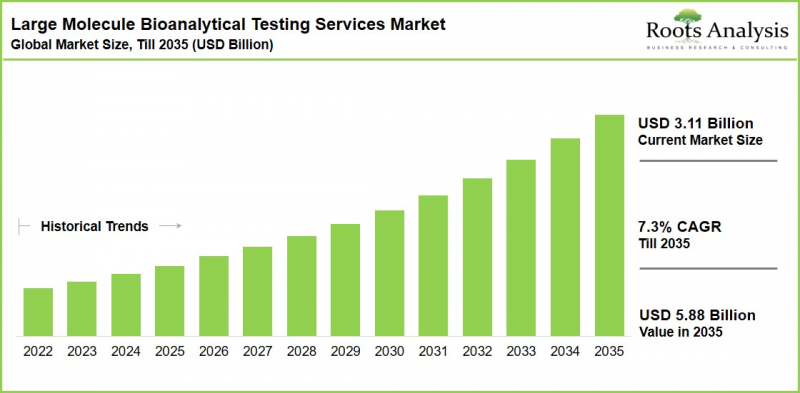
As per Roots Analysis, the large molecule bioanalytical testing services market is estimated to grow from USD 3.11 billion in the current year to USD 5.88 billion by 2035, at a CAGR of 7.3% during the forecast period, till 2035.
LARGE MOLECULE BIOANALYTICAL TESTING SERVICES MARKET: GROWTH AND TRENDS
Large molecule bioanalytical testing plays a critical role in evaluating complex biological samples to assess the safety, efficacy, pharmacokinetics, and overall performance of biologic therapies. The insights generated through these studies enable researchers to better understand drug behavior within the body, support therapeutic effectiveness assessments, and facilitate regulatory compliance and product approvals. The growing demand for advanced biologics and personalized therapies has significantly increased the need for specialized bioanalytical services, including biomarker analysis, pharmacokinetic assessments, and bioequivalence studies.
However, the increasing complexity of drug development programs presents challenges in simultaneously managing research activities and extensive analytical testing requirements. In addition, establishing and maintaining in-house bioanalytical laboratories requires substantial capital investment, advanced infrastructure, and highly skilled personnels. As a result, many pharmaceutical and biotechnology companies are increasingly outsourcing large bioanalytical molecule testing to specialized service providers, enabling access to technical expertise, advanced high-throughput technologies, cost efficiencies, and state-of-the-art analytical platforms that ensure accurate and reliable biological sample analysis.
Growth Drivers: Strategic Enablers of Market Expansion
The large molecule bioanalytical testing market is experiencing significant growth, driven by rapid technological advancements, expanding biomarker research, and increasing outsourcing activities across the pharmaceutical and biotechnology sectors. Innovations in analytical platforms, including mass spectrometry, chromatography, and immunoassays, coupled with automation and artificial intelligence, are enhancing analytical sensitivity, throughput, and data accuracy, thereby streamlining drug development processes, reducing timelines, and improving cost efficiency.
At the same time, the integration of multi-omics technologies with AI is accelerating biomarker discovery and validation, strengthening the role of bioanalytical testing in precision medicine and supporting the development of targeted therapies. Further, the growing complexity of biologics and evolving regulatory requirements is prompting pharmaceutical and biotechnology companies to increasingly outsource bioanalytical testing services to contract research organizations (CROs). This enables access to specialized expertise, advanced infrastructure, and regulatory capabilities while accelerating the development and commercialization of innovative therapies.
Market Challenges: Critical Barriers Impeding Progress
The large molecule bioanalytical testing market faces several challenges despite its strong growth potential. One of the primary barriers is the increasing complexity of biologics, including monoclonal antibodies, cell and gene therapies, and other advanced biologic modalities, which require highly specialized analytical methods and sophisticated testing platforms. Additionally, stringent and evolving regulatory requirements for method development, validation, and data integrity increase operational complexity and compliance costs for service providers. The market also faces challenges related to the high capital investment required for advanced instrumentation, laboratory infrastructure, and skilled scientific personnel capable of handling complex bioanalytical workflows. Furthermore, variability in biological samples, difficulties in biomarker standardization, and limitations in assay sensitivity and reproducibility can affect analytical accuracy and study outcomes. The growing demand for bioanalytical services has also intensified competition for experienced professionals, creating talent shortages that may constrain operational scalability and turnaround times. Collectively, these factors can increase development costs, extend project timelines, and pose challenges to the efficient execution of large molecule bioanalytical testing programs.
Large Molecule Bioanalytical Testing Services Market Segments
The market sizing and opportunity analysis has been segmented across the following parameters:
By Type of Testing
- Pharmacokinetics
- Pharmacodynamics
- Bioequivalence
- Other Tests
By Type of Modality
- Monoclonal Antibodies
- Cell Therapies
- Gene Therapies
- Biosimilars
- Fusion Proteins
- Traditional viral-based Therapies
- Other Biologics
By End-user
- Pharmaceutical and Biotechnology Companies
- Contract Research Organizations / Contract Development and Manufacturing Organizations
- Academic and Research Institutes
By Geographical Regions
- North America
- US
- Canada
- Europe
- Germany
- UK
- France
- Italy
- Spain
- Rest of Europe
- Asia-Pacific
- China
- Japan
- India
- South Korea
- Rest of Asia-Pacific
- Middle East and North Africa
- Saudi Arabia
- Egypt
- Rest of Middle East and North Africa
- Latin America
- Brazil
- Argentina
- Rest of Latin America
LARGE MOLECULE BIOANALYTICAL TESTING SERVICES MARKET: KEY SEGMENT INSIGHTS
Pharmacokinetics Segment Holds the Largest Market Share
According to our analysis, the pharmacokinetics segment currently accounts for the largest share of the large molecule bioanalytical testing services market, representing approximately 45% of total revenue. This dominance is attributed to the indispensable role of pharmacokinetic studies in evaluating the absorption, distribution, metabolism, and excretion (ADME) profiles of biologic therapies. These assessments are critical for dose optimization, efficacy evaluation, safety monitoring, and regulatory submissions throughout the drug development lifecycle. Meanwhile, the bioequivalence testing segment is expected to register the fastest growth during the forecast period, driven by increasing global initiatives aimed at promoting the adoption of generic biologics and biosimilars to reduce healthcare expenditures and improve patient access to advanced therapies.
Pharmaceutical and Biotechnology Companies to Remain Key Revenue Contributors
According to market forecasts, pharmaceutical and biotechnology companies are expected to account for nearly 50% of the large molecule bioanalytical testing services market in the current year. Their market leadership is supported by extensive research and development capabilities, significant capital investments, and robust pipelines of innovative biologics for addressing various unmet medical needs. The continued expansion of biologic drug development programs is expected to generate substantial demand for specialized bioanalytical testing services. In parallel, contract research organizations (CROs) and contract development and manufacturing organizations (CDMOs) are projected to witness the highest growth rate, with an anticipated CAGR of 8.6%, driven by increasing outsourcing trends and the need for specialized analytical expertise.
Expanding Monoclonal Antibody Pipeline Driving Market Growth
The monoclonal antibodies segment currently represents approximately 45% of the overall market, making it the leading molecule category within the large molecule bioanalytical testing services industry. This strong market position is primarily attributable to the high specificity, broad therapeutic applicability, and proven clinical efficacy of monoclonal antibody-based therapies. As pharmaceutical companies continue to expand their monoclonal antibody pipelines across multiple therapeutic areas, the demand for advanced bioanalytical testing services is expected to increase, supporting sustained market growth over the forecast period.
North America Leads the Global Market
North America is expected to maintain its position as the largest regional market, accounting for approximately 50% of global revenue by 2035. The region's dominance is driven by the strong presence of pharmaceutical and biotechnology companies, advanced research infrastructure, significant investments in biologics development, and a well-established regulatory framework. These factors collectively contribute to a high demand for large molecule bioanalytical testing services across the drug development continuum.
Asia-Pacific Emerges as the Fastest-Growing Region
The Asia-Pacific large molecule bioanalytical testing services market is projected to expand at a CAGR of 8.6% during the forecast period. This growth is primarily supported by the rapid expansion of pharmaceutical and biotechnology research activities, increasing clinical trial volumes, growing investments in healthcare innovation, and the emergence of the region as a preferred destination for outsourced drug development services. As a result, Asia-Pacific is expected to offer significant growth opportunities for bioanalytical testing service providers in the coming years.
Example Players in Large Molecule Bioanalytical Testing Services Market
- BioAgilytix
- Catalent
- Charles River Laboratories
- Clean Cells
- Coriolis Pharma
- Eurofins
- Genezen
- SGS
- Solvias
- Texcell
- Wuxi AppTec
Primary Research Overview
The opinions and insights presented in this study were influenced by discussions conducted with multiple stakeholders. The research report features detailed transcripts of interviews held with the following industry stakeholders:
- Business Development Officer, Mid-sized Organization, Australia
In addition, the large molecule bioanalytical testing services market report includes transcripts of the following other third-party discussions:
- Founder and Chief Executive, Officer, Large Organization, US
- Executive Vice President of Global Bioanalytical Services, Small Organization, Singapore
- Principal Investigator, US
- Executive Director, Large Organization, US
- R&D Analytical Development Manager, Large Organization, France
- Senior Scientist, Large Organization, US
- Lab Director, Very Large Organization, US
- Bioanalytical Operational Head, Large Organization, US
- Development Lead, Large Organization, France
- Director, Large Organization, Canada
LARGE MOLECULE BIOANALYTICAL TESTING SERVICES MARKET: RESEARCH COVERAGE
- Market Sizing and Opportunity Analysis: The report features an in-depth analysis of the large molecule bioanalytical testing services market, focusing on key market segments, including [A] type of testing, [B] type of modality, [C] end user, and [D] geographical regions.
- Large Molecule Bioanalytical Testing Services Landscape: A detailed assessment of the overall large molecule bioanalytical testing services market landscape, featuring information on several relevant parameters, such as [A] type of testing offered, [B] type of modality, [C] type of workflow, [D] type of technology, [E] end users, [F] year of establishment, [G] company size (based on employee count) and [H] location of headquarters.
- Company Competitiveness Analysis: A detailed competitiveness analysis of the large molecule bioanalytical testing service providers based on several relevant parameters, such as company strength, portfolio strength and portfolio diversity.
- Company Profiles: In-depth profiles of prominent players that are engaged in offering large molecule bioanalytical testing services industry, featuring information on their year of establishment, location of headquarters, company size (in terms of number of employees), management team, portfolio and key initiatives.
- Market Impact Analysis: The report analyzes various factors such as drivers, restraints, opportunities, and challenges affecting market growth.
KEY QUESTIONS ANSWERED IN THIS REPORT
- Which are the leading companies in the large molecule bioanalytical testing services market?
- Which region dominates the large molecule bioanalytical testing services market?
- What are the key trends observed in the large molecule bioanalytical testing services market?
- What factors are likely to influence the evolution of this market?
- What are the primary challenges faced by large molecule bioanalytical testing service providers?
- What is the current and future market size?
- What is the CAGR of this market?
- How is the current and future market opportunity likely to be distributed across key market segments?
REASONS TO BUY THIS REPORT
- The report provides a comprehensive market analysis, offering detailed revenue projections of the overall market and its specific sub-segments. This information is valuable to both established market leaders and emerging entrants.
- The report offers stakeholders a comprehensive overview of the market, including key drivers, barriers, opportunities, and challenges. This information empowers stakeholders to stay abreast of market trends and make data-driven decisions to capitalize on growth prospects.
- The report can aid businesses in identifying future opportunities in any sector. It also helps in understanding if those opportunities are worth pursuing.
- The report helps in identifying customer demand by understanding the needs, preferences, and behavior of the target audience in order to tailor products or services effectively.
- The report equips new entrants with requisite information regarding a particular market to help them build successful business strategies.
- The report allows for more effective communication with the audience and in building strong business relations.
ADDITIONAL BENEFITS
- Complementary Excel Data Packs for all Analytical Modules in the Report
- 15% Free Content Customization
- Detailed Report Walkthrough Session with Research Team
- Free Updated report if the report is 6-12 months old or older
TABLE OF CONTENTS
1. BACKGROUND
- 1.1. Context
- 1.2. Project Objectives
2. RESEARCH METHODOLOGY
- 2.1. Chapter Overview
- 2.2. Research Assumptions
- 2.2.1. Market Landscape and Market Trends
- 2.2.2. Market Forecast and Opportunity Analysis
- 2.2.3. Comparative Analysis
- 2.3. Database Building
- 2.3.1. Data Collection
- 2.3.2. Data Validation
- 2.3.3. Data Analysis
- 2.4. Project Methodology
- 2.4.1. Secondary Research
- 2.4.1.1. Annual Reports
- 2.4.1.2. Academic Research Papers
- 2.4.1.3. Company Websites
- 2.4.1.4. Investor Presentations
- 2.4.1.5. Regulatory Filings
- 2.4.1.6. White Papers
- 2.4.1.7. Industry Publications
- 2.4.1.8. Conferences and Seminars
- 2.4.1.9. Government Portals
- 2.4.1.10. Media and Press Releases
- 2.4.1.11. Newsletters
- 2.4.1.12. Industry Databases
- 2.4.1.13. Roots Proprietary Databases
- 2.4.1.14. Paid Databases and Sources
- 2.4.1.15. Social Media Portals
- 2.4.1.16. Other Secondary Sources
- 2.4.2. Primary Research
- 2.4.2.1. Types of Primary Research
- 2.4.2.1.1. Qualitative Research
- 2.4.2.1.2. Quantitative Research
- 2.4.2.1.3. Hybrid Approach
- 2.4.2.2. Advantages of Primary Research
- 2.4.2.3. Techniques for Primary Research
- 2.4.2.3.1. Interviews
- 2.4.2.3.2. Surveys
- 2.4.2.3.3. Focus Groups
- 2.4.2.3.4. Observational Research
- 2.4.2.3.5. Social Media Interactions
- 2.4.2.4. Key Opinion Leaders Considered in Primary Research
- 2.4.2.4.1. Company Executives (CXOs)
- 2.4.2.4.2. Board of Directors
- 2.4.2.4.3. Company Presidents and Vice Presidents
- 2.4.2.4.4. Research and Development Heads
- 2.4.2.4.5. Technical Experts
- 2.4.2.4.6. Subject Matter Experts
- 2.4.2.4.7. Scientists
- 2.4.2.4.8. Doctors and Other Healthcare Providers
- 2.4.2.5. Ethics and Integrity
- 2.4.2.5.1. Research Ethics
- 2.4.2.5.2. Data Integrity
- 2.4.2.1. Types of Primary Research
- 2.4.3. Analytical Tools and Databases
- 2.4.1. Secondary Research
- 2.5. Robust Quality Control
3. MARKET DYNAMICS
- 3.1. Chapter Overview
- 3.2. Forecast Methodology
- 3.2.1. Top-down Approach
- 3.2.2. Bottom-up Approach
- 3.2.3. Hybrid Approach
- 3.3. Market Assessment Framework
- 3.3.1. Total Addressable Market (TAM)
- 3.3.2. Serviceable Addressable Market (SAM)
- 3.3.3. Serviceable Obtainable Market (SOM)
- 3.3.4. Currently Acquired Market (CAM)
- 3.4. Forecasting Tools and Techniques
- 3.4.1. Qualitative Forecasting
- 3.4.2. Correlation
- 3.4.3. Regression
- 3.4.4. Extrapolation
- 3.4.5. Convergence
- 3.4.6. Sensitivity Analysis
- 3.4.7. Scenario Planning
- 3.4.8. Data Visualization
- 3.4.9. Time Series Analysis
- 3.4.10. Forecast Error Analysis
- 3.5. Key Considerations
- 3.5.1. Demographics
- 3.5.2. Government Regulations
- 3.5.3. Reimbursement Scenarios
- 3.5.4. Market Access
- 3.5.5. Supply Chain
- 3.5.6. Industry Consolidation
- 3.5.7. Pandemic / Unforeseen Disruptions Impact
- 3.6. Limitations
4. MACRO-ECONOMIC INDICATORS
- 4.1. Chapter Overview
- 4.2. Market Dynamics
- 4.2.1. Time Period
- 4.2.1.1. Historical Trends
- 4.2.1.2. Current and Forecasted Estimates
- 4.2.2. Currency Coverage
- 4.2.2.1. Major Currencies Affecting the Market
- 4.2.2.2. Factors Affecting Currency Fluctuations in the Industry
- 4.2.2.3. Impact of Currency Fluctuations on the Industry
- 4.2.3. Foreign Currency Exchange Rate
- 4.2.3.1. Impact of Foreign Exchange Rate Volatility on the Market
- 4.2.3.2. Strategies for Mitigating Foreign Exchange Risk
- 4.2.4. Recession
- 4.2.4.1. Assessment of Current Economic Conditions and Potential Impact on the Market
- 4.2.4.2. Historical Analysis of Past Recessions and Lessons Learnt
- 4.2.5. Inflation
- 4.2.5.1. Measurement and Analysis of Inflationary Pressures in the Economy
- 4.2.5.2. Potential Impact of Inflation on the Market Evolution
- 4.2.6. Interest Rates
- 4.2.6.1. Interest Rates and Their Impact on the Market
- 4.2.6.2. Strategies for Managing Interest Rate Risk
- 4.2.7. Commodity Flow Analysis
- 4.2.7.1. Type of Commodity
- 4.2.7.2. Origins and Destinations
- 4.2.7.3. Values and Weights
- 4.2.7.4. Modes of Transportation
- 4.2.8. Global Trade Dynamics
- 4.2.8.1. Import Scenario
- 4.2.8.2. Export Scenario
- 4.2.8.3. Trade Policies
- 4.2.8.4. Strategies for Mitigating the Risks Associated with Trade Barriers
- 4.2.8.5. Impact of Trade Barriers on the Market
- 4.2.9. War Impact Analysis
- 4.2.9.1. Russian-Ukraine War
- 4.2.9.2. Israel-Hamas War
- 4.2.10. COVID Impact / Related Factors
- 4.2.10.1. Global Economic Impact
- 4.2.10.2. Industry-specific Impact
- 4.2.10.3. Government Response and Stimulus Measures
- 4.2.10.4. Future Outlook and Adaptation Strategies
- 4.2.11. Other Indicators
- 4.2.11.1. Fiscal Policy
- 4.2.11.2. Consumer Spending
- 4.2.11.3. Gross Domestic Product
- 4.2.11.4. Employment
- 4.2.11.5. Taxes
- 4.2.11.6. Stock Market Performance
- 4.2.11.7. Cross Border Dynamics
- 4.2.1. Time Period
- 4.3. Conclusion
5. EXECUTIVE SUMMARY
- 5.1. Executive Summary: Market Landscape
- 5.2. Executive Summary: Market Forecast
6. INTRODUCTION
- 6.1. Chapter Overview
- 6.2. Overview of Large Molecule Bioanalytical Testing Services
- 6.3. Type of Large Molecule Bioanalytical Testing
- 6.4. Advantages of Large Molecule Bioanalytical Testing
- 6.5. Challenges of Large Molecule Bioanalytical Testing
- 6.6. Recent Development in Large Molecule Bioanalytical Testing Domain
- 6.7. Future Perspective
7. MARKET LANDSCAPE
- 7.1. Large Molecule Bioanalytical Testing Service Providers: Market Landscape
- 7.1.1. Analysis by Type of Testing Offered
- 7.1.2. Analysis by Type of Modality
- 7.1.3. Analysis by Type of Workflow
- 7.1.4. Analysis by Type of Technology
- 7.1.5. Analysis by End Users
- 7.1.6. Analysis by Year of Establishment
- 7.1.7. Analysis by Company Size
- 7.1.8. Analysis by Location of Headquarters
8. COMPANY COMPETITIVENESS ANALYSIS
- 8.1. Methodology and Key Parameters
- 8.2. Scoring Criteria
- 8.3. Peer Groups
- 8.3.1. Service Providers Offering Services for Peptides
- 8.3.2. Service Providers Offering Services for Monoclonal Antibodies
- 8.3.3. Service Providers Offering Services for Gene Therapies
- 8.3.4. Service Providers Offering Services for Cell Therapies
- 8.3.5. Service Providers Offering Services for Vaccines
- 8.3.6. Service Providers Offering Services for Biosimilars
- 8.3.7. Service Providers Offering Services for Vectors
- 8.3.8. Service Providers Offering Services for Fusion Proteins
- 8.3.9. Service Providers Offering Services for mRNA
- 8.3.10. Service Providers Offering Services for Other Biologics
- 8.3.11. Service Providers Offering Services for Small Molecules
9. COMPANY PROFILES: LARGE MOLECULE BIOANALYTICAL TESTING SERVICE PROVIDERS
- 9.1. BioAgilytix Labs
- 9.1.1. Company Details
- 9.1.2. Service Portfolio
- 9.1.3. Future Outlook
- 9.2. Catalent
- 9.2.1. Company Details
- 9.2.2. Service Portfolio
- 9.2.3. Financial Details
- 9.2.4. Future Outlook
- 9.3. Charles River Laboratories
- 9.3.1. Company Details
- 9.3.2. Service Portfolio
- 9.3.3. Financial Details
- 9.3.4. Future Outlook
- 9.4. Clean Cells
- 9.4.1. Company Details
- 9.4.2. Service Portfolio
- 9.4.3. Financial Details
- 9.4.4. Future Outlook
- 9.5. Coriolis Pharma
- 9.5.1. Company Details
- 9.5.2. Service Portfolio
- 9.5.3. Financial Details
- 9.5.4. Future Outlook
- 9.6. Eurofins
- 9.6.1. Company Details
- 9.6.2. Service Portfolio
- 9.6.3. Financial Details
- 9.6.4. Future Outlook
- 9.7. SGS
- 9.7.1. Company Details
- 9.7.2. Service Portfolio
- 9.7.3. Financial Details
- 9.7.4. Future Outlook
- 9.8. Solvias
- 9.8.1. Company Details
- 9.8.2. Service Portfolio
- 9.8.3. Financial Details
- 9.8.4. Future Outlook
- 9.9. Texcells
- 9.9.1. Company Details
- 9.9.2. Service Portfolio
- 9.9.3. Financial Details
- 9.9.4. Future Outlook
- 9.10. WuXi AppTech
- 9.10.1. Company Details
- 9.10.2. Service Portfolio
- 9.10.3. Financial Details
- 9.10.4. Future Outlook
10. MARKET IMPACT ANALYSIS
- 10.1. Chapter Overview
- 10.2. Market Drivers
- 10.3. Market Restraints
- 10.4. Market Opportunities
- 10.5. Market Challenges
11. GLOBAL LARGE MOLECULE BIOANALYTICAL TESTING MARKET
- 11.1. Key Assumptions and Methodology
- 11.2. Global Large Molecule Bioanalytical Testing Services Market, Historical Trends (Since 2022) and Forecasted Estimates (Till 2035)
- 11.2.1. Roots Analysis Perspective on Market Growth
- 11.2.2. Scenario Analysis
- 11.2.2.1. Conservative Scenario
- 11.2.2.2. Optimistic Scenario
- 11.3. Key Market Segmentations
12. LARGE MOLECULE BIOANALYTICAL TESTING SERVICES MARKET, BY TYPE OF TESTING OFFERED
- 12.1. Key Assumptions and Methodology
- 12.2. Large Molecule Bioanalytical Testing Services Market: Distribution by Type of Testing Offered
- 12.2.1. Large Molecule Bioanalytical Testing Services Market for Pharmacokinetics, Historical Trends (Since 2022) and Forecasted Estimates (Till 2035)
- 12.2.2. Large Molecule Bioanalytical Testing Services Market for Pharmacodynamics, Historical Trends (Since 2022) and Forecasted Estimates (Till 2035)
- 12.2.3. Large Molecule Bioanalytical Testing Services Market for Bioavailability, Historical Trends (Since 2022) and Forecasted Estimates (Till 2035)
- 12.2.4. Large Molecule Bioanalytical Testing Services Market for Bioequivalence, Historical Trends (Since 2022) and Forecasted Estimates (Till 2035)
- 12.2.5. Large Molecule Bioanalytical Testing Services Market for Other Tests, Historical Trends (Since 2022) and Forecasted Estimates (Till 2035)
- 12.3. Data Triangulation and Validation
13. LARGE MOLECULE BIOANALYTICAL TESTING SERVICES MARKET, BY TYPE OF MODALITY
- 13.1. Key Assumptions and Methodology
- 13.2. Large Molecule Bioanalytical Testing Services Market: Distribution by Type of Modality
- 13.2.1. Large Molecule Bioanalytical Testing Services Market for Monoclonal Antibodies, Historical Trends (Since 2022) and Forecasted Estimates (Till 2035)
- 13.2.2. Large Molecule Bioanalytical Testing Services Market for Cell Therapies, Historical Trends (Since 2022) and Forecasted Estimates (Till 2035)
- 13.2.3. Large Molecule Bioanalytical Testing Services Market for Gene Therapies, Historical Trends (Since 2022) and Forecasted Estimates (Till 2035)
- 13.2.4. Large Molecule Bioanalytical Testing Services Market for Biosimilars, Historical Trends (Since 2022) and Forecasted Estimates (Till 2035)
- 13.2.5. Large Molecule Bioanalytical Testing Services Market for Fusion Proteins, Historical Trends (Since 2022) and Forecasted Estimates (Till 2035)
- 13.2.6. Large Molecule Bioanalytical Testing Services Market for Traditional Viral Based Therapies, Historical Trends (Since 2022) and Forecasted Estimates (Till 2035)
- 13.2.7. Large Molecule Bioanalytical Testing Services Market for Other Biologics, Historical Trends (Since 2022) and Forecasted Estimates (Till 2035)
- 13.3. Data Triangulation and Validation
14. LARGE MOLECULE BIOANALYTICAL TESTING SERVICES MARKET, BY END USERS
- 14.1. Key Assumptions and Methodology
- 14.2. Large Molecule Bioanalytical Testing Services Market: Distribution by Type of End Users
- 14.2.1. Large Molecule Bioanalytical Testing Services Market for Pharmaceutical and Biotechnology Companies, Historical Trends (Since 2022) and Forecasted Estimates (Till 2035)
- 14.2.2. Large Molecule Bioanalytical Testing Services Market for CROs and CDMOs, Historical Trends (Since 2022) and Forecasted Estimates (Till 2035)
- 14.2.3. Large Molecule Bioanalytical Testing Services Market for Academic and Research Institutes, Historical Trends (Since 2022) and Forecasted Estimates (Till 2035)
15. LARGE MOLECULE BIOANALYTICAL TESTING SERVICES MARKET, BY GEOGRAPHICAL REGIONS
- 15.1. Chapter Overview
- 15.2. Key Assumptions and Methodology
- 15.3. Large Molecule Bioanalytical Testing Services Market: Distribution by Geographical Regions
- 15.3.1. Large Molecule Bioanalytical Testing Services Market in North America, Historical Trends (Since 2022) and Forecasted Estimates (Till 2035)
- 15.3.1.1. Large Molecule Bioanalytical Testing Services Market in the US, Historical Trends (Since 2022) and Forecasted Estimates (Till 2035)
- 15.3.1.2. Large Molecule Bioanalytical Testing Services Market in Canada, Historical Trends (Since 2022) and Forecasted Estimates (Till 2035)
- 15.3.2. Large Molecule Bioanalytical Testing Services Market in Europe, Historical Trends (Since 2022) and Forecasted Estimates (Till 2035)
- 15.3.2.1. Large Molecule Bioanalytical Testing Services Market in Germany, Historical Trends (Since 2022) and Forecasted Estimates (Till 2035)
- 15.3.2.2. Large Molecule Bioanalytical Testing Services Market in the UK, Historical Trends (Since 2022) and Forecasted Estimates (Till 2035)
- 15.3.2.3. Large Molecule Bioanalytical Testing Services Market in France, Historical Trends (Since 2022) and Forecasted Estimates (Till 2035)
- 15.3.2.4. Large Molecule Bioanalytical Testing Services Market in Italy, Historical Trends (Since 2022) and Forecasted Estimates (Till 2035)
- 15.3.2.5. Large Molecule Bioanalytical Testing Services Market in Spain, Historical Trends (Since 2022) and Forecasted Estimates (Till 2035)
- 15.3.2.6. Large Molecule Bioanalytical Testing Services Market in Rest of the Europe, Historical Trends (Since 2022) and Forecasted Estimates (Till 2035)
- 15.3.3. Large Molecule Bioanalytical Testing Services Market in Asia-Pacific, Historical Trends (Since 2022) and Forecasted Estimates (Till 2035)
- 15.3.3.1. Large Molecule Bioanalytical Testing Services Market in China, Historical Trends (Since 2022) and Forecasted Estimates (Till 2035)
- 15.3.3.2. Large Molecule Bioanalytical Testing Services Market in India, Historical Trends (Since 2022) and Forecasted Estimates (Till 2035)
- 15.3.3.3. Large Molecule Bioanalytical Testing Services Market in Japan, Historical Trends (Since 2022) and Forecasted Estimates (Till 2035)
- 15.3.3.4. Large Molecule Bioanalytical Testing Services Market in South Korea, Historical Trends (Since 2022) and Forecasted Estimates (Till 2035)
- 15.3.3.5. Large Molecule Bioanalytical Testing Services Market in Rest of Asia-Pacific, Historical Trends (Since 2022) and Forecasted Estimates (Till 2035)
- 15.3.4. Large Molecule Bioanalytical Testing Services Market in Latin America, Historical Trends (Since 2022) and Forecasted Estimates (Till 2035)
- 15.3.4.1. Large Molecule Bioanalytical Testing Services Market in Brazil, Historical Trends (Since 2022) and Forecasted Estimates (Till 2035)
- 15.3.4.2. Large Molecule Bioanalytical Testing Services Market in Argentina, Historical Trends (Since 2022) and Forecasted Estimates (Till 2035)
- 15.3.4.3. Large Molecule Bioanalytical Testing Services Market in Rest of Latin America, Historical Trends (Since 2022) and Forecasted Estimates (Till 2035)
- 15.3.5. Large Molecule Bioanalytical Testing Services Market in Middle East and North Africa, Historical Trends (Since 2022) and Forecasted Estimates (Till 2035)
- 15.3.5.1. Large Molecule Bioanalytical Testing Services Market in Saudi Arabia, Historical Trends (Since 2022) and Forecasted Estimates (Till 2035)
- 15.3.5.2. Large Molecule Bioanalytical Testing Services Market in Egypt, Historical Trends (Since 2022) and Forecasted Estimates (Till 2035)
- 15.3.5.3. Large Molecule Bioanalytical Testing Services Market in Rest of Middle East and North Africa, Historical Trends (Since 2022) and Forecasted Estimates (Till 2035)
- 15.3.6. Penetration Growth (P-G) Matrix
- 15.3.7. Market Movement Analysis
- 15.3.1. Large Molecule Bioanalytical Testing Services Market in North America, Historical Trends (Since 2022) and Forecasted Estimates (Till 2035)
- 15.4. Data Triangulation and Validation
16. MARKET OPPORTUNITY ANALYSIS: NORTH AMERICA
- 16.1. Large Molecule Bioanalytical Testing Services Market in North America: Distribution by Type of Testing
- 16.1.1. Large Molecule Bioanalytical Testing Services Market in North America for Pharmacokinetics, Historical Trends (Since 2022) and Forecasted Estimates (Till 2035)
- 16.1.2. Large Molecule Bioanalytical Testing Services Market in North America for Pharmacodynamics, Historical Trends (Since 2022) and Forecasted Estimates (Till 2035)
- 16.1.3. Large Molecule Bioanalytical Testing Services Market in North America for Bioavailability, Historical Trends (Since 2022) and Forecasted Estimates (Till 2035)
- 16.1.4. Large Molecule Bioanalytical Testing Services Market in North America for Bioequivalence, Historical Trends (Since 2022) and Forecasted Estimates (Till 2035)
- 16.1.5. Large Molecule Bioanalytical Testing Services Market in North America for Other Tests, Historical Trends (Since 2022) and Forecasted Estimates (Till 2035)
- 16.2. Large Molecule Bioanalytical Testing Services Market in North America: Distribution by Type of Modality
- 16.2.1. Large Molecule Bioanalytical Testing Services Market in North America for Monoclonal Antibodies, Historical Trends (Since 2022) and Forecasted Estimates (Till 2035)
- 16.2.2. Large Molecule Bioanalytical Testing Services Market in North America for Cell Therapies, Historical Trends (Since 2022) and Forecasted Estimates (Till 2035)
- 16.2.3. Large Molecule Bioanalytical Testing Services Market in North America for Gene Therapies, Historical Trends (Since 2022) and Forecasted Estimates (Till 2035)
- 16.2.4. Large Molecule Bioanalytical Testing Services Market in North America for Biosimilars, Historical Trends (Since 2022) and Forecasted Estimates (Till 2035)
- 16.2.5. Large Molecule Bioanalytical Testing Services Market in North America for Fusion Proteins, Historical Trends (Since 2022) and Forecasted Estimates (Till 2035)
- 16.2.6. Large Molecule Bioanalytical Testing Services Market in North America for Traditional Viral Based Therapies, Historical Trends (Since 2022) and Forecasted Estimates (Till 2035)
- 16.2.7. Large Molecule Bioanalytical Testing Services Market in North America for Other Biologics, Historical Trends (Since 2022) and Forecasted Estimates (Till 2035)
- 16.3. Large Molecule Bioanalytical Testing Services Market in North America: Distribution by End Users
- 16.3.1. Large Molecule Bioanalytical Testing Services Market in North America for Pharmaceutical and Biotechnology Companies, Historical Trends (Since 2022) and Forecasted Estimates (Till 2035)
- 16.3.2. Large Molecule Bioanalytical Testing Services Market in North America for CROs and CDMOs, Historical Trends (Since 2022) and Forecasted Estimates (Till 2035)
- 16.3.3. Large Molecule Bioanalytical Testing Services Market in North America for Academic and Research Institutes, Historical Trends (Since 2022) and Forecasted Estimates (Till 2035)
17. MARKET OPPORTUNITY ANALYSIS: EUROPE
- 17.1. Large Molecule Bioanalytical Testing Services Market in Europe: Distribution by Type of Testing
- 17.1.1. Large Molecule Bioanalytical Testing Services Market in Europe for Pharmacokinetics, Historical Trends (Since 2022) and Forecasted Estimates (Till 2035)
- 17.1.2. Large Molecule Bioanalytical Testing Services Market in Europe for Pharmacodynamics, Historical Trends (Since 2022) and Forecasted Estimates (Till 2035)
- 17.1.3. Large Molecule Bioanalytical Testing Services Market in Europe for Bioavailability, Historical Trends (Since 2022) and Forecasted Estimates (Till 2035)
- 17.1.4. Large Molecule Bioanalytical Testing Services Market in Europe for Bioequivalence, Historical Trends (Since 2022) and Forecasted Estimates (Till 2035)
- 17.1.5. Large Molecule Bioanalytical Testing Services Market in Europe for Other Tests, Historical Trends (Since 2022) and Forecasted Estimates (Till 2035)
- 17.2. Large Molecule Bioanalytical Testing Services Market in Europe: Distribution by Type of Modality
- 17.2.1. Large Molecule Bioanalytical Testing Services Market in Europe for Monoclonal Antibodies, Historical Trends (Since 2022) and Forecasted Estimates (Till 2035)
- 17.2.2. Large Molecule Bioanalytical Testing Services Market in Europe for Cell Therapies, Historical Trends (Since 2022) and Forecasted Estimates (Till 2035)
- 17.2.3. Large Molecule Bioanalytical Testing Services Market in Europe for Gene Therapies, Historical Trends (Since 2022) and Forecasted Estimates (Till 2035)
- 17.2.4. Large Molecule Bioanalytical Testing Services Market in Europe for Biosimilars, Historical Trends (Since 2022) and Forecasted Estimates (Till 2035)
- 17.2.5. Large Molecule Bioanalytical Testing Services Market in Europe for Fusion Proteins, Historical Trends (Since 2022) and Forecasted Estimates (Till 2035)
- 17.2.6. Large Molecule Bioanalytical Testing Services Market in Europe for Traditional Viral Based Therapies, Historical Trends (Since 2022) and Forecasted Estimates (Till 2035)
- 17.2.7. Large Molecule Bioanalytical Testing Services Market in Europe for Other Biologics, Historical Trends (Since 2022) and Forecasted Estimates (Till 2035)
- 17.3. Large Molecule Bioanalytical Testing Services Market in Europe: Distribution by End Users
- 17.3.1. Large Molecule Bioanalytical Testing Services Market in Europe for Pharmaceutical and Biotechnology Companies, Historical Trends (Since 2022) and Forecasted Estimates (Till 2035)
- 17.3.2. Large Molecule Bioanalytical Testing Services Market in Europe for CROs and CDMOs, Historical Trends (Since 2022) and Forecasted Estimates (Till 2035)
- 17.3.3. Large Molecule Bioanalytical Testing Services Market in Europe for Academic and Research Institutes, Historical Trends (Since 2022) and Forecasted Estimates (Till 2035)
18. MARKET OPPORTUNITY ANALYSIS: ASIA PACIFIC
- 18.1. Large Molecule Bioanalytical Testing Services Market in Asia-Pacific: Distribution by Type of Testing
- 18.1.1. Large Molecule Bioanalytical Testing Services Market in Asia-Pacific for Pharmacokinetics, Historical Trends (Since 2022) and Forecasted Estimates (Till 2035)
- 18.1.2. Large Molecule Bioanalytical Testing Services Market in Asia-Pacific for Pharmacodynamics, Historical Trends (Since 2022) and Forecasted Estimates (Till 2035)
- 18.1.3. Large Molecule Bioanalytical Testing Services Market in Asia-Pacific for Bioavailability, Historical Trends (Since 2022) and Forecasted Estimates (Till 2035)
- 18.1.4. Large Molecule Bioanalytical Testing Services Market in Asia-Pacific for Bioequivalence, Historical Trends (Since 2022) and Forecasted Estimates (Till 2035)
- 18.1.5. Large Molecule Bioanalytical Testing Services Market in Asia-Pacific for Other Tests, Historical Trends (Since 2022) and Forecasted Estimates (Till 2035)
- 18.2. Large Molecule Bioanalytical Testing Services Market in Asia-Pacific: Distribution by Type of Modality
- 18.2.1. Large Molecule Bioanalytical Testing Services Market in Asia-Pacific for Monoclonal Antibodies, Historical Trends (Since 2022) and Forecasted Estimates (Till 2035)
- 18.2.2. Large Molecule Bioanalytical Testing Services Market in Asia-Pacific for Cell Therapies, Historical Trends (Since 2022) and Forecasted Estimates (Till 2035)
- 18.2.3. Large Molecule Bioanalytical Testing Services Market in Asia-Pacific for Gene Therapies, Historical Trends (Since 2022) and Forecasted Estimates (Till 2035)
- 18.2.4. Large Molecule Bioanalytical Testing Services Market in Asia-Pacific for Biosimilars, Historical Trends (Since 2022) and Forecasted Estimates (Till 2035)
- 18.2.5. Large Molecule Bioanalytical Testing Services Market in Asia-Pacific for Fusion Proteins, Historical Trends (Since 2022) and Forecasted Estimates (Till 2035)
- 18.2.6. Large Molecule Bioanalytical Testing Services Market in Asia-Pacific for Traditional Viral Based Therapies, Historical Trends (Since 2022) and Forecasted Estimates (Till 2035)
- 18.2.7. Large Molecule Bioanalytical Testing Services Market in Asia-Pacific for Other Biologics, Historical Trends (Since 2022) and Forecasted Estimates (Till 2035)
- 18.3. Large Molecule Bioanalytical Testing Services Market in Asia-Pacific: Distribution by End Users
- 18.3.1. Large Molecule Bioanalytical Testing Services Market in Asia-Pacific for Pharmaceutical and Biotechnology Companies, Historical Trends (Since 2022) and Forecasted Estimates (Till 2035)
- 18.3.2. Large Molecule Bioanalytical Testing Services Market in Asia-Pacific for CROs and CDMOs, Historical Trends (Since 2022) and Forecasted Estimates (Till 2035)
- 18.3.3. Large Molecule Bioanalytical Testing Services Market in Asia-Pacific for Academic and Research Institutes, Historical Trends (Since 2022) and Forecasted Estimates (Till 2035)
19. MARKET OPPORTUNITY ANALYSIS: LATIN AMERICA
- 19.1. Large Molecule Bioanalytical Testing Services Market in Latin America: Distribution by Type of Testing
- 19.1.1. Large Molecule Bioanalytical Testing Services Market in Latin America for Pharmacokinetics, Historical Trends (Since 2022) and Forecasted Estimates (Till 2035)
- 19.1.2. Large Molecule Bioanalytical Testing Services Market in Latin America for Pharmacodynamics, Historical Trends (Since 2022) and Forecasted Estimates (Till 2035)
- 19.1.3. Large Molecule Bioanalytical Testing Services Market in Latin America for Bioavailability, Historical Trends (Since 2022) and Forecasted Estimates (Till 2035)
- 19.1.4. Large Molecule Bioanalytical Testing Services Market in Latin America for Bioequivalence, Historical Trends (Since 2022) and Forecasted Estimates (Till 2035)
- 19.1.5. Large Molecule Bioanalytical Testing Services Market in Latin America for Other Tests, Historical Trends (Since 2022) and Forecasted Estimates (Till 2035)
- 19.2. Large Molecule Bioanalytical Testing Services Market in Latin America: Distribution by Type of Modality
- 19.2.1. Large Molecule Bioanalytical Testing Services Market in Latin America for Monoclonal Antibodies, Historical Trends (Since 2022) and Forecasted Estimates (Till 2035)
- 19.2.2. Large Molecule Bioanalytical Testing Services Market in Latin America for Cell Therapies, Historical Trends (Since 2022) and Forecasted Estimates (Till 2035)
- 19.2.3. Large Molecule Bioanalytical Testing Services Market in Latin America for Gene Therapies, Historical Trends (Since 2022) and Forecasted Estimates (Till 2035)
- 19.2.4. Large Molecule Bioanalytical Testing Services Market in Latin America for Biosimilars, Historical Trends (Since 2022) and Forecasted Estimates (Till 2035)
- 19.2.5. Large Molecule Bioanalytical Testing Services Market in Latin America for Fusion Proteins, Historical Trends (Since 2022) and Forecasted Estimates (Till 2035)
- 19.2.6. Large Molecule Bioanalytical Testing Services Market in Latin America for Traditional Viral Based Therapies, Historical Trends (Since 2022) and Forecasted Estimates (Till 2035)
- 19.2.7. Large Molecule Bioanalytical Testing Services Market in Latin America for Other Biologics, Historical Trends (Since 2022) and Forecasted Estimates (Till 2035)
- 19.3. Large Molecule Bioanalytical Testing Services Market in Latin America: Distribution by End Users
- 19.3.1. Large Molecule Bioanalytical Testing Services Market in Latin America for Pharmaceutical and Biotechnology Companies, Historical Trends (Since 2022) and Forecasted Estimates (Till 2035)
- 19.3.2. Large Molecule Bioanalytical Testing Services Market in Latin America for CROs and CDMOs, Historical Trends (Since 2022) and Forecasted Estimates (Till 2035)
- 19.3.3. Large Molecule Bioanalytical Testing Services Market in Latin America for Academic and Research Institutes, Historical Trends (Since 2022) and Forecasted Estimates (Till 2035)
20. MARKET OPPORTUNITY ANALYSIS: MIDDLE EAST AND NORTH AFRICA
- 20.1. Large Molecule Bioanalytical Testing Services Market in Middle East and North Africa: Distribution by Type of Testing
- 20.1.1. Large Molecule Bioanalytical Testing Services Market in Middle East and North Africa for Pharmacokinetics, Historical Trends (Since 2022) and Forecasted Estimates (Till 2035)
- 20.1.2. Large Molecule Bioanalytical Testing Services Market in Middle East and North Africa for Pharmacodynamics, Historical Trends (Since 2022) and Forecasted Estimates (Till 2035)
- 20.1.3. Large Molecule Bioanalytical Testing Services Market in Middle East and North Africa for Bioavailability, Historical Trends (Since 2022) and Forecasted Estimates (Till 2035)
- 20.1.4. Large Molecule Bioanalytical Testing Services Market in Middle East and North Africa for Bioequivalence, Historical Trends (Since 2022) and Forecasted Estimates (Till 2035)
- 20.1.5. Large Molecule Bioanalytical Testing Services Market in Middle East and North Africa for Other Tests, Historical Trends (Since 2022) and Forecasted Estimates (Till 2035)
- 20.2. Large Molecule Bioanalytical Testing Services Market in Middle East and North Africa: Distribution by Type of Modality
- 20.2.1. Large Molecule Bioanalytical Testing Services Market in Middle East and North Africa for Monoclonal Antibodies, Historical Trends (Since 2022) and Forecasted Estimates (Till 2035)
- 20.2.2. Large Molecule Bioanalytical Testing Services Market in Middle East and North Africa for Cell Therapies, Historical Trends (Since 2022) and Forecasted Estimates (Till 2035)
- 20.2.3. Large Molecule Bioanalytical Testing Services Market in Middle East and North Africa for Gene Therapies, Historical Trends (Since 2022) and Forecasted Estimates (Till 2035)
- 20.2.4. Large Molecule Bioanalytical Testing Services Market in Middle East and North Africa for Biosimilars, Historical Trends (Since 2022) and Forecasted Estimates (Till 2035)
- 20.2.5. Large Molecule Bioanalytical Testing Services Market in Middle East and North Africa for Fusion Proteins, Historical Trends (Since 2022) and Forecasted Estimates (Till 2035)
- 20.2.6. Large Molecule Bioanalytical Testing Services Market in Middle East and North Africa for Traditional Viral Based Therapies, Historical Trends (Since 2022) and Forecasted Estimates (Till 2035)
- 20.2.7. Large Molecule Bioanalytical Testing Services Market in Middle East and North Africa for Other Biologics, Historical Trends (Since 2022) and Forecasted Estimates (Till 2035)
- 20.3. Large Molecule Bioanalytical Testing Services Market in Middle East and North Africa: Distribution by End Users
- 20.3.1. Large Molecule Bioanalytical Testing Services Market in Middle East and North Africa for Pharmaceutical and Biotechnology Companies, Historical Trends (Since 2022) and Forecasted Estimates (Till 2035)
- 20.3.2. Large Molecule Bioanalytical Testing Services Market in Middle East and North Africa for CROs and CDMOs, Historical Trends (Since 2022) and Forecasted Estimates (Till 2035)
- 20.3.3. Large Molecule Bioanalytical Testing Services Market in Middle East and North Africa for Academic and Research Institutes, Historical Trends (Since 2022) and Forecasted Estimates (Till 2035)
21. EXECUTIVE INSIGHTS
- 21.1. Chapter Overview
- 21.2. Company A
- 21.2.1. Company Snapshot
- 21.2.2. Interview Transcript: Senior Business Development Personnel
- 21.3. Company B
- 21.3.1. Company Snapshot
- 21.3.2. Interview Transcript: Founder and Chief Executive Officer
- 21.4. Company C
- 21.4.1. Company Snapshot
- 21.4.2. Interview Transcript: Executive Vice President of Global Bioanalytical Services
- 21.5. Company D
- 21.5.1. Company Snapshot
- 21.5.2. Interview Transcript: Principal Investigator
22. APPENDIX 1: TABULATED DATA
23. APPENDIX 2: LIST OF COMPANIES AND ORGANIZATIONS
List of Tables
List of Figures

