PUBLISHER: Roots Analysis | PRODUCT CODE: 2107334

PUBLISHER: Roots Analysis | PRODUCT CODE: 2107334
Anti-Obesity Drugs Market by Type of Molecule, Type of Drug, Active Compound, Mechanism of Action, Type of Agonist, Action Pathway, Route of Administration, Distribution Channel, Geographical Regions, and Key Players - Trends and Forecast Till 2035
ANTI-OBESITY DRUGS MARKET: OVERVIEW
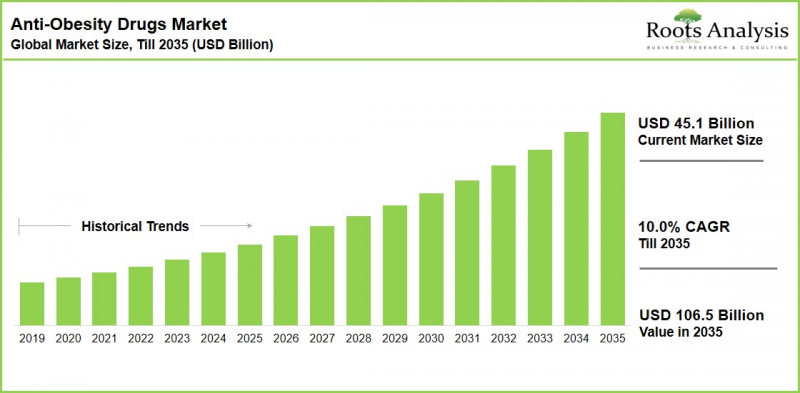
As per Roots Analysis, the global anti-obesity drugs market is estimated to grow from USD 45.1 billion in the current year to USD 106.5 billion by 2035, reflecting a compound annual growth rate (CAGR) of approximately 10.0% during the forecast period.
Anti-Obesity Drugs Market: Growth and Trends
Obesity has emerged as one of the most significant chronic metabolic diseases worldwide, poses a significant global public health burden. As per the global data compiled by the NCD Risk Factor Collaboration, more than a billion people worldwide are currently living with obesity, comprising close to 880 million adults and roughly 159 million children and adolescents. The growing burden of obesity is creating sustained demand for effective pharmacological interventions. This demand is further driven by the strong association of obesity with diabetes, cardiovascular diseases, and several types of cancer.
The commercial inflection point for this market has been the rise of GLP-1 receptor agonists. Therapies built around this mechanism, including semaglutide and tirzepatide, have demonstrated weight-loss outcomes that rival or exceed those historically associated with surgical intervention.
Clinical evidence continues to strengthen the value proposition of anti-obesity therapies beyond weight management. For example, the SELECT cardiovascular outcomes trial demonstrated that semaglutide reduced the risk of major adverse cardiovascular events by 20% in overweight or obese adults with established cardiovascular disease. These findings have expanded the clinical role of these therapies as cardiometabolic treatments, supporting broader patient eligibility and improving reimbursement prospects.
Furthermore, the increasing shift from injectable to oral formats has further caught the attention of market players for innovations. While injectable GLP-1 therapies established the clinical benchmark, they carry meaningful friction in the form of cold-chain logistics, needle aversion, and distribution cost. The development of oral anti-obesity therapies is expected to improve patient access and convenience. For instance, OPKO Health and Entera Bio are jointly developing OPK-88006, an oral, once-daily dual GLP-1/glucagon agonist. Such innovations could expand the use of weight-loss therapies, particularly in regions with limited cold-chain storage and healthcare infrastructure.
Growth Drivers: Factors Accelerating Market Expansion
- Rising Global Obesity Prevalence: Adult and pediatric obesity cases continue to rise across both developed and emerging economies. As a result, governments and healthcare payers are under growing pressure to support effective pharmacological interventions, creating a favorable regulatory and reimbursement environment for new drug launches.
- Clinical Benefits Extending Beyond Weight Loss: GLP-1 and multi-agonist therapies have demonstrated cardiovascular, renal, and metabolic benefits in addition to weight reduction. As a result, healthcare providers and payers increasingly recognize these therapies as disease-modifying treatments rather than weight-loss drugs alone, supporting broader indications and longer treatment durations.
- Increasing Clinical Pipeline: The anti-obesity drug pipeline is expanding beyond currently marketed single-agonist therapies. Several dual- and tri-agonist candidates, including CagriSema, retatrutide, and survodutide, are progressing through late-stage clinical trials. In addition, oral candidates such as orforglipron and ECC5004 have the potential to expand treatment access and increase adoption following regulatory approval.
- Strategic Consolidation and Geographic Expansion: Larger pharmaceutical and digital-health players are acquiring niche capabilities to secure their position in this category. Voy's acquisition of India-based online weight-management platform EarlyFit is an example of how companies are using M&A to enter large, underpenetrated obesity markets quickly.
Market Challenges: Critical Barriers Hindering Progress
Despite the strength of underlying demand, the market faces several challenges. One of the potential challenges is high cost of novel obesity drugs development. In addition, the multi-year, multi-phase trial requirements needed to demonstrate durable weight loss and cardiometabolic safety discourage some developers from entering the category. Stringent regulatory review adds further time and cost to market entry.
Manufacturing capacity has also become a significant constraint. Novo Nordisk and Eli Lilly, the two companies that currently dominate the market, have faced persistent supply shortages since 2022 as demand for GLP-1-based therapies has outpaced installed production capacity. Public perception is a further variable as side effects and long-term safety questions can slow patient uptake even where clinical evidence is favorable. To address this challenge, post-marketing surveillance and physician education are of utmost importance.
Anti-Obesity Drugs Market: Key Insights
The report examines the current state of the anti-obesity drugs market and identifies the developments most likely to shape its trajectory. Selected findings include:
- Increasing Market Competition with Emerging Entrants: Eli Lilly and Novo Nordisk continue to dominate the global supply and revenue. However, Roche has recently announced a USD 2 billion investment to expand US manufacturing capacity for obesity drugs. Moreover, Teva's launch of the first generic liraglutide signals that the competitive base is starting to widen across well-established and new entrants.
- Oral Therapies Represent a Significant Growth Opportunity: Oral, once-daily obesity therapies, such as OPK-88006, are advancing through clinical development. Once approved, they could improve treatment access, especially in cost-sensitive regions with limited healthcare infrastructure.
- Biologics Continue to Dominate the Development Pipeline: The large majority of late-stage obesity candidates remain GLP-1-based biologics, reinforcing why this molecule class is expected to keep gaining share even as small-molecule and oral alternatives mature.
- Increasing Mergers and Acquisitions: Companies are increasingly using acquisitions as a strategic means of expanding their distribution capabilities rather than creating new distribution networks independently. For instance, Voy entered the Indian market by acquiring EarlyFit, enabling faster market access and an established local presence.
Anti-Obesity Drugs Market Segments
The market sizing and opportunity analysis has been segmented across the following parameters:
By Type of Molecule
- Biologics
- Small Molecules
By Type of Drug
- Prescription Drugs
- OTC Drugs
By Active Compound Used
- Tirzepatide
- Semaglutide
- Retatrutide
- Survodutide
- Cagrilintide and Semaglutide
- Orforglipron
- Liraglutide
- Other Active Compounds
By Mechanism of Action
- GLP-1 Agonist
- GLP-1 Agonist / GIP Agonist
- GLP-1 Agonist / GCGR Agonist
- GLP-1 Agonist / Amylin Analogue
- GLP-1 / GCGR / GIP Agonist
- Other Mechanisms of Action
By Type of Agonist
- Single-Agonist
- Dual-Agonist
- Tri-Agonist
By Action Pathway
- Centrally Acting
- Peripherally Acting
- Centrally Acting and Peripherally Acting
By Route of Administration
- Oral
- Parenteral
By Distribution Channel
- Hospital Pharmacy
- Retail and Online Pharmacy
By Geographical Regions
- North America
- US
- Canada
- Europe
- Germany
- UK
- France
- Italy
- Spain
- Rest of Europe
- Asia-Pacific
- Japan
- China
- Australia
- India
- South Korea
- Rest of Asia-Pacific
- Latin America
- Brazil
- Argentina
- Rest of Latin America
Anti-Obesity Drugs Market: Key Segmentation Insights
Biologics Lead the Anti-Obesity Drugs Market
Based on Roots Analysis market assessment, the biologics segment currently holds the highest share of the market. This leadership reflects the ability of biologic agents to act on gut-brain hormone pathways, namely GLP-1, GIP, and glucagon receptors, delivering metabolic benefits that extend well past weight reduction, including cardiovascular risk mitigation and improved glycemic control. With the majority of late-stage obesity pipeline candidates also built on biologic platforms, this segment is well positioned to extend its lead as newer, more effective molecules reach the market.
Prescription Therapies Dominate the Market Landscape
On the basis of our analysis, prescription therapies hold the larger share of the market. This highest share is due to clinically validated efficacy and the confidence that rigorous trial data affords physicians and patients. On the other hand, OTC weight-management products, while smaller today, are expected to grow at a faster pace as consumers increasingly seek accessible, self-directed options for early-stage weight management.
Tirzepatide Leads Among Active Compound
Based on the Roots Analysis market report, Tirzepatide holds more than 45% of market share among active compounds. This highest share is due to its dual GIP/GLP-1 mechanism, which simultaneously regulates appetite, insulin secretion, and energy expenditure. Meanwhile, other active compounds segment is expected to register the highest CAGR as next-generation candidates diversify the treatment landscape.
GLP-1 Agonists Remain Dominant
Based on the Roots Analysis market report, GLP-1 agonists remain the dominant mechanism given their established ability to improve glycemic control while enhancing satiety. However, dual GLP-1/GCGR agonists are likely to register the highest CAGR during the forecast period. This growth is largely because clinical data increasingly show that targeting multiple metabolic pathways simultaneously can improve both weight loss and broader metabolic outcomes.
North America Maintains Market Leadership
North America currently commands the highest global market revenue share. This highest share is supported by high obesity prevalence, mature healthcare infrastructure, and comparatively favourable reimbursement pathways. Asia-Pacific, meanwhile, is projected to register the highest regional CAGR through 2035. This unprecedented growth is driven by rising obesity rates in China, India, Japan, and South Korea, rapid urbanization, and expanding healthcare access and expenditure across the region.
Example Players in Anti-Obesity Drugs Market
- Eli Lilly
- Novo Nordisk
- Pfizer
- AstraZeneca
- Roche
- Boehringer Ingelheim
- Zealand Pharma
- Viking Therapeutics
- Regeneron
Expert Interview and Industry Insights
The research features detailed transcripts of interviews held with the following industry stakeholders:
- Co-founder and Chief Medical Advisor, Mid-sized Company, US
- Chief Executive Officer, Very Large Company, US
- Chief Executive Officer, Small Company, US
- Chief Physician Editor, Health and Lifestyle Medicine, Large Company, US
- Endocrinologist and Owner, Small Institute, US
- Associate Professor of Medicine and Pediatrics, Very Large Institute, US
- Professor of Medicine, Division of Diabetes, Endocrinology and Metabolism, Very Large Institute, US
- Research Scientist, Small Institute, Canada
- Former Chief Executive Officer, Very Large Company, Denmark
- Former Vice President of IDEA, Very Large Company, Denmark
ANTI-OBESITY DRUGS MARKET: RESEARCH COVERAGE
- Market Sizing and Opportunity Analysis: An in-depth analysis of the global anti-obesity drugs market across type of molecule, type of drug, active compound, mechanism of action, type of agonist, action pathway, route of administration, distribution channel, and geography.
- Competitive Landscape: A detailed assessment of companies developing and marketing anti-obesity drugs, benchmarked on parameters such as year of establishment, company size, headquarters location, and pipeline breadth.
- Company Profiles: In-depth profiles of leading players, covering year of establishment, headquarters, company size, management team, product portfolio, and recent strategic initiatives.
- Big Pharma Initiatives: A comprehensive analysis of strategic initiatives undertaken by leading pharmaceutical companies in the anti-obesity drugs market. The chapter evaluates initiatives across multiple parameters, including number of initiatives, year of initiatives, year and types of initiatives, type of partnership, type of expansion, and big pharma players analysis by number and regions.
- Market Impact Analysis: An evaluation of the drivers, restraints, opportunities, and challenges most likely to shape near- and long-term market growth.
Key Questions Answered in this Report
- What is the current and projected size of the anti-obesity drugs market through 2035?
- What is the CAGR of the anti-obesity drugs market, and which segments are outgrowing the overall category?
- Which type of molecule, drug, active compound, and mechanism of action lead the market today?
- Which region currently dominates the market, and which region is growing the fastest?
- What are the primary growth drivers and restraints facing anti-obesity drug developers?
- Which companies are the leading developers and marketers of anti-obesity drugs?
- How is the shift from injectable to oral therapies expected to reshape competitive dynamics?
- What recent partnerships, approvals, and acquisitions are shaping the competitive landscape?
Reasons to Buy this Report
- Provides a comprehensive, segment-by-segment market analysis with detailed revenue projections, useful to established market leaders and new entrants alike.
- Offers a clear view of the drivers, restraints, opportunities, and challenges shaping the market, enabling data-driven strategic decisions.
- Helps businesses identify and evaluate emerging opportunities across molecule classes, routes of administration, and geographies.
- Supports demand forecasting by clarifying patient needs, prescribing patterns, and channel preferences across regions.
- Equips new entrants with the market intelligence needed to design credible go-to-market and pricing strategies.
- Strengthens stakeholder communication and partnership discussions with a single, well-referenced source of market data.
Additional Benefits
- Complementary PPT Insights Pack
- Complementary Excel Data Packs for all Analytical Modules in the Report
- 15% Free Content Customization
- Detailed Report Walkthrough Session with Research Team
- Free Updated report if the report is 6-12 months old or older
TABLE OF CONTENTS
1. BACKGROUND
- 1.1. Context
- 1.2. Project Objectives
2. RESEARCH METHODOLOGY
- 2.1. Chapter Overview
- 2.2. Research Assumptions
- 2.2.1. Market Landscape and Market Trends
- 2.2.2. Market Forecast and Opportunity Analysis
- 2.2.3. Comparative Analysis
- 2.3. Database Building
- 2.3.1. Data Collection
- 2.3.2. Data Validation
- 2.3.3. Data Analysis
- 2.4. Project Methodology
- 2.4.1. Secondary Research
- 2.4.1.1. Annual Reports
- 2.4.1.2. Academic Research Papers
- 2.4.1.3. Company Websites
- 2.4.1.4. Investor Presentations
- 2.4.1.5. Regulatory Filings
- 2.4.1.6. White Papers
- 2.4.1.7. Industry Publications
- 2.4.1.8. Conferences and Seminars
- 2.4.1.9. Government Portals
- 2.4.1.10. Media and Press Releases
- 2.4.1.11. Newsletters
- 2.4.1.12. Industry Databases
- 2.4.1.13. Roots Proprietary Databases
- 2.4.1.14. Paid Databases and Sources
- 2.4.1.15. Social Media Portals
- 2.4.1.16. Other Secondary Sources
- 2.4.2. Primary Research
- 2.4.2.1. Types of Primary Research
- 2.4.2.1.1. Qualitative Research
- 2.4.2.1.2. Quantitative Research
- 2.4.2.1.3. Hybrid Approach
- 2.4.2.2. Advantages of Primary Research
- 2.4.2.3. Techniques for Primary Research
- 2.4.2.3.1. Interviews
- 2.4.2.3.2. Surveys
- 2.4.2.3.3. Focus Groups
- 2.4.2.3.4. Observational Research
- 2.4.2.3.5. Social Media Interactions
- 2.4.2.4. Key Opinion Leaders Considered in Primary Research
- 2.4.2.4.1. Company Executives (CXOs)
- 2.4.2.4.2. Board of Directors
- 2.4.2.4.3. Company Presidents and Vice Presidents
- 2.4.2.4.4. Research and Development Heads
- 2.4.2.4.5. Technical Experts
- 2.4.2.4.6. Subject Matter Experts
- 2.4.2.4.7. Scientists
- 2.4.2.4.8. Doctors and Other Healthcare Providers
- 2.4.2.5. Ethics and Integrity
- 2.4.2.5.1. Research Ethics
- 2.4.2.5.2. Data Integrity
- 2.4.2.1. Types of Primary Research
- 2.4.3. Analytical Tools and Databases
- 2.4.1. Secondary Research
- 2.5. Robust Quality Control
3. ECONOMIC AND OTHER PROJECT-SPECIFIC CONSIDERATIONS
- 3.1. Chapter Overview
- 3.2. Forecast Methodology
- 3.2.1. Top-down Approach
- 3.2.2. Bottom-up Approach
- 3.2.3. Hybrid Approach
- 3.3. Market Assessment Framework
- 3.3.1. Total Addressable Market (TAM)
- 3.3.2. Serviceable Addressable Market (SAM)
- 3.3.3. Serviceable Obtainable Market (SOM)
- 3.3.4. Currently Acquired Market (CAM)
- 3.4. Forecasting Tools and Techniques
- 3.4.1. Qualitative Forecasting
- 3.4.2. Correlation
- 3.4.3. Regression
- 3.4.4. Extrapolation
- 3.4.5. Convergence
- 3.4.6. Sensitivity Analysis
- 3.4.7. Scenario Planning
- 3.4.8. Data Visualization
- 3.4.9. Time Series Analysis
- 3.4.10. Forecast Error Analysis
- 3.5. Key Considerations
- 3.5.1. Demographics
- 3.5.2. Government Regulations
- 3.5.3. Reimbursement Scenarios
- 3.5.4. Market Access
- 3.5.5. Supply Chain
- 3.5.6. Industry Consolidation
- 3.5.7. Pandemic / Unforeseen Disruptions Impact
- 3.6. Limitations
4. MACRO-ECONOMIC INDICATORS
- 4.1. Chapter Overview
- 4.2. Market Dynamics
- 4.2.1. Time Period
- 4.2.1.1. Historical Trends
- 4.2.1.2. Current and Forecasted Estimates
- 4.2.2. Currency Coverage
- 4.2.2.1. Major Currencies Affecting the Market
- 4.2.2.2. Factors Affecting Currency Fluctuations
- 4.2.2.3. Impact of Currency Fluctuations on the Industry
- 4.2.3. Foreign Currency Exchange Rate
- 4.2.3.1. Impact of Foreign Exchange Rate Volatility on the Market
- 4.2.3.2. Strategies for Mitigating Foreign Exchange Risk
- 4.2.4. Recession
- 4.2.4.1. Assessment of Current Economic Conditions and Potential Impact on the Market
- 4.2.4.2. Historical Analysis of Past Recessions and Lessons Learnt
- 4.2.5. Inflation
- 4.2.5.1. Measurement and Analysis of Inflationary Pressures in the Economy
- 4.2.5.2. Potential Impact of Inflation on the Market Evolution
- 4.2.6. Interest Rates
- 4.2.6.1. Interest Rates and Their Impact on the Market
- 4.2.6.2. Strategies for Managing Interest Rate Risk
- 4.2.7. Commodity Flow Analysis
- 4.2.7.1. Type of Commodity
- 4.2.7.2. Origins and Destinations
- 4.2.7.3. Values and Weights
- 4.2.7.4. Modes of Transportation
- 4.2.8. Global Trade Dynamics
- 4.2.8.1. Import Scenario
- 4.2.8.2. Export Scenario
- 4.2.8.3. Trade Policies
- 4.2.8.4. Strategies for Mitigating the Risks Associated with Trade Barriers
- 4.2.8.5. Impact of Trade Barriers on the Market
- 4.2.9. War Impact Analysis
- 4.2.9.1. Russian-Ukraine War
- 4.2.9.2. Israel-Hamas War
- 4.2.10. COVID Impact / Related Factors
- 4.2.10.1. Global Economic Impact
- 4.2.10.2. Industry-specific Impact
- 4.2.10.3. Government Response and Stimulus Measures
- 4.2.10.4. Future Outlook and Adaptation Strategies
- 4.2.11. Other Indicators
- 4.2.11.1. Fiscal Policy
- 4.2.11.2. Consumer Spending
- 4.2.11.3. Gross Domestic Product (GDP)
- 4.2.11.4. Employment
- 4.2.11.5. Taxes
- 4.2.11.6. Stock Market Performance
- 4.2.11.7. Cross-Border Dynamics
- 4.2.1. Time Period
- 4.3. Conclusion
5. EXECUTIVE SUMMARY
6. INTRODUCTION
- 6.1. Overview of Anti-Obesity Drugs
- 6.2. Health Risks Linked with Long-term Obesity
- 6.3. Currently Approved Anti-Obesity Drug Classes
- 6.4. Challenges Associated with Anti-Obesity Drugs
- 6.5. Future Perspectives
7. MARKET LANDSCAPE: ANTI-OBESITY DRUGS
- 7.1. Market Landscape: Anti-Obesity Drugs
- 7.1.1. Analysis by Status of Development
- 7.1.2. Analysis by Type of Molecule
- 7.1.3. Analysis by Mechanism of Action
- 7.1.4. Analysis by Type of Agonist
- 7.1.5. Analysis by Route of Administration
- 7.1.6. Analysis by Dosage Frequency
- 7.1.7. Analysis by Type of Therapy
- 7.2. Developer Landscape: Anti-Obesity Drugs
- 7.2.1. Analysis by Year of Establishment
- 7.2.2. Analysis by Company Size
- 7.2.3. Analysis by Location of Headquarters
- 7.2.4. Analysis by Headquarters (Country) and Status of Development
- 7.2.5. Most Active Developers: Analysis by Number of Drug Candidates
8. COMPANY PROFILES: ANTI-OBESITY DRUG DEVELOPERS BASED IN NORTH AMERICA
- 8.1. Chapter Overview
- 8.2. Detailed Company Profiles
- 8.2.1. Eli Lilly
- 8.2.1.1. Company Details
- 8.2.1.2. Pipeline Portfolio
- 8.2.1.3. Financial Details
- 8.2.1.4. Recent Developments and Future Outlook
- 8.2.2. Pfizer
- 8.2.3. Regeneron
- 8.2.1. Eli Lilly
- 8.3. Brief Company Profiles
- 8.3.1. CinFina Pharma
- 8.3.1.1. Company Details
- 8.3.1.2. Pipeline Portfolio
- 8.3.2. Kallyope
- 8.3.3. Viking Therapeutics
- 8.3.1. CinFina Pharma
9. COMPANY PROFILES: ANTI-OBESITY DRUG DEVELOPERS BASED IN EUROPE
- 9.1. Chapter Overview
- 9.2. Detailed Company Profiles
- 9.2.1. AstraZeneca
- 9.2.1.1. Company Details
- 9.2.1.2. Pipeline Portfolio
- 9.2.1.3. Financial Details
- 9.2.1.4. Recent Developments and Future Outlook
- 9.2.2. Novo Nordisk
- 9.2.3. Roche
- 9.2.1. AstraZeneca
- 9.3. Brief Company Profiles
- 9.3.1. Adocia
- 9.3.1.1. Company Details
- 9.3.1.2. Pipeline Portfolio
- 9.3.2. Boehringer Ingelheim
- 9.3.3. Zealand Pharma
- 9.3.1. Adocia
10. COMPANY PROFILES: ANTI-OBESITY DRUG DEVELOPERS BASED IN ASIA-PACIFIC AND REST OF THE WORLD
- 10.1. Chapter Overview
- 10.2. Detailed Company Profiles
- 10.2.1. Hanmi Pharmaceuticals
- 10.2.1.1. Company Details
- 10.2.1.2. Pipeline Portfolio
- 10.2.1.3. Financial Details
- 10.2.1.4. Recent Developments and Future Outlook
- 10.2.2. Jiangsu Hengrui Pharmaceuticals
- 10.2.1. Hanmi Pharmaceuticals
- 10.3. Brief Company Profiles
- 10.3.1. Gmax Biopharma
- 10.3.1.1. Company Details
- 10.3.1.2. Pipeline Portfolio
- 10.3.2. PegBio
- 10.3.3. QL Biopharm
- 10.3.4. Sciwind Biosciences
- 10.3.1. Gmax Biopharma
11. BIG PHARMA INITIATIVES
- 11.1. Methodology
- 11.2. Big Pharma Players: Anti-obesity focused Initiatives
- 11.2.1. Analysis of Big Pharma Players by Number of Initiatives
- 11.2.2. Analysis by Year of Initiative
- 11.2.3. Analysis by Big Pharma Player by Year of Initiative and Number of Initiatives
- 11.2.4. Analysis by Type of Initiative
- 11.2.5. Analysis by Year and Type of Initiative
- 11.2.6. Analysis by Big Pharma Player and Type of Initiative
- 11.2.7. Analysis by Big Pharma Player and Number of Partnerships
- 11.2.8. Analysis by Type of Partnership
- 11.2.9. Analysis by Type of Expansion
- 11.2.10. Analysis by Big Pharma Player by Region and Number of Initiatives
- 11.2.11. Benchmarking of Big Pharma Players
12. MARKET IMPACT ANALYSIS: DRIVERS, RESTRAINTS, OPPORTUNITIES AND CHALLENGES
- 12.1. Chapter Overview
- 12.2. Market Drivers
- 12.3. Market Restraints
- 12.4. Market Opportunities
- 12.5. Market Challenges
13. GLOBAL ANTI-OBESITY DRUGS MARKET
- 13.1. Forecast Methodology and Key Assumptions
- 13.2. Global Anti-Obesity Drugs Market, Historical Trends (Since 2019) and Forecasted Estimates (Till 2035) (USD Billion)
- 13.2.1. Scenario Analysis
- 13.2.1.1. Conservative Scenario
- 13.2.1.2. Optimistic Scenario
- 13.2.1. Scenario Analysis
- 13.3. Key Market Segmentations
14. ANTI-OBESITY DRUGS MARKET, BY TYPE OF MOLECULE
- 14.1. Anti-Obesity Drugs Market: Distribution by Type of Molecule
- 14.1.1. Anti-Obesity Drugs Market for Biologics, Historical Trends (since 2019) and Forecasted Estimates (till 2035)
- 14.1.2. Anti-Obesity Drugs Market for Small Molecules, Historical Trends (since 2019) and Forecasted Estimates (till 2035)
15. ANTI-OBESITY DRUGS MARKET, BY TYPE OF DRUG
- 15.1. Anti-Obesity Drugs Market: Distribution by Type of Drug
- 15.1.1. Anti-Obesity Drugs Market for Prescription Drugs, Historical Trends (since 2019) and Forecasted Estimates (till 2035)
- 15.1.2. Anti-Obesity Drugs Market for OTC Drugs, Historical Trends (since 2019) and Forecasted Estimates (till 2035)
16. ANTI-OBESITY DRUGS MARKET, BY ACTIVE COMPOUND USED
- 16.1. Anti-Obesity Drugs Market: Distribution by Active Compound Used
- 16.1.1. Anti-Obesity Drugs Market for Tirzepatide, Historical Trends (since 2019) and Forecasted Estimates (till 2035)
- 16.1.2. Anti-Obesity Drugs Market for Semaglutide, Historical Trends (since 2019) and Forecasted Estimates (till 2035)
- 16.1.3. Anti-Obesity Drugs Market for Retatrutide, Historical Trends (since 2019) and Forecasted Estimates (till 2035)
- 16.1.4. Anti-Obesity Drugs Market for Survodutide, Historical Trends (since 2019) and Forecasted Estimates (till 2035)
- 16.1.5. Anti-Obesity Drugs Market for Cagrilintide and Semaglutide, Historical Trends (since 2019) and Forecasted Estimates (till 2035)
- 16.1.6. Anti-Obesity Drugs Market for Orforglipron, Historical Trends (since 2019) and Forecasted Estimates (till 2035)
- 16.1.7. Anti-Obesity Drugs Market for Liraglutide, Historical Trends (since 2019) and Forecasted Estimates (till 2035)
- 16.1.8. Anti-Obesity Drugs Market for other active compounds used, Historical Trends (since 2019) and Forecasted Estimates (till 2035)
17. ANTI-OBESITY DRUGS MARKET, BY MECHANISM OF ACTION
- 17.1. Anti-Obesity Drugs Market: Distribution by Mechanism of Action
- 17.1.1. Anti-Obesity Drugs Market for GLP-1 Agonist / GIP Agonist, Historical Trends (since 2019) and Forecasted Estimates (till 2035)
- 17.1.2. Anti-Obesity Drugs Market for GLP-1 Agonist, Historical Trends (since 2019) and Forecasted Estimates (till 2035)
- 17.1.3. Anti-Obesity Drugs Market for GLP-1 Agonist / GCGR Agonist, Historical Trends (since 2019) and Forecasted Estimates (till 2035)
- 17.1.4. Anti-Obesity Drugs Market for GLP-1 / GCGR / GIP Agonist, Historical Trends (since 2019) and Forecasted Estimates (till 2035)
- 17.1.5. Anti-Obesity Drugs Market for GLP-1 Agonist / Amylin Analogue, Historical Trends (since 2019) and Forecasted Estimates (till 2035)
- 17.1.6. Anti-Obesity Drugs Market for Other Mechanisms of Action, Historical Trends (since 2019) and Forecasted Estimates (till 2035)
18. ANTI-OBESITY DRUGS MARKET, BY TYPE OF AGONIST
- 18.1. Anti-Obesity Drugs Market: Distribution by Type of Agonist
- 18.1.1. Anti-Obesity Drugs Market for Single-Agonist, Historical Trends (since 2019) and Forecasted Estimates (till 2035)
- 18.1.2. Anti-Obesity Drugs Market for Dual-Agonist, Historical Trends (since 2019) and Forecasted Estimates (till 2035)
- 18.1.3. Anti-Obesity Drugs Market for Tri-Agonist, Historical Trends (since 2019) and Forecasted Estimates (till 2035)
19. ANTI-OBESITY DRUGS MARKET, BY ACTION PATHWAY
- 19.1. Anti-Obesity Drugs Market: Distribution by Action Pathway
- 19.1.1. Anti-Obesity Drugs Market for Centrally Acting Drugs, Historical Trends (since 2019) and Forecasted Estimates (till 2035)
- 19.1.2. Anti-Obesity Drugs Market for Peripherally Acting Drugs, Historical Trends (since 2019) and Forecasted Estimates (till 2035)
- 19.1.3. Anti-Obesity Drugs Market for Centrally Acting and Peripherally Acting Drugs, Historical Trends (since 2019) and Forecasted Estimates (till 2035)
20. ANTI-OBESITY DRUGS MARKET, BY ROUTE OF ADMINISTRATION
- 20.1. Anti-Obesity Drugs Market: Distribution by Route of Administration
- 20.1.1. Anti-Obesity Drugs Market for Oral Administration, Historical Trends (since 2019) and Forecasted Estimates (till 2035)
- 20.1.2. Anti-Obesity Drugs Market for Parenteral Administration, Historical Trends (since 2019) and Forecasted Estimates (till 2035)
21. ANTI-OBESITY DRUGS MARKET, BY DISTRIBUTION CHANNEL
- 21.1. Anti-Obesity Drugs Market: Distribution by Distribution Channel
- 21.1.1. Anti-Obesity Drugs Market for Hospital Pharmacy, Historical Trends (since 2019) and Forecasted Estimates (till 2035)
- 21.1.2. Anti-Obesity Drugs Market for Retail and Online Pharmacy, Historical Trends (since 2019) and Forecasted Estimates (till 2035)
22. ANTI-OBESITY DRUGS MARKET, BY KEY GEOGRAPHICAL REGIONS
- 22.1. Anti-Obesity Drugs Market: Distribution by Key Geographical Regions
- 22.1.1. Anti-Obesity Drugs Market in North America, Historical Trends (since 2019) and Forecasted Estimates (till 2035)
- 22.1.2. Anti-Obesity Drugs Market in Europe, Historical Trends (since 2019) and Forecasted Estimates (till 2035)
- 22.1.3. Anti-Obesity Drugs Market in Asia-Pacific, Historical Trends (since 2019) and Forecasted Estimates (till 2035)
- 22.1.4. Anti-Obesity Drugs Market in Latin America, Historical Trends (since 2019) and Forecasted Estimates (till 2035)
23. ANTI-OBESITY DRUGS MARKET, SALES FORECAST OF MARKETED AND PHASE III DRUGS
- 23.1. Marketed Drugs: Sales Forecast
- 23.1.1. Contrave / Mysimba (Naltrexone, Bupropion)
- 23.1.2. Feisumei (Beinaglutide)
- 23.1.3. Imcivree (Setmelanotide)
- 23.1.4. LOMAIRA (Phentermine Hydrochloride)
- 23.1.5. QSYMIA (Phentermine and Topiramate)
- 23.1.6. Saxenda (Liraglutide)
- 23.1.7. Wegovy / Ozempic (Semaglutide)
- 23.1.8. Zepbound / Mounjaro (Tirzepatide)
- 23.2. Phase III Drugs: Sales Forecast
- 23.2.1. BI 456906 (Survodutide)
- 23.2.2. CagriSema (Cagrilintide and Semaglutide)
- 23.2.3. HM11260C (Efpeglenatide)
- 23.2.4. HRS-9531
- 23.2.5. IBI362 (Mazdutide)
- 23.2.6. LM-008
- 23.2.7. LY3437943 (Retatrutide)
- 23.2.8. LY3502970 (Orforglipron)
- 23.2.9. TG103
- 23.2.10. Semaglutide 7.2 mg (Subcutaneous)
- 23.2.11. Semaglutide (Oral)
- 23.2.12. XW003
24. ANTI-OBESITY DRUGS MARKET, BY KEY PLAYERS
25. EXECUTIVE INSIGHTS
26. APPENDIX 1: TABULATED DATA
27. APPENDIX 2: LIST OF COMPANIES AND ORGANIZATIONS
List of Tables
- Table 7.1 List of Anti-Obesity Drugs
- Table 7.2 List of Anti-Obesity Drug Developers
- Table 8.1 Eli Lily: Pipeline Portfolio
- Table 8.2 Eli Lily: Recent Developments and Future Outlook
- Table 8.3 Pfizer: Pipeline Portfolio
- Table 8.4 Pfizer: Recent Developments and Future Outlook
- Table 8.5 Regeneron: Pipeline Portfolio
- Table 8.6 Regeneron: Recent Developments and Future Outlook
- Table 8.7 CinFina Pharma: Pipeline Portfolio
- Table 8.8 Kallyope: Pipeline Portfolio
- Table 8.9 Viking Therapeutics: Pipeline Portfolio
- Table 9.1 AstraZeneca: Pipeline Portfolio
- Table 9.2 AstraZeneca: Recent Developments and Future Outlook
- Table 9.3 Novo Nordisk: Pipeline Portfolio
- Table 9.4 Novo Nordisk: Recent Developments and Future Outlook
- Table 9.5 Roche: Pipeline Portfolio
- Table 9.6 Roche: Recent Developments and Future Outlook
- Table 9.7 Adocia: Pipeline Portfolio
- Table 9.8 Boehringer Ingelheim: Pipeline Portfolio
- Table 9.9 Zealand Pharma: Pipeline Portfolio
- Table 10.1 Hanmi Pharmaceuticals: Pipeline Portfolio
- Table 10.2 Hanmi Pharmaceuticals: Recent Developments and Future Outlook
- Table 10.3 Jiangsu Hengrui Pharmaceuticals: Pipeline Portfolio
- Table 10.4 Jiangsu Hengrui Pharmaceuticals: Recent Developments and Future Outlook
- Table 10.5 Gmax Biopharma: Pipeline Portfolio
- Table 10.6 PegBio: Pipeline Portfolio
- Table 10.7 QL Biopharm: Pipeline Portfolio
- Table 10.8 Sciwind Biosciences: Pipeline Portfolio
- Table 11.1 Big Pharma Players: List of Anti-obesity Focused Initiatives
- Table 13.1 Anti-obesity Market: List of Forecasted Drugs
- Table 26.1 Anti-Obesity Drugs: Distribution by Status of Development
- Table 26.2 Anti-Obesity Drugs: Distribution by Type of Molecule
- Table 26.3 Anti-Obesity Drugs: Distribution by Mechanism of Action
- Table 26.4 Anti-Obesity Drugs: Distribution by Type of Agonist
- Table 26.5 Anti-Obesity Drugs: Distribution by Route of Administration
- Table 26.6 Anti-Obesity Drugs: Distribution by Dosage Frequency
- Table 26.7 Anti-Obesity Drugs: Distribution by Type of Therapy
- Table 26.8 Anti-Obesity Drug Developers: Distribution by Year of Establishment
- Table 26.9 Anti-Obesity Drug Developers: Distribution by Company Size
- Table 26.10 Anti-Obesity Drug Developers: Distribution by Location of Headquarters
- Table 26.11 Anti-Obesity Drug Developers: Distribution by Headquarters (Country) and Status of Development
- Table 26.12 Most Active Developers: Distribution by Number of Drugs
- Table 26.13 Eli Lilly: Annual Revenues (USD Billion)
- Table 26.14 Pfizer: Annual Revenues (USD Billion)
- Table 26.15 Regeneron: Annual Revenues (USD Billion)
- Table 26.16 AstraZeneca: Annual Revenues (USD Billion)
- Table 26.17 Novo Nordisk: Annual Revenues (DKK Billion)
- Table 26.18 Roche: Annual Revenues (CHF Billion)
- Table 26.19 Hanmi Pharmaceuticals: Annual Revenues (KRW Billion)
- Table 26.20 Jiangsu Hengrui Pharmaceuticals: Annual Revenues (CNY Billion)
- Table 26.21 Big Pharma Initiatives: Distribution of Big Pharma Players by Number of Initiatives
- Table 26.22 Big Pharma Initiatives: Distribution by Year of Initiative
- Table 26.23 Big Pharma Initiatives: Distribution by Big Pharma Players by Year and Number of Initiatives
- Table 26.24 Big Pharma Initiatives: Distribution by Type of Initiative
- Table 26.25 Big Pharma Initiatives: Distribution by Year and Type of Initiative
- Table 26.26 Big Pharma Initiatives: Distribution by Big Pharma Players and Type of Initiative
- Table 26.27 Big Pharma Initiatives: Distribution by Type of Partnership
- Table 26.28 Big Pharma Initiatives: Distribution by Type of Expansion
- Table 26.29 Big Pharma Initiatives: Distribution by Big Pharma Players by Region and Number of Initiatives
- Table 26.30 Global Anti-Obesity Drugs Market, Historical Trends (Since 2019) and Forecasted Estimates (Till 2035)
- Table 26.31 Global Anti-obesity Drugs Market, till 2035 (USD Billion): Conservative Scenario
- Table 26.32 Global Anti-obesity Drugs Market, till 2035 (USD Billion): Optimistic Scenario
- Table 26.33 Anti-obesity Drugs Market: Distribution by Type of Molecule
- Table 26.34 Anti-obesity Market for Biologics, till 2035 (USD Billion)
- Table 26.35 Anti-obesity Market for Small Molecules, till 2035 (USD Billion)
- Table 26.36 Anti-obesity Drugs Market: Distribution by Type of Drug
- Table 26.37 Anti-obesity Market for Prescription Drugs, till 2035 (USD Billion)
- Table 26.38 Anti-obesity Market for OTC Drugs, till 2035 (USD Billion)
- Table 26.39 Anti-obesity Drugs Market: Distribution by Active Compound Used
- Table 26.40 Anti-obesity Market for Tirzepatide, till 2035 (USD Billion)
- Table 26.41 Anti-obesity Market for Semaglutide, till 2035 (USD Billion)
- Table 26.42 Anti-obesity Market for Retatrutide, till 2035 (USD Billion)
- Table 26.43 Anti-obesity Market for Survodutide, till 2035 (USD Billion)
- Table 26.44 Anti-obesity Market for Cagrilintide / Semaglutide, till 2035 (USD Billion)
- Table 26.45 Anti-obesity Market for Orforglipron, till 2035 (USD Billion)
- Table 26.46 Anti-obesity Market for Liraglutide, till 2035 (USD Billion)
- Table 26.47 Anti-obesity Market for Other Compounds, till 2035 (USD Billion)
- Table 26.48 Anti-obesity Drugs Market: Distribution by Mechanism of Action
- Table 26.49 Anti-obesity Market for GLP-1 Agonist / GIP Agonist, till 2035 (USD Billion)
- Table 26.50 Anti-obesity Market for GLP-1 Agonist, till 2035 (USD Billion)
- Table 26.51 Anti-obesity Market for GLP-1 / GCGR / GIP Agonist, till 2035 (USD Billion)
- Table 26.52 Anti-obesity Market for GLP-1 Agonist / GCGR Agonist, till 2035 (USD Billion)
- Table 26.53 Anti-obesity Market for GLP-1 Agonist / Amylin Analogue, till 2035 (USD Billion)
- Table 26.54 Anti-obesity Market for Other Mechanisms of Action, till 2035 (USD Billion)
- Table 26.55 Anti-obesity Market: Distribution by Type of Agonist
- Table 26.56 Anti-obesity Market for Single-Agonist, till 2035 (USD Billion)
- Table 26.57 Anti-obesity Market for Dual-Agonist, till 2035 (USD Billion)
- Table 26.58 Anti-obesity Market for Tri-Agonist, till 2035 (USD Billion)
- Table 26.59 Anti-obesity Drugs Market: Distribution by Action Pathway
- Table 26.60 Anti-obesity Market for Centrally Acting Drugs, till 2035 (USD Billion)
- Table 26.61 Anti-obesity Market for Peripherally Acting Drugs, till 2035 (USD Billion)
- Table 26.62 Anti-obesity Market for Centrally and Peripherally Acting, till 2035 (USD Billion)
- Table 26.63 Anti-obesity Drugs Market: Distribution by Route of Administration
- Table 26.64 Anti-obesity Market for Parenteral Administration, till 2035 (USD Billion)
- Table 26.65 Anti-obesity Market for Oral Administration, till 2035 (USD Billion)
- Table 26.66 Anti-obesity Drugs Market: Distribution by Distribution Channel
- Table 26.67 Anti-obesity Market for Hospital Pharmacy, till 2035 (USD Billion)
- Table 26.68 Anti-obesity Market for Retail and Online Pharmacy, till 2035 (USD Billion)
- Table 26.69 Anti-obesity Drugs Market: Distribution by Geography
- Table 26.70 Anti-obesity Market in North America, till 2035 (USD Billion)
- Table 26.71 Anti-obesity Market in North America (country-wise), till 2035 (USD Billion)
- Table 26.72 Anti-obesity Market in Europe, till 2035 (USD Billion)
- Table 26.73 Anti-obesity Market in Europe (country-wise), till 2035 (USD Billion)
- Table 26.74 Anti-obesity Market in Asia-Pacific, till 2035 (USD Billion)
- Table 26.75 Anti-obesity Market in Asia-Pacific (country-wise), till 2035 (USD Billion)
- Table 26.76 Anti-obesity Market in Latin America, till 2035 (USD Billion)
- Table 26.77 Anti-obesity Market in Latin America (country-wise), till 2035 (USD Billion)
- Table 26.78 Contrave / Mysimba (Naltrexone, Bupropion) Sales Forecast, till 2035 (USD Billion)
- Table 26.79 Feisumei (Beinaglutide) Sales Forecast, till 2035 (USD Billion)
- Table 26.80 Imcivree (Setmelanotide) Sales Forecast, till 2035 (USD Billion)
- Table 26.81 LOMAIRA (Phentermine Hydrochloride) Sales Forecast, till 2035 (USD Billion)
- Table 26.82 QSYMIA (Phentermine and Topiramate) Sales Forecast, till 2035 (USD Billion)
- Table 26.83 Saxenda (Liraglutide) Sales Forecast, till 2035 (USD Billion)
- Table 26.84 Wegovy / Ozempic (Semaglutide) Sales Forecast, till 2035 (USD Billion)
- Table 26.85 Zepbound / Mounjaro (Tirzepatide) Sales Forecast, till 2035 (USD Billion)
- Table 26.86 BI 456906 (Survodutide) Sales Forecast, till 2035 (USD Billion)
- Table 26.87 CagriSema (Cagrilintide and Semaglutide) Sales Forecast, till 2035 (USD Billion)
- Table 26.88 HM11260C (Efpeglenatide) Sales Forecast, till 2035 (USD Billion)
- Table 26.89 HRS-9531 Sales Forecast, till 2035 (USD Billion)
- Table 26.90 IBI362 (Mazdutide) Sales Forecast, till 2035 (USD Billion)
- Table 26.91 LM-008 Sales Forecast, till 2035 (USD Billion)
- Table 26.92 LY3437943 (Retatrutide) Sales Forecast, till 2035 (USD Billion)
- Table 26.93 LY3502970 (Orforglipron) Sales Forecast, till 2035 (USD Billion)
- Table 26.94 TG103 Sales Forecast, till 2035 (USD Billion)
- Table 26.95 Semaglutide 7.2 mg (Subcutaneous) Sales Forecast, till 2035 (USD Billion)
- Table 26.96 Semaglutide (Oral) Sales Forecast, till 2035 (USD Billion)
- Table 26.97 XW003 Sales Forecast, till 2035 (USD Billion)
- Table 26.98 Anti-obesity Drugs Market: Distribution by Key Players, 2020 (USD Billion)
- Table 26.99 Anti-obesity Drugs Market: Distribution by Key Players, Current Year (USD Billion)
- Table 26.100 Anti-obesity Drugs Market: Distribution by Key Players, 2035 (USD Billion)
List of Figures
- Figure 2.1 Research Methodology: Project Methodology
- Figure 2.2 Research Methodology: Data Sources for Secondary Research
- Figure 2.3 Research Methodology: Robust Quality Control
- Figure 3.1 Market Dynamics: Forecast Methodology
- Figure 3.2 Market Dynamics: Market Assessment Framework
- Figure 4.1 Lessons Learnt from Past Recessions
- Figure 6.1 Health Risks Linked with Long-term Obesity
- Figure 6.2 Currently Approved Anti-Obesity Drug Classes
- Figure 7.1 Anti-Obesity Drugs: Distribution by Status of Development
- Figure 7.2 Anti-Obesity Drugs: Distribution by Type of Molecule
- Figure 7.3 Anti-Obesity Drugs: Distribution by Mechanism of Action
- Figure 7.4 Anti-Obesity Drugs: Distribution by Type of Agonist
- Figure 7.5 Anti-Obesity Drugs: Distribution by Route of Administration
- Figure 7.6 Anti-Obesity Drugs: Distribution by Dosage Frequency
- Figure 7.7 Anti-Obesity Drugs: Distribution by Type of Therapy
- Figure 7.8 Anti-Obesity Drug Developers: Distribution by Year of Establishment
- Figure 7.9 Anti-Obesity Drug Developers: Distribution by Company Size
- Figure 7.10 Anti-Obesity Drug Developers: Distribution by Location of Headquarters
- Figure 7.11 Anti-Obesity Drug Developers: Distribution by Headquarters (Country) and Status of Development
- Figure 7.12 Most Active Developers: Distribution by Number of Drug Candidates
- Figure 8.1 Eli Lilly: Annual Revenues (USD Billion)
- Figure 8.2 Pfizer: Annual Revenues (USD Billion)
- Figure 8.3 Regeneron: Annual Revenues (USD Billion)
- Figure 9.1 AstraZeneca: Annual Revenues (USD Billion)
- Figure 9.2 Novo Nordisk: Annual Revenues (DKK Billion)
- Figure 9.3 Roche: Annual Revenues (CHF Billion)
- Figure 10.1 Hanmi Pharmaceuticals: Annual Revenues (KRW Billion)
- Figure 10.2 Jiangsu Hengrui Pharmaceuticals: Annual Revenues (CNY Billion)
- Figure 11.1 Big Pharma Initiatives: Distribution of Big Pharma Players by Number of Initiatives
- Figure 11.2 Big Pharma Initiatives: Distribution by Year of Initiative
- Figure 11.3 Big Pharma Initiatives: Distribution by Big Pharma Players by Year and Number of Initiatives
- Figure 11.4 Big Pharma Initiatives: Distribution by Type of Initiative
- Figure 11.5 Big Pharma Initiatives: Distribution by Year and Type of Initiative
- Figure 11.6 Big Pharma Initiatives: Distribution by Big Pharma Players and Type of Initiative
- Figure 11.7 Big Pharma Initiatives: Distribution by Type of Partnership
- Figure 11.8 Big Pharma Initiatives: Distribution by Type of Expansion
- Figure 11.9 Big Pharma Initiatives: Distribution of Big Pharma Players by Region and Number of Initiatives
- Figure 11.10 Benchmarking of Big Pharma Players
- Figure 12.1 Anti-Obesity Drugs: Market Drivers
- Figure 12.2 Anti-Obesity Drugs: Market Restraints
- Figure 12.3 Anti-Obesity Drugs: Market Opportunities
- Figure 12.4 Anti-Obesity Drugs: Market Challenges
- Figure 13.1 Global Anti-Obesity Drugs Market, Historical Trends (Since 2019) and Forecasted Estimates (till 2035)
- Figure 13.2 Global Anti-obesity Drugs Market, till 2035 (USD Billion): Conservative Scenario
- Figure 13.3 Global Anti-obesity Drugs Market, till 2035 (USD Billion): Optimistic Scenario
- Figure 14.1 Anti-obesity Drugs Market: Distribution by Type of Molecule
- Figure 14.2 Anti-obesity Market for Biologics, till 2035 (USD Billion)
- Figure 14.3 Anti-obesity Market for Small Molecules, till 2035 (USD Billion)
- Figure 15.1 Anti-obesity Drugs Market: Distribution by Type of Drug
- Figure 15.2 Anti-obesity Market for Prescription Drugs, till 2035 (USD Billion)
- Figure 15.3 Anti-obesity Market for OTC Drugs, till 2035 (USD Billion)
- Figure 16.1 Anti-obesity Drugs Market: Distribution by Active Compound Used
- Figure 16.2 Anti-obesity Market for Tirzepatide, till 2035 (USD Billion)
- Figure 16.3 Anti-obesity Market for Semaglutide, till 2035 (USD Billion)
- Figure 16.4 Anti-obesity Market for Retatrutide, till 2035 (USD Billion)
- Figure 16.5 Anti-obesity Market for Survodutide, till 2035 (USD Billion)
- Figure 16.6 Anti-obesity Market for Cagrilintide / Semaglutide, till 2035 (USD Billion)
- Figure 16.7 Anti-obesity Market for Orforglipron, till 2035 (USD Billion)
- Figure 16.8 Anti-obesity Market for Liraglutide, till 2035 (USD Billion)
- Figure 16.9 Anti-obesity Market for Other Compounds, till 2035 (USD Billion)
- Figure 17.1 Anti-obesity Drugs Market: Distribution by Mechanism of Action
- Figure 17.2 Anti-obesity Market for GLP-1 Agonist / GIP Agonist, till 2035 (USD Billion)
- Figure 17.3 Anti-obesity Market for GLP-1 Agonist, till 2035 (USD Billion)
- Figure 17.4 Anti-obesity Market for GLP-1 Agonist / GCGR Agonist, till 2035 (USD Billion)
- Figure 17.5 Anti-obesity Market for GLP-1 / GCGR / GIP Agonist, till 2035 (USD Billion)
- Figure 17.6 Anti-obesity Market for GLP-1 Agonist / Amylin Analogue, till 2035 (USD Billion)
- Figure 17.7 Anti-obesity Market for Other Mechanisms of Action, till 2035 (USD Billion)
- Figure 18.1 Anti-obesity Market: Distribution by Type of Agonist
- Figure 18.2 Anti-obesity Market for Single-Agonist, till 2035 (USD Billion)
- Figure 18.3 Anti-obesity Market for Dual-Agonist, till 2035 (USD Billion)
- Figure 18.4 Anti-obesity Market for Tri-Agonist, till 2035 (USD Billion)
- Figure 19.1 Anti-obesity Drugs Market: Distribution by Action Pathway
- Figure 19.2 Anti-obesity Market for Centrally Acting Drugs, till 2035 (USD Billion)
- Figure 19.3 Anti-obesity Market for Peripherally Acting Drugs, till 2035 (USD Billion)
- Figure 19.4 Anti-obesity Market for Centrally and Peripherally Acting Drugs, till 2035 (USD Billion)
- Figure 20.1 Anti-obesity Drugs Market: Distribution by Route of Administration
- Figure 20.2 Anti-obesity Market for Oral Administration, till 2035 (USD Billion)
- Figure 20.3 Anti-obesity Market for Parenteral Administration, till 2035 (USD Billion)
- Figure 21.1 Anti-obesity Drugs Market: Distribution by Distribution Channel
- Figure 21.2 Anti-obesity Market for Hospital Pharmacy, till 2035 (USD Billion)
- Figure 21.3 Anti-obesity Market for Retail and Online Pharmacy, till 2035 (USD Billion)
- Figure 22.1 Anti-obesity Drugs Market: Distribution by Key Geographical Regions
- Figure 22.2 Anti-obesity Market in North America, till 2035 (USD Billion)
- Figure 22.3 Anti-obesity Market in North America (country-wise), till 2035 (USD Billion)
- Figure 22.4 Anti-obesity Market in Europe, till 2035 (USD Billion)
- Figure 22.5 Anti-obesity Market in Europe (country-wise), till 2035 (USD Billion)
- Figure 22.6 Anti-obesity Market in Asia-Pacific, till 2035 (USD Billion)
- Figure 22.7 Anti-obesity Market in Asia-Pacific (country-wise), till 2035 (USD Billion)
- Figure 22.8 Anti-obesity Market in Latin America, till 2035 (USD Billion)
- Figure 22.9 Anti-obesity Market in Latin America (country-wise), till 2035 (USD Billion)
- Figure 23.1 Contrave / Mysimba (Naltrexone, Bupropion) Sales Forecast, till 2035 (USD Billion)
- Figure 23.2 Feisumei (Beinaglutide) Sales Forecast, till 2035 (USD Billion)
- Figure 23.3 Imcivree (Setmelanotide) Sales Forecast, till 2035 (USD Billion)
- Figure 23.4 LOMAIRA (Phentermine Hydrochloride) Sales Forecast, till 2035 (USD Billion)
- Figure 23.5 QSYMIA (Phentermine and Topiramate) Sales Forecast, till 2035 (USD Billion)
- Figure 23.6 Saxenda (Liraglutide) Sales Forecast, till 2035 (USD Billion)
- Figure 23.7 Wegovy / Ozempic (Semaglutide) Sales Forecast, till 2035 (USD Billion)
- Figure 23.8 Zepbound / Mounjaro (Tirzepatide) Sales Forecast, till 2035 (USD Billion)
- Figure 23.9 BI 456906 (Survodutide) Sales Forecast, till 2035 (USD Billion)
- Figure 23.10 CagriSema (Cagrilintide and Semaglutide) Sales Forecast, till 2035 (USD Billion)
- Figure 23.11 HM11260C (Efpeglenatide) Sales Forecast, till 2035 (USD Billion)
- Figure 23.12 HRS-9531 Sales Forecast, till 2035 (USD Billion)
- Figure 23.13 IBI362 (Mazdutide) Sales Forecast, till 2035 (USD Billion)
- Figure 23.14 LM-008 Sales Forecast, till 2035 (USD Billion)
- Figure 23.15 LY3437943 (Retatrutide) Sales Forecast, till 2035 (USD Billion)
- Figure 23.16 LY3502970 (Orforglipron) Sales Forecast, till 2035 (USD Billion)
- Figure 23.17 TG103 Sales Forecast, till 2035 (USD Billion)
- Figure 23.18 Semaglutide 7.2 mg (Subcutaneous) Sales Forecast, till 2035 (USD Billion)
- Figure 23.19 Semaglutide (Oral) Sales Forecast, till 2035 (USD Billion)
- Figure 23.20 XW003 Sales Forecast, till 2035 (USD Billion)
- Figure 24.1 Anti-obesity Drugs Market: Distribution by Key Players, 2020 (USD Billion)
- Figure 24.2 Anti-obesity Drugs Market: Distribution by Key Players, Current Year (USD Billion)
- Figure 24.3 Anti-obesity Drugs Market: Distribution by Key Players, 2035 (USD Billion)

