PUBLISHER: Roots Analysis | PRODUCT CODE: 2125132

PUBLISHER: Roots Analysis | PRODUCT CODE: 2125132
Asia-Pacific (APAC) Biologics Contract Development and Manufacturing (CDMO) Market - Trends and Forecast, Till 2035
ASIA-PACIFIC BIOLOGICS CDMO MARKET: OVERVIEW
As per Roots Analysis, the Asia-Pacific biologics contract development and manufacturing market is estimated to grow from USD 6.26 billion in the current year and is projected to reach USD 15.20 billion by 2035, at a CAGR of 10.37% during the forecast period, till 2035.
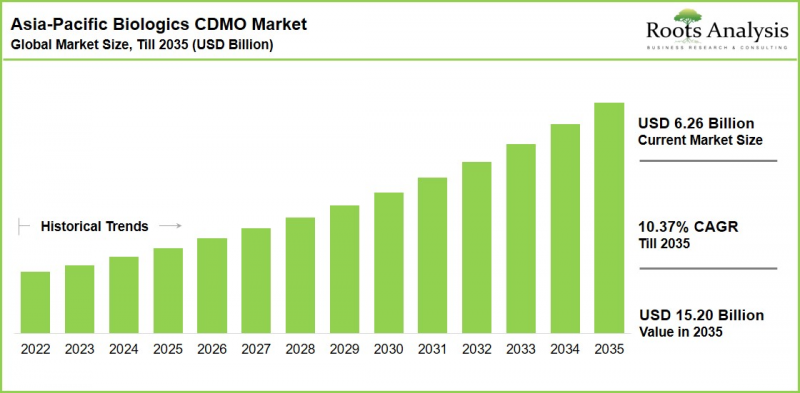
Asia-Pacific Biologics CDMO Market: Growth and Trends
Biologics such as monoclonal antibodies, recombinant proteins, vaccines, and cell and gene therapies, are complex macromolecules that require specialized bioprocessing infrastructure, technical expertise, and stringent quality control for commercial scale production. Given the substantial capital investment and specialized requirement to establish in-house manufacturing capabilities, an increasing number of biopharmaceutical companies are shifting to contract development and manufacturing organizations (CDMOs) to support their production requirements across the development lifecycle.
Notably, the Asia-Pacific region has emerged as a preferred destination for biologics manufacturing outsourcing. Notably, this preference is further supported by a combination of lower operating and labor costs, government-backed biomanufacturing initiatives, an expanding base of GMP-certified facilities, and a growing pool of trained scientific talent. Countries such as China, South Korea, Japan, India, and Singapore have made significant investments in bioprocessing infrastructure over the past decade. has positioned this region as a credible alternative to established manufacturing hubs in North America and Europe.
Regional players have progressively expanded their service offerings, moving beyond fill / finish and analytical testing toward integrated, end-to-end capabilities spanning cell line development, upstream and downstream process development, and commercial-scale drug substance and drug product manufacturing. This shift, combined with rising local demand for biosimilars and innovative biologics, is enabling APAC-based CDMOs to compete for both regional and global outsourcing contracts.
With multinational biopharmaceutical companies increasingly diversifying their manufacturing footprint and regional developers scaling up their pipelines, the Asia-Pacific Biologics CDMO market is expected to witness sustained growth.
Growth Drivers: Strategic Enablers of Market Expansion
The Asia-Pacific Biologics CDMO market is gaining momentum as biopharmaceutical companies increasingly seek cost-efficient manufacturing solutions and access to expanding production capacity. The region offers a significant cost advantage over Western manufacturing hubs, primarily due to comparatively lower facility construction, labor, and raw material costs. In parallel, investments in large-scale biologics manufacturing infrastructure and the expansion of production capabilities are enhancing the region's ability to support complex and high-volume biologics manufacturing programs.
These advantages are strengthening Asia-Pacific's position as an increasingly attractive destination for biologics development and manufacturing outsourcing. These factors make it an attractive destination for both clinical and commercial-scale outsourcing. Government-led initiatives, including China's Healthy China 2030 program and similar biomanufacturing-focused policies across South Korea, Japan, and India, continue to provide substantial public and private investment into bioprocessing infrastructure, further reinforcing the region's manufacturing base.
In addition, the continuous rise in the number of biologics entering clinical development and gaining regulatory approval is driving demand for both preclinical / clinical and commercial-scale manufacturing capacity. Moreover, established regional players are expanding their manufacturing footprints to meet rising demand for biologics production. For instance, South Korea-based Samsung Biologics has continued to increase its manufacturing capacity through new production facilities, strengthening the region's position as a high-capacity biomanufacturing hub.
Market Challenges: Critical Barriers Impeding Progress
Despite favorable growth prospects, the Asia-Pacific Biologics CDMO market faces several challenges that could temper its growth trajectory. Regulatory heterogeneity across APAC countries, including differing GMP requirements, approval timelines, and quality standards, can complicate technology transfer and add operational complexity for CDMOs serving multiple export markets. Additionally, evolving trade policies and tariff-related uncertainty affecting cross-border pharmaceutical supply chains may influence sourcing decisions of biopharmaceutical developers headquartered outside the region.
Further, the region continues to face competition from established manufacturing hubs in North America and Europe that offer superior intellectual property protection frameworks, more mature regulatory ecosystems, and long-standing client relationships. Talent retention, consistent quality compliance across an expanding facility base, and the substantial capital intensity associated with biomanufacturing also remain important considerations for stakeholders operating in this space.
ASIA-PACIFIC BIOLOGICS CDMO MARKET: KEY INSIGHTS
The report delves into the current state of the Asia-Pacific Biologics CDMO market and identifies potential growth opportunities within the industry. Some key from the report include:
- Owing to the rising outsourcing penetration among biopharmaceutical innovators and the region's cost advantage, several APAC-based contract manufacturers are actively expanding their bioprocessing capacity to capture a larger share of global biologics manufacturing demand.
- In terms of type of service offered, drug substance (API) manufacturing is likely to remain the leading segment in the APAC region, driven by rising interest in upstream process outsourcing and access to advanced cell line development platforms.
- Antibodies are expected to continue to represent the largest share of biologic types manufactured across the region, owing to their broad application across oncology, autoimmune, and infectious disease indications; the cell and gene therapy segment is anticipated to be the over the forecast period.
- Mammalian expression systems are anticipated to remain the preferred platform for biologics manufacturing in the region, given their proven ability to produce complex, high-yield therapeutic proteins.
- Commercial-scale manufacturing is expected to continue to account for the majority of regional demand; however, the preclinical / clinical-scale segment is poised to grow at a relatively faster pace, supported by the region's expanding early-stage biologics pipeline.
- China is expected to remain the dominant country-level market within APAC, supported by its scale of bioprocessing capacity, favorable government policy, and growing base of domestic biologics developers.
- South Korea has emerged as a key hub for large-scale biomanufacturing, led by continued capacity expansions among established regional CDMOs.
- India is positioning itself as an emerging biomanufacturing hub within APAC, supported by an expanding base of GMP-certified facilities and increasing interest from global biopharmaceutical companies in establishing regional manufacturing partnerships.
- Oncological disorders are expected to remain the leading therapeutic area for biologics manufactured in the region, in line with the sustained global pipeline of antibody-based oncology therapeutics.
- Large and very large companies are anticipated to continue to dominate the competitive landscape, owing to their established infrastructure, regulatory track record, and long-standing client relationships; however, small and mid-sized regional players are increasingly securing niche outsourcing contracts.
- Partnerships, facility expansions, and funding activity ha remained prominent themes across the region; recent examples include continued capacity additions by South Korea-based Samsung Biologics and expanding local presence among global CDMOs establishing operations in India and Singapore.
- Given the region's cost competitiveness, expanding capacity base, and continued policy support, the Asia-Pacific Biologics CDMO market is anticipated to outpace the growth of other global regions over the forecast period.
Asia-Pacific Biologics CDMO Market
The market sizing and opportunity analysis has been segmented across the following parameters:
By Type of Service Offered
- Drug Substance (API) Manufacturing
- Drug Product (FDF) Manufacturing
By Type of Biologic Manufactured
- Antibodies
- Proteins / Peptides
- Vaccines
- Cell Therapies
- Gene Therapies
- Other Biologics
By Type of Expression System Used
- Mammalian Expression Systems
- Microbial Expression Systems
- Other Expression Systems
By Scale of Operation
- Preclinical / Clinical Scale
- Commercial Scale
By Therapeutic Area
- Oncological Disorders
- Autoimmune Disorders
- Infectious Diseases
- Metabolic Disorders
- Other Disorders
By Company Size
- Small Companies
- Mid-sized Companies
- Large and Very Large Companies
By Country
- China
- Japan
- South Korea
- India
- Singapore
- Rest of Asia-Pacific
ASIA-PACIFIC BIOLOGICS CDMO MARKET: KEY SEGMENTS
Drug Substance Manufacturing Continues to Lead the Asia-Pacific Biologics CDMO Market
Based on our market assessment, drug substance (API) manufacturing currently represents the largest share of service demand within the Asia-Pacific Biologics CDMO market and is expected to retain this position throughout the forecast period. This can be attributed to the region's growing upstream bioprocessing capabilities, rising demand for cell line development and process optimization services, and the comparatively lower cost of API manufacturing infrastructure relative to Western markets.
Antibodies Remain the Dominant Biologic Type Manufactured in the Region
According to our analysis, antibody manufacturing accounts for the of the Asia-Pacific Biologics CDMO market, supported by the broad clinical application of monoclonal antibodies across oncology, autoimmune, and infectious disease indications. Cell and gene therapies, while representing a comparatively smaller share today, are expected to be the fastest-growing biologic type over the forecast period, in line with the region's expanding advanced therapy pipeline.
China Maintains its Position as the Largest Country-Level Market Within APAC
China is expected to remain the largest contributor to the Asia-Pacific Biologics CDMO market through 2035, supported by its considerable bioprocessing capacity, government-backed biomanufacturing initiatives such as Healthy China 2030, and a rapidly growing base of domestic biologics developers seeking outsourced manufacturing support.
South Korea and India Emerge as High-Growth Country Markets
South Korea is poised for robust growth owing to continued investments in biomanufacturing capacity by leading CDMOs. Meanwhile, India is expected to expand rapidly due to its strengthening GMP manufacturing infrastructure, competitive production capabilities, and rising demand from global biopharma companies for outsourcing services.
Large and Very Large Companies Account for the Largest Market Share
Based on our analysis, large and very large companies currently account for the majority of the Asia-Pacific Biologics CDMO market share. This dominance is due to their established infrastructure, proven regulatory track record, and long-standing relationships with global biopharmaceutical sponsors. Small and mid-sized regional players, however, continue to gain traction by offering flexible, niche outsourcing capabilities.
EXAMPLE PLAYERS IN THE ASIA-PACIFIC BIOLOGICS CDMO MARKET
- AGC Biologics
- Biocon Biologics
- Boehringer Ingelheim
- Celltrion
- Fujifilm Diosynth Biotechnologies
- Innovent Biologics
- JHL Biotech
- Lonza
- Samsung Biologics
- Syngene International
- WuXi Biologics
ASIA-PACIFIC BIOLOGICS CDMO MARKET: RESEARCH COVERAGE
- Market Sizing and Opportunity Analysis: The report features an in-depth analysis of the Asia-Pacific Biologics CDMO market, focusing on key market segments, including [A] type of service offered, [B] type of biologic manufactured, [C] type of expression system used, [D] scale of operation, [E] therapeutic area, [F] company size and [G] country.
- Asia-Pacific Biologics CDMO Landscape: A detailed assessment of the overall Asia-Pacific Biologics contract manufacturing landscape, featuring information on several relevant parameters, such as type of service offered, type of biologic manufactured, type of expression system used, scale of operation, therapeutic area, and location of manufacturing facilities. Additionally, it also features detailed analysis of Asia-Pacific Biologics CDMOs, based on parameters, such as year of establishment, company size (based on employee count) and location of headquarters.
- Regional Capability and Capacity Analysis: An in-depth analysis of the bioprocessing capacity installed across APAC-based biologics manufacturing facilities, featuring a comparative assessment of capability across key countries within the region.
- Company Profiles: In-depth profiles of prominent players engaged in offering biologics contract manufacturing services within APAC, featuring information on their year of establishment, location of headquarters, company size (in terms of number of employees), service portfolio and key initiatives.
- Big Pharma Initiatives: An analysis of the various initiatives undertaken by big pharmaceutical players to leverage biologics manufacturing capabilities within the APAC region, including facility investments and strategic outsourcing partnerships.
- Demand Analysis: An estimate of the current and future demand for biologics contract manufacturing services within the APAC region, segmented by type of service, type of biologic and scale of operation.
- Total Cost of Ownership Analysis: A comparative analysis of the cost components associated with in-house versus outsourced biologics manufacturing within the APAC region.
- Recent Developments: A detailed analysis of the various recent developments in this industry, including partnerships and collaborations, mergers and acquisitions, funding and investments, and facility expansions, based on several relevant parameters.
- Porter's Five Forces Analysis: A qualitative analysis of five competitive forces in this domain, namely, threats of new entrants, bargaining power of buyers, bargaining power of providers, threat of substitute products, and rivalry among existing competitors.
- Market Impact Analysis: The report analyzes various factors such as drivers, restraints, opportunities, and challenges affecting market growth.
KEY QUESTIONS ANSWERED IN THIS REPORT
- Which are the leading companies in the Asia-Pacific Biologics CDMO market?
- Which country dominates the Asia-Pacific Biologics CDMO market?
- What are the key trends observed in the Asia-Pacific Biologics CDMO market?
- What factors are likely to influence the evolution of this market?
- What are the primary challenges faced by biologics CDMOs operating in the region?
- What is the current and future market size?
- What is the CAGR of this market?
- How is the current and future market opportunity likely to be distributed across key market segments?
REASONS TO BUY THIS REPORT
- The report provides a comprehensive market analysis, offering detailed revenue projections of the overall Asia-Pacific Biologics CDMO market and its specific sub-segments. This information is valuable to both established market leaders and emerging entrants.
- The report offers stakeholders a comprehensive overview of the market, including key drivers, barriers, opportunities, and challenges. This information empowers stakeholders to stay abreast of market trends and make data-driven decisions to capitalize on growth prospects.
- The report can aid businesses in identifying future opportunities across APAC countries. It also helps in understanding if those opportunities are worth pursuing.
- The report helps in identifying customer demand by understanding the needs, preferences, and behavior of the target audience in order to tailor products or services effectively.
- The report equips new entrants with requisite information regarding this market to help them build successful business strategies.
- The report allows for more effective communication with the audience and in building strong business relations.
ADDITIONAL BENEFITS
- Complementary Excel Data Packs for all Analytical Modules in the Report
- 15% Free Content Customization
- Detailed Report Walkthrough Session with Research Team
- Free Updated Report if the Report is 6-12 Months Old or Older
TABLE OF CONTENTS
1. PREFACE
- 1.1. Introduction
- 1.2. Market Share Insights
- 1.3. Key Market Insights
- 1.4. Report Coverage
- 1.5. Key Questions Answered
- 1.6. Chapter Outlines
2. RESEARCH METHODOLOGY
- 2.1. Chapter Overview
- 2.2. Research Assumptions
- 2.2.1. Market Landscape and Market Trends
- 2.2.2. Market Forecast and Opportunity Analysis
- 2.2.3. Comparative Analysis
- 2.3. Database Building
- 2.3.1. Data Collection
- 2.3.2. Data Validation
- 2.3.3. Data Analysis
- 2.4. Project Methodology
- 2.4.1. Secondary Research
- 2.4.1.1. Annual Reports
- 2.4.1.2. Academic Research Papers
- 2.4.1.3. Company Websites
- 2.4.1.4. Investor Presentations
- 2.4.1.5. Regulatory Filings
- 2.4.1.6. White Papers
- 2.4.1.7. Industry Publications
- 2.4.1.8. Conferences and Seminars
- 2.4.1.9. Government Portals
- 2.4.1.10. Media and Press Releases
- 2.4.1.11. Newsletters
- 2.4.1.12. Industry Databases
- 2.4.1.13. Roots Proprietary Databases
- 2.4.1.14. Paid Databases and Sources
- 2.4.1.15. Social Media Portals
- 2.4.1.16. Other Secondary Sources
- 2.4.2. Primary Research
- 2.4.2.1. Types of Primary Research
- 2.4.2.1.1. Qualitative Research
- 2.4.2.1.2. Quantitative Research
- 2.4.2.1.3. Hybrid Approach
- 2.4.2.2. Advantages of Primary Research
- 2.4.2.3. Techniques for Primary Research
- 2.4.2.3.1. Interviews
- 2.4.2.3.2. Surveys
- 2.4.2.3.3. Focus Groups
- 2.4.2.3.4. Observational Research
- 2.4.2.3.5. Social Media Interactions
- 2.4.2.4. Key Opinion Leaders Considered in Primary Research
- 2.4.2.4.1. Company Executives (CXOs)
- 2.4.2.4.2. Board of Directors
- 2.4.2.4.3. Company Presidents and Vice Presidents
- 2.4.2.4.4. Research and Development Heads
- 2.4.2.4.5. Technical Experts
- 2.4.2.4.6. Subject Matter Experts
- 2.4.2.4.7. Scientists
- 2.4.2.4.8. Doctors and Other Healthcare Providers
- 2.4.2.5. Ethics and Integrity
- 2.4.2.5.1. Research Ethics
- 2.4.2.5.2. Data Integrity
- 2.4.2.1. Types of Primary Research
- 2.4.3. Analytical Tools and Databases
- 2.4.1. Secondary Research
- 2.5. Robust Quality Control
3. MARKET DYNAMICS
- 3.1. Chapter Overview
- 3.2. Forecast Methodology
- 3.2.1. Top-down Approach
- 3.2.2. Bottom-up Approach
- 3.2.3. Hybrid Approach
- 3.3. Market Assessment Framework
- 3.3.1. Total Addressable Market (TAM)
- 3.3.2. Serviceable Addressable Market (SAM)
- 3.3.3. Serviceable Obtainable Market (SOM)
- 3.3.4. Currently Acquired Market (CAM)
- 3.4. Forecasting Tools and Techniques
- 3.4.1. Qualitative Forecasting
- 3.4.2. Correlation
- 3.4.3. Regression
- 3.4.4. Extrapolation
- 3.4.5. Convergence
- 3.4.6. Sensitivity Analysis
- 3.4.7. Scenario Planning
- 3.4.8. Data Visualization
- 3.4.9. Time Series Analysis
- 3.4.10. Forecast Error Analysis
- 3.5. Key Considerations
- 3.5.1. Demographics
- 3.5.2. Government Regulations
- 3.5.3. Reimbursement Scenarios
- 3.5.4. Market Access
- 3.5.5. Supply Chain
- 3.5.6. Industry Consolidation
- 3.5.7. Pandemic / Unforeseen Disruptions Impact
- 3.6. Limitations
4. MACRO-ECONOMIC INDICATORS
- 4.1. Chapter Overview
- 4.2. Market Dynamics
- 4.2.1. Time Period
- 4.2.1.1. Historical Trends
- 4.2.1.2. Current and Forecasted Estimates
- 4.2.2. Currency Coverage
- 4.2.2.1. Major Currencies Affecting the Market
- 4.2.2.2. Factors Affecting Currency Fluctuations on the Industry
- 4.2.2.3. Impact of Currency Fluctuations on the Industry
- 4.2.3. Foreign Currency Exchange Rate
- 4.2.3.1. Impact of Foreign Exchange Rate Volatility on the Market
- 4.2.3.2. Strategies for Mitigating Foreign Exchange Risk
- 4.2.4. Recession
- 4.2.4.1. Assessment of Current Economic Conditions and Potential Impact on the Market
- 4.2.4.2. Historical Analysis of Past Recessions and Lessons Learnt
- 4.2.5. Inflation
- 4.2.5.1. Measurement and Analysis of Inflationary Pressures in the Economy
- 4.2.5.2. Potential Impact of Inflation on the Market Evolution
- 4.2.6. Interest Rates
- 4.2.6.1. Interest Rates and Their Impact on the Market
- 4.2.6.2. Strategies for Managing Interest Rate Risk
- 4.2.7. Commodity Flow Analysis
- 4.2.7.1. Type of Commodity
- 4.2.7.2. Origins and Destinations
- 4.2.7.3. Values and Weights
- 4.2.7.4. Modes of Transportation
- 4.2.8. Global Trade Dynamics
- 4.2.8.1. Import Scenario
- 4.2.8.2. Export Scenario
- 4.2.8.3. Trade Policies
- 4.2.8.4. Strategies for Mitigating the Risks Associated with Trade Barriers
- 4.2.8.5. Impact of Trade Barriers on the Market
- 4.2.9. War Impact Analysis
- 4.2.9.1. Russian-Ukraine War
- 4.2.9.2. Israel-Hamas War
- 4.2.10. COVID Impact / Related Factors
- 4.2.10.1. Global Economic Impact
- 4.2.10.2. Industry-specific Impact
- 4.2.10.3. Government Response and Stimulus Measures
- 4.2.10.4. Future Outlook and Adaptation Strategies
- 4.2.11. Other Indicators
- 4.2.11.1. Fiscal Policy
- 4.2.11.2. Consumer Spending
- 4.2.11.3. Gross Domestic Product
- 4.2.11.4. Employment
- 4.2.11.5. Taxes
- 4.2.11.6. Stock Market Performance
- 4.2.11.7. Cross Border Dynamics
- 4.2.1. Time Period
- 4.3. Conclusion
5. EXECUTIVE SUMMARY
6. INTRODUCTION
- 6.1. Overview of Biologics
- 6.2. Biologics Manufacturing: Process Overview
- 6.3. Overview of Biologics Contract Development and Manufacturing
- 6.4. APAC Biomanufacturing Landscape: An Overview
- 6.5. Regulatory Landscape Across Key APAC Countries
- 6.6. Future Perspectives
7. MARKET LANDSCAPE: ASIA-PACIFIC BIOLOGICS CONTRACT MANUFACTURING ORGANIZATIONS
- 7.1. Methodology and Key Parameters
- 7.2. Asia-Pacific Biologics CDMOs: Market Landscape
- 7.2.1. Analysis by Type of Service Offered
- 7.2.2. Analysis by Type of Biologic Manufactured
- 7.2.3. Analysis by Type of Expression System Used
- 7.2.4. Analysis by Scale of Operation
- 7.2.5. Analysis by Therapeutic Area
- 7.2.6. Analysis by Year of Establishment
- 7.2.7. Analysis by Company Size
- 7.2.8. Analysis by Location of Headquarters
- 7.2.9. Analysis by Location of Manufacturing Facilities
8. REGIONAL CAPABILITY AND CAPACITY ANALYSIS
- 8.1. Chapter Overview
- 8.2. Asia-Pacific Biologics Manufacturing Capacity: Country-wise Comparison
- 8.3. Analysis by Scale of Operation and Country
- 8.4. Capacity Expansion Initiatives
9. COMPANY PROFILES
- 9.1. AGC Biologics
- 9.1.1. Company Overview
- 9.1.2. Facility and Service Portfolio
- 9.1.3. Key Initiatives
- 9.2. Samsung Biologics
- 9.3. WuXi Biologics
- 9.4. Celltrion
- 9.5. Fujifilm Diosynth Biotechnologies
- 9.6. Biocon Biologics
- 9.7. Syngene International
10. BIG PHARMA INITIATIVES
- 10.1. Chapter Overview
- 10.2. Big Pharma Initiatives in the Asia-Pacific Biologics CDMO Space
11. DEMAND ANALYSIS
- 11.1. Chapter Overview
- 11.2. Asia-Pacific Biologics CDMO Demand: Analysis by Type of Service
- 11.3. Asia-Pacific Biologics CDMO Demand: Analysis by Scale of Operation
12. TOTAL COST OF OWNERSHIP ANALYSIS
- 12.1. Chapter Overview
- 12.2. Methodology and Key Assumptions
- 12.3. In-house versus Outsourced Manufacturing: Comparative Cost Analysis
13. RECENT DEVELOPMENTS
- 13.1. Chapter Overview
- 13.2. Partnerships and Collaborations
- 13.3. Mergers and Acquisitions
- 13.4. Funding and Investments
- 13.5. Facility Expansions
14. PORTER'S FIVE FORCES ANALYSIS
- 14.1. Chapter Overview
- 14.2. Methodology
- 14.3. Threat of New Entrants
- 14.4. Bargaining Power of Buyers
- 14.5. Bargaining Power of Suppliers
- 14.6. Threat of Substitute Solutions
- 14.7. Rivalry Among Existing Competitors
- 14.8. Conclusion
15. MARKET IMPACT ANALYSIS: DRIVERS, RESTRAINTS, OPPORTUNITIES AND CHALLENGES
- 15.1. Chapter Overview
- 15.2. Market Drivers
- 15.3. Market Restraints
- 15.4. Market Opportunities
- 15.5. Market Challenges
16. ASIA-PACIFIC BIOLOGICS CDMO MARKET
- 16.1. Key Assumptions and Methodology
- 16.2. Asia-Pacific Biologics CDMO Market, Historical Trends (Since 2022) and Forecasted Estimates (Till 2035)
- 16.2.1. Multivariate Scenario Analysis
- 16.3. Key Market Segmentations
17. ASIA-PACIFIC BIOLOGICS CDMO MARKET, BY TYPE OF SERVICE OFFERED
- 17.1. Key Assumptions and Methodology
- 17.2. Asia-Pacific Biologics CDMO Market: Distribution by Type of Service Offered
- 17.2.1. Asia-Pacific Biologics CDMO Market for Drug Substance (API) Manufacturing: Historical Trends (since 2022) and Forecasted Estimates (till 2035)
- 17.2.2. Asia-Pacific Biologics CDMO Market for Drug Product (FDF) Manufacturing: Historical Trends (since 2022) and Forecasted Estimates (till 2035)
- 17.3. Data Triangulation and Validation
18. ASIA-PACIFIC BIOLOGICS CDMO MARKET, BY TYPE OF BIOLOGIC MANUFACTURED
- 18.1. Key Assumptions and Methodology
- 18.2. Asia-Pacific Biologics CDMO Market: Distribution by Type of Biologic Manufactured
- 18.2.1. Asia-Pacific Biologics CDMO Market for Antibodies: Historical Trends (since 2022) and Forecasted Estimates (till 2035)
- 18.2.2. Asia-Pacific Biologics CDMO Market for Proteins / Peptides: Historical Trends (since 2022) and Forecasted Estimates (till 2035)
- 18.2.3. Asia-Pacific Biologics CDMO Market for Vaccines: Historical Trends (since 2022) and Forecasted Estimates (till 2035)
- 18.2.4. Asia-Pacific Biologics CDMO Market for Cell Therapies: Historical Trends (since 2022) and Forecasted Estimates (till 2035)
- 18.2.5. Asia-Pacific Biologics CDMO Market for Gene Therapies: Historical Trends (since 2022) and Forecasted Estimates (till 2035)
- 18.2.6. Asia-Pacific Biologics CDMO Market for Other Biologics: Historical Trends (since 2022) and Forecasted Estimates (till 2035)
- 18.3. Data Triangulation and Validation
19. ASIA-PACIFIC BIOLOGICS CDMO MARKET, BY TYPE OF EXPRESSION SYSTEM USED
- 19.1. Key Assumptions and Methodology
- 19.2. Asia-Pacific Biologics CDMO Market: Distribution by Type of Expression System Used
- 19.2.1. Asia-Pacific Biologics CDMO Market for Mammalian Expression Systems: Historical Trends (since 2022) and Forecasted Estimates (till 2035)
- 19.2.2. Asia-Pacific Biologics CDMO Market for Microbial Expression Systems: Historical Trends (since 2022) and Forecasted Estimates (till 2035)
- 19.2.3. Asia-Pacific Biologics CDMO Market for Other Expression Systems: Historical Trends (since 2022) and Forecasted Estimates (till 2035)
- 19.3. Data Triangulation and Validation
20. ASIA-PACIFIC BIOLOGICS CDMO MARKET, BY SCALE OF OPERATION
- 20.1. Key Assumptions and Methodology
- 20.2. Asia-Pacific Biologics CDMO Market: Distribution by Scale of Operation: Historical Trends (since 2022) and Forecasted Estimates (till 2035)
- 20.2.1. Asia-Pacific Biologics CDMO Market for Preclinical / Clinical Scale: Historical Trends (since 2022) and Forecasted Estimates (till 2035)
- 20.2.2. Asia-Pacific Biologics CDMO Market for Commercial Scale: Historical Trends (since 2022) and Forecasted Estimates (till 2035)
- 20.3. Data Triangulation and Validation
21. ASIA-PACIFIC BIOLOGICS CDMO MARKET, BY THERAPEUTIC AREA
- 21.1. Key Assumptions and Methodology
- 21.2. Asia-Pacific Biologics CDMO Market: Distribution by Therapeutic Area
- 21.2.1. Asia-Pacific Biologics CDMO Market for Oncological Disorders: Historical Trends (since 2022) and Forecasted Estimates (till 2035)
- 21.2.2. Asia-Pacific Biologics CDMO Market for Autoimmune Disorders: Historical Trends (since 2022) and Forecasted Estimates (till 2035)
- 21.2.3. Asia-Pacific Biologics CDMO Market for Infectious Diseases: Historical Trends (since 2022) and Forecasted Estimates (till 2035)
- 21.2.4. Asia-Pacific Biologics CDMO Market for Metabolic Disorders: Historical Trends (since 2022) and Forecasted Estimates (till 2035)
- 21.2.5. Asia-Pacific Biologics CDMO Market for Other Disorders: Historical Trends (since 2022) and Forecasted Estimates (till 2035)
- 21.3. Data Triangulation and Validation
22. ASIA-PACIFIC BIOLOGICS CDMO MARKET, BY COMPANY SIZE
- 22.1. Key Assumptions and Methodology
- 22.2. Asia-Pacific Biologics CDMO Market: Distribution by Company Size
- 22.2.1. Asia-Pacific Biologics CDMO Market for Small Companies: Historical Trends (since 2022) and Forecasted Estimates (till 2035)
- 22.2.2. Asia-Pacific Biologics CDMO Market for Mid-sized Companies: Historical Trends (since 2022) and Forecasted Estimates (till 2035)
- 22.2.3. Asia-Pacific Biologics CDMO Market for Large and Very Large Companies: Historical Trends (since 2022) and Forecasted Estimates (till 2035)
- 22.3. Data Triangulation and Validation
23. ASIA-PACIFIC BIOLOGICS CDMO MARKET, BY COUNTRY
- 23.1. Key Assumptions and Methodology
- 23.2. Asia-Pacific Biologics CDMO Market: Distribution by Country
- 23.2.1. Asia-Pacific Biologics CDMO Market in China, Historical Trends (Since 2022) and Forecasted Estimates (Till 2035)
- 23.2.2. Asia-Pacific Biologics CDMO Market in Japan, Historical Trends (Since 2022) and Forecasted Estimates (Till 2035)
- 23.2.3. Asia-Pacific Biologics CDMO Market in South Korea, Historical Trends (Since 2022) and Forecasted Estimates (Till 2035)
- 23.2.4. Asia-Pacific Biologics CDMO Market in India, Historical Trends (Since 2022) and Forecasted Estimates (Till 2035)
- 23.2.5. Asia-Pacific Biologics CDMO Market in Singapore, Historical Trends (Since 2022) and Forecasted Estimates (Till 2035)
- 23.2.6. Asia-Pacific Biologics CDMO Market in Rest of Asia-Pacific, Historical Trends (Since 2022) and Forecasted Estimates (Till 2035)
- 23.3. Data Triangulation and Validation
24. CONCLUSION
25. APPENDIX
- 25.1. List of Companies and Organizations

