PUBLISHER: Roots Analysis | PRODUCT CODE: 2132675

PUBLISHER: Roots Analysis | PRODUCT CODE: 2132675
Europe CAR-T Therapies Market for Autoimmune Disorders - Trends and Forecast Till 2035
EUROPE CAR-T THERAPIES MARKET FOR AUTOIMMUNE DISORDERS: OVERVIEW
As per Roots Analysis, the Europe CAR-T therapies market for autoimmune disorders is estimated to grow from USD 0.038 billion in the current year to USD 1.25 billion by 2035, reflecting a compound annual growth rate (CAGR) of approximately 47.4% during the forecast period.
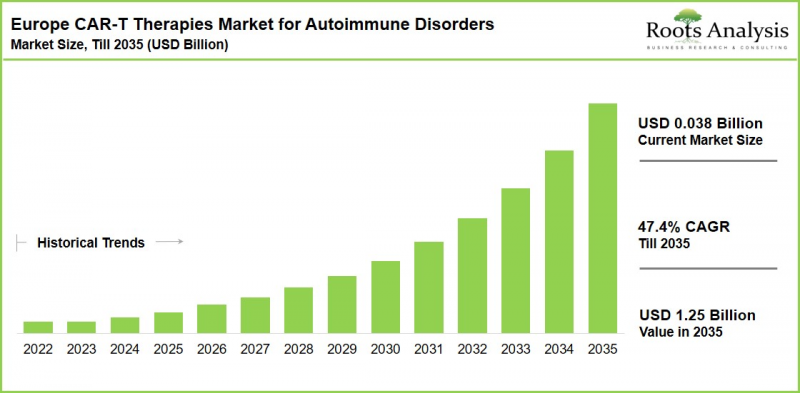
The Europe CAR-T therapies market for autoimmune disorders is entering a defining growth phase as chimeric antigen receptor (CAR) T-cell platforms, first validated in oncology, are repositioned to treat severe, treatment-refractory autoimmune and rheumatological conditions. Building on landmark proof-of-concept data generated by European academic centers in systemic lupus erythematosus (SLE), the region has evolved from an early research hub into a core commercial battleground for autologous, allogeneic, and in vivo CAR-T developers. Industry estimates place the current market in the low hundreds of millions of dollars, with the opportunity set to expand into the multi-billion-dollar range by 2035, at a robust double-digit CAGR, as pivotal trials mature, regulatory pathways solidify, and the first CAR-T therapies for autoimmune indications move toward European Medicines Agency (EMA) review and reimbursement.
Europe CAR-T Therapies Market for Autoimmune Disorders: Growth and Trends
Autoimmune diseases collectively affect around 5 to 8% of the European population. Examples of the autoimmune diseases includes systemic lupus erythematosus, systemic sclerosis, idiopathic inflammatory myopathies, generalized myasthenia gravis, multiple sclerosis, ANCA-associated vasculitis, and stiff person syndrome. A meaningful proportion of these patients remain refractory to conventional immunosuppressants, biologics, and monoclonal antibody therapies, leaving a substantial unmet need for disease-modifying, potentially curative interventions.
CD19-directed CAR-T cell therapy, engineered to deplete autoreactive B cells, has emerged as one of the most promising approaches to address this gap. The field's inflection points trace back to Europe, early-phase academic studies conducted in Germany demonstrated durable, drug-free remissions in patients with severe lupus following a single autologous CD19 CAR-T infusion, a result replicated and extended across multiple academic and industry-sponsored programs between 2022 and the present. This evidence catalyzed a wave of venture financing, licensing deals, and large-scale biopharma investment that has meaningfully accelerated the translational pathway from bench to bedside.
Presently, the autoimmune CAR-T pipeline spans more than three dozen active clinical trials, with European sites particularly in Germany and the United Kingdom, playing an outsized role relative to the region's share of the global autoimmune disease burden. Kyverna Therapeutics' KYSA trial program, Cabaletta Bio's RESET franchise, Autolus Therapeutics' obe-cel studies, and Miltenyi Biomedicine's autoimmune expansion of its CD19 / CD20 platform each maintain a meaningful European clinical footprint. These initiatives reflect the continent's deep bench of academic rheumatology, neurology, and cell-therapy manufacturing expertise.
Autologous, patient-derived CAR-T remains the dominant modality. However, allogeneic "off-the-shelf" and in vivo CAR-T approaches are advancing through preclinical and early clinical development. These platforms aim to reprogram T cells directly in the body using lipid nanoparticles or viral vectors, potentially reducing manufacturing time, lymphodepletion burden, and per-patient costs. Europe's ATMP regulatory framework, along with EMA PRIME designation for selecting autoimmune candidates, is expected to accelerate regulatory review for the first approved products. However, HTA and reimbursement processes remain fragmented across Germany, France, the UK, Italy, and Spain. Collectively, the rising disease prevalence, compelling early efficacy signals, an expanding indication set, and accelerating strategic investment position in the Europe CAR-T therapies market for autoimmune disorders for sustained, high-growth expansion through 2035.
Growth Drivers: Strategic Enablers of Market Expansion
Growth in the market is being driven by the substantial and underserved population of patients with refractory systemic lupus erythematosus, lupus nephritis, systemic sclerosis, and inflammatory myopathies who fail to achieve sustained remission on standard-of-care immunosuppressants and biologics. The single-infusion, potentially drug-free remission profile demonstrated in early CD19 CAR-T studies offers a fundamentally different value proposition than chronic maintenance therapy, generating strong interest among clinicians, patient advocacy groups, and payers evaluating long-term cost offsets.
Leading rheumatology and neuroimmunology centers in Germany, the UK, and France have positioned Europe as a preferred region for pivotal and confirmatory autoimmune CAR-T trials. This is supported by specialized apheresis, cell manufacturing, and lymphodepletion capabilities. The region also benefits from established cell therapy manufacturers, including Miltenyi Biotec's dedicated autoimmune disease spin-out, which brings extensive B-cell-targeted platform expertise.
Regulatory support is further accelerating market momentum. The EU's ATMP classification, PRIME designation, and adaptive pathways for serious conditions with unmet needs can shorten review timelines for leading candidates. At the same time, licensing deals, acquisitions, and venture financing are expanding capital and manufacturing capacity for European developers and their distribution partners, including through large-pharma investments in in-vivo and allogeneic CAR-T for B-cell-driven autoimmune diseases.
Market Challenges: Critical Barriers Impeding Progress
Despite strong momentum, several barriers could constrain the pace of market expansion. Some of the significant challenges include manufacturing complexity and high cost of developing CAR-T therapies. Autologous CAR-T requires individualized apheresis, viral-vector transduction, cell expansion, and cryopreservation, leading to long treatment timelines and high per-patient costs. These challenges are particularly significant for chronic, non-oncology autoimmune diseases, which often affect younger patients.
Safety in a non-oncology setting is a second consideration, as cytokine release syndrome, neurotoxicity, and infection risk associated with lymphodepleting chemotherapy must be carefully examined against the risk-benefit profile of existing biologic therapies, particularly in patients who are not facing an imminent life-threatening malignancy.
Fragmented reimbursement and HTA frameworks across Germany's AMNOG process, France's HAS assessment, the UK's NICE appraisal, and comparable bodies in Italy and Spain add further complexity to market access planning. Limited CDMO and viral-vector manufacturing capacity in Europe, competition from bispecific T-cell engagers and other B-cell depleting biologics, and the need for long-term safety and durability data remain key challenges. Addressing these factors will be critical to realizing the region's full growth potential.
Europe CAR-T Therapies Market for Autoimmune Disorders: Key Insights
The report delves into the current state of the Europe CAR-T therapies market for autoimmune disorders and identifies potential growth opportunities within the industry. Some key findings include:
- Presently, more than 35 active clinical trials are evaluating CAR-T constructs across autoimmune indications globally, with European trial sites anchored by Germany, playing a foundational role in generating the field's first human proof-of-concept data in systemic lupus erythematosus.
- Germany continues to anchor clinical and translational leadership in the region, hosting pivotal academic and industry-sponsored studies evaluating CD19-directed CAR-T across lupus nephritis, systemic sclerosis, generalized myasthenia gravis, and multiple sclerosis.
- The United Kingdom has emerged as a second regional hub, led by London-headquartered Autolus Therapeutics, which is advancing its CD19 CAR-T candidate across SLE, lupus nephritis, and multiple sclerosis alongside its approved oncology franchise.
- CD19-targeted constructs dominate the current European pipeline, reflecting the strong mechanistic rationale for B-cell depletion in B-cell-driven autoimmune disease; CD19/CD20 dual-targeted and next-generation approaches are emerging as differentiated second-wave options.
- Autologous, patient-derived CAR-T remains the predominant modality in active development, though allogeneic and in vivo platforms that are designed to shorten manufacturing timelines and reduce per-patient cost - are advancing rapidly through preclinical and early clinical stages.
- Deal-making activity is accelerating, exemplified by large-cap pharmaceutical acquisitions of in vivo CAR-T platforms targeting B-cell-driven autoimmune disease, a trend expected to expand licensing, co-development, and distribution opportunities across European markets.
- Systemic lupus erythematosus and lupus nephritis remain the leading indications by clinical trial volume, followed by generalized myasthenia gravis, systemic sclerosis, idiopathic inflammatory myopathies, and stiff person syndrome.
- Hospitals and specialized cell-and-gene-therapy treatment centers with apheresis, lymphodepletion, and intensive monitoring capabilities are expected to remain the primary end users given the clinical complexity of CAR-T infusion and post-infusion care.
- The EU's ATMP framework and EMA PRIME designation are expected to compress regulatory review timelines for lead autoimmune CAR-T candidates, even as Health Technology Assessment and reimbursement structures remain fragmented across Germany, France, the UK, Italy, and Spain.
- Given the depth of early clinical data, the scale of the refractory autoimmune patient population, and accelerating strategic investment, the Europe CAR-T therapies market for autoimmune disorders is positioned to be among the fastest-growing sub-segments of the broader European cell and gene therapy industry through 2035.
Europe CAR-T Therapies Market for Autoimmune Disorders: Market Segmentation
The market sizing and opportunity analysis has been segmented across the following parameters:
By Target Antigen
- CD19
- CD19 / CD20 (Dual-Targeted)
- BCMA
- Others
By Type of Therapy
- Autologous CAR-T
- Allogeneic CAR-T
- In Vivo CAR-T
By Cell Source
- Patient-Derived (Autologous)
- Donor-Derived (Allogeneic)
By Indication
- Systemic Lupus Erythematosus (SLE) / Lupus Nephritis
- Systemic Sclerosis
- Idiopathic Inflammatory Myopathies (Myositis)
- Generalized Myasthenia Gravis
- Multiple Sclerosis
- Stiff Person Syndrome
- ANCA-Associated Vasculitis
- Other Autoimmune / Rheumatological Disorders
By End User
- Hospitals
- Specialty Cell & Gene Therapy Centers
- Academic & Research Institutes
By Country
- Germany
- UK
- France
- Italy
- Spain
- Rest of Europe
Europe CAR-T Therapies Market for Autoimmune Disorders: Key Segment Insights
CD19 Targeted Therapies Command the Largest Share
Based on our market assessment, CD19-targeted CAR-T constructs represent the largest and most clinically mature segment of the Europe CAR-T therapies market for autoimmune disorders. This largest share is owing to the well-established mechanistic rationale for depleting autoreactive B cells across lupus, myositis, systemic sclerosis, and neuroimmunological indications. As dual-targeted (CD19 / CD20) and next-generation antigen-binding designs progress through clinical development, this segment is expected to retain its leadership position while broadening its addressable indication set through the forecast period.
Germany Leads the Europe CAR-T Therapies Market for Autoimmune Disorders
According to our assessment, Germany is expected to remain the largest national market for CAR-T therapies in autoimmune disease across Europe through 2035. This largest share is underpinned by the country's foundational role in generating the field's earliest human efficacy data, its dense network of academic rheumatology and neurology centers running pivotal trials, and the presence of Miltenyi Biotec's dedicated cell-therapy manufacturing and R&D infrastructure. The United Kingdom follows as a key secondary hub, anchored by Autolus Therapeutics' clinical and commercial platform, while France, Italy, and Spain are expected to contribute expanding trial activity and post-approval demand as reimbursement pathways mature.
Hospitals Account for the Largest End User Share
Hospitals and specialized cell-and-gene-therapy treatment centers are expected to account for the majority of the market share. This high share reflects the need for on-site apheresis, lymphodepleting chemotherapy, and close post-infusion monitoring for cytokine release syndrome and neurotoxicity. Academic and research institutes will continue to play an outsized role relative to their commercial share, given their central position in early-phase and investigator-initiated autoimmune CAR-T studies across the region.
Neuroimmunology Emerges as the Fastest-Growing Segment
While systemic lupus erythematosus and lupus nephritis remain the leading indications by clinical trial volume and cumulative evidence base, generalized myasthenia gravis, stiff person syndrome, and multiple sclerosis are emerging as the fastest-growing areas within the market, supported by strong recent clinical readouts and an absence of comparably durable disease-modifying alternatives in these neuroimmunological conditions.
Example Players in the Europe CAR-T Therapies Market for Autoimmune Disorders
- Autolus Therapeutics
- Cabaletta Bio
- Cartesian Therapeutics
- Kite Pharma (Acquired by Gilead Sciences)
- Kyverna Therapeutics
- Miltenyi Biomedicine
- Novartis
- Orbital Therapeutics (Acquired by Bristol Myers Squibb)
- Sana Biotechnology
EUROPE CAR-T THERAPIES MARKET FOR AUTOIMMUNE DISORDERS: RESEARCH COVERAGE
- Market Sizing and Opportunity Analysis: An in-depth analysis of the Europe CAR-T therapies market for autoimmune disorders, focusing on key segments, including [A] target antigen, [B] type of therapy, [C] cell source, [D] indication, [E] end user, [F] country and [G] sales forecast.
- CAR-T Therapies Landscape: A detailed assessment of the overall CAR-T autoimmune therapies landscape, featuring information on stage of development, target antigen, type of therapy, cell source, and route of administration, along with developer analysis by year of establishment, company size, and location of headquarters.
- Company Profiles: In-depth profiles of prominent players engaged in the Europe CAR-T therapies market for autoimmune disorders, featuring information on year of establishment, headquarters, company size, management team, portfolio, and key initiatives.
- Big Pharma Initiatives: An analysis of big pharma initiatives related to CAR-T therapies for autoimmune disorders, based on several relevant parameters, such as year of initiative, type of initiative, type of partnership, expansion type and company, along with a benchmarking assessment of major big pharma players based on their respective initiatives.
- Clinical Trial Analysis: An analysis of completed and ongoing clinical trials related to CAR-T therapies in autoimmune disease, based on trial registration year, enrolled patient population, trial phase, trial status, sponsor / collaborator type, patient demographics, study design, and geography.
- Partnerships and Collaborations Analysis: An analysis of partnerships and collaborations related to CAR-T therapies for autoimmune disorders, based on several relevant parameters, such as year of partnership, type of partnership, therapeutic area, target antigen, number of partnerships and geographical scope, including intercontinental, intracontinental, local and international agreements.
- Funding and Investment Analysis: An analysis of funding and investments in CAR-T therapies for autoimmune disorders, based on several relevant parameters, such as year of funding, type of funding, funding instances, amount invested, amount raised, therapeutic area, geography and the most active players by number of funding instances and amount raised.
- Patent Analysis: An analysis of the patent landscape for CAR-T therapies for autoimmune disorders, based on several relevant parameters, such as type of patent, patent publication year, patent application year, patent jurisdiction, CPC symbols, type of applicant, leading industry and non-industry players, leading inventors, patent benchmarking, patent valuation and leading patents by number of citations.
- Regulatory and Reimbursement Landscape: An assessment of the EU ATMP framework, EMA PRIME designation, and country-specific HTA and reimbursement pathways across Germany, France, the UK, Italy, and Spain.
- Market Impact Analysis: The report analyzes drivers, restraints, opportunities, and challenges affecting market growth across the region.
KEY QUESTIONS ANSWERED IN THIS REPORT
- Which are the leading companies in the Europe CAR-T therapies market for autoimmune disorders?
- Which country dominates the Europe CAR-T therapies market for autoimmune disorders?
- What are the key trends observed in the Europe CAR-T therapies market for autoimmune disorders?
- What factors are likely to influence the evolution of this market?
- What are the primary challenges faced by CAR-T therapy developers targeting autoimmune indications?
- What is the current and future market size?
- What is the CAGR of this market?
- How is the current and future market opportunity likely to be distributed across key market segments and countries?
REASONS TO BUY THIS REPORT
- The report provides a comprehensive market analysis, offering detailed revenue projections of the overall Europe CAR-T therapies market for autoimmune disorders and its specific sub-segments, valuable to both established market leaders and emerging entrants.
- The report offers stakeholders a comprehensive overview of the market, including key drivers, barriers, opportunities, and challenges, empowering data-driven decision-making.
- The report aids businesses in identifying future opportunities within the sector and assessing whether those opportunities are worth pursuing.
- The report helps identify customer and patient demand by understanding the needs, preferences, and behavior of the target audience in order to tailor products or services effectively.
- The report equips new entrants with the requisite information to build successful market-entry and go-to-market strategies across Europe.
- The report allows for more effective communication with stakeholders and supports the building of strong business relationships.
ADDITIONAL BENEFITS
- Complementary Excel Data Packs for all Analytical Modules in the Report
- 15% Free Content Customization
- Detailed Report Walkthrough Session with Research Team
- Free Updated Report if the Report is 6-12 Months Old or Older
TABLE OF CONTENTS
1. PREFACE
- 1.1. Introduction
- 1.2. Market Share Insights
- 1.3. Key Market Insights
- 1.4. Report Coverage
- 1.5. Key Questions Answered
- 1.6. Chapter Outlines
2. RESEARCH METHODOLOGY
- 2.1. Chapter Overview
- 2.2. Research Assumptions
- 2.2.1. Market Landscape and Market Trends
- 2.2.2. Market Forecast and Opportunity Analysis
- 2.2.3. Comparative Analysis
- 2.3. Database Building
- 2.3.1. Data Collection
- 2.3.2. Data Validation
- 2.3.3. Data Analysis
- 2.4. Project Methodology
- 2.4.1. Secondary Research
- 2.4.1.1. Annual Reports
- 2.4.1.2. Academic Research Papers
- 2.4.1.3. Company Websites
- 2.4.1.4. Investor Presentations
- 2.4.1.5. Regulatory Filings
- 2.4.1.6. White Papers
- 2.4.1.7. Industry Publications
- 2.4.1.8. Conferences and Seminars
- 2.4.1.9. Government and Regulatory Portals
- 2.4.1.10. Media and Press Releases
- 2.4.1.11. Clinical Trial Registries
- 2.4.1.12. Industry Databases
- 2.4.1.13. Roots Proprietary Databases
- 2.4.1.14. Paid Databases and Sources
- 2.4.1.15. Social Media Portals
- 2.4.1.16. Other Secondary Sources
- 2.4.2. Primary Research
- 2.4.2.1. Types of Primary Research
- 2.4.2.1.1. Qualitative Research
- 2.4.2.1.2. Quantitative Research
- 2.4.2.1.3. Hybrid Approach
- 2.4.2.2. Advantages of Primary Research
- 2.4.2.3. Techniques for Primary Research
- 2.4.2.3.1. Interviews
- 2.4.2.3.2. Surveys
- 2.4.2.3.3. Focus Groups
- 2.4.2.3.4. Observational Research
- 2.4.2.3.5. Social Media Interactions
- 2.4.2.4. Key Opinion Leaders Considered in Primary Research
- 2.4.2.4.1. Company Executives
- 2.4.2.4.2. Research and Development Heads
- 2.4.2.4.3. Technical Experts
- 2.4.2.4.4. Subject Matter Experts
- 2.4.2.4.5. Scientists
- 2.4.2.4.6. Physicians and Other Healthcare Providers
- 2.4.2.5. Ethics and Integrity
- 2.4.2.5.1. Research Ethics
- 2.4.2.5.2. Data Integrity
- 2.4.2.1. Types of Primary Research
- 2.4.3. Analytical Tools and Databases
- 2.4.1. Secondary Research
- 2.5. Robust Quality Control
3. MARKET DYNAMICS
- 3.1. Chapter Overview
- 3.2. Forecast Methodology
- 3.2.1. Top-down Approach
- 3.2.2. Bottom-up Approach
- 3.2.3. Hybrid Approach
- 3.3. Market Assessment Framework
- 3.3.1. Total Addressable Market
- 3.3.2. Serviceable Addressable Market
- 3.3.3. Serviceable Obtainable Market
- 3.3.4. Currently Acquired Market
- 3.4. Forecasting Tools and Techniques
- 3.4.1. Qualitative Forecasting
- 3.4.2. Correlation
- 3.4.3. Regression
- 3.4.4. Extrapolation
- 3.4.5. Convergence
- 3.4.6. Sensitivity Analysis
- 3.4.7. Scenario Planning
- 3.4.8. Data Visualization
- 3.4.9. Time Series Analysis
- 3.4.10. Forecast Error Analysis
- 3.5. Key Considerations
- 3.5.1. Disease Epidemiology
- 3.5.2. Regulatory Environment
- 3.5.3. Reimbursement Scenarios
- 3.5.4. Market Access
- 3.5.5. CAR-T Manufacturing Capacity
- 3.5.6. Treatment Center Infrastructure
- 3.5.7. Supply Chain
- 3.5.8. Industry Consolidation
- 3.6. Limitations
4. MACRO-ECONOMIC INDICATORS
- 4.1. Chapter Overview
- 4.2. Market Dynamics
- 4.2.1. Time Period
- 4.2.1.1. Historical Trends
- 4.2.1.2. Current and Forecasted Estimates
- 4.2.2. Currency Coverage
- 4.2.2.1. Major Currencies Affecting the Market
- 4.2.2.2. Factors Affecting Currency Fluctuations
- 4.2.2.3. Impact of Currency Fluctuations on the Market
- 4.2.3. Foreign Currency Exchange Rate
- 4.2.3.1. Impact of Foreign Exchange Rate Volatility
- 4.2.3.2. Strategies for Mitigating Foreign Exchange Risk
- 4.2.4. Recession
- 4.2.4.1. Assessment of Current Economic Conditions
- 4.2.4.2. Historical Analysis of Past Recessions
- 4.2.5. Inflation
- 4.2.5.1. Measurement and Analysis of Inflationary Pressures
- 4.2.5.2. Potential Impact on Market Evolution
- 4.2.6. Interest Rates
- 4.2.6.1. Interest Rates and Their Impact on the Market
- 4.2.6.2. Strategies for Managing Interest Rate Risk
- 4.2.7. Healthcare Expenditure
- 4.2.8. European Healthcare and Biopharmaceutical Investment Trends
- 4.2.9. Cross-Border Healthcare Dynamics
- 4.2.10. Other Macroeconomic Indicators
- 4.2.10.1. Gross Domestic Product
- 4.2.10.2. Employment
- 4.2.10.3. Government Spending
- 4.2.10.4. Taxes
- 4.2.1. Time Period
- 4.3. Conclusion
5. EXECUTIVE SUMMARY
6. INTRODUCTION
- 6.1. Chapter Overview
- 6.2. CAR-T Cell Therapy
- 6.2.1. Principles of CAR-T Cell Therapy
- 6.2.2. Key Components of CAR-T Cell Therapy
- 6.2.3. CAR-T Cell Manufacturing Process
- 6.2.4. Advantages of CAR-T Cell Therapy
- 6.2.5. Limitations and Challenges
- 6.3. CAR-T Therapy for Autoimmune Disorders
- 6.3.1. Mechanism of Action in Autoimmune Disorders
- 6.3.2. B Cell Depletion and Immune Reconstitution
- 6.3.3. Potential for Treatment-Free Remission
- 6.4. Types of CAR-T Therapies
- 6.4.1. Autologous CAR-T
- 6.4.2. Allogeneic CAR-T
- 6.4.3. In Vivo CAR-T
- 6.5. Target Antigens in Autoimmune CAR-T Therapies
- 6.5.1. CD19
- 6.5.2. CD19 / CD20
- 6.5.3. BCMA
- 6.5.4. Other Target Antigens
- 6.6. CAR-T Therapy Development Process
- 6.7. Key Autoimmune Disorders Targeted by CAR-T Therapies
- 6.8. Key Challenges Associated with CAR-T Therapies for Autoimmune Disorders
- 6.9. Future Perspectives
7. MARKET LANDSCAPE
- 7.1. Chapter Overview
- 7.2. Europe CAR-T Therapies for Autoimmune Disorders: Overall Market Landscape
- 7.2.1. Analysis by Development Status
- 7.2.2. Analysis by Target Antigen
- 7.2.3. Analysis by Type of Therapy
- 7.2.4. Analysis by Cell Source
- 7.2.5. Analysis by Indication
- 7.2.6. Analysis by Route of Administration
- 7.2.7. Analysis by Therapeutic Approach
- 7.2.8. Analysis by Trial Phase
- 7.2.9. Analysis by Geography
- 7.3. CAR-T Developer Landscape
- 7.3.1. Analysis by Year of Establishment
- 7.3.2. Analysis by Company Size
- 7.3.3. Analysis by Headquarters Location
- 7.3.4. Analysis by Development Stage
- 7.3.5. Most Active Developers: Analysis by Number of Programs
8. COMPANY COMPETITIVENESS ANALYSIS
- 8.1. Chapter Overview
- 8.2. Assumptions and Key Parameters
- 8.3. Methodology
- 8.4. Overview of Peer Groups Based in Europe
9. COMPANY PROFILES: CAR-T THERAPY DEVELOPERS BASED IN EUROPE
- 9.1. Chapter Overview
- 9.2. Autolus Therapeutics
- 9.2.1. Company Overview
- 9.2.2. Financial Information
- 9.2.3. CAR-T Therapy Portfolio
- 9.2.4. Autoimmune Disorder Pipeline
- 9.2.5. Manufacturing Capabilities
- 9.2.6. Recent Developments and Future Outlook
- Similar details are presented for other below mentioned players based on information in the public domain
- 9.3. Bristol Myers Squibb (Orbital Therapeutics)
- 9.4. Cabaletta Bio
- 9.5. Cartesian Therapeutics
- 9.6. Gilead Sciences (Kite Pharma)
- 9.7. Johnson & Johnson (Janssen / Legend Biotech)
- 9.8. Kyverna Therapeutics
- 9.9. Miltenyi Biomedicine
- 9.10. Novartis
- 9.11. Sana Biotechnology
10. PARTNERSHIPS AND COLLABORATIONS
- 10.1. Chapter Overview
- 10.2. Partnership Models
- 10.3. CAR-T Therapies for Autoimmune Disorders: Partnerships and Collaborations
- 10.3.1. Analysis by Year of Partnership
- 10.3.2. Analysis by Type of Partnership
- 10.3.3. Analysis by Year and Type of Partnership
- 10.3.4. Analysis by Therapeutic Area
- 10.3.5. Analysis by Target Antigen
- 10.3.6. Most Active Players: Analysis by Number of Partnerships
- 10.3.7. Analysis by Geography
- 10.3.7.1. Intercontinental and Intracontinental Agreements
- 10.3.7.2. Local and International Agreements
11. FUNDING AND INVESTMENTS
- 11.1. Chapter Overview
- 11.2. Funding Models
- 11.3. CAR-T Therapies for Autoimmune Disorders: Funding and Investment Analysis
- 11.3.1. Analysis by Year of Funding
- 11.3.1.1. Cumulative Year-wise Trend of Funding Instances
- 11.3.1.2. Cumulative Year-wise Trend of Amount Invested
- 11.3.2. Analysis by Type of Funding
- 11.3.2.1. Analysis of Funding Instances
- 11.3.2.2. Analysis of Amount Invested
- 11.3.3. Analysis by Year and Type of Funding
- 11.3.4. Analysis by Amount Raised by Year and Type of Funding
- 11.3.5. Analysis by Therapeutic Area
- 11.3.6. Analysis by Geography
- 11.3.7. Most Active Players: Analysis by Number of Funding Instances
- 11.3.8. Most Active Players: Analysis by Amount Raised
- 11.3.1. Analysis by Year of Funding
- 11.4. Summary of Funding and Investments
12. MARKET IMPACT ANALYSIS
- 12.1. Chapter Overview
- 12.2. Market Drivers
- 12.3. Market Restraints
- 12.4. Market Opportunities
- 12.5. Market Challenges
- 12.6. Conclusion
13. EUROPE CAR-T THERAPIES MARKET FOR AUTOIMMUNE DISORDERS
- 13.1. Chapter Overview
- 13.2. Assumptions and Methodology
- 13.3. Europe CAR-T Therapies Market for Autoimmune Disorders, Historic Trend (Since 2022) and Forecasted Estimates (Till 2035)
- 13.4. Scenario Analysis
- 13.4.1. Conservative Scenario
- 13.4.2. Base Scenario
- 13.4.3. Optimistic Scenario
- 13.5. Key Market Segmentations
- 13.5.1. By Target Antigen
- 13.5.2. By Type of Therapy
- 13.5.3. By Cell Source
- 13.5.4. By Indication
- 13.5.5. By End User
- 13.5.6. By Country
14. EUROPE CAR-T THERAPIES MARKET FOR AUTOIMMUNE DISORDERS, BY TARGET ANTIGEN
- 14.1. Chapter Overview
- 14.2. Key Assumptions and Methodology
- 14.3. Europe CAR-T Therapies Market: Distribution by Target Antigen
- 14.3.1. CD19 CAR-T Therapies Market, Historic Trend (Since 2022) and Forecasted Estimates (Till 2035)
- 14.3.2. CD19 / CD20 (Dual-Targeted) CAR-T Therapies Market, Historic Trend (Since 2022) and Forecasted Estimates (Till 2035)
- 14.3.3. BCMA CAR-T Therapies Market, Historic Trend (Since 2022) and Forecasted Estimates (Till 2035)
- 14.3.4. Other Target Antigens CAR-T Therapies Market, Historic Trend (Since 2022) and Forecasted Estimates (Till 2035)
- 14.4. Data Triangulation and Validation
15. EUROPE CAR-T THERAPIES MARKET FOR AUTOIMMUNE DISORDERS, BY TYPE OF THERAPY
- 15.1. Chapter Overview
- 15.2. Key Assumptions and Methodology
- 15.3. Europe CAR-T Therapies Market: Distribution by Type of Therapy
- 15.3.1. Autologous CAR-T Market, Historic Trend (Since 2022) and Forecasted Estimates (Till 2035)
- 15.3.2. Allogeneic CAR-T Market, Historic Trend (Since 2022) and Forecasted Estimates (Till 2035)
- 15.3.3. In Vivo CAR-T Market, Historic Trend (Since 2022) and Forecasted Estimates (Till 2035)
- 15.4. Data Triangulation and Validation
16. EUROPE CAR-T THERAPIES MARKET FOR AUTOIMMUNE DISORDERS, BY TYPE OF CELL SOURCE
- 16.1. Chapter Overview
- 16.2. Key Assumptions and Methodology
- 16.3. Europe CAR-T Therapies Market: Distribution by Cell Source
- 16.3.1. Patient-Derived (Autologous) CAR-T Market, Historic Trend (Since 2022) and Forecasted Estimates (Till 2035)
- 16.3.2. Donor-Derived (Allogeneic) CAR-T Market, Historic Trend (Since 2022) and Forecasted Estimates (Till 2035)
- 16.4. Data Triangulation and Validation
17. EUROPE CAR-T THERAPIES MARKET FOR AUTOIMMUNE DISORDERS, BY INDICATION
- 17.1. Chapter Overview
- 17.2. Key Assumptions and Methodology
- 17.3. Europe CAR-T Therapies Market: Distribution by Indication
- 17.3.1. Systemic Lupus Erythematosus (SLE) / Lupus Nephritis CAR-T Therapies Market, Historic Trend (Since 2022) and Forecasted Estimates (Till 2035)
- 17.3.2. Systemic Sclerosis CAR-T Therapies Market, Historic Trend (Since 2022) and Forecasted Estimates (Till 2035)
- 17.3.3. Idiopathic Inflammatory Myopathies (Myositis) CAR-T Therapies Market, Historic Trend (Since 2022) and Forecasted Estimates (Till 2035)
- 17.3.4. Generalized Myasthenia Gravis CAR-T Therapies Market, Historic Trend (Since 2022) and Forecasted Estimates (Till 2035)
- 17.3.5. Multiple Sclerosis CAR-T Therapies Market, Historic Trend (Since 2022) and Forecasted Estimates (Till 2035)
- 17.3.6. Stiff Person Syndrome CAR-T Therapies Market, Historic Trend (Since 2022) and Forecasted Estimates (Till 2035)
- 17.3.7. ANCA-Associated Vasculitis CAR-T Therapies Market, Historic Trend (Since 2022) and Forecasted Estimates (Till 2035)
- 17.3.8. Other Autoimmune / Rheumatological Disorders CAR-T Therapies Market, Historic Trend (Since 2022) and Forecasted Estimates (Till 2035)
- 17.4. Data Triangulation and Validation
18. EUROPE CAR-T THERAPIES MARKET FOR AUTOIMMUNE DISORDERS, BY END USER
- 18.1. Chapter Overview
- 18.2. Key Assumptions and Methodology
- 18.3. Europe CAR-T Therapies Market: Distribution by End User
- 18.3.1. Hospitals, Historic Trend (Since 2022) and Forecasted Estimates (Till 2035)
- 18.3.2. Specialty Cell & Gene Therapy Centers, Historic Trend (Since 2022) and Forecasted Estimates (Till 2035)
- 18.3.3. Academic & Research Institutes, Historic Trend (Since 2022) and Forecasted Estimates (Till 2035)
- 18.4. Data Triangulation and Validation
19. EUROPE CAR-T THERAPIES MARKET FOR AUTOIMMUNE DISORDERS, BY COUNTRY
- 19.1. Chapter Overview
- 19.2. Key Assumptions and Methodology
- 19.3. Europe CAR-T Therapies Market: Distribution by Country
- 19.3.1. CAR-T Therapies Market in Germany, Historic Trend (Since 2022) and Forecasted Estimates (Till 2035)
- 19.3.2. CAR-T Therapies Market in UK, Historic Trend (Since 2022) and Forecasted Estimates (Till 2035)
- 19.3.3. CAR-T Therapies Market in France, Historic Trend (Since 2022) and Forecasted Estimates (Till 2035)
- 19.3.4. CAR-T Therapies Market in Italy, Historic Trend (Since 2022) and Forecasted Estimates (Till 2035)
- 19.3.5. CAR-T Therapies Market in Spain, Historic Trend (Since 2022) and Forecasted Estimates (Till 2035)
- 19.3.6. CAR-T Therapies Market in Rest of Europe, Historic Trend (Since 2022) and Forecasted Estimates (Till 2035)
- 19.4. Data Triangulation and Validation
20. CONCLUSION AND FUTURE PERSPECTIVES
21. APPENDIX I: TABULATED DATA
22. APPENDIX II: LIST OF COMPANIES AND ORGANIZATIONS

