PUBLISHER: Roots Analysis | PRODUCT CODE: 2132680

PUBLISHER: Roots Analysis | PRODUCT CODE: 2132680
LATAM Biosimilars Market by Product Type, Application Area, and Distribution Channel - Trends and Forecast till 2035
LATAM BIOSIMILARS MARKET: OVERVIEW
According to the Roots Analysis, the LATAM biosimilar market is valued at USD 2.28 billion in the current year and is projected to reach USD 6.80 billion by 2035, representing a CAGR of 12.9% during the forecast period.
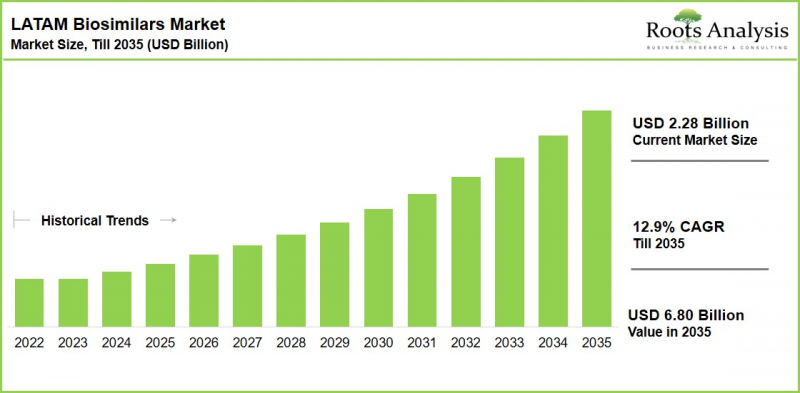
LATAM Biosimilars Market: Growth and Trends
The LATAM biosimilars market is entering a decisive growth phase as Brazil, Mexico, and Argentina modernize their regulatory pathways and public health systems lean harder on lower-cost biologics to manage rising chronic-disease burden. Brazil's health regulator, ANVISA, has updated its biosimilar approval framework through Resolution RDC 875, which for the first time allows developers to bridge clinical data already accepted by 'Equivalent Foreign Regulatory Authorities' such as the EMA or FDA. This is a shift expected to compress the historical two-to-three-year lag between global and Brazilian biosimilar launches. Parallel regulatory maturity at COFEPRIS (Mexico), ANMAT (Argentina), and INVIMA (Colombia), all aligned with WHO and EMA guidance, is creating a more predictable, harmonized landscape for distributors and manufacturers evaluating regional expansion.
Latin America's biosimilar sector has evolved from Colombia's first regional approval in 2013 into a growing multi-country manufacturing and commercialization ecosystem, supported by local players such as Bionovis, Biomm, Libbs, Cristalia, Probiomed, and mAbxience. Brazil remains the region's largest and fastest-growing market, driven by its population scale, public-tender procurement model, and increasingly supportive regulatory environment under ANVISA. Cross-border licensing is also strengthening the market, with partnerships such as Polpharma Biologics-Libbs and mAbxience's collaborations with global pharmaceutical companies expanding access to biosimilars across LATAM. Meanwhile, upcoming biologic patent expirations, including ustekinumab, and Brazil's RDC 875 bridging pathway could further accelerate biosimilar launches and competitive entry across the region.
Growth Drivers: Factors Fueling Market Expansion
Rising chronic-disease prevalence, such as cancer, rheumatoid arthritis, diabetes, and inflammatory bowel disease combined with sustained public-budget pressure on originator biologic spend, is the primary structural driver of biosimilar adoption across LATAM's public health systems. Biosimilars, generally offered at discounts of around 30-50% compared with reference biologics, provide substantial cost-saving opportunities for healthcare systems. This pricing advantage is encouraging public payers and health ministries in Brazil, Mexico, Argentina, and Colombia to increasingly prioritize biosimilars in procurement tenders, especially for high-demand oncology and autoimmune therapies.
Regulatory convergence is further supporting biosimilar adoption across Latin America, with agencies such as ANVISA, COFEPRIS, ANMAT, and INVIMA implementing abbreviated approval pathways aligned with WHO and EMA principles. These frameworks can streamline registration for multinational developers while maintaining requirements for robust analytical characterization and appropriate clinical bridging evidence. Government incentives for domestic manufacturing, technology-transfer agreements between global biosimilar developers and local pharmaceutical companies and expanding CDMO capabilities are strengthening the region's supply infrastructure. Platforms such as mAbxience's biologics operations in Argentina illustrate how these developments are enabling both international and regional companies to establish production and supply capabilities serving the broader LATAM market.
Market Challenges: Critical Barriers Hindering Progress
Despite the positive outlook, the LATAM biosimilars market remains fragmented and inconsistent across its constituent countries. Despite progress in key markets, biosimilar regulation remains fragmented across Latin America. Fewer than half of the region's more than 30 countries have established or initiated biosimilar-specific frameworks, requiring manufacturers and distributors to manage separate registration, pricing, and procurement requirements in individual markets rather than benefiting from a unified regional approval pathway.
Uncertainty surrounding biosimilar interchangeability among clinicians and prescribers continues to constrain adoption. In Brazil, for instance, ANVISA considers interchangeability primarily a matter of clinical practice rather than a formal regulatory designation and has not endorsed repeated switching between biosimilars and reference products, partly due to concerns over treatment traceability. Combined with the high fixed costs of biologics R&D and clinical development, short-term economic and policy cycles in several LATAM economies, and currency volatility affecting multinational investment decisions, these factors continue to slow the pace at which biosimilar uptake converts into realized cost savings for regional health systems.
LATAM Biosimilars Market: Key Insights
- Brazil's RDC 875 regulatory update allows bridging of clinical data already accepted by the EMA or FDA, materially shortening the historical launch lag between global and Brazilian biosimilar approvals and creating a near-term wave of new market entries.
- Local champion manufacturers including Bionovis, Biomm, and Libbs in Brazil, Probiomed in Mexico, and Grupo Insud / mAbxience in Argentina are central to market access, frequently serving as the exclusive in-country commercialization and distribution partner for global biosimilar developers via licensing agreements.
- Public-tender procurement remains the dominant commercial channel across the region's largest markets, meaning distributors and channel partners that can navigate government tender processes and pricing negotiations hold a structural advantage over pure logistics-focused entrants.
- Regulatory divergence between ANVISA, COFEPRIS, ANMAT, and INVIMA means a single-country registration and distribution strategy does not translate directly across borders, elevating the value of regional distribution partners with multi-country regulatory affairs capability.
- mAbxience's CDMO platform, spanning Argentina and Spain with a combined 50,000L of single-use bioreactor capacity, illustrates how LATAM-based manufacturing is increasingly integrated into global biosimilar supply chains rather than serving purely domestic demand.
- Oncology and autoimmune / rheumatology indications led by monoclonal antibody biosimilars such as trastuzumab, rituximab, and adalimumab analogues represent the largest addressable application areas, reflecting both disease burden and the high per-patient cost of originator biologics in these categories.
- Distributors offering value-added regulatory, cold-chain, and tender-support services are increasingly favored over cost-only logistics providers, mirroring the broader shift seen in global biologics distribution toward specialized, compliance-capable partners.
Recent Deal Activity Signaling Investor Momentum
- Polpharma Biologics signed a licensing agreement with Libbs Farmaceutica (Brazil), granting Libbs exclusive commercialization, marketing, and distribution rights to a biosimilar for autoimmune diseases in Brazil, while Polpharma retains development and manufacturing responsibility.
- mAbxience (majority owned by Fresenius Kabi, with Insud Pharma holding a minority stake) expanded its licensing relationship with Teva for an anti-PD-1 oncology biosimilar candidate, with mAbxience leading development and manufacturing and Teva leading global regulatory and commercialization efforts.
- mAbxience and Abbott signed a strategic agreement under which Abbott will register and commercialize a pipeline of mAbxience-manufactured biosimilars across key emerging markets in Latin America, Southeast Asia, and the Middle East and Africa.
- Celltrion received a positive CHMP opinion from the EMA for a ustekinumab biosimilar, positioning the company to leverage Brazil's new RDC 875 bridging pathway for an accelerated local launch.
- Brazilian domestic players Bionovis and Biomm continue to expand technology-transfer and licensing partnerships with international biosimilar developers to broaden local manufacturing and commercialization capability under ANVISA's evolving framework.
Collectively, these transactions reflect sustained multinational and regional confidence in LATAM as a commercially significant biosimilars market with licensing, technology transfer, and CDMO partnership models emerging as the dominant entry strategy, directly relevant to distributors and channel partners evaluating exposure to the region.
LATAM Biosimilars Market Segments
The market sizing and opportunity analysis has been segmented across the following parameters:
By Product Type
- Monoclonal Antibodies (mAbs)
- Insulin
- Recombinant Glycosylated Proteins
- Recombinant Non-Glycosylated Proteins
- Erythropoietin
- Growth Hormones
- Other Biosimilars
By Application Area
- Oncology
- Autoimmune and Rheumatological Disorders
- Diabetes
- Ophthalmology
- Growth Hormone Deficiency and Other Endocrine Disorders
- Other Therapeutic Areas
By Distribution Channel
- Public Tender / Government Procurement
- Hospital Pharmacy
- Retail Pharmacy
LATAM Biosimilars Market: Key Segment Insights
Monoclonal Antibodies Lead the Product Type Segment
According to our market forecast, Monoclonal antibody biosimilars including trastuzumab, rituximab, bevacizumab, and adalimumab analogues represent the largest product-type segment in the LATAM biosimilars market. This largest share reflects both high originator pricing and the severity of the oncology and autoimmune indications they treat. Brazilian manufacturers such as Libbs and Biomm are already established trastuzumab biosimilar suppliers, underscoring the segment's maturity relative to newer biosimilar classes.
Brazil Leads the Country Segment
Brazil accounts for the largest share of LATAM biosimilars market, a position reinforced by its large patient population, ANVISA's increasingly harmonized regulatory framework under RDC 875, and an established base of domestic manufacturers (Bionovis, Biomm, Libbs, Cristalia) that partner extensively with global developers. Mexico and Argentina follow as the next most attractive markets, each anchored by strong local champions (Probiomed in Mexico; Grupo Insud / mAbxience in Argentina) and increasingly sophisticated regulatory pathways at COFEPRIS and ANMAT respectively.
Public Tender Remains the Dominant Distribution Channel
Public healthcare systems play a pivotal role in biologics procurement across Latin America, with government tenders and public procurement channels representing a substantial share of biosimilar volumes in the region's major markets. As a result, expertise in tender processes, pricing strategies, and public-sector contracting has become a key competitive advantage for both biosimilar manufacturers and distribution partners.
Example Players in LATAM Biosimilars Market
- Amgen
- Bionovis
- Biomm
- Biocon
- Celltrion
- Cristalia
- Grupo Insud / mAbxience
- Libbs Farmaceutica
- Pfizer
- Probiomed
- Samsung Bioepis
- Sandoz
LATAM BIOSIMILARS MARKET: RESEARCH COVERAGE
- Regulatory Landscape Analysis: A detailed assessment of biosimilar regulatory pathways across ANVISA (Brazil), COFEPRIS (Mexico), ANMAT (Argentina), and INVIMA (Colombia), including recent updates such as Brazil's RDC 875.
- Company Profiles: In-depth profiles of prominent players engaged in LATAM biosimilars manufacturing and commercialization, covering year of establishment, headquarters, product portfolio, and key recent initiatives.
- Case Study (Public Tender Procurement Dynamics): A focused assessment of public-tender procurement models across Brazil, Mexico, and Argentina, covering pricing dynamics, award criteria, and implications for distributors and manufacturers.
- Case Study (Interchangeability and Switching Policy): A concise comparison of interchangeability and switching policy across LATAM's major regulatory agencies, highlighting divergence from US and EU practice.
- Partnerships and Licensing Agreements: An analysis of licensing, technology-transfer, and distribution partnerships inked by LATAM biosimilar manufacturers and global developers, based on parameters such as year of agreement, type of partnership, and most active players.
- Funding and Investments Analysis: A detailed analysis of funding and investments in LATAM biosimilar manufacturing capacity, based on parameters such as year of funding, type of funding, amount invested, and most active players.
- Distribution and Channel-Partner Opportunity Mapping: An explicit mapping of the public-tender navigation, cold-chain logistics, and value-added service opportunities available to distribution partners entering the LATAM biosimilars supply chain.
- Patent Cliff and Pipeline Analysis: A comprehensive assessment of upcoming biologic patent expirations relevant to LATAM markets and the biosimilar pipeline positioned to capture resulting opportunity.
- SWOT Analysis: A strategic assessment of the LATAM biosimilars market, evaluating strengths, weaknesses, opportunities, and threats across the region's major country markets.
KEY QUESTIONS ANSWERED IN THIS REPORT
- What is the current and projected size of the LATAM biosimilars market?
- Which country leads the market, and which is growing fastest?
- Which product type (monoclonal antibodies, insulin, recombinant proteins) commands the largest market share?
- How do ANVISA, COFEPRIS, ANMAT, and INVIMA regulatory pathways differ, and what does Brazil's RDC 875 change?
- Which companies lead biosimilar manufacturing and commercialization across LATAM?
- What opportunities exist for distributors and channel partners entering public-tender-driven markets?
- What are the key growth drivers and challenges facing biosimilar adoption in the region?
- Which therapeutic areas offer the greatest near-term commercial opportunity?
REASONS TO BUY THIS REPORT
This report is designed to give distributors, channel partners, and investors a decisive analytical edge in a fast-consolidating, multi-country market. Its core differentiators include:
- Country-by-Country Regulatory Granularity: Detailed, side-by-side coverage of ANVISA, COFEPRIS, ANMAT, and INVIMA pathways, including the practical implications of Brazil's RDC 875 update for market entry timing.
- Actionable Segmentation: Five-parameter segmentation (product type, application, distribution channel, company size, country) enables precise opportunity sizing for any go-to-market or investment thesis.
- Primary Research-Backed Insights: Findings are designed to be validated through direct interviews with manufacturing, regulatory, and commercial leaders across Brazil, Mexico, Argentina, and Colombia, ensuring insights reflect real operating conditions rather than desk research alone.
- Licensing and Technology-Transfer Deal Tracking: Structured tracking of licensing, technology-transfer, and distribution agreements between global biosimilar developers and LATAM local-champion manufacturers.
ADDITIONAL BENEFITS
- Complementary PPT Insights Pack
- Complementary Excel Data Pack for all Analytical Modules in the Report
- 15% Free Content Customization
- Detailed Report Walkthrough Session with Research Team
- Free Updated Report if the Report is 6-12 Months Old or Older
TABLE OF CONTENTS
1. BACKGROUND
- 1.1. Context
- 1.2. Project Objectives
2. RESEARCH METHODOLOGY
- 2.1. Chapter Overview
- 2.2. Research Assumptions
- 2.2.1. Market Landscape and Market Trends
- 2.2.2. Market Forecast and Opportunity Analysis
- 2.2.3. Comparative Analysis
- 2.3. Database Building
- 2.3.1. Data Collection
- 2.3.2. Data Validation
- 2.3.3. Data Analysis
- 2.4. Project Methodology
- 2.4.1. Secondary Research
- 2.4.1.1. Annual Reports
- 2.4.1.2. Academic Research Papers
- 2.4.1.3. Company Websites
- 2.4.1.4. Investor Presentations
- 2.4.1.5. Regulatory Filings
- 2.4.1.6. White Papers
- 2.4.1.7. Industry Publications
- 2.4.1.8. Conferences and Seminars
- 2.4.1.10. Government Portals
- 2.4.1.10. Media and Press Releases
- 2.4.1.11. Newsletters
- 2.4.1.12. Industry Databases
- 2.4.1.13. Roots Proprietary Databases
- 2.4.1.14. Paid Databases and Sources
- 2.4.1.15. Social Media Portals
- 2.4.1.16. Other Secondary Sources
- 2.4.2. Primary Research
- 2.4.2.1. Types of Primary Research
- 2.4.2.1.1. Qualitative Research
- 2.4.2.1.2. Quantitative Research
- 2.4.2.1.3. Hybrid Approach
- 2.4.2.2. Advantages of Primary Research
- 2.4.2.3. Techniques for Primary Research
- 2.4.2.3.1. Interviews
- 2.4.2.3.2. Surveys
- 2.4.2.3.3. Focus Groups
- 2.4.2.3.4. Observational Research
- 2.4.2.3.5. Social Media Interactions
- 2.4.2.4. Key Opinion Leaders Considered in Primary Research
- 2.4.2.4.1. Company Executives (CXOs)
- 2.4.2.4.2. Board of Directors
- 2.4.2.4.3. Company Presidents and Vice Presidents
- 2.4.2.4.4. Research and Development Heads
- 2.4.2.4.5. Technical Experts
- 2.4.2.4.6. Subject Matter Experts
- 2.4.2.4.7. Scientists
- 2.4.2.4.8. Doctors and Other Healthcare Providers
- 2.4.2.5. Ethics and Integrity
- 2.4.2.5.1. Research Ethics
- 2.4.2.5.2. Data Integrity
- 2.4.2.1. Types of Primary Research
- 2.4.3. Analytical Tools and Databases
- 2.4.1. Secondary Research
- 2.5. Robust Quality Control
3. MARKET DYNAMICS
- 3.1. Chapter Overview
- 3.2. Forecast Methodology
- 3.2.1. Top-down Approach
- 3.2.2. Bottom-up Approach
- 3.2.3. Hybrid Approach
- 3.3. Market Assessment Framework
- 3.3.1. Total Addressable Market (TAM)
- 3.3.2. Serviceable Addressable Market (SAM)
- 3.3.3. Serviceable Obtainable Market (SOM)
- 3.3.4. Currently Acquired Market (CAM)
- 3.4. Forecasting Tools and Techniques
- 3.4.1. Qualitative Forecasting
- 3.4.2. Correlation
- 3.4.3. Regression
- 3.4.4. Extrapolation
- 3.4.5. Convergence
- 3.4.6. Sensitivity Analysis
- 3.4.7. Scenario Planning
- 3.4.8. Data Visualization
- 3.4.10. Time Series Analysis
- 3.4.10. Forecast Error Analysis
- 3.5. Key Considerations
- 3.5.1. Demographics
- 3.5.2. Government Regulations
- 3.5.3. Reimbursement Scenarios
- 3.5.4. Market Access
- 3.5.5. Supply Chain
- 3.5.6. Industry Consolidation
- 3.5.7. Pandemic / Unforeseen Disruptions Impact
- 3.6. Limitations
4. MACRO-ECONOMIC INDICATORS
- 4.1. Chapter Overview
- 4.2. Market Dynamics
- 4.2.1. Time Period
- 4.2.1.1. Historical Trends
- 4.2.1.2. Current and Forecasted Estimates
- 4.2.2. Currency Coverage
- 4.2.2.1. Major Currencies Affecting the Market
- 4.2.2.2. Factors Affecting Currency Fluctuations
- 4.2.2.3. Impact of Currency Fluctuations on the Industry
- 4.2.3. Foreign Currency Exchange Rate
- 4.2.3.1. Impact of Foreign Exchange Rate Volatility on the Market
- 4.2.3.2. Strategies for Mitigating Foreign Exchange Risk
- 4.2.4. Recession
- 4.2.4.1. Assessment of Current Economic Conditions and Potential Impact on the Market
- 4.2.4.2. Historical Analysis of Past Recessions and Lessons Learnt
- 4.2.5. Inflation
- 4.2.5.1. Measurement and Analysis of Inflationary Pressures in the Economy
- 4.2.5.2. Potential Impact of Inflation on the Market Evolution
- 4.2.6. Interest Rates
- 4.2.6.1. Interest Rates and Their Impact on the Market
- 4.2.6.2. Strategies for Managing Interest Rate Risk
- 4.2.7. Commodity Flow Analysis
- 4.2.7.1. Type of Commodity
- 4.2.7.2. Origins and Destinations
- 4.2.7.3. Values and Weights
- 4.2.7.4. Modes of Transportation
- 4.2.8. Global Trade Dynamics
- 4.2.8.1. Import Scenario
- 4.2.8.2. Export Scenario
- 4.2.8.3. Trade Policies
- 4.2.8.4. Strategies for Mitigating the Risks Associated with Trade Barriers
- 4.2.8.5. Impact of Trade Barriers on the Market
- 4.2.10. War Impact Analysis
- 4.2.10.1. Russian-Ukraine War
- 4.2.10.2. Israel-Hamas War
- 4.2.10. COVID Impact / Related Factors
- 4.2.10.1. Global Economic Impact
- 4.2.10.2. Industry-specific Impact
- 4.2.10.3. Government Response and Stimulus Measures
- 4.2.10.4. Future Outlook and Adaptation Strategies
- 4.2.11. Other Indicators
- 4.2.11.1. Fiscal Policy
- 4.2.11.2. Consumer Spending
- 4.2.11.3. Gross Domestic Product
- 4.2.11.4. Employment
- 4.2.11.5. Taxes
- 4.2.11.6. Stock Market Performance
- 4.2.11.7. Cross Border Dynamics
- 4.2.1. Time Period
- 4.3. Conclusion
5. EXECUTIVE SUMMARY
- 5.1. Executive Summary: Market Landscape
- 5.2. Executive Summary: Market Trends
- 5.3. Executive Summary: Market Forecast and Opportunity Analysis
6. INTRODUCTION
- 6.1. Overview of Biosimilars
- 6.2. Key Characteristics of Biosimilars
- 6.3. Core Role of Biosimilars
- 6.4. Advantages of Biosimilars
- 6.5. Challenges Associated with Biosimilars
- 6.6. Future Outlook
7. MARKET LANDSCAPE
- 7.1. Methodology and Key Parameters
- 7.2. LATAM Biosimilars: Overall Market Landscape
- 7.2.1. Analysis by Product Type
- 7.2.2. Analysis by Type of Biosimilar Manufactured
- 7.2.3. Analysis by Application Area
- 7.2.4. Analysis by Distribution Channel
- 7.2.5. Analysis by Company Size
- 7.3. LATAM Biosimilars: Developer Landscape
- 7.3.1. Analysis by Year of Establishment
- 7.3.2. Analysis by Company Size
- 7.3.3. Analysis by Location of Headquarters
- 7.3.4. Analysis by Company Size and Location of Headquarters
- 7.3.5. Most Active Players: Analysis by Number of Therapies Developed
8. COMPANY COMPETITIVENESS ANALYSIS
- 8.1. Chapter Overview
- 8.2. Assumptions and Key Parameters
- 8.3. Methodology
- 8.4. Overview of Peer Groups Based in Latin America
9. COMPANY PROFILES
- 9.1. Chapter Overview
- 9.2. Amgen
- 9.2.1. Company Details
- 9.2.2. Biosimilars
- 9.2.3. Key Initiatives
- Similar details are presented for other companies mentioned below (based on information in the public domain)
- 9.3. Bionovis
- 9.4. Biomm
- 9.5. Biocon
- 9.6. Celltrion
- 9.7. Cristalia
- 9.8. Grupo Insud / mAbxience
- 9.10. Libbs Farmaceutica
- 9.11. Pfizer
- 9.12. Probiomed
- 9.13. Samsung Bioepis
- 9.14. Sandoz
10. CLINICAL TRIAL ANALYSIS
- 10.1. Methodology and Key Parameters
- 10.2. LATAM Biosimilars: Clinical Trial Analysis
- 10.2.1. Analysis by Trial Registration Year
- 10.2.2. Analysis by Trial Status
- 10.2.3. Analysis by Trial Registration Year and Trial Status
- 10.2.4. Analysis by Number of Patients Enrolled and Trial Registration Year
- 10.2.5. Analysis by Number of Patients Enrolled and Trial Status
- 10.2.6. Analysis by Trial Phase
- 10.2.7. Analysis by Number of Patients Enrolled and Trial Phase
- 10.2.8. Analysis by Study Design
- 10.2.8.1. Analysis by Design Masking
- 10.2.8.2. Analysis by Type of Intervention Model
- 10.2.8.3. Analysis by Trial Purpose
- 10.2.8.4. Analysis by Type of Allocation
- 10.2.10. Analysis by Type of Sponsor / Collaborator
- 10.2.10. Analysis by Patient Gender
- 10.2.11. Most Active Industry Players: Analysis by Number of Clinical Trials
- 10.2.12. Most Active Non-Industry Players: Analysis by Number of Clinical Trials
- 10.2.13. Geographical Distribution of Trials and Number of Patients Enrolled
11. PARTNERSHIPS AND COLLABORATIONS
- 11.1. Partnership Models
- 11.2. LATAM Biosimilars: Partnerships and Collaborations
- 11.2.1. Analysis by Year of Partnership
- 11.2.2. Analysis by Type of Partnership
- 11.2.3. Analysis by Year and Type of Partnership
- 11.2.4. Analysis by Target Disease Indication
- 11.2.5. Most Active Players: Analysis by Number of Partnerships
- 11.2.6. Analysis by Geography
- 11.2.6.1. Local and International Deals
- 11.2.6.2. Intercontinental and Intracontinental Deals
12. MARKET IMPACT ANALYSIS
- 12.1. Chapter Overview
- 12.2. Market Drivers
- 12.3. Market Restraints
- 12.4. Market Opportunities
- 12.5. Market Challenges
13. LATAM BIOSIMILARS MARKET
- 13.1. Chapter Overview
- 13.2. Key Assumptions
- 13.3. Forecast Methodology
- 13.4. LATAM Biosimilars Market, Historical Trends (Since 2021) and Forecasted Estimates (Till 2035)
- 13.5. Multivariate Scenario Analysis
- 13.5.1. LATAM Biosimilars Market, Forecasted Estimates (Till 2035), Conservative Scenario
- 13.5.2. LATAM Biosimilars Market, Forecasted Estimates (Till 2035), Optimistic Scenario
- 13.6. Key Market Segmentations
14. LATAM BIOSIMILARS MARKET, BY TYPE OF PRODUCT
- 14.1. LATAM Biosimilars Market: Distribution by Type of Product
- 14.1.1. LATAM Biosimilars Market for Monoclonal Antibodies: Historical Trends (Since 2021) and Forecasted Estimates (Till 2035)
- 14.1.2. LATAM Biosimilars Market for Insulin: Historical Trends (Since 2021) and Forecasted Estimates (Till 2035)
- 14.1.3. LATAM Biosimilars Market for Recombinant Glycosylated Proteins: Historical Trends (Since 2021) and Forecasted Estimates (Till 2035)
- 14.1.4. LATAM Biosimilars Market for Recombinant Non-Glycosylated Proteins: Historical Trends (Since 2021) and Forecasted Estimates (Till 2035)
- 14.1.5. LATAM Biosimilars Market for Erythropoietin: Historical Trends (Since 2021) and Forecasted Estimates (Till 2035)
- 14.1.6. LATAM Biosimilars Market for Growth Hormones: Historical Trends (Since 2021) and Forecasted Estimates (Till 2035)
- 14.1.7. LATAM Biosimilars Market for Other Biosimilars: Historical Trends (Since 2021) and Forecasted Estimates (Till 2035)
- 14.2. Data Triangulation and Validation
15. LATAM BIOSIMILARS MARKET, BY TYPE OF APPLICATION AREA
- 15.1. LATAM Biosimilars Market: Distribution by Application Area
- 15.1.1. LATAM Biosimilars Market for Oncology: Historical Trends (Since 2021) and Forecasted Estimates (Till 2035)
- 15.1.2. LATAM Biosimilars Market for Autoimmune and Rheumatological Disorders: Forecasted Estimates (Till 2035)
- 15.1.3. LATAM Biosimilars Market for Diabetes: Forecasted Estimates (Till 2035)
- 15.1.4. LATAM Biosimilars Market for Ophthalmology: Forecasted Estimates (Till 2035)
- 15.1.5. LATAM Biosimilars Market for Growth Hormone Deficiency and Other Endocrine Disorders: Forecasted Estimates (Till 2035)
- 15.1.6. LATAM Biosimilars Market for Other Therapeutic Areas: Forecasted Estimates (Till 2035)
- 15.2. Data Triangulation and Validation
16. LATAM BIOSIMILARS MARKET, BY TYPE OF DISTRIBUTION CHANNEL
- 16.1. LATAM Biosimilars Market: Distribution by Distribution Channel
- 16.1.1. LATAM Biosimilars Market for Public Tender / Government Procurement: Historical Trends (Since 2021) and Forecasted Estimates (Till 2035)
- 16.1.2. LATAM Biosimilars Market for Hospital Pharmacy: Historical Trends (Since 2021) and Forecasted Estimates (Till 2035)
- 16.1.3. LATAM Biosimilars Market for Retail Pharmacy: Historical Trends (Since 2021) and Forecasted Estimates (Till 2035)
- 16.2. Data Triangulation and Validation
17. LATAM BIOSIMILARS MARKET BY COMPANY SIZE
- 17.1. LATAM Biosimilars Market: Distribution by Company Size
- 17.1.1. LATAM Biosimilars Market for Small Companies: Historical Trends (Since 2021) and Forecasted Estimates (Till 2035)
- 17.1.2. LATAM Biosimilars Market for Mid-Sized Companies: Historical Trends (Since 2021) and Forecasted Estimates (Till 2035)
- 17.1.3. LATAM Biosimilars Market for Large and Very Large Companies: Historical Trends (Since 2021) and Forecasted Estimates (Till 2035)
- 17.2. Data Triangulation and Validation
18. LATAM BIOSIMILARS MARKET BY COUNTRY
- 18.1. LATAM Biosimilars Market: Distribution by Country
- 18.1.1. LATAM Biosimilars Market for Brazil: Historical Trends (Since 2021) and Forecasted Estimates (Till 2035)
- 18.1.2. LATAM Biosimilars Market for Mexico: Historical Trends (Since 2021) and Forecasted Estimates (Till 2035)
- 18.1.3. LATAM Biosimilars Market for Argentina: Historical Trends (Since 2021) and Forecasted Estimates (Till 2035)
- 18.1.4. LATAM Biosimilars Market for Columbia: Historical Trends (Since 2021) and Forecasted Estimates (Till 2035)
- 18.1.5. LATAM Biosimilars Market for Chile: Historical Trends (Since 2021) and Forecasted Estimates (Till 2035)
- 18.1.6. LATAM Biosimilars Market for Rest of LATAM: Historical Trends (Since 2021) and Forecasted Estimates (Till 2035)
- 18.2. Data Triangulation and Validation
19. CONCLUDING REMARKS
20. EXECUTIVE INSIGHTS
21. APPENDIX I: TABULATED DATA
22. APPENDIX II: LIST OF COMPANIES AND ORGANIZATIONS

