PUBLISHER: Roots Analysis | PRODUCT CODE: 2132682

PUBLISHER: Roots Analysis | PRODUCT CODE: 2132682
Singapore RNA Therapeutics Manufacturing Market by Type of RNA, Type of Service Offered, Application Area, Scale of Operation, End User, and Facility Location - Trends and Forecast till 2035
SINGAPORE RNA THERAPEUTICS MANUFACTURING MARKET: OVERVIEW
Singapore RNA therapeutic manufacturing market size is USD 56.96 million in the current year and is projected to exceed USD 229.89 million by 2035, a compound annual growth rate of 16.8 the forecast period, till 2035.
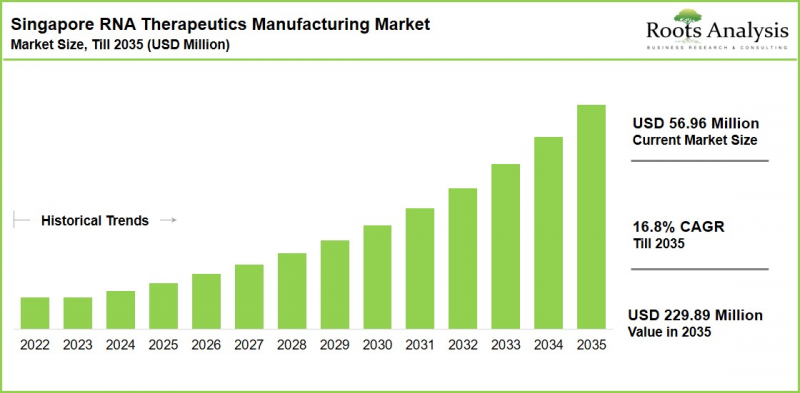
Singapore RNA Therapeutics Manufacturing Market: Growth and Trends
Singapore has emerged as a leading Asia-Pacific hub for RNA therapeutics manufacturing, supported by A*STAR's NATi mRNA BioFoundry and the government's nearly USD 100 million Nucleic Acid Therapeutics Initiative under the RIE plan. As demand for mRNA vaccines, siRNA drugs, ASOs, and saRNA therapies grows, biopharmaceutical companies are evaluating Singapore's LNP formulation, GMP-aligned fill/finish, and HSA regulatory capabilities for clinical- and commercial-scale nucleic acid manufacturing. RNA therapeutics manufacturing is among Singapore's fastest-growing segments, supported by BioNTech's integrated mRNA manufacturing facility and Southeast Asia headquarters, as well as collaborations involving Arcturus Therapeutics and Duke-NUS Medical School in mRNA vaccines and nucleic acid delivery.
Momentum is further supported by major biomanufacturing investments. WuXi Biologics' USD 1.4 billion CRDMO facility and AstraZeneca's USD 1.5 billion ADC facility in Tuas Biomedical Park reinforce Singapore's position as a regional hub for complex, high-value modalities, including nucleic acid therapeutics. Government-backed platforms such as ARTC and BioPIPS are supporting RNA process development, digital automation, and single-use and continuous bioprocessing. These capabilities are expected to shorten the path from research to GMP-scale RNA manufacturing in Singapore.
Growth Drivers: Factors Fueling Market Expansion
Demand for outsourced RNA manufacturing in Singapore is being driven by the global commercialization of mRNA vaccines and the expanding clinical pipeline of siRNA, ASO, and saRNA candidates targeting oncology, infectious disease, rare genetic disorders, and cardiometabolic indications. Pharmaceutical companies without in-house LNP formulation or nucleic acid synthesis capacity are increasingly turning to regional CDMOs and foundry-style infrastructure such as the NATi mRNA BioFoundry to de-risk early-stage development before committing to larger commercial-scale investment.
Singapore's appeal is strengthened by HSA's high regulatory maturity and a biopharmaceutical talent pool that has grown 55% over the past decade to about 9,500 professionals. Government co-investment and ready-to-use infrastructure at Biopolis and Tuas Biomedical Park also provide access to advanced RNA synthesis, purification, and fill/finish capabilities without lengthy facility development timelines.
Market Challenges: Critical Barriers Hindering Progress
Despite high growth momentum, Singapore's RNA therapeutics manufacturing market faces constraints that may hinder the market progress. Some of the potential challenges include high capital intensity for LNP formulation and cold-chain-dependent fill / finish infrastructure, a still-developing base of commercial-scale (as opposed to gram- or kilogram-scale foundry) RNA manufacturing capacity, and competition from established regional hubs in Australia (Victoria) and South Korea that have attracted parallel mRNA investment from Moderna and BioNTech. Additionally, the technical complexity of scaling saRNA and circRNA platforms, combined with evolving global regulatory expectations for novel nucleic acid modalities, continues to add cost and time to manufacturing programs.
For distributors and logistics partners, entering this market requires validated ultra-cold-chain infrastructure and GMP-compliant handling protocols due to the temperature sensitivity of LNP-formulated RNA products. This higher standard favors specialized providers over general-purpose logistics companies.
Singapore RNA Therapeutics Manufacturing Market: Key Insights
- The NATi mRNA BioFoundry, launched by A*STAR, is positioned as Asia's first facility dedicated to gram-scale mRNA manufacturing, giving Singapore an early-mover foundry model that complementsrather than competes with commercial-scale CDMO capacity being built by multinational sponsors.
- BioNTech's decision to base its Southeast Asia regional headquarters and first regional mRNA manufacturing facility in Singapore signals sustained multinational confidence in the country as a nucleic acid therapeutics manufacturing base, extending beyond one-off vaccine production into broader mRNA drug substance capability.
- Distributors and specialty logistics providers with validated ultra-cold-chain and GMP-aligned handling infrastructure are emerging as critical enablers of RNA drug supply chains, given the instability of LNP-formulated nucleic acid products relative to conventional small-molecule and biologic drugs.
- Government co-funding through the USD 100 million Nucleic Acid Therapeutics Initiative is lowering the capital barrier for translational research, creating a pipeline of early-stage RNA candidates that will require outsourced GMP manufacturing partners as they progress toward clinical and commercial scale.
- Large parallel investments in adjacent WuXi Biologics' USD 1.4 billion CRDMO facility and AstraZeneca's USD 1.5 billion ADC facility, both in Tuas Biomedical Park indicate that Singapore's biomanufacturing infrastructure, workforce, and supplier base are being built for multi-modality flexibility, an advantage for RNA-focused entrants seeking shared utilities, talent, and raw-material supply chains.
- Distribution and channel partners are increasingly expected to compete on value-added services - regulatory documentation support, temperature-controlled transport validated for LNP stability, and inventory management for high-value RNA drug substance rather than on logistics cost alone.
- Academic-industry linkages, particularly Duke-NUS Medical School's nucleic acid delivery research and A*STAR's biofoundry infrastructure, are shortening the distance between discovery-stage RNA science and GMP-ready manufacturing processes, a structural advantage relative to markets where research and manufacturing capacity are geographically separated.
Recent Deal Activity Signalling Investor Momentum
- A*STAR launched the NATi mRNA BioFoundry, Asia's first facility dedicated to gram-scale mRNA manufacturing, under the Nucleic Acid Therapeutics Initiative.
- WuXi Biologics broke ground on a USD 1.4 billion CRDMO facility in Tuas Biomedical Park, expanding Singapore's large-scale biologics and nucleic acid-adjacent manufacturing capacity.
- AstraZeneca advanced plans for a USD 1.5 billion end-to-end antibody-drug conjugate facility in Tuas, reinforcing Singapore's positioning for complex, high-value biomanufacturing modalities.
- Novartis broke ground on a USD 256 million expansion of its Singapore biopharmaceutical manufacturing site, expected to be operational in early 2026, deploying digital and automation solutions relevant to next-generation manufacturing platforms.
- BioNTech announced the establishment of its Southeast Asia regional headquarters and first regional mRNA manufacturing facility in Singapore, supported by the Singapore Economic Development Board (EDB).
Singapore RNA Therapeutics Manufacturing Market Segments
The market sizing and opportunity analysis has been segmented across the following parameters:
By Type of RNA Therapeutic
- Messenger RNA (mRNA)
- Small Interfering RNA (siRNA)
- Antisense Oligonucleotides (ASOs)
- Self-Amplifying RNA (saRNA)
- Other RNA Modalities
By Type of Service Offered
- RNA Drug Substance Manufacturing (Synthesis / IVT)
- Lipid Nanoparticle (LNP) Formulation and Encapsulation
- Drug Product / Fill-Finish Operations
- Analytical Testing and Quality Control
By Application Area
- Infectious Disease Vaccines
- Oncology
- Rare and Genetic Disorders
- Cardiometabolic
- Other Chronic Disorders
By Scale of Operation
- Preclinical / Clinical (Foundry) Scale
- Commercial Scale
By End User
- Big Pharmaceutical Companies
- Small and Mid-Sized Biotechnology Companies
- Academic and Government Research Institutes
Singapore RNA Therapeutics Manufacturing Market: Key Segment Insights
mRNA Leads the Type of RNA Segment
Reflecting the global commercial precedent set by mRNA vaccines and Singapore's early foundry-scale infrastructure investment, the mRNA segment currently represents the largest share of activity within the Singapore RNA therapeutics manufacturing market. The presence of BioNTech's regional mRNA manufacturing facility and A*STAR's gram-scale biofoundry gives Singapore a concentration of mRNA-specific capability that siRNA, ASO, and saRNA segments are still building toward, though these modalities are expected to register comparatively higher growth as regional clinical pipelines mature.
LNP Formulation Emerges as Growing Segment
Because many RNA therapeutics use LNP-based delivery rather than stating that most require LNP encapsulation and fill-finish services are increasingly cited by sponsors as the most capacity-constrained stage of the Singapore RNA manufacturing value chain. Providers that can offer validated, GMP-aligned LNP formulation alongside downstream fill-finish are positioned to capture a disproportionate share of outsourcing demand relative to synthesis-only providers.
Foundry-Scale Operations Bridge Research and Commercial Manufacturing
The NATi mRNA BioFoundry's gram-scale, non-GMP model occupies a distinct niche relative to multinational commercial-scale investment from BioNTech, Novartis, and WuXi Biologics, enabling Singapore to support the full continuum from discovery-stage RNA candidates through to clinical and eventual commercial-scale manufacturing without requiring every sponsor to build proprietary infrastructure.
Example Players in Singapore RNA Therapeutics Manufacturing Market
- A*STAR (NATi mRNA BioFoundry)
- AstraZeneca
- BioNTech
- Duke-NUS Medical School
- GenScript Biotech
- Novartis
- Sanofi
- WuXi Biologics
SINGAPORE RNA THERAPEUTICS MANUFACTURING MARKET: RESEARCH COVERAGE
- Market Sizing and Opportunity Analysis: An in-depth analysis of the Singapore RNA therapeutics manufacturing market focusing on key segments, including type of RNA, type of service offered, application area, scale of operation, end user, and facility location.
- RNA Manufacturing Landscape: A detailed assessment of active and planned RNA manufacturing facilities in Singapore, featuring information on year of establishment, operator, facility location, scale of operation, and range of services offered.
- Company Profiles: In-depth profiles of prominent players engaged in Singapore RNA therapeutics manufacturing, covering year of establishment, headquarters, facility scale, service portfolio, and key recent initiatives.
- Case Study (LNP Formulation Capacity): A focused assessment of lipid nanoparticle formulation and fill-finish capacity in Singapore, covering current capability, bottlenecks, and outsourcing implications for sponsors and distributors.
- Make versus Buy Decision-Making Framework: A concise framework evaluating in-house RNA manufacturing versus outsourcing to Singapore-based CDMOs and foundry infrastructure, using predefined assumptions and scenario-based analysis.
- Partnerships and Collaborations: An analysis of partnerships and collaborations inked by Singapore RNA therapeutics manufacturers and research institutes, based on parameters such as year of partnership, type of partnership, and most active players.
- Funding and Investments Analysis: A detailed analysis of funding and investments in Singapore's RNA therapeutics manufacturing ecosystem, including government co-investment, corporate capital expenditure, and venture funding.
- Recent Expansions Analysis: A comprehensive assessment of recent facility expansions in Singapore relevant to RNA and adjacent biomanufacturing, analyzing trends by investment size, facility location, and most active companies.
- SWOT Analysis: A strategic assessment of the Singapore RNA therapeutics manufacturing market, evaluating strengths, weaknesses, opportunities, and threats relative to competing Asia-Pacific hubs.
KEY QUESTIONS ANSWERED IN THIS REPORT
- What is the current and projected size of the Singapore RNA therapeutics manufacturing market?
- Which type of RNA therapeutic (mRNA, siRNA, ASO, saRNA) commands the largest share of manufacturing activity in Singapore?
- Which companies and institutes lead RNA manufacturing capability in Singapore, and what services do they offer?
- What are the key growth drivers and challenges facing RNA therapeutics manufacturers in Singapore?
- How does Singapore's RNA manufacturing capacity compare with competing Asia-Pacific hubs such as Australia and South Korea?
- What opportunities exist for distributors, cold-chain logistics providers, and channel partners entering this space?
- What government initiatives and funding programs are shaping the market's trajectory?
- Which facility locations within Singapore (Biopolis, Tuas Biomedical Park) are attracting the most RNA-related investment?
REASONS TO BUY THIS REPORT
This report is designed to give distributors, channel partners, and investors a decisive analytical edge in a fast-emerging, high-value manufacturing niche. Its core differentiators include:
- Distribution and Channel-Partner Lens: Unlike conventional CDMO capability reports, this study explicitly maps the cold-chain, logistics, and value-added service opportunities available to distribution partners entering Singapore's RNA therapeutics supply chain.
- Modality-Specific Segmentation: Six-parameter segmentation (RNA type, service type, application, scale, end user, facility location) enables precise opportunity sizing for any go-to-market or investment thesis specific to nucleic acid manufacturing.
- Primary Research-Backed Insights: Findings are designed to be validated through direct interviews with manufacturing, regulatory, and commercial leaders across Singapore's RNA ecosystem, ensuring insights reflect real operating conditions rather than desk research alone.
- Singapore-Specific Regulatory and Infrastructure Context: Detailed coverage of the HSA regulatory framework, Biopolis and Tuas Biomedical Park infrastructure, and government co-funding programs relevant to nucleic acid therapeutics.
- Competitive Benchmarking: Positioning of Singapore against competing Asia-Pacific RNA manufacturing hubs, supporting location and partner selection decisions.
ADDITIONAL BENEFITS
- Complementary PPT Insights Pack
- Complementary Excel Data Pack for all Analytical Modules in the Report
- 15% Free Content Customization
- Detailed Report Walkthrough Session with Research Team
- Free Updated Report if the Report is 6-12 Months Old or Older
TABLE OF CONTENTS
1. PREFACE
- 1.1. Introduction
- 1.2. Market Share Insights
- 1.3. Key Market Insights
- 1.4. Report Coverage
- 1.5. Key Questions Answered
- 1.6. Chapter Outlines
2. RESEARCH METHODOLOGY
- 2.1. Chapter Overview
- 2.2. Research Assumptions
- 2.3. Database Building
- 2.3.1. Data Collection
- 2.3.2. Data Validation
- 2.3.3. Data Analysis
- 2.4. Project Methodology
- 2.4.1. Secondary Research
- 2.4.1.1. Annual Reports
- 2.4.1.2. Academic Research Papers
- 2.4.1.3. Company Websites
- 2.4.1.4. Investor Presentations
- 2.4.1.5. Regulatory Filings
- 2.4.1.6. White Papers
- 2.4.1.7. Industry Publications
- 2.4.1.8. Conferences and Seminars
- 2.4.1.9. Government Portals
- 2.4.1.10. Media and Press Releases
- 2.4.1.11. Newsletters
- 2.4.1.12. Industry Databases
- 2.4.1.9. Roots Proprietary Databases
- 2.4.1.14. Paid Databases and Sources
- 2.4.1.15. Social Media Portals
- 2.4.1.16. Other Secondary Sources
- 2.4.2. Primary Research
- 2.4.2.1. Introduction
- 2.4.2.2. Types
- 2.4.2.2.1. Qualitative
- 2.4.2.2.2. Quantitative
- 2.4.2.3. Advantages
- 2.4.2.4. Techniques
- 2.4.2.4.1. Interviews
- 2.4.2.4.2. Surveys
- 2.4.2.4.3. Focus Groups
- 2.4.2.4.4. Observational Research
- 2.4.2.4.5. Social Media Interactions
- 2.4.2.5. Stakeholders
- 2.4.2.5.1. Company Executives (CXOs)
- 2.4.2.5.2. Board of Directors
- 2.4.2.5.3. Company Presidents and Vice Presidents
- 2.4.2.5.4. Key Opinion Leaders
- 2.4.2.5.5. Research and Development Heads
- 2.4.2.5.6. Technical Experts
- 2.4.2.5.7. Subject Matter Experts
- 2.4.2.5.8. Scientists
- 2.4.2.5.9. Doctors and Other Healthcare Providers
- 2.4.2.6. Ethics and Integrity
- 2.4.2.6.1. Research Ethics
- 2.4.2.6.2. Data Integrity
- 2.4.3. Analytical Tools and Databases
- 2.4.1. Secondary Research
3. MARKET DYNAMICS
- 3.1. Forecast Methodology
- 3.1.1. Top-Down Approach
- 3.1.2. Bottom-Up Approach
- 3.1.3. Hybrid Approach
- 3.2. Market Assessment Framework
- 3.2.1. Total Addressable Market (TAM)
- 3.2.2. Serviceable Addressable Market (SAM)
- 3.2.3. Serviceable Obtainable Market (SOM)
- 3.2.4. Currently Acquired Market (CAM)
- 3.3. Forecasting Tools and Techniques
- 3.3.1. Qualitative Forecasting
- 3.3.2. Correlation
- 3.3.3. Regression
- 3.3.4. Time Series Analysis
- 3.3.5. Extrapolation
- 3.3.6. Convergence
- 3.3.7. Forecast Error Analysis
- 3.3.8. Data Visualization
- 3.3.9. Scenario Planning
- 3.3.10. Sensitivity Analysis
- 3.4. Key Considerations
- 3.4.1. Demographics
- 3.4.2. Market Access
- 3.4.3. Reimbursement Scenarios
- 3.4.4. Industry Consolidation
- 3.5. Robust Quality Control
- 3.6. Key Market Segmentations
- 3.7. Limitations
4. MACRO-ECONOMIC INDICATORS
- 4.1. Chapter Overview
- 4.2. Market Dynamics
- 4.2.1. Time Period
- 4.2.1.1. Historical Trends
- 4.2.1.2. Current and Forecasted Estimates
- 4.2.2. Currency Coverage
- 4.2.2.1. Overview of Major Currencies Affecting the Market
- 4.2.2.2. Impact of Currency Fluctuations on the Industry
- 4.2.3. Foreign Exchange Impact
- 4.2.3.1. Evaluation of Foreign Exchange Rates and Their Impact on Market
- 4.2.3.2. Strategies for Mitigating Foreign Exchange Risk
- 4.2.4. Recession
- 4.2.4.1. Historical Analysis of Past Recessions and Lessons Learnt
- 4.2.4.2. Assessment of Current Economic Conditions and Potential Impact on the Market
- 4.2.5. Inflation
- 4.2.5.1. Measurement and Analysis of Inflationary Pressures in the Economy
- 4.2.5.2. Potential Impact of Inflation on the Market Evolution
- 4.2.6. Interest Rates
- 4.2.6.1. Overview of Interest Rates and Their Impact on the Market
- 4.2.6.2. Strategies for Managing Interest Rate Risk
- 4.2.7. Commodity Flow Analysis
- 4.2.7.1. Type of Commodity
- 4.2.7.2. Origins and Destinations
- 4.2.7.3. Values and Weights
- 4.2.7.4. Modes of Transportation
- 4.2.8. Global Trade Dynamics
- 4.2.8.1. Import Scenario
- 4.2.8.2. Export Scenario
- 4.2.9. War Impact Analysis
- 4.2.9.1. Russian-Ukraine War
- 4.2.9.2. Israel-Hamas War
- 4.2.10. COVID Impact / Related Factors
- 4.2.10.1. Global Economic Impact
- 4.2.10.2. Industry-specific Impact
- 4.2.10.3. Government Response and Stimulus Measures
- 4.2.10.4. Future Outlook and Adaptation Strategies
- 4.2.11. Other Indicators
- 4.2.11.1. Fiscal Policy
- 4.2.11.2. Consumer Spending
- 4.2.11.3. Gross Domestic Product (GDP)
- 4.2.11.4. Employment
- 4.2.11.5. Taxes
- 4.2.11.6. R&D Innovation
- 4.2.11.7. Stock Market Performance
- 4.2.11.8. Supply Chain
- 4.2.11.9. Cross-Border Dynamics
- 4.2.1. Time Period
5. EXECUTIVE SUMMARY
6. INTRODUCTION
- 6.1. Chapter Overview
- 6.2. Overview of Singapore RNA Therapeutics Manufacturing
- 6.2.1. Key Characteristics of Singapore RNA Therapeutics Manufacturing
- 6.2.2. Key Applications of the Singapore RNA Therapeutics Manufacturing
- 6.2.3. Challenges Associated with Singapore RNA Therapeutics Manufacturing
- 6.3. Future Perspective
7. COMPETITIVE LANDSCAPE
- 7.1. Chapter Overview
- 7.2. Singapore RNA Therapeutics Manufacturing: Overall Market Landscape
- 7.2.1. Analysis by Year of Establishment
- 7.2.2. Analysis by Company Size
- 7.2.3. Analysis by Location of Headquarters
- 7.2.4. Singapore RNA Therapeutics Manufacturing Market: Overall Market Landscape
- 7.2.4.1. Analysis by Type of RNA
- 7.2.4.2. Analysis by Type of Service Offered
- 7.2.4.3. Analysis by Application Area
- 7.2.4.4. Analysis by Scale of Operation
- 7.2.4.5. Analysis by End User
8. COMPANY COMPETITIVENESS ANALYSIS
- 8.1. Chapter Overview
- 8.2. Assumptions and Key Parameters
- 8.3. Methodology
- 8.4. Overview of Peer Groups Based in Singapore
9. COMPANY PROFILES
- 9.1. Chapter Overview
- 9.2. A*STAR Bioprocessing Technology Institute (Research and Technology-Transfer Partner)
- 9.2.1. Company Overview
- 9.2.2. Company Mission
- 9.2.3. Company Footprint
- 9.2.4. Management Team
- 9.2.5. Contact Details
- 9.2.6. Financial Performance
- 9.2.7. Operating Business Segments
- 9.2.8. Product Portfolio
- 9.2.9. MOAT Analysis
- 9.2.10. Recent Developments and Future Outlook
- similar detail is presented for other below mentioned companies based on information in the public domain
- 9.3. AstraZeneca
- 9.4. BioNTech
- 9.5. Duke-NUS Medical School
- 9.6. GenScript Biotech
- 9.7. Novartis
- 9.8. Sanofi
- 9.9. WuXi Biologics
10. PARTNERSHIPS AND COLLABORATIONS
- 10.1. Chapter Overview
- 10.2. Partnership Models
- 10.3. Singapore RNA Therapeutics Manufacturing: Partnerships and Collaborations
- 10.3.1. Analysis by Year of Partnership
- 10.3.2. Analysis by Type of Partnership
- 10.3.3. Analysis by Year and Type of Partnership
- 10.3.4. Analysis by Type of Partner
- 10.3.5. Analysis by Type of Partnership and Type of Partner
- 10.3.6. Most Active Players: Analysis by Number of Partnerships
- 10.4. Analysis by Region
- 10.4.1. Local and International Agreements
- 10.4.2. Intracontinental and Intercontinental Agreements
11. FUNDING AND INVESTMENT ANALYSIS
- 11.1. Chapter Overview
- 11.2. Funding Models
- 11.3. Singapore RNA Therapeutics Manufacturing: Funding and Investment Analysis
- 11.3.1. Analysis by Year of Funding
- 11.3.1.1. Cumulative Year-wise Trend of Funding Instances
- 11.3.1.2. Cumulative Year-wise Trend of Amount Invested
- 11.3.2. Analysis by Type of Funding
- 11.3.2.1. Analysis of Funding Instances
- 11.3.2.2. Analysis of Amount Invested
- 11.3.3. Analysis by Year and Type of Funding
- 11.3.4. Analysis of Amount Invested by Year and Type of Funding
- 11.3.5. Analysis by Region
- 11.3.6. Most Active Players
- 11.3.6.1. Analysis by Number of Funding Instances
- 11.3.6.2. Analysis by Amount Raised
- 11.3.6.3. Leading Investors: Analysis by Number of Funding Instances
- 11.3.1. Analysis by Year of Funding
12. MEGA TRENDS
- 12.1. Chapter Overview
- 12.2. Singapore RNA Therapeutics Manufacturing: Key Megatrends
13. MARKET IMPACT ANALYSIS
- 13.1. Chapter Overview
- 13.2. Market Drivers
- 13.3. Market Restraints
- 13.4. Market Opportunities
- 13.5. Market Challenges
- 13.6. Conclusion
14. SINGAPORE RNA THERAPEUTICS MANUFACTURING MARKET
- 14.1. Chapter Overview
- 14.2. Key Assumptions and Methodology
- 14.3. Global Singapore RNA Therapeutics Manufacturing Market, Historical Trends (Since 2020) and Forecasted Estimates (Till 2035)
- 14.4. Multivariate Scenario Analysis
- 14.4.1. Conservative Scenario
- 14.4.2. Optimistic Scenario
- 14.5. Investment Feasibility Index
- 14.6. Key Market Segmentations
15. MARKET OPPORTUNITIES BASED ON TYPE OF RNA THERAPEUTIC
- 15.1. Chapter Overview
- 15.2. Key Assumptions and Methodology
- 15.3. Singapore RNA Therapeutics Manufacturing Market for Messenger RNA (mRNA): Historical Trends (Since 2020) and Forecasted Estimates (Till 2035)
- 15.4. Singapore RNA Therapeutics Manufacturing Market for Small Interfering RNA (siRNA): Historical Trends (Since 2020) and Forecasted Estimates (Till 2035)
- 15.5. Singapore RNA Therapeutics Manufacturing Market for Antisense Oligonucleotides (ASOs): Historical Trends (Since 2020) and Forecasted Estimates (Till 2035)
- 15.6. Singapore RNA Therapeutics Manufacturing Market for Self-Amplifying RNA (saRNA): Historical Trends (Since 2020) and Forecasted Estimates (Till 2035)
- 15.7. Singapore RNA Therapeutics Manufacturing Market for Other RNA Modalities: Historical Trends (Since 2020) and Forecasted Estimates (Till 2035)
- 15.8. Data Triangulation and Validation
- 15.8.1. Secondary Sources
- 15.8.2. Primary Sources
- 15.8.3. Statistical Modeling
16. MARKET OPPORTUNITIES BASED ON TYPE OF SERVICE OFFERED
- 16.1. Chapter Overview
- 16.2. Key Assumptions and Methodology
- 16.3. Singapore RNA Therapeutics Manufacturing Market for RNA Drug Substance Manufacturing (Synthesis / IVT): Historical Trends (Since 2020) and Forecasted Estimates (Till 2035)
- 16.4. Singapore RNA Therapeutics Manufacturing Market for Lipid Nanoparticle (LNP) Formulation and Encapsulation: Historical Trends (Since 2020) and Forecasted Estimates (Till 2035)
- 16.5. Singapore RNA Therapeutics Manufacturing Market for Drug Product / Fill-Finish Operations: Historical Trends (Since 2020) and Forecasted Estimates (Till 2035)
- 16.6. Singapore RNA Therapeutics Manufacturing Market for Analytical Testing and Quality Control: Historical Trends (Since 2020) and Forecasted Estimates (Till 2035)
- 16.7. Data Triangulation and Validation
- 16.7.1. Secondary Sources
- 16.7.2. Primary Sources
- 16.7.3. Statistical Modeling
17. MARKET OPPORTUNITIES BASED ON APPLICATION AREA
- 17.1. Chapter Overview
- 17.2. Key Assumptions and Methodology
- 17.3. Singapore RNA Therapeutics Manufacturing Market for Infectious Disease Vaccines: Historical Trends (Since 2020) and Forecasted Estimates (Till 2035)
- 17.4. Singapore RNA Therapeutics Manufacturing Market for Oncology: Historical Trends (Since 2020) and Forecasted Estimates (Till 2035)
- 17.5. Singapore RNA Therapeutics Manufacturing Market for Rare and Genetic Disorders: Historical Trends (Since 2020) and Forecasted Estimates (Till 2035)
- 17.6. Singapore RNA Therapeutics Manufacturing Market for Cardiometabolic: Historical Trends (Since 2020) and Forecasted Estimates (Till 2035)
- 17.7. Singapore RNA Therapeutics Manufacturing Market for Other Chronic Disorders: Historical Trends (Since 2020) and Forecasted Estimates (Till 2035)
- 17.8. Data Triangulation and Validation
- 17.8.1. Secondary Sources
- 17.8.2. Primary Sources
- 17.8.3. Statistical Modeling
18. MARKET OPPORTUNITIES BASED ON TYPE OF SCALE OF OPERATION
- 18.1. Chapter Overview
- 18.2. Key Assumptions and Methodology
- 18.3. Singapore RNA Therapeutics Manufacturing Market for Preclinical / Clinical (Foundry) Scale: Historical Trends (Since 2020) and Forecasted Estimates (Till 2035)
- 18.4. Singapore RNA Therapeutics Manufacturing Market for Commercial Scale: Historical Trends (Since 2020) and Forecasted Estimates (Till 2035)
- 18.5. Data Triangulation and Validation
- 18.5.1. Secondary Sources
- 18.5.2. Primary Sources
- 18.5.3. Statistical Modeling
19. MARKET OPPORTUNITIES BASED ON TYPE OF END USER
- 19.1. Chapter Overview
- 19.2. Key Assumptions and Methodology
- 19.3. Singapore RNA Therapeutics Manufacturing Market in Big Pharmaceutical Companies: Historical Trends (Since 2020) and Forecasted Estimates (Till 2035)
- 19.4. Singapore RNA Therapeutics Manufacturing Market in the Small and Mid-Sized Biotechnology Companies: Historical Trends (Since 2020) and Forecasted Estimates (Till 2035)
- 19.5. Singapore RNA Therapeutics Manufacturing Market in the Academic and Government Research Institutes: Historical Trends (Since 2020) and Forecasted Estimates (Till 2035)
- 19.6. Data Triangulation and Validation
21. KEY WINNING STRATEGIES
22. ROOTS STRATEGIC RECOMMENDATIONS
23. REPORT CONCLUSION
24. TABULATED DATA
25. LIST OF COMPANIES AND ORGANIZATIONS

