PUBLISHER: Roots Analysis | PRODUCT CODE: 2161677

PUBLISHER: Roots Analysis | PRODUCT CODE: 2161677
Automated Rapid Microbiology Testing Platforms Market - Trends and Forecast Till 2035
AUTOMATED RAPID MICROBIOLOGY TESTING PLATFORMS MARKET: OVERVIEW
The global automated rapid microbiology testing platforms market is valued at USD 51.7 million in the current year, before climbing to USD 108.7 million by 2035, reflecting a CAGR of 8.6% during the forecast period.
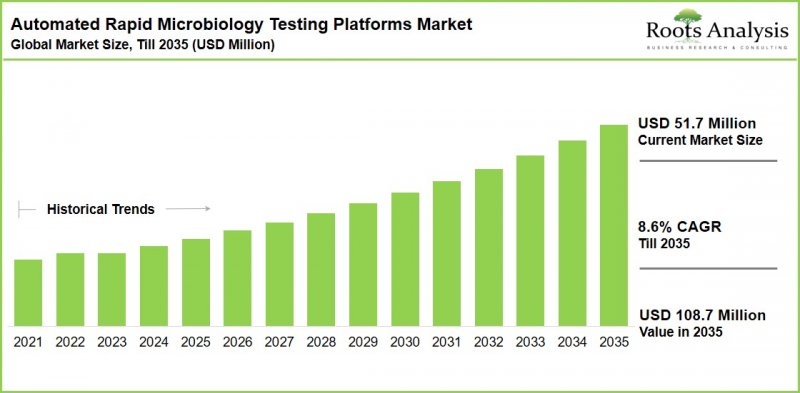
Automated Rapid Microbiology Testing Platforms Market: Growth and Trends
Automated rapid microbiology testing (RMT) platforms integrate automated sample handling, incubation, and rapid detection technologies to accelerate microbial detection and sterility testing. These technologies can reduce testing timelines from days to hours, addressing the growing need for faster quality-control and batch-release decisions across pharmaceutical and biopharmaceutical manufacturing.
The expanding production of biologics, cell and gene therapies, and other sterility-sensitive products is accelerating the transition from conventional culture-based microbiology toward automated rapid microbial methods (RMMs). Shorter product shelf lives, compressed batch-release windows, and increasing regulatory focus on contamination control and data integrity are further strengthening demand among pharmaceutical manufacturers, CDMOs, and clinical laboratories. Adoption is also extending into food safety and clinical diagnostics, where faster microbial detection can improve operational efficiency and response times.
Beyond automation, the market is moving toward connected and intelligent microbiology workflows. Platform providers are integrating RMT systems with laboratory information management systems (LIMS), electronic quality management systems (eQMS), and AI-enabled analytics to support predictive quality control, remote monitoring, automated decision-making, and end-to-end audit-trail traceability. This evolution is shifting microbiology laboratories from standalone testing environments toward high-throughput, data-driven quality-control ecosystems.
As connected microbiology becomes increasingly important across regulated end markets, market players will be capable of offering interoperable, scalable, high-throughput, and validated solutions to meet the emerging demand. Competitive advantage will increasingly depend not only on detection speed, but also on seamless system integration, regulatory compliance, data connectivity, and the ability to support standardized workflows across complex laboratory environments.
Growth Drivers: Factors Fueling Market Expansion
High demand for faster microbiological results across regulated industries is a key growth driver of the market. Conventional culture-based testing can take five to seven days, which delays product release and inflates inventory holding costs. However, the automated platforms built on ATP bioluminescence, flow cytometry, nucleic acid amplification, and automated imaging cut this to roughly 24-48 hours, which in turn improve batch-release velocity and working-capital efficiency for manufacturers.
Further, the intensifying regulatory emphasis on quality assurance and data integrity is a second major driver. Regulatory agencies are encouraging manufacturers to adopt standardized, electronically documented workflows that reduce operator variability. Growing adoption of Quality by Design (QbD), Process Analytical Technology (PAT), and digital quality management systems is further driving demand for automated, audit-ready microbiology testing infrastructure.
Market Challenges: Critical Barriers Hindering Progress
High capital investment and total cost of ownership remain key challenges that may impact the market growth. Notably, automated rapid microbiology platforms require significant upfront investment in instruments, software integration, and laboratory automation. Repeating costs for consumables, validation, and staff training can further limit adoption, particularly among small and mid-sized manufacturers and contract testing laboratories.
Limited standardization across sample types and applications is another significant challenge that hinders market progress. No single platform is universally suited for all types of microorganisms, product matrices, or testing use cases. This often requires customized workflows or a combination of automated and conventional methods, making platform selection more complex and slowing adoption.
Recent Developments Signaling Market Momentum
- bioMerieux launched GENE-UP(R) TYPER SLM, a real-time PCR solution enabling faster Salmonella strain discrimination and automated decision-making for food safety and contamination-control workflows.
- Symcel launched caloTrace, a biocalorimetry-based rapid microbial testing platform featuring independently loaded calorimetric channels, random-access operation, and automated result interpretation.
- Q-linea secured US FDA 510(k) clearance for an expanded ASTar(R) Gram-negative Blood Culture test menu, an automated phenotypic antimicrobial susceptibility testing platform that delivers results directly from positive blood cultures in roughly six to seven hours.
Collectively, these launches and regulatory clearances underscore sustained innovation momentum and validate the strategic case for distributors and investors evaluating exposure to the automated rapid microbiology testing platforms space.
Automated Rapid Microbiology Testing Platforms Market Segments
The market sizing and opportunity analysis has been segmented across the following parameters:
By Type of Modality
- Biologics (Monoclonal Antibodies, Vaccines, Cell and Gene Therapies, and Other Biologics)
- Small Molecules
- Radiopharmaceuticals
By Type of Offering
- Consumables
- Instruments
- Software and Services
By Method of Testing
- Growth-Based Methods
- Nucleic Acid-based Methods
- Cellular Component-based Methods
- Viability-Based Methods
- Immunological Methods
- Microfluidic Methods
- Other Methods
By Type of Pathogen
- Bacteria
- Viruses
- Fungi
- Endotoxins
- Mycoplasmas
By Application Area
- Sterility Testing
- Bioburden Testing
- Microbial Identification
- Endotoxin Testing
- Mycoplasma Testing
By End User
- Drug Developers
- Contract Manufacturers
By Geographical Regions
- North America (US, Canada)
- Europe (Germany, UK, France, Italy, Spain, Rest of Europe)
- Asia-Pacific (China, Japan, South Korea, Australia)
- Middle East and North Africa
- Latin America
Automated Rapid Microbiology Testing Platforms Market: Key Segment Insights
Biologics Lead the Type of Modality Segment
Based on current market assessment, the biologics segment accounts for the highest market share. This dominance is driven by the inherently high sterility requirements and process complexity associated with biologics manufacturing. Manufacturers of monoclonal antibodies, vaccines, and cell and gene therapies are increasingly adopting automated rapid microbiology platforms to accelerate sterility testing and batch release. The radiopharmaceuticals segment, though smaller today, is projected to register the highest CAGR during the forecast period given the short half-life of radioactive isotopes and the resulting need for near-instant microbial release testing.
Consumables Dominate the Offering Segment
Consumables including reagents, cartridges, growth media, and single-use assay kits currently capture the largest share of the market. This recurring revenue model strengthens the market's long-term value. Each installed instrument generates ongoing demand for consumables, creating a stable, annuity-like revenue stream for distributors and channel partners.
Growth-Based Methods Lead Testing Technologies
Growth-based detection methods currently capture the largest share of the testing-method segment and are likely to remain dominant during the forecast period. This is largely because of their established regulatory acceptance and broad applicability across pathogen types. Nucleic acid-based and cellular component-based methods, including PCR and MALDI-TOF platforms, continue to expand their footprint in applications demanding faster, more specific pathogen identification.
Bacteria Represents the Leading Pathogen Segment
Among pathogen types, bacteria account for the largest market share. This high share is supported by mature, commercially validated detection technologies spanning ATP bioluminescence, flow cytometry, automated imaging, and nucleic acid amplification. The viruses segment is expected to grow at a comparatively higher CAGR, propelled by rising regulatory scrutiny of adventitious virus detection and expanding viral vector manufacturing for gene therapies and mRNA vaccines.
Sterility Testing Leads Application Areas
Sterility testing dominates current application-area demand. This dominance is largely because sterility testing is a mandatory release requirement across injectable biologics, cell and gene therapies, and other aseptically manufactured products. Bioburden testing, microbial identification, endotoxin testing, and mycoplasma testing represent complementary, fast-growing application areas as biologic pipelines diversify.
Drug Developers Represent the Largest End-User Segment
Drug developers currently account for the largest share of end-user demand. This high share reflects their direct responsibility for product release testing and regulatory compliance. Contract manufacturers represent a fast-growing end-user category as outsourcing of both drug substance and drug product manufacturing continues to expand across the biopharmaceutical industry.
North America Leads the Market; Asia-Pacific Registers the Fastest Growth
North America currently holds the highest regional market share and is likely to remain dominant in the future. This highest share is underpinned by a dense concentration of biopharmaceutical manufacturing facilities, high adoption of Industry 4.0 and laboratory-automation technologies, and mature electronic quality management system (eQMS) infrastructure that supports seamless integration of automated microbiology platforms into existing QC workflows. Asia-Pacific is projected to expand at a comparatively faster CAGR through 2035. This unprecedented growth is largely because the region transitions from cost-driven to value-driven, globally compliant manufacturing and expands exports into strictly regulated markets such as the US and Europe.
Example Players in the Automated Rapid Microbiology Testing Platforms Market
- BD
- bioMerieux
- Charles River Laboratories
- Lonza
- Merck
- Neogen
- Rapid Micro Biosystems
- Thermo Fisher Scientific
Expert and Industry Insights
The opinions and insights presented in this study were shaped by discussions with multiple stakeholders across the automated rapid microbiology testing value chain. Stacey Ramsey, Senior Manager, Microbial Applications Lab at Charles River Laboratories, observed that as the pharmaceutical industry increasingly targets orphan diseases, rare cancers, and previously untreatable infections, quality control can no longer take fourteen days, and rapid microbial methods have moved from a nice-to-have to an operational necessity.
The automated rapid microbiology testing platforms market report includes detailed transcripts of interviews conducted with the following individuals:
- Founder and Managing Director, Small Organization, Germany
- Chief Operating Officer and Chief Financial Officer, Small Organization, Switzerland
- Senior Vice President of Sales, Small Organization, United States
- Head of Business Development, Small Organization, Canada
- Technical Sales & Marketing Coordinator, Small Organization, United Kingdom
- Founder and Chief Operating Officer, Small Organization, Netherlands
In addition, the market report includes transcripts of the following third-party discussions:
- President, Small Organization, United States
- Commercial Director, Very Large Company, Germany
- Senior Manager, Very Large Organization, United States
- Microbiology Supervisor, General Manager, Very Large Organization, United Kingdom
- Global Subject Matter Expert - Testing Solutions, Very Large Organization, Switzerland
- Senior Commercial Applications Expert, Very Large Organization, United States
- Manager, Global Product Management, Very Large Organization, Germany
- Country Head: Industrial Application, Very Large Organization, France
- Product Manager, Mid-sized Company, Switzerland
- Product Manager, Mid-sized Company, Switzerland
AUTOMATED RAPID MICROBIOLOGY TESTING PLATFORMS MARKET: RESEARCH COVERAGE
- Market Sizing and Opportunity Analysis: An in-depth analysis of the market focusing on key segments, including type of modality, type of offering, method of testing, type of pathogen, application area, end user, and geographical regions.
- Competitive Landscape and Platform Benchmarking: A detailed assessment of active platform providers, featuring year of establishment, headquarters location, technology base, and range of testing solutions offered.
- Company Profiles: In-depth profiles of prominent players engaged in automated rapid microbiology testing, covering company overview, flagship platforms, technology portfolio, and recent initiatives.
- Distribution and Channel-Partner Landscape: An explicit mapping of the consumables, service, and value-added support opportunities available to distributors and channel partners entering the rapid microbiology testing space.
- Case Study (Rapid versus Conventional Microbiological Methods): A focused comparison of automated rapid methods against traditional culture-based testing, covering turnaround time, cost, regulatory acceptance, and adoption barriers.
- Regulatory Landscape: A review of relevant regulatory frameworks and quality guidelines shaping platform validation and adoption across major markets.
- Partnerships and Collaborations: An analysis of partnerships and collaborations inked by automated rapid microbiology testing platform providers, based on year, type of partnership, technology focus, and most active players.
- Funding and Investment Analysis: A detailed analysis of funding and investments made in this domain, based on year, type of funding, amount invested, geography, and leading investors.
- Recent Developments Analysis: A comprehensive assessment of product launches, regulatory clearances, and platform upgrades, identifying the most active companies by initiative type and quarter.
- Demand Analysis: A comprehensive evaluation of demand across modalities, testing methods, and end-user segments, identifying future outsourcing and distribution opportunities.
- SWOT Analysis: A strategic assessment evaluating the market's key strengths, weaknesses, opportunities, and threats, with actionable insight into its competitive position and growth potential.
KEY QUESTIONS ANSWERED IN THIS REPORT
- Which are the leading companies in the automated rapid microbiology testing platforms market?
- Which region dominates the market, and which is growing the fastest?
- What are the key trends observed in this market?
- What factors are likely to influence the evolution of this market?
- What are the primary challenges faced by automated rapid microbiology testing platform providers and adopters?
- What is the current and future market size?
- What is the CAGR of this market through 2035?
- How is current and future market opportunity distributed across key segments?
- What opportunities exist for distributors and channel partners entering this space?
REASONS TO BUY THIS REPORT
This report is designed to give distributors, channel partners, and investors a decisive analytical edge in a fast-evolving, technology-driven market. Its core differentiators include:
- Top-Down and Bottom-Up Triangulated Forecasting: Market estimates are built using a hybrid methodology that cross-validates top-down macro assessments against bottom-up, company-level installed-base and demand data, minimizing forecast bias.
- Distribution and Channel-Partner Lens: Unlike conventional platform capability reports, this study explicitly maps the consumables, service, and value-added opportunities available to distribution partners entering the rapid microbiology testing supply chain.
- Comprehensive Chapter Coverage: Coverage spanning market sizing, competitive benchmarking, regulatory landscape, funding and partnership analysis, and regional demand mapping across key geographies.
- Primary Research-Backed Insights: Findings are validated through direct interviews with founders, commercial leaders, and technical experts across small, mid-sized, and very large organizations, ensuring insights reflect real operating conditions rather than desk research alone.
- Actionable Segmentation: Seven-parameter segmentation (modality, offering, testing method, pathogen type, application, end user, geography) enables precise opportunity sizing for any go-to-market or investment thesis.
ADDITIONAL BENEFITS
- Complimentary PowerPoint Insights Pack
- Complimentary Excel Data Packs for all Analytical Modules in the Report
- 15% Free Content Customization
- Detailed Report Walkthrough Session with Research Team
- Free Updated Report if the Report is 6-12 Months Old or Older
TABLE OF CONTENTS
1. PREFACE
- 1.1. Scope of the Report
- 1.2. Research Methodology
- 1.3. Market Segmentations
- 1.4. Key Questions Answered
- 1.5. Chapter Outlines
2. RESEARCH METHODOLOGY
- 2.1. Chapter Overview
- 2.2. Research Assumptions
- 2.2.1. Market Landscape and Market Trends
- 2.2.2. Market Forecast and Opportunity Analysis
- 2.2.3. Comparative Analysis
- 2.3. Database Building
- 2.3.1. Data Collection
- 2.3.2. Data Validation
- 2.3.3. Data Analysis
- 2.4. Project Methodology
- 2.4.1. Secondary Research
- 2.4.1.1. Annual Reports
- 2.4.1.2. Academic Research Papers
- 2.4.1.3. Company Websites
- 2.4.1.4. Investor Presentations
- 2.4.1.5. Regulatory Filings
- 2.4.1.6. White Papers
- 2.4.1.7. Industry Publications
- 2.4.1.8. Conferences and Seminars
- 2.4.1.9. Government Portals
- 2.4.1.10. Media and Press Releases
- 2.4.1.11. Newsletters
- 2.4.1.12. Industry Databases
- 2.4.1.13. Roots Proprietary Databases
- 2.4.1.14. Paid Databases and Sources
- 2.4.1.15. Social Media Portals
- 2.4.1.16. Other Secondary Sources
- 2.4.2. Primary Research
- 2.4.2.1. Types of Primary Research
- 2.4.2.1.1. Qualitative Research
- 2.4.2.1.2. Quantitative Research
- 2.4.2.1.3. Hybrid Approach
- 2.4.2.2. Advantages of Primary Research
- 2.4.2.3. Techniques for Primary Research
- 2.4.2.3.1. Interviews
- 2.4.2.3.2. Surveys
- 2.4.2.3.3. Focus Groups
- 2.4.2.3.4. Observational Research
- 2.4.2.3.5. Social Media Interactions
- 2.4.2.4. Key Opinion Leaders Considered in Primary Research
- 2.4.2.4.1. Company Executives (CXOs)
- 2.4.2.4.2. Board of Directors
- 2.4.2.4.3. Company Presidents and Vice Presidents
- 2.4.2.4.4. Research and Development Heads
- 2.4.2.4.5. Technical Experts
- 2.4.2.4.6. Subject Matter Experts
- 2.4.2.4.7. Scientists
- 2.4.2.4.8. Doctors and Other Healthcare Providers
- 2.4.2.5. Ethics and Integrity
- 2.4.2.5.1. Research Ethics
- 2.4.2.5.2. Data Integrity
- 2.4.2.1. Types of Primary Research
- 2.4.3. Analytical Tools and Databases
- 2.4.1. Secondary Research
- 2.5. Robust Quality Control
3. MARKET DYNAMICS
- 3.1. Chapter Overview
- 3.2. Forecast Methodology
- 3.2.1. Top-down Approach
- 3.2.2. Bottom-up Approach
- 3.2.3. Hybrid Approach
- 3.3. Market Assessment Framework
- 3.3.1. Total Addressable Market (TAM)
- 3.3.2. Serviceable Addressable Market (SAM)
- 3.3.3. Serviceable Obtainable Market (SOM)
- 3.3.4. Currently Acquired Market (CAM)
- 3.4. Forecasting Tools and Techniques
- 3.4.1. Qualitative Forecasting
- 3.4.2. Correlation
- 3.4.3. Regression
- 3.4.4. Extrapolation
- 3.4.5. Convergence
- 3.4.6. Sensitivity Analysis
- 3.4.7. Scenario Planning
- 3.4.8. Data Visualization
- 3.4.9. Time Series Analysis
- 3.4.10. Forecast Error Analysis
- 3.5. Key Considerations
- 3.5.1. Demographics
- 3.5.2. Government Regulations
- 3.5.3. Reimbursement Scenarios
- 3.5.4. Market Access
- 3.5.5. Supply Chain
- 3.5.6. Industry Consolidation
- 3.5.7. Pandemic / Unforeseen Disruptions Impact
- 3.6. Limitations
4. MACRO-ECONOMIC INDICATORS
- 4.1. Chapter Overview
- 4.2. Market Dynamics
- 4.2.1. Time Period
- 4.2.1.1. Historical Trends
- 4.2.1.2. Current and Forecasted Estimates
- 4.2.2. Currency Coverage
- 4.2.2.1. Major Currencies Affecting the Market
- 4.2.2.2. Factors Affecting Currency Fluctuations
- 4.2.2.3. Impact of Currency Fluctuations on the Industry
- 4.2.3. Foreign Currency Exchange Rate
- 4.2.3.1. Impact of Foreign Exchange Rate Volatility on the Market
- 4.2.3.2. Strategies for Mitigating Foreign Exchange Risk
- 4.2.4. Recession
- 4.2.4.1. Assessment of Current Economic Conditions and Potential Impact on the Market
- 4.2.4.2. Historical Analysis of Past Recessions and Lessons Learnt
- 4.2.5. Inflation
- 4.2.5.1. Measurement and Analysis of Inflationary Pressures in the Economy
- 4.2.5.2. Potential Impact of Inflation on the Market Evolution
- 4.2.6. Interest Rates
- 4.2.6.1. Interest Rates and Their Impact on the Market
- 4.2.6.2. Strategies for Managing Interest Rate Risk
- 4.2.7. Commodity Flow Analysis
- 4.2.7.1. Type of Commodity
- 4.2.7.2. Origins and Destinations
- 4.2.7.3. Values and Weights
- 4.2.7.4. Modes of Transportation
- 4.2.8. Global Trade Dynamics
- 4.2.8.1. Import Scenario
- 4.2.8.2. Export Scenario
- 4.2.8.3. Trade Policies
- 4.2.8.4. Strategies for Mitigating the Risks Associated with Trade Barriers
- 4.2.8.5. Impact of Trade Barriers on the Market
- 4.2.9. War Impact Analysis
- 4.2.9.1. Russian-Ukraine War
- 4.2.9.2. Israel-Hamas War
- 4.2.10. COVID Impact / Related Factors
- 4.2.10.1. Global Economic Impact
- 4.2.10.2. Industry-specific Impact
- 4.2.10.3. Government Response and Stimulus Measures
- 4.2.10.4. Future Outlook and Adaptation Strategies
- 4.2.11. Other Indicators
- 4.2.11.1. Fiscal Policy
- 4.2.11.2. Consumer Spending
- 4.2.11.3. Gross Domestic Product (GDP)
- 4.2.11.4. Employment
- 4.2.11.5. Taxes
- 4.2.11.6. Stock Market Performance
- 4.2.11.7. Cross-Border Dynamics
- 4.2.1. Time Period
- 4.3. Conclusion
5. EXECUTIVE SUMMARY
- 5.1. Executive Summary: Market Landscape
- 5.2. Executive Summary: Market Trends
- 5.3. Executive Summary: Market Forecast and Opportunity Analysis
6. INTRODUCTION
- 6.1. Overview of Automated Rapid Microbiology Testing Platforms
- 6.2. Key Components of Automated Rapid Microbiology Testing Platforms
- 6.3. Classification of Automated Rapid Microbiological Testing Methods
- 6.4. Key Applications of Automated Rapid Microbiology Testing Platforms
- 6.5. Future Perspectives
7. MARKET LANDSCAPE: AUTOMATED RAPID MICROBIOLOGY TESTING PLATFORMS
- 7.1. Chapter Overview
- 7.2. Automated Rapid Microbiology Testing Platforms: Overall Market Landscape
- 7.2.1. Analysis by Year of Establishment
- 7.2.2. Analysis by Company Size
- 7.2.3. Analysis by Location of Headquarters
- 7.2.4. Analysis by Company Ownership
- 7.2.5. Analysis by Type of Offering
- 7.2.6. Analysis by Method of Testing
- 7.2.7. Analysis by Mode of Testing
- 7.2.8. Analysis by Type of Pathogen
- 7.2.9. Analysis by Application Area
- 7.2.10. Analysis by End User
8. COMPANY COMPETITIVENESS ANALYSIS
- 8.1. Chapter Overview
- 8.2. Assumptions and Key Parameters
- 8.3. Methodology
- 8.4. Automated Rapid Microbiology Testing Platforms: Company Competitiveness Analysis
- 8.4.1. Established Players (Peer Group I)
- 8.4.2. Emerging Players (Peer Group II)
9. COMPANY PROFILES
- 9.1. Chapter Overview
- 9.2. BD
- 9.2.1. Company Overview
- 9.2.2. Financial Information
- 9.2.3. Product Portfolio
- 9.2.4. Recent Developments and Future Outlook
- Similar details are presented for other below mentioned companies based on information in the public domain
- 9.3. bioMerieux
- 9.4. Charles River Laboratories
- 9.5. Lonza
- 9.6. Merck
- 9.7. Neogen
- 9.8. Rapid Micro Biosystems
- 9.9. Thermo Fisher Scientific
10. RECENT DEVELOPMENTS
- 10.1. Chapter Overview
- 10.2. Partnerships and Collaborations
- 10.2.1. Partnership Models
- 10.2.2. Automated Rapid Microbiology Testing Platforms Market: Partnerships and Collaborations
- 10.2.3. Analysis by Year of Partnership
- 10.2.4. Analysis by Type of Partnership
- 10.2.5. Analysis by Year and Type of Partnership
- 10.2.6. Most Active Players: Analysis by Number of Partnerships
- 10.2.7. Analysis by Geography
- 10.2.7.1. Intercontinental and Intracontinental Agreements
- 10.2.7.2. Local and International Agreements
- 10.3. Funding and Investment Analysis
- 10.3.1. Funding Models
- 10.3.2. List of Funding and Investments
- 10.3.3. Analysis by Year of Funding
- 10.3.3.1. Cumulative Year-wise Trend of Funding Instances
- 10.3.3.2. Cumulative Year-wise Trend of Amount Invested
- 10.3.4. Analysis by Type of Funding
- 10.3.4.1. Analysis of Funding Instances
- 10.3.4.2. Analysis of Amount Invested
- 10.3.5. Analysis by Geography
- 10.3.6. Most Active Players: Analysis by Number of Funding Instances
- 10.3.7. Most Active Players: Analysis by Amount Raised
11. MARKET IMPACT ANALYSIS
- 11.1. Chapter Overview
- 11.2. Market Drivers
- 11.3. Market Restraints
- 11.4. Market Opportunities
- 11.5. Market Challenges
12. GLOBAL AUTOMATED RAPID MICROBIOLOGY TESTING PLATFORMS MARKET
- 12.1. Chapter Overview
- 12.2. Key Assumptions and Methodology
- 12.3. Global Automated Rapid Microbiology Testing Platforms Market, Historical Trends (Since 2021) and Forecasted Estimates (Till 2035)
- 12.3.1. Scenario Analysis
- 12.3.1.1. Conservative Scenario
- 12.3.1.2. Optimistic Scenario
- 12.3.1. Scenario Analysis
- 12.4. Key Market Segmentations
13. AUTOMATED RAPID MICROBIOLOGY TESTING PLATFORMS MARKET, BY TYPE OF MODALITY
- 13.1. Chapter Overview
- 13.2. Key Assumptions and Methodology
- 13.3. Automated Rapid Microbiology Testing Platforms Market: Distribution by Type of Modality
- 13.3.1. Automated Rapid Microbiology Testing Platforms Market for Biologics, Historical Trends (Since 2021) and Forecasted Estimates (Till 2035)
- 13.3.1.1. Automated Rapid Microbiology Testing Platforms Market for Monoclonal Antibodies, Historical Trends (Since 2021) and Forecasted Estimates (Till 2035)
- 13.3.1.2. Automated Rapid Microbiology Testing Platforms Market for Vaccines, Historical Trends (Since 2021) and Forecasted Estimates (Till 2035)
- 13.3.1.3. Automated Rapid Microbiology Testing Platforms Market for Cell and Gene Therapies, Historical Trends (Since 2021) and Forecasted Estimates (Till 2035)
- 13.3.1.4. Automated Rapid Microbiology Testing Platforms Market for Other Biologics, Historical Trends (Since 2021) and Forecasted Estimates (Till 2035)
- 13.3.2. Automated Rapid Microbiology Testing Platforms Market for Small Molecules, Historical Trends (Since 2021) and Forecasted Estimates (Till 2035)
- 13.3.3. Automated Rapid Microbiology Testing Platforms Market for Radiopharmaceuticals, Historical Trends (Since 2021) and Forecasted Estimates (Till 2035)
- 13.3.1. Automated Rapid Microbiology Testing Platforms Market for Biologics, Historical Trends (Since 2021) and Forecasted Estimates (Till 2035)
- 13.4. Data Triangulation and Validation
14. AUTOMATED RAPID MICROBIOLOGY TESTING PLATFORMS MARKET, BY TYPE OF OFFERING
- 14.1. Chapter Overview
- 14.2. Key Assumptions and Methodology
- 14.3. Automated Rapid Microbiology Testing Platforms Market: Distribution by Type of Offering
- 14.3.1. Automated Rapid Microbiology Testing Platforms Market for Consumables, Historical Trends (Since 2021) and Forecasted Estimates (Till 2035)
- 14.3.2. Automated Rapid Microbiology Testing Platforms Market for Instruments, Historical Trends (Since 2021) and Forecasted Estimates (Till 2035)
- 14.3.3. Automated Rapid Microbiology Testing Platforms Market for Software and Services, Historical Trends (Since 2021) and Forecasted Estimates (Till 2035)
- 14.4. Data Triangulation and Validation
15. AUTOMATED RAPID MICROBIOLOGY TESTING PLATFORMS MARKET, BY METHOD OF TESTING
- 15.1. Chapter Overview
- 15.2. Key Assumptions and Methodology
- 15.3. Automated Rapid Microbiology Testing Platforms Market: Distribution by Method of Testing
- 15.3.1. Automated Rapid Microbiology Testing Platforms Market for Growth-based Methods, Historical Trends (Since 2021) and Forecasted Estimates (Till 2035)
- 15.3.2. Automated Rapid Microbiology Testing Platforms Market for Nucleic Acid-based Methods, Historical Trends (Since 2021) and Forecasted Estimates (Till 2035)
- 15.3.3. Automated Rapid Microbiology Testing Platforms Market for Cellular Component-based Methods, Historical Trends (Since 2021) and Forecasted Estimates (Till 2035)
- 15.3.4. Automated Rapid Microbiology Testing Platforms Market for Viability-based Methods, Historical Trends (Since 2021) and Forecasted Estimates (Till 2035)
- 15.3.5. Automated Rapid Microbiology Testing Platforms Market for Immunological Methods, Historical Trends (Since 2021) and Forecasted Estimates (Till 2035)
- 15.3.6. Automated Rapid Microbiology Testing Platforms Market for Microfluidic Methods, Historical Trends (Since 2021) and Forecasted Estimates (Till 2035)
- 15.3.7. Automated Rapid Microbiology Testing Platforms Market for Other Methods, Historical Trends (Since 2021) and Forecasted Estimates (Till 2035)
- 15.4. Data Triangulation and Validation
16. AUTOMATED RAPID MICROBIOLOGY TESTING PLATFORMS MARKET, BY TYPE OF PATHOGEN
- 16.1. Chapter Overview
- 16.2. Key Assumptions and Methodology
- 16.3. Automated Rapid Microbiology Testing Platforms Market: Distribution by Type of Pathogen
- 16.3.1. Automated Rapid Microbiology Testing Platforms Market for Bacteria, Historical Trends (Since 2021) and Forecasted Estimates (Till 2035)
- 16.3.2. Automated Rapid Microbiology Testing Platforms Market for Viruses, Historical Trends (Since 2021) and Forecasted Estimates (Till 2035)
- 16.3.3. Automated Rapid Microbiology Testing Platforms Market for Endotoxins, Historical Trends (Since 2021) and Forecasted Estimates (Till 2035)
- 16.3.4. Automated Rapid Microbiology Testing Platforms Market for Fungi, Historical Trends (Since 2021) and Forecasted Estimates (Till 2035)
- 16.3.5. Automated Rapid Microbiology Testing Platforms Market for Mycoplasmas, Historical Trends (Since 2021) and Forecasted Estimates (Till 2035)
- 16.4. Data Triangulation and Validation
17. AUTOMATED RAPID MICROBIOLOGY TESTING PLATFORMS MARKET, BY APPLICATION
- 17.1. Chapter Overview
- 17.2. Key Assumptions and Methodology
- 17.3. Automated Rapid Microbiology Testing Platforms Market: Distribution by Application
- 17.3.1. Automated Rapid Microbiology Testing Platforms Market for Sterility Testing, Historical Trends (Since 2021) and Forecasted Estimates (Till 2035)
- 17.3.2. Automated Rapid Microbiology Testing Platforms Market for Bioburden Testing, Historical Trends (Since 2021) and Forecasted Estimates (Till 2035)
- 17.3.3. Automated Rapid Microbiology Testing Platforms Market for Microbial Identification, Historical Trends (Since 2021) and Forecasted Estimates (Till 2035)
- 17.3.4. Automated Rapid Microbiology Testing Platforms Market for Endotoxin Testing, Historical Trends (Since 2021) and Forecasted Estimates (Till 2035)
- 17.3.5. Automated Rapid Microbiology Testing Platforms Market for Mycoplasma Testing, Historical Trends (Since 2021) and Forecasted Estimates (Till 2035)
- 17.4. Data Triangulation and Validation
18. AUTOMATED RAPID MICROBIOLOGY TESTING PLATFORMS MARKET, BY END USER
- 18.1. Chapter Overview
- 18.2. Key Assumptions and Methodology
- 18.3. Automated Rapid Microbiology Testing Platforms Market: Distribution by End User
- 18.3.1. Automated Rapid Microbiology Testing Platforms Market for Drug Developers, Historical Trends (Since 2021) and Forecasted Estimates (Till 2035)
- 18.3.2. Automated Rapid Microbiology Testing Platforms Market for Contract Manufacturers, Historical Trends (Since 2021) and Forecasted Estimates (Till 2035)
- 18.4. Data Triangulation and Validation
19. AUTOMATED RAPID MICROBIOLOGY TESTING PLATFORMS MARKET, BY GEOGRAPHICAL REGIONS
- 19.1. Chapter Overview
- 19.2. Key Assumptions and Methodology
- 19.3. Automated Rapid Microbiology Testing Platforms Market: Distribution by Geographical Regions
- 19.3.1. Automated Rapid Microbiology Testing Platforms Market in North America, Historical Trends (Since 2021) and Forecasted Estimates (Till 2035)
- 19.3.2. Automated Rapid Microbiology Testing Platforms Market in Europe, Historical Trends (Since 2021) and Forecasted Estimates (Till 2035)
- 19.3.3. Automated Rapid Microbiology Testing Platforms Market in Asia-Pacific, Historical Trends (Since 2021) and Forecasted Estimates (Till 2035)
- 19.3.4. Automated Rapid Microbiology Testing Platforms Market in Middle East and North Africa, Historical Trends (Since 2021) and Forecasted Estimates (Till 2035)
- 19.3.5. Automated Rapid Microbiology Testing Platforms Market in Latin America, Historical Trends (Since 2021) and Forecasted Estimates (Till 2035)
- 19.4. Market Dynamics Assessment
- 19.4.1. Market Movement Analysis
- 19.4.2. Penetration-Growth (P-G) Matrix
- 19.5. Data Triangulation and Validation
20. PORTER's FIVE FORCES ANALYSIS
- 20.1. Chapter Overview
- 20.2. Methodology and Assumptions
- 20.3. Key Parameters
- 20.3.1. Threats of New Entrants
- 20.3.2. Bargaining Power of Buyers
- 20.3.3. Bargaining Power of Service Providers
- 20.3.4. Threats of Substitute Products
- 20.3.5. Rivalry Among Existing Competitors
21. CONCLUDING REMARKS
22. EXECUTIVE INSIGHTS
23. APPENDIX I: TABULATED DATA
24. APPENDIX II: LIST OF COMPANIES AND ORGANIZATIONS

