PUBLISHER: Roots Analysis | PRODUCT CODE: 2161681

PUBLISHER: Roots Analysis | PRODUCT CODE: 2161681
Global CAR-T Therapies for Autoimmune Diseases Market - Trends and Forecast Till 2035
CAR-T THERAPIES FOR AUTOIMMUNE DISEASES MARKET: OVERVIEW
As per Roots Analysis, the global CAR-T therapies for autoimmune disease market is valued at USD 2.14 billion in the current year and is projected to reach USD 8.02 billion by 2035, representing a CAGR of 15.8% during the forecast period.
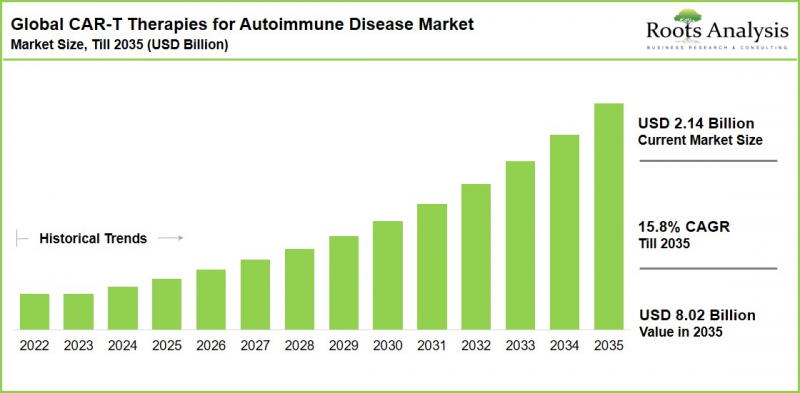
CAR-T Therapies for Autoimmune Diseases Market: Growth and Trends
Autoimmune diseases have emerged as the most promising new application area for CAR-T cell therapy beyond oncology. The therapeutic rationale lies in CD19-directed "B-cell reset," where CAR-T therapy deeply depletes autoreactive and memory B cells, enabling regeneration of a naive B-cell repertoire with fewer disease-driving autoantibody-producing clones than conventional biologics such as rituximab or belimumab.
Notably, Cabaletta Bio's rese-cel program has reported encouraging early responses across five simultaneous RESET trials spanning lupus, myositis, systemic sclerosis, generalized myasthenia gravis, and pemphigus vulgaris. Meanwhile, Kyverna's miv-cel has produced registrational-quality data in stiff person syndrome and interim Phase 2 results in generalized myasthenia gravis. Cartesian Therapeutics is pursuing a differentiated approach with Descartes-08, an mRNA-based, transiently expressed CAR-T therapy designed to avoid the lymphodepleting chemotherapy and hospitalization associated with conventional autologous CAR-T manufacturing.
The acquisition of autoimmune-focused CAR-T platforms by major pharmaceutical companies reflects the broader wave of M&A activity targeting in vivo cell engineering technologies. AbbVie, Bristol Myers Squibb, and Roche have each acquired platform companies with CD19-directed autoimmune programs, underscoring the growing strategic importance of autoimmune indications as a commercial opportunity alongside oncology in the next generation of CAR-T therapies.
Growth Drivers: Factors Fueling Market Expansion
The CAR-T therapies for autoimmune diseases market is being propelled by an unprecedented convergence of positive early clinical data, a rapidly expanding pipeline of clinical-stage assets, and continued manufacturing innovation. Registrational and Phase 2 readouts in stiff person syndrome, generalized myasthenia gravis, and lupus have demonstrated the potential for durable, treatment-free remission after a single dose, a profile that current biologics and small-molecule immunosuppressants cannot match.
Commercial interest is supported by a large unmet patient population, with an estimated 400,000-600,000 patients globally with SLE who have failed two or more standard therapies. Emerging approaches, including transient mRNA CAR-T and in vivo CAR-T platforms, could reduce lymphodepletion, manufacturing complexity, treatment burden, and cost, potentially expanding patient and treatment-center access.
Market Challenges: Critical Barriers Hindering Progress
Despite strong clinical momentum, the market faces meaningful barriers to broad commercialization. No CAR-T therapy has yet received approval for an autoimmune indication, leaving regulators to establish appropriate efficacy benchmarks, trial designs, and long-term safety requirements. This is particularly important because autoimmune patients are generally younger and healthier than oncology CAR-T recipients, making risks such as cytokine release syndrome, neurotoxicity, and prolonged B-cell aplasia less acceptable.
The high cost and complexity of patient-specific autologous CAR-T manufacturing remain key access barriers, particularly in chronic, non-fatal autoimmune diseases where its economic value must be demonstrated against established biologic therapies through payer negotiations. Competition from next-generation B-cell-depleting biologics, CD19/CD3 bispecific antibodies, and other T-cell engagers is also intensifying. Consequently, developers must demonstrate that a one-time CAR-T infusion offers a meaningfully better benefit-risk and total cost of care profile to justify premium pricing.
CAR-T Therapies for Autoimmune Diseases Market: Key Insights
This report examines the current state of the global CAR-T therapies for autoimmune diseases market and identifies the growth opportunities available to biopharmaceutical innovators, CDMOs, and investors. Some of the key findings include:
- Kyverna Therapeutics' miv-cel is positioned to become the first CAR-T cell therapy approved for an autoimmune indication, with a biologics license application for stiff person syndrome planned following registrational data showing improved mobility and elimination of chronic immunotherapy after a single infusion.
- Cabaletta Bio holds the broadest clinical-stage autoimmune CAR-T portfolio, running five simultaneous RESET Phase 1/2 trials in lupus, myositis, systemic sclerosis, generalized myasthenia gravis, and pemphigus vulgaris, supported by multiple FDA Fast Track and Regenerative Medicine Advanced Therapy (RMAT) designations.
- Systemic lupus erythematosus (including lupus nephritis) represents the leading disease-indication segment, projected to grow at a high CAGR through 2035 on the strength of an estimated 400,000-600,000 addressable patients who have failed two or more prior lines of therapy.
- Manufacturing differentiation is emerging as a key competitive axis transient, non-integrating mRNA CAR-T platforms such as Cartesian Therapeutics' Descartes-08 aim to avoid lymphodepleting chemotherapy altogether, while in-vivo delivered platforms from AbbVie/Capstan and Bristol Myers Squibb/Orbital aim to eliminate ex-vivo cell manufacturing entirely.
- Big pharma has committed more than USD 5 billion in disclosed acquisition value to autoimmune-focused CAR-T and adjacent cell-engineering platforms since late 2024, led by Roche/Poseida, AbbVie/Capstan, and Bristol Myers Squibb/Orbital, validating autoimmune disease as a core commercial thesis alongside oncology.
- Competitive positioning is bifurcating into three technology camps: autologous, DNA-integrating CAR-T; transient mRNA CAR-T and in-vivo delivered CAR-T; and in-vivo delivered CAR-T, each carrying distinct manufacturing, durability, safety, and re-dosing profiles that will shape licensing, partnership, and pricing strategy over the next 12-24 months.
Recent Deal Activity Signaling Investor Momentum
Big pharma acquisition activity has accelerated around autoimmune-focused CAR-T and adjacent in-vivo cell-engineering platforms, with more than USD 5 billion in disclosed deal value committed:
- Roche acquires Poseida Therapeutics, gaining allogeneic CAR-T programs spanning oncology, lupus, and multiple sclerosis.
- AbbVie acquires Capstan Therapeutics for its CD19-targeted in vivo CAR-T platform in B-cell-driven autoimmune disease.
- Bristol Myers Squibb acquires Orbital Therapeutics, gaining OTX-201, an in vivo CD19 CAR-T candidate for autoimmune "immune reset".
- Kyverna Therapeutics completes a public offering to fund its planned BLA filing for miv-cel in stiff person syndrome.
Collectively, these transactions underscore sustained strategic-acquirer conviction that CD19-directed "B-cell reset" CAR-T constructs can address chronic autoimmune disease with a durability and depth of response that existing biologics cannot match, and that manufacturing innovation, whether allogeneic, transient mRNA, or in-vivo delivered, will be central to unlocking broad patient access.
Global CAR-T Therapies for Autoimmune Diseases Market Segments
The market sizing and opportunity analysis has been segmented across the following parameters:
By Cell Source
- Autologous CAR-T
- Allogeneic (Off-the-Shelf) CAR-T
By Target Antigen
- CD19
- BCMA
- CD20
- Other Targets
By Disease Indication
- Systemic Lupus Erythematosus / Lupus Nephritis
- Idiopathic Inflammatory Myositis
- Systemic Sclerosis
- Generalized Myasthenia Gravis
- Stiff Person Syndrome
- Multiple Sclerosis
- Rheumatoid Arthritis
- Other Autoimmune Indications
By End User
- Hospitals
- Specialty and Academic Treatment Centers
- Ambulatory Infusion Centers
By Geographical Regions
- North America
- US
- Canada
- Europe
- Germany
- UK
- France
- Italy
- Spain
- Rest of Europe
- Asia-Pacific
- China
- Japan
- India
- South Korea
- Australia
- Rest of Asia-Pacific
- Middle East and North Africa
- Saudi Arabia
- UAE
- Latin America
- Brazil
- Argentina
- Rest of Latin America
CAR-T Therapies for Autoimmune Diseases Market: Key Segment Insights
Systemic Lupus Erythematosus Leads the Indication Landscape
Systemic lupus erythematosus, including lupus nephritis, is the leading disease-indication segment and is projected to grow at a higher CAGR through 2035. This largest share is due to the growing number of patients globally who have failed two or more lines of standard immunosuppressive therapy, and by encouraging early efficacy data reported across multiple sponsor programs.
Neuroimmunology Is Positioned to Deliver the First Approval
Stiff person syndrome and generalized myasthenia gravis, both pursued by Kyverna Therapeutics, are on the most advanced regulatory timelines in the market, with a BLA filing already planned for the approval. A first approval in neuroimmunology is expected to establish the regulatory precedent and reimbursement framework that subsequent rheumatology-focused programs, including those in lupus, myositis, and systemic sclerosis, will follow.
Autologous CAR-T Dominates Current Clinical Activity
Autologous, lentivirally-transduced CAR-T remains the most clinically mature cell source given its direct lineage from approved oncology CAR-T products. However, allogeneic and in-vivo delivered platforms are gaining momentum as developers seek to reduce manufacturing lead time, lymphodepletion requirements, and per-patient cost for a chronic, non-oncology patient population.
North America Dominates the Market
Based on our regional analysis, North America accounted for the highest share of the market, reflecting the concentration of registrational and Phase 2 trial activity among leading developers. On the other hand, Asia-Pacific is expected to grow at a higher CAGR during the forecast period. China-based developers, including AbelZeta, are advancing parallel clinical programs in lupus nephritis, myositis, and stiff person syndrome, positioning Asia-Pacific as an increasingly important contributor to global pipeline activity.
Example Players in the CAR-T Therapies for Autoimmune Diseases Market
- AbelZeta
- AbbVie (Capstan Therapeutics)
- Autolus Therapeutics
- Cabaletta Bio
- Cartesian Therapeutics
- Bristol Myers Squibb Company (Orbital Therapeutics)
- Gilead Sciences (Kite Pharma)
- Roche (Poseida Therapeutics)
- Kyverna Therapeutics
- Novartis
- Sana Biotechnology
- Umoja Biopharma
CAR-T THERAPIES FOR AUTOIMMUNE DISEASES MARKET: RESEARCH COVERAGE
- Market Sizing and Opportunity Analysis: In-depth analysis across cell source, target antigen, disease indication, end user, and geography.
- Competitive Landscape: A detailed assessment of active developers, including platform technology, pipeline stage, and regulatory designation status.
- Company Profiles: Profiles of prominent players, covering platform overview, pipeline, recent financing / M&A history, and strategic partnerships.
- Clinical Analysis: Comparative assessment of efficacy, safety (CRS/ICANS rates), and durability data reported across autologous, allogeneic, mRNA, and in-vivo delivered programs.
- Pipeline Analysis: Clinical and preclinical pipeline mapped by phase of development, target antigen, disease indication, and sponsor.
- Partnerships and Collaborations Analysis: Analysis of licensing deals, co-development agreements, and technology partnerships by year, deal type, and platform.
- Funding and M&A Analysis: A detailed review of venture financing, acquisitions, and licensing transactions, including deal value, structure, and most active acquirers.
- Regulatory Landscape: Assessment of FDA Fast Track, RMAT, and Breakthrough Therapy designations, and anticipated approval timelines by indication.
- SWOT Analysis: Strategic assessment of strengths, weaknesses, opportunities, and threats facing autoimmune CAR-T developers relative to incumbent biologics.
- Future Outlook: Perspective on indication expansion, manufacturing evolution, and anticipated regulatory and reimbursement milestones through 2035.
KEY QUESTIONS ANSWERED IN THIS REPORT
- Which companies and platforms are leading the CAR-T therapies for autoimmune diseases market?
- Which disease indication and region dominate the market today, and which are growing the fastest?
- What are the key clinical and technology trends shaping this market?
- Which program is likely to achieve the first regulatory approval, and on what timeline?
- What are the primary clinical, manufacturing, and regulatory challenges facing developers?
- What is the current and projected future size of the CAR-T therapies for autoimmune diseases market?
- What is the CAGR of this market through 2035?
- How is current and future market opportunity distributed across cell source, target antigen, and disease indication?
- What licensing, partnership, and acquisition opportunities exist for pharmaceutical companies and investors entering this space?
REASONS TO BUY THIS REPORT
This report is designed to give biopharmaceutical companies, investors, and manufacturing partners a decisive analytical edge in a fast-emerging market. Its core differentiators include:
- Top-Down and Bottom-Up Triangulated Forecasting: Market estimates are built using a hybrid methodology that cross-validates top-down macro assessments against bottom-up, indication-level pipeline and deal data to minimize forecast bias.
- Clinical Data and Regulatory Timeline Lens: Unlike conventional cell therapy landscape reports, this study tracks program-level efficacy, safety, and regulatory designation data to identify which assets are best positioned for the market's first approvals.
- Technology Platform Benchmarking: Comparative evaluation of autologous, allogeneic, transient mRNA, and in-vivo delivered CAR-T platforms, supporting technology diligence for in-licensing, partnership, or in-house platform investment decisions.
- Primary Research-Backed Insights: Findings are informed by review of company disclosures, clinical trial data, and deal documentation, ensuring insights reflect real development and commercial conditions.
- Actionable Segmentation: Multi-parameter segmentation (cell source, construct platform, target antigen, disease indication, end user, geography) enables precise opportunity sizing for any go-to-market, licensing, or investment thesis.
ADDITIONAL BENEFITS
- Complementary data packs covering key market segments
- Content customization available on request
- Detailed report walkthrough session with the research team
- Free report update if the report is 6-12 months old or older
TABLE OF CONTENTS
1. PREFACE
- 1.1. Introduction
- 1.2. Market Share Insights
- 1.3. Key Market Insights
- 1.4. Report Coverage
- 1.5. Key Questions Answered
- 1.6. Chapter Outlines
2. RESEARCH METHODOLOGY
- 2.1. Chapter Overview
- 2.2. Research Assumptions
- 2.2.1. Market Landscape and Market Trends
- 2.2.2. Market Forecast and Opportunity Analysis
- 2.2.3. Comparative Analysis
- 2.3. Database Building
- 2.3.1. Data Collection
- 2.3.2. Data Validation
- 2.3.3. Data Analysis
- 2.4. Project Methodology
- 2.4.1. Secondary Research
- 2.4.1.1. Annual Reports
- 2.4.1.2. Academic Research Papers
- 2.4.1.3. Company Websites
- 2.4.1.4. Investor Presentations
- 2.4.1.5. Regulatory Filings
- 2.4.1.6. White Papers
- 2.4.1.7. Industry Publications
- 2.4.1.8. Conferences and Seminars
- 2.4.1.9. Government Portals
- 2.4.1.10. Media and Press Releases
- 2.4.1.11. Newsletters
- 2.4.1.12. Industry Databases
- 2.4.1.13. Roots Proprietary Databases
- 2.4.1.14. Paid Databases and Sources
- 2.4.1.15. Social Media Portals
- 2.4.1.16. Other Secondary Sources
- 2.4.2. Primary Research
- 2.4.2.1. Types of Primary Research
- 2.4.2.1.1. Qualitative Research
- 2.4.2.1.2. Quantitative Research
- 2.4.2.1.3. Hybrid Approach
- 2.4.2.2. Advantages of Primary Research
- 2.4.2.3. Techniques for Primary Research
- 2.4.2.3.1. Interviews
- 2.4.2.3.2. Surveys
- 2.4.2.3.3. Focus Groups
- 2.4.2.3.4. Observational Research
- 2.4.2.3.5. Social Media Interactions
- 2.4.2.4. Key Opinion Leaders Considered in Primary Research
- 2.4.2.4.1. Company Executives (CXOs)
- 2.4.2.4.2. Board of Directors
- 2.4.2.4.3. Company Presidents and Vice Presidents
- 2.4.2.4.4. Research and Development Heads
- 2.4.2.4.5. Technical Experts
- 2.4.2.4.6. Subject Matter Experts
- 2.4.2.4.7. Scientists
- 2.4.2.4.8. Doctors and Other Healthcare Providers
- 2.4.2.5. Ethics and Integrity
- 2.4.2.5.1. Research Ethics
- 2.4.2.5.2. Data Integrity
- 2.4.2.1. Types of Primary Research
- 2.4.3. Analytical Tools and Databases
- 2.4.1. Secondary Research
- 2.5. Robust Quality Control
3. MARKET DYNAMICS
- 3.1. Chapter Overview
- 3.2. Forecast Methodology
- 3.2.1. Top-down Approach
- 3.2.2. Bottom-up Approach
- 3.2.3. Hybrid Approach
- 3.3. Market Assessment Framework
- 3.3.1. Total Addressable Market (TAM)
- 3.3.2. Serviceable Addressable Market (SAM)
- 3.3.3. Serviceable Obtainable Market (SOM)
- 3.3.4. Currently Acquired Market (CAM)
- 3.4. Forecasting Tools and Techniques
- 3.4.1. Qualitative Forecasting
- 3.4.2. Correlation
- 3.4.3. Regression
- 3.4.4. Extrapolation
- 3.4.5. Convergence
- 3.4.6. Sensitivity Analysis
- 3.4.7. Scenario Planning
- 3.4.8. Data Visualization
- 3.4.9. Time Series Analysis
- 3.4.10. Forecast Error Analysis
- 3.5. Key Considerations
- 3.5.1. Demographics
- 3.5.2. Government Regulations
- 3.5.3. Reimbursement Scenarios
- 3.5.4. Market Access
- 3.5.5. Supply Chain
- 3.5.6. Industry Consolidation
- 3.5.7. Pandemic / Unforeseen Disruptions Impact
- 3.6. Limitations
4. MACRO-ECONOMIC INDICATORS
- 4.1. Chapter Overview
- 4.2. Market Dynamics
- 4.2.1. Time Period
- 4.2.1.1. Historical Trends
- 4.2.1.2. Current and Forecasted Estimates
- 4.2.2. Currency Coverage
- 4.2.2.1. Major Currencies Affecting the Market
- 4.2.2.2. Factors Affecting Currency Fluctuations
- 4.2.2.3. Impact of Currency Fluctuations on the Industry
- 4.2.3. Foreign Currency Exchange Rate
- 4.2.3.1. Impact of Foreign Exchange Rate Volatility on the Market
- 4.2.3.2. Strategies for Mitigating Foreign Exchange Risk
- 4.2.4. Recession
- 4.2.4.1. Assessment of Current Economic Conditions and Potential Impact on the Market
- 4.2.4.2. Historical Analysis of Past Recessions and Lessons Learnt
- 4.2.5. Inflation
- 4.2.5.1. Measurement and Analysis of Inflationary Pressures in the Economy
- 4.2.5.2. Potential Impact of Inflation on the Market Evolution
- 4.2.6. Interest Rates
- 4.2.6.1. Interest Rates and Their Impact on the Market
- 4.2.6.2. Strategies for Managing Interest Rate Risk
- 4.2.7. Commodity Flow Analysis
- 4.2.7.1. Type of Commodity
- 4.2.7.2. Origins and Destinations
- 4.2.7.3. Values and Weights
- 4.2.7.4. Modes of Transportation
- 4.2.8. Global Trade Dynamics
- 4.2.8.1. Import Scenario
- 4.2.8.2. Export Scenario
- 4.2.8.3. Trade Policies
- 4.2.8.4. Strategies for Mitigating the Risks Associated with Trade Barriers
- 4.2.8.5. Impact of Trade Barriers on the Market
- 4.2.9. War Impact Analysis
- 4.2.9.1. Russian-Ukraine War
- 4.2.9.2. Israel-Hamas War
- 4.2.10. COVID Impact / Related Factors
- 4.2.10.1. Global Economic Impact
- 4.2.10.2. Industry-specific Impact
- 4.2.10.3. Government Response and Stimulus Measures
- 4.2.10.4. Future Outlook and Adaptation Strategies
- 4.2.11. Other Indicators
- 4.2.11.1. Fiscal Policy
- 4.2.11.2. Consumer Spending
- 4.2.11.3. Gross Domestic Product (GDP)
- 4.2.11.4. Employment
- 4.2.11.5. Taxes
- 4.2.11.6. Stock Market Performance
- 4.2.11.7. Cross-Border Dynamics
- 4.2.1. Time Period
- 4.3. Conclusion
5. EXECUTIVE SUMMARY
6. INTRODUCTION
- 6.1. Chapter Overview
- 6.2. Overview of T-cell Immunotherapies
- 6.2.1. Historical Evolution
- 6.2.2. Key Considerations for Developing T-cell Immunotherapies
- 6.2.3. Strategies Employed for the Redirection of T-cells
- 6.2.4. Manufacturing of Engineered T-cells
- 6.3. Chimeric Antigen Receptor T-cell (CAR-T) Therapy
- 6.3.1. Development History
- 6.3.2. Structure of CAR
- 6.3.2.1. Ectodomain
- 6.3.2.2. Transmembrane (TM) Domain
- 6.3.2.3. Endodomain
- 6.3.3. Development of CAR-T Cells
- 6.3.4. Universal CAR-T Cells
- 6.3.5. Route of Administration
- 6.3.6. Challenges Associated with CAR-T Cell Therapies for Autoimmune Diseases
- 6.3.6.1. Competitive Risks
- 6.3.6.2. Clinical Risks
- 6.3.6.3. Regulatory Risks
- 6.3.6.4. Commercial Risks
- 6.4. Concluding Remarks
7. CAR-T CELL THERAPIES FOR AUTOIMMUNE DISEASES: MARKET LANDSCAPE
- 7.1. Chapter Overview
- 7.2. CAR-T Cell Therapies for Autoimmune Diseases: Market Landscape
- 7.2.1. Analysis by Type of Cell Source
- 7.2.2. Analysis by Type of Target Antigen
- 7.2.3. Analysis by Disease Indication
- 7.2.4. Analysis by End User
- 7.3. CAR-T Cell Therapies for Autoimmune Diseases: Overall Developer Landscape
- 7.3.1. Analysis by Year of Establishment
- 7.3.2. Analysis by Company Size
- 7.3.3. Analysis by Location of Headquarters
8. KEY INSIGHTS
- 8.1. Chapter Overview
- 8.2. CAR-T Cell Therapies for Autoimmune Diseases: Popular Target Antigens
- 8.2.1. Popular Targets for Hematological Malignancies
- 8.2.2. Popular Targets for Solid Tumors
- 8.3. CAR-T Therapies: CAR Construct Analysis
- 8.3.1. Analysis by Generation of CAR
- 8.3.2. Analysis by Type of scFv Antibody Used
- 8.3.3. Analysis by Type of Virus Used
- 8.3.4. Analysis by Type of Gene Transfer Method Used
- 8.3.5. Analysis by Type of Co-Stimulatory Domain
9. CLINICAL TRIAL ANALYSIS
- 9.1. Chapter Overview
- 9.2. Scope and Methodology
- 9.3. CAR-T Cell Therapies for Autoimmune Diseases: Clinical Trial Analysis
- 9.3.1. Analysis by Trial Registration Year
- 9.3.2. Analysis of Enrolled Patient Population by Trial Registration Year
- 9.3.3. Analysis by Trial Phase
- 9.3.4. Analysis of Enrolled Patient Population by Trial Phase
- 9.3.5. Analysis by Trial Registration Year and Trial Phase
- 9.3.6. Analysis by Trial Status
- 9.3.7. Analysis by Patient Gender
- 9.3.8. Analysis by Therapeutic Area
- 9.3.9. Analysis by Study Design
- 9.3.10. Most Active Industry Players: Analysis by Number of Registered Trials
- 9.3.11. Most Active Non-Industry Players: Analysis by Number of Registered Trials
- 9.3.12. Analysis by Geography
10. KEY OPINION LEADERS
- 10.1. Chapter Overview
- 10.2. Assumptions and Key Parameters
- 10.3. Methodology
- 10.4. CAR-T Cell Therapies for Autoimmune Diseases: Key Opinion Leaders
- 10.4.1. Analysis by Type of Organization
- 10.4.2. Analysis by Affiliated Organization
- 10.4.3. Analysis by Geographical Location of KOLs
- 10.4.4. KOL Activeness versus KOL Strength
- 10.4.5. Most Prominent KOLs: Analysis by RA score
- 10.4.6. Most Prominent KOLs: Comparison of RA Score and Third-Party Score
11. COMPANY PROFILES
- 11.1. Chapter Overview
- 11.2. AbelZeta
- 11.3. AbbVie (Capstan Therapeutics)
- 11.4. Autolus Therapeutics
- 11.5. Cabaletta Bio
- 11.6. Cartesian Therapeutics
- 11.7. Bristol Myers Squibb Company (Orbital Therapeutics)
- 11.8. Gilead Sciences (Kite Pharma)
- 11.9. Roche (Poseida Therapeutics)
- 11.10. Kyverna Therapeutics
- 11.11. Novartis
- 11.12. Sana Biotechnology
- 11.13. Umoja Biopharma
12. PARTNERSHIPS AND COLLABORATIONS
- 12.1. Chapter Overview
- 12.2. Partnership Models
- 12.3. CAR-T Cell Therapies for Autoimmune Diseases: Partnerships and Collaborations
- 12.3.1. Analysis by Year of Partnership
- 12.3.2. Analysis by Type of Partnership
- 12.3.3. Analysis by Year and Type of Partnership
- 12.3.4. Analysis by Type of Partner
- 12.3.5. Most Popular Therapies: Analysis by Number of Partnerships
- 12.3.6. Most Active Industry Players: Analysis by Number of Partnerships
- 12.3.7. Most Active Non-Industry Players: Analysis by Number of Partnerships
- 12.3.8. Analysis by Geography
- 12.3.8.1. Intercontinental and Intracontinental Agreements
- 12.3.8.2. International and Local Agreements
13. FUNDING AND INVESTMENTS ANALYSIS
- 13.1. Chapter Overview
- 13.2. Types of Funding
- 13.3. CAR-T Cell Therapies for Autoimmune Diseases: Funding and Investment Analysis
- 13.3.1. Analysis by Year of Funding
- 13.3.2. Analysis of Amount Invested
- 13.3.3. Analysis by Type of Funding
- 13.3.4. Analysis by Amount Invested and Type of Funding
- 13.3.5. Analysis of Amount Invested by Year and Type of Funding
- 13.3.6. Analysis by Type of Investor
- 13.3.7. Analysis by Geography
- 13.3.8. Most Active Players
- 13.3.9. Leading Investors: Analysis by Number of Funding Instances
14. PATENT ANALYSIS
- 14.1. Chapter Overview
- 14.2. Scope and Methodology
- 14.3. CAR-T Cell Therapies for Autoimmune Diseases: Patent Analysis
- 14.3.1. Analysis by Patent Publication Year
- 14.3.2. Analysis by Patent Application Year
- 14.3.3. Analysis of Granted Patents and Patent Applications by Publication Year
- 14.3.4. Analysis by Patent Jurisdiction
- 14.3.5. Analysis by CPC Symbols
- 14.3.6. Analysis by Type of Applicant
- 14.3.7. Leading Industry Players: Analysis by Number of Patents
- 14.3.8. Leading Non-Industry Players: Analysis by Number of Patents
- 14.3.9. Leading Patent Assignees: Analysis by Number of Patents
- 14.4. Patent Benchmarking Analysis
- 14.4.1. Analysis by Patent Characteristics
- 14.5. Patent Valuation
- 14.6. Leading Patents by Number of Citations
15. CASE STUDY: CELL THERAPY MANUFACTURING
- 15.1. Chapter Overview
- 15.2. Overview of Cell Therapy Manufacturing
- 15.3. Cell Therapy Manufacturing Models
- 15.3.1. Centralized Manufacturing Model
- 15.3.2. Decentralized Manufacturing Model
- 15.4. Scalability of Cell Therapy Manufacturing Processes
- 15.4.1. Scale-Up
- 15.4.2. Scale-Out
- 15.5. Types of Cell Therapy Manufacturers
- 15.6. Key Challenges Related to Manufacturing of Cell Therapies
- 15.7. Key Considerations for Cell Therapy Manufacturing
- 15.7.1. Characterization
- 15.7.2. Cost of Goods
- 15.8. Automation of Cell Therapy Manufacturing Process
- 15.9. Cell Therapy Manufacturing Supply Chain
- 15.10. Comparison of Players Having In-house Capabilities and Contract Manufacturers
- 15.11. Regulatory Landscape
- 15.12. Future Perspectives
16. COST PRICE ANALYSIS
- 16.1. Chapter Overview
- 16.2. Factors Contributing to the High Price of Cell / Gene Therapies
- 16.3. Pricing Models for T-cell Immunotherapies
- 16.3.1. Based on Associated Costs
- 16.3.2. Based on Availability of Competing Products
- 16.3.3. Based on Patient Population
- 16.3.4. Based on Opinions of Industry Experts
- 16.4. Reimbursement related Considerations for T-cell Immunotherapies
- 16.4.1. Case Study: The National Institute for Health and Care Excellence (NICE) Appraisal of CAR-T Therapies
17. MARKET IMPACT ANALYSIS: DRIVERS, RESTRAINTS, OPPORTUNITIES AND CHALLENGES
- 17.1. Chapter Overview
- 17.2. Market Drivers
- 17.3. Market Restraints
- 17.4. Market Opportunities
- 17.5. Market Challenges
- 17.6. Conclusion
18. GLOBAL CAR-T CELL THERAPY MARKET
- 18.1. Chapter Overview
- 18.2. Key Assumptions and Methodology
- 18.3. Global CAR-T Cell Therapy Market, Historical Trends (since 2018) and Forecasted Estimates (till 2035)
- 18.4. Scenario Analysis
- 18.4.1. Conservative Scenario
- 18.4.2. Optimistic Scenario
- 18.5. Key Market Segmentations
19. CAR-T CELL THERAPY MARKET, BY CELL SOURCE
- 19.1. Chapter Overview
- 19.2. Key Assumptions and Methodology
- 19.3. CAR-T Cell Therapy Market: Distribution by Cell Source
- 19.3.1. CAR-T Cell Therapy Market for Autologous CAR-T: Forecasted Estimates (till 2035)
- 19.3.2. CAR-T Cell Therapy Market for Allogeneic (Off-the-Shelf) CAR-T: Forecasted Estimates (till 2035)
- 19.4. Data Triangulation and Validation
20. CAR-T CELL THERAPY MARKET, BY TARGET ANTIGEN
- 20.1. Chapter Overview
- 20.2. Key Assumptions and Methodology
- 20.3. CAR-T Cell Therapy Market: Distribution by Target Antigen
- 20.3.1. CAR-T Cell Therapy Market for CD19: Forecasted Estimates (till 2035)
- 20.3.2. CAR-T Cell Therapy Market for BCMA: Forecasted Estimates (till 2035)
- 20.3.3. CAR-T Cell Therapy Market for CD20: Forecasted Estimates (till 2035)
- 20.3.4. CAR-T Cell Therapy Market for Other Target Antigens: Forecasted Estimates (till 2035)
- 20.4. Data Triangulation and Validation
21. CAR-T CELL THERAPY MARKET, BY DISEASE INDICATION
- 21.1. Chapter Overview
- 21.2. Key Assumptions and Methodology
- 21.3. CAR-T Cell Therapy Market: Distribution by Disease Indication
- 21.3.1. CAR-T Cell Therapy Market for Systemic Lupus Erythematosus / Lupus Nephritis: Forecasted Estimates (till 2035)
- 21.3.2. CAR-T Cell Therapy Market for Idiopathic Inflammatory Myositis: Forecasted Estimates (till 2035)
- 21.3.3. CAR-T Cell Therapy Market for Systemic Sclerosis: Forecasted Estimates (till 2035)
- 21.3.4. CAR-T Cell Therapy Market for Generalized Myasthenia Gravis: Forecasted Estimates (till 2035)
- 21.3.5. CAR-T Cell Therapy Market for Stiff Person Syndrome: Forecasted Estimates (till 2035)
- 21.3.6. CAR-T Cell Therapy Market for Multiple Sclerosis: Forecasted Estimates (till 2035)
- 21.3.7. CAR-T Cell Therapy Market for Rheumatoid Arthritis: Forecasted Estimates (till 2035)
- 21.3.8. CAR-T Cell Therapy Market for Other Autoimmune Indications: Forecasted Estimates (till 2035)
- 21.4. Data Triangulation and Validation
22. CAR-T CELL THERAPY MARKET, BY END USER
- 22.1. Chapter Overview
- 22.2. Key Assumptions and Methodology
- 22.3. CAR-T Cell Therapy Market: Distribution by End User
- 22.3.1. CAR-T Cell Therapy Market for Hospitals: Forecasted Estimates (till 2035)
- 22.3.2. CAR-T Cell Therapy Market for Specialty and Academic Treatment Centers: Forecasted Estimates (till 2035)
- 22.3.3. CAR-T Cell Therapy Market for Ambulatory Infusion Centers: Forecasted Estimates (till 2035)
- 22.4. Data Triangulation and Validation
23. CAR-T CELL THERAPY MARKET: DISTRIBUTION BY GEOGRAPHICAL REGIONS
- 23.1. Chapter Overview
- 23.2. Key Assumptions and Methodology
- 23.3. CAR-T Cell Therapy Market: Distribution by Key Geographical Regions
- 23.3.1. CAR-T Cell Therapy Market in North America: Forecasted Estimates (till 2035)
- 23.3.2. CAR-T Cell Therapy Market in Europe: Forecasted Estimates (till 2035)
- 23.3.3. CAR-T Cell Therapy Market in Asia-Pacific: Forecasted Estimates (till 2035)
- 23.3.4. CAR-T Cell Therapy Market in Latin America: Forecasted Estimates (till 2035)
- 23.3.5. CAR-T Cell Therapy Market in Middle East and North Africa: Forecasted Estimates (till 2035)
- 23.3.6. CAR-T Cell Therapy Market in Rest of the World: Forecasted Estimates (till 2035)
- 23.4. Data Triangulation and Validation
24. CAR-T CELL THERAPY MARKET, SALES FORECAST OF DRUGS
- 24.1. Chapter Overview
- 24.2. Key Assumptions and Methodology
- 24.3. Commercialized CAR-T Cell Therapies for Autoimmune Diseases: Sales Forecast
- 24.4. Clinical CAR-T Cell Therapies for Autoimmune Diseases: Sales Forecast
- 24.5. Data Triangulation and Validation
25. CAR-T CELL THERAPY MARKET: SALES FORECAST OF LEADING PLAYERS
- 25.1. Chapter Overview
- 25.2. Key Assumptions and Methodology
- 25.3. CAR-T Cell Therapies for Autoimmune Diseases: Leading Players
- 25.4. Data Triangulation and Validation
26. EXECUTIVE INSIGHTS
27. CONCLUDING REMARKS
28. APPENDIX I: TABULATED DATA
29. APPENDIX II: LIST OF COMPANIES AND ORGANIZATIONS
30. APPENDIX III: LIST OF FUNDING AND INVESTMENTS

