PUBLISHER: Zhar Research | PRODUCT CODE: 2158078

PUBLISHER: Zhar Research | PRODUCT CODE: 2158078
Long Duration Energy Storage, Grid, Datacenter, Microgrid: Markets, Technology 2027-2047
Summary
To understand your LDES opportunities, we must get beyond AI unable to access unpublished expert insights, the LDES Council seeking to maximise members’ sales, and those unable to think beyond LDES for grids and minimal metrics. To the rescue comes the new, commercially-oriented 499-page Zhar Research report, “Long Duration Energy Storage, Grid, Datacenter, Microgrid: Markets, Technology 2027-2047”.
The situation has changed
It reveals that, faced with LDES affordability problems, there is strong adoption of escape routes. It provides a full chapter on them. It deeply examines research and initiatives through 2026 because the situation has changed. Many 1-200MW AI datacenters and large microgrids will adopt solar and wind with LDES, as they offer lowest cost without compromise. Some of the nine LDES technology families (each with many examined subsets) will provide short- and long-duration from one facility. We now have serious consideration of the eventual creation of national strategic electricity reserves, preceded by LDES for seasonal storage covering solar weak in winter.
Winners identified
Which technology families out of the nine will take most of the large, emerging LDES value market on the important twenty-year view? See eleven reasons why pumped hydro – including emerging new forms of it using mines, underwater, seawater, heavier water – will remain the gold standard of LDES. Suppressed negatives are surfaced. Which option is least efficient, least safe and causes global warming? With the trend to longer duration and larger capacity, which options will be crippled by poor self-leakage, fade or lack of scalability - you just buy more of everything?
It is not all about grids
Learn how you can create a $1 billion LDES business just for microgrids. The report finds that datacenters and microgrids will, take over 20% of the LDES value market, but they must prioritise different LDES technologies from grids. Which? When? Uniquely balanced and thorough, the report has 22 SWOT appraisals, prospects for 17 LDES parameters and reality checks such as, graphed, the duration, power and capacity of a large number of actual and planned LDES projects.
Report coverage
The Executive Summary and Conclusions (53 pages) is sufficient in itself for those with limited time. It has the basics, 11 of the SWOT appraisals, 15 LDES escape routes in three categories, 17 key conclusions, roadmaps and 23 new forecast lines 2027-2047 as easily understood infograms, graphs and tables with explanation. Chapter 2. LDES Need and Design Principles (38 pages) briefly explains the race into renewables and why solar is winning. Then you see adoption of LDES of increasing duration driven by increased wind/solar percentage and cost reduction but how LDES is also needed for every other energy option. Curtailment is discussed – not always a bad thing. LDES will be adopted only when and where it is cost-effective. LDES definitions and specific needs are introduced, including LDES integrated with renewable energy sources and detail on the difference between grid and beyond-grid LDES needs. In this chapter and all following, there is a close look at research 2025 through 2026, references leading you to further reading, including a Zhar Research drill-down on datacenter and microgrid LDES.
Chapter 3. LDES Escape Routes is 18 pages including a SWOT and much 2026 research. The world will not spend a significant part of its GDP on LDES. Engineers do workarounds, so this chapter explains 15 options in three categories, most of which are already happening somewhere because they save money or are more practicable. They are business opportunities for you. Some of the outstanding versions are international electricity interconnectors spanning time and weather zones, differential pricing and generation combinations and types that are far less intermittent than solar or wind. It is concluded that LDES market potential remains large even when at least halved by these escapes.
Chapters on each LDES technology begin with Chapter 4. Pumped Hydro: Conventional PHES (33 pages) responsible for 94% of stationary storage. Arriving PHES projects set records such as longest duration, power, capacity and life. Variable speed turbines are successful. As in the other chapters, there are SWOT appraisals, parameter summaries and advances promised by quoted research through 2026 and earlier. Yes, these giants generate carbon dioxide in manufacture of their concrete but that then lasts over 100 years. PHES is now being multipurposed, such as acting as backup fresh water supplies and adding floating solar that reduces evaporation, increases income. PHES is increasingly specified for short-duration and LDES from one facility, promising further reduction in its already-excellent Levelised Cost of Storage LCOS.
Much more to come
That naturally leads to Chapter 5. Advanced Pumped Hydro APHES (48 pages) revealing the huge significance of trials of such options as using seawater, heavier water up mere hills, underground and other options with their strong research pipeline. It is found that these may extend 100 times the number of sites and some are of interest for datacenters and large microgrids. Then comes strongest rival as Chapter 6. Compressed Air CAES (47 pages) with the second-largest duration-power output achievements, a 15% learning curve driving down to reach PHES LCOS figures. Six companies are profiled.
Chapter 7. Redox Flow Batteries RFB (88 pages) compares these technologies as they slowly eliminate expensive materials such as vanadium that must be recovered and adding hybrid forms that are smaller for microgrids but not as scalable in size. RGB has niche grid potential but could dominate large microgrid LDES for reasons given. 47 RFB manufacturers are compared in eight columns and many profiled. Realise that massive four-hour versions in China will easily be converted to LDES when the need arises.
Chapter 8. Solid Gravity Energy Storage SGES (25 pages) explains how lifting blocks promises no self-leakage, little fade, longest duration but suppliers departing. Latest arrival Green Energy Australia uses mines. Chapter 9. Advanced Conventional Construction Batteries ACCB (44 pages and 6 SWOTs) appraises many options and companies, with Form Energy iron-air the most successful, its many grid projects promising 100 hours. We await actual data for these.
Chapter 10. Liquefied Gas Energy Storage LGES: Liquid air LAES or CO2 (37 pages) describes options that have success in the middle ground without needing major earthworks. Will late-starter CO2 overtake? The report then closes with Chapter 12. Hydrogen and Other Chemical Intermediary LDES (27 pages) which assesses the small number of projects and the claims that it is the only way to go for seasonal storage and strategic electricity reserves.
The new report, “Long Duration Energy Storage, Grid, Datacenter, Microgrid: Markets, Technology 2027-2047” is your essential guide to success.
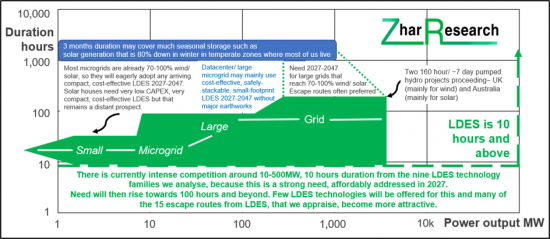
CAPTION: Actual installations 2027: LDES duration vs power deliverable, simplified version. Current LDES situation in green with trends as text. Source: Zhar Research report, “Long Duration Energy Storage, Grid, Datacenter, Microgrid: Markets, Technology 2027-2047”.
Table of Contents
1. Executive summary and conclusions
- 1.1 Purpose and unique scope of this report
- 1.2 Methodology of this analysis
- 1.3 Key conclusions with infograms on why PHES is gold standard and LDES escape routes
- 1.3.1 11 reasons why pumped hydro energy storage is the gold standard for LDES
- 1.3.2 Examples of current installations and potential
- 1.3.3 Escape routes from grid LDES 2027-2047 – 3 categories, 15 options
- 1.4 Interconnector and delayed heat examples reducing LDES needs: UK, Norway, Denmark, Italy, Greece, Singapore, with SWOT
- 1.5 Main technology candidates for electricity-to-electricity LDES 2027-2047
- 1.6 Key conclusions concerning LDES parameters and investment
- 1.7 Optimal LDES for a given need changes over time
- 1.8 Potential LDES performance by ten technologies in 19 columns
- 1.9 Three LDES sizes, with different technology winners 2027-2047 on current evidence
- 1.10 Acceptable sites: numbers by technology 2027-2047
- 1.11 Current and emerging LDES: duration vs power deliverable in
- 1.11.1 Simplified version – detail on next page
- 1.11.2 Duration hours vs power delivered by project and 13 technologies in
- 1.12 SWOT appraisals of ten LDES technologies for 2027-2047
- 1.13 Investment trends, value market winners, important regions
- 1.14 Companies to watch
- 1.15 LDES roadmap 2027-2047
- 1.16 Market forecasts in 21 lines 2027-2047 with graphs and explanation
- 1.16.1 LDES total value market showing microgrid gaining share 2027-2047
- 1.16.2 LDES market in 8 technology categories $ billion 2026-2047 table, graphs, explanation
- 1.16.3 Number of LDES actual and putative manufacturers: RFB vs Other showing shakeout 2027-2047
- 1.16.4 Total LDES value market % in three size categories 2027-2047 table, graph, explanation
- 1.16.5 Regional share of LDES value market % in four regions 2027-2047 table, graph, explanation
- 1.16.6 Vanadium vs iron vs other RFB LDES market % value sales with technology strategies 2027-2047
2. LDES need and design principles
- 2.1 Energy fundamentals
- 2.2 Racing into renewables with rapid cost reduction: 2025 statistics and trends
- 2.3 Solar winning and the intermittency challenge
- 2.4 Adoption of LDES of increasing duration driven by increased wind/solar percentage and cost reduction
- 2.5 LDES definitions and needs
- 2.5.1 General
- 2.5.2 Integrated energy storage systems for grids
- 2.5.3 Example of urgent need for grid LDES – UK government report
- 2.5.4 Very different needs for grid vs beyond-grid LDES 2026-2046
- 2.5.5 Duration vs power showing three size sectors needing different technologies
- 2.6 LDES metrics
- 2.7 LDES projects in 2025-6 showing leading technology subsets
- 2.7.1 Installations in progress and complete 2027: duration vs power and trend in need
- 2.7.2 Leading projects in 2025-6 showing detail and leading technology subsets, trend
- 2.8 LDES impediments, alternatives and investment climate
- 2.9 LDES toolkit
- 2.9.1 Overview
- 2.9.2 LDES choices compared
- 2.9.3 Electrochemical LDES options explained
- 2.10 Latest independent assessments of performance by technology
- 2.11 Batteries that struggle above 8-hour duration
- 2.12 Drill down report on beyond-grid LDES 2025-2045 and other reading
3. LDES escape routes
- 3.1 General situation
- 3.2 Infogram: Escape routes from grid LDES 2027-2047 – 3 categories, 15 options
- 3.3 Interconnector and delayed heat examples reducing LDES needs: UK, Norway, Denmark, Greece, Singapore, China, USA with SWOT
- 3.4 Solar-from-space, over-specification and vertical solar, fusion power, ocean power
- 3.4.1 Continuous solar from space
- 3.4.2 Solar over-specification and vertical solar give strong power even at dawn, dusk, winter
- 3.4.3 Continuous fusion power
- 3.4.4 Less-intermittent ocean power
- 3.5 2026 research on LDES escape routes
- 3.5.1 Interconnectors
- 3.5.1 AI datacenter light computing needs little power or LDES
- 3.5.2 Solar with reduced intermittency
- 3.5.3 Home Energy Management Systems coping with intermittent supply
4. Pumped hydro: conventional PHES
- 4.1 Overview
- 4.1.1 Three options
- 4.1.2 History, environmental, timescales, potential sites, DOE appraisal
- 4.1.3 Site-limited primarily due environmental concerns not number of appropriate topologies
- 4.1.4 Problem analysis, actions to reduce PHES emissions, ugliness, water use, cost
- 4.1.5 PHES for short-duration and LDES from one facility
- 4.2 Research advances and view of potential through
- 4.3 Projects and intentions across the world
- 4.3.1 Geographical
- 4.3.2 Large pumped hydro schemes worldwide
- 4.4 Economics
- 4.5 Policy recommendations
- 4.6 Parameter appraisal of conventional pumped hydro PHES
- 4.7 SWOT appraisal of conventional pumped hydro PHES
5. Advanced pumped hydro APHES
- 5.1 Overview with SWOT appraisal
- 5.2 Repurposing mining sites
- 5.2.1 Potential
- 5.2.2 Research advances in
- 5.3 Pressurised sprung rocks underground: Quidnet Energy USA
- 5.4 Using heavier water up mere hills: RheEnergise UK
- 5.4.1 General
- 5.4.2 RheEnergise installation progress 2025-6
- 5.4.3 Power for mines and other targets with appraisal of prospects
- 5.5 Using seawater or other brine
- 5.5.1 General
- 5.5.2 Brine in salt caverns Cavern Energy USA
- 5.5.3 SWOT appraisal of seawater pumped hydro on land
- 5.5.4 2026 research advances
- 5.6 Sizeable Energy Italy, StEnSea Germany, Ocean Grazer Netherlands
- 5.6.1 General
- 5.6.2 Sizable Energy Itay
- 5.6.3 StEnSea Germany
- 5.6.4 Ocean Grazer Netherlands
- 5.6.5 SWOT appraisal of underwater energy storage for LDES
- 5.7 Hybrid technologies: research advances in 2024 and
- 5.8 Research advances in
- 5.9 SWOT appraisal of APHES
6. Compressed air CAES
- 6.1 Overview
- 6.1.1 Basics
- 6.1.2 System design
- 6.1.3 Research advances in
- 6.2 Market positioning of CAES
- 6.3 SWOT appraisal and parameter comparison of CAES for LDES
- 6.4 CAES technology options
- 6.4.1 Thermodynamic
- 6.4.2 Isochoric or isobaric storage
- 6.4.3 Adiabatic choice of cooling is winning
- 6.5 CAES projects, subsystem manufacturers, objectives, research 2025 onwards
- 6.5.1 Overview: largest projects are in China
- 6.5.2 Increasing the CAES storage time and discharge duration
- 6.5.3 Research in UK and European Union 2025 onwards
- 6.6 Profiles of CAES company progress with Zhar Research appraisals
- 6.6.1 ALCAES Switzerland
- 6.6.2 APEX CAES USA
- 6.6.3 Augwind Energy Israel
- 6.6.4 Keep Energy Systems UK formerly Cheesecake
- 6.6.5 Huaneng Group China
- 6.6.6 Hydrostor Canada
- 6.6.7 Storelectric UK
- 6.6.8 Terrastor Energy Corporation USA
7. Redox flow batteries RFB
- 7.1 Overview
- 7.2 RFB research pivoting to LDES
- 7.2.1 Overview of RFB and its potential for LDES
- 7.2.2 Infogram: RFB achievements and aspirations 2027-2047
- 7.2.3 RFB research advances in
- 7.3 Winning LDES redox flow battery technologies 2027-2047
- 7.4 SWOT appraisal and parameter comparison of RFB for LDES
- 7.5 45 RFB companies compared in 8 columns: name, brand, technology, tech. readiness, beyond grid focus, LDES focus, comment
- 7.6 RFB technologies with research advances through
- 7.6.1 Regular or hybrid, their chemistries and the main ones being commercialised
- 7.6.2 SWOT appraisals of regular vs hybrid options
- 7.7 Specific designs by material: vanadium, iron and variants, other metal ligand, halogen-based, organic, manganese with latest research, three SWOT appraisals
- 7.7.1 Vanadium RFB design and SWOT appraisal
- 7.7.2 All-iron and variants RFB design and SWOT appraisal
- 7.7.3 Other metal ligand RFB
- 7.7.4 Halogen-based and zinc-based RFB design
- 7.7.5 Organic RFB design
- 7.7.6 Manganese-based RFB
- 7.7.7 Examples of RFB competing on-grid and off-grid
- 7.8 RFB manufacturer profiles: some leaders and some innovators
8. Solid gravity energy storage SGES
- 8.1 Overview including research in
- 8.1.1 General
- 8.1.2 Three stages of operation
- 8.1.3 Three geometries
- 8.1.4 Pumped hydro gravity storage compared to the three SGES options
- 8.1.5 Basics
- 8.1.6 SWOT appraisal of solid gravity storage SGES for LDES
- 8.1.7 Parameter appraisal of solid gravity energy storage SGES for LDES
- 8.1.8 CAPEX challenge
- 8.1.9 Challenge of ongoing expenses
- 8.1.10 Possibility of pumping sand
- 8.1.11 Hydraulic piston lift instead of cable: 2025 modelling
- 8.1.12 Appraisal of other SGES research
- 8.2 Energy Vault Switzerland, USA and China, India licensees
- 8.3 Green Gravity Australia
9. Advanced conventional construction batteries ACCB
- 9.1 Overview including advances through
- 9.2 Eight ACCB manufacturers compared: 8 columns: name, brand, technology, tech. readiness, beyond-grid focus, LDES focus, comment
- 9.3 Parameter appraisal and SWOT appraisal of ACCB for LDES
- 9.3.1 Parameter appraisal
- 9.3.2 SWOT appraisal of ACCB for LDES
- 9.3.3 Research appraisal: 2026 advances
- 9.4 Metal-air batteries
- 9.4.1 Iron-air with SWOT : Form Energy USA
- 9.4.2 Aluminium-air : Phinergy Israel
- 9.4.3 Zinc-air with SWOT: E-Zinc, AZA battery, Zinc8 (Abound)
- 9.5 High temperature batteries
- 9.5.1 Molten calcium antimony: Ambri USA out of business, SWOT
- 9.5.2 Sodium or lithium sulfur: NGK/ BASF Japan/ Germany, others, research in 2025, SWOT
- 9.6 Metal-ion batteries including Inlyte, Altris, HiNa, Tiamat, Natron, Faradion Reliance
- 9.6.1 Sodium-ion with SWOT
- 9.6.2 Zinc halide EOS Energy Enterprises USA with SWOT
- 9.6.3 Zinc-ion Enerpoly, Urban Electric Power USA, NextEra USA
- 9.7 Nickel hydrogen batteries: EnerVenue USA with SWOT
10. Liquefied gas energy storage LGES: Liquid air LAES or CO2
- 10.1 Overview
- 10.2 Liquid air LAES LDES
- 10.2.1 Technology and research advances
- 10.2.2 Parameter comparison of LAES for LDES
- 10.2.3 SWOT appraisal of LAES for LDES
- 10.2.4 Indicative LAES systems, footprints and operating parameters
- 10.2.5 Research advances in
- 10.2.6 CGDG, Zhongli Zhongke Energy Storage Technology Co China
- 10.2.7 Highview Energy UK and partners Sumitomo, Centrica, Rio Tinto and others
- 10.2.8 MIT study of LAES viability in USA
- 10.2.9 Phelas Germany
- 10.3 Liquid and compressed carbon dioxide LDES
- 10.3.1 Overview
- 10.3.2 Parameter comparison of CO2 for LDES
- 10.3.3 SWOT appraisal of liquid CO2 for LDES
- 10.3.4 Research advances in
- 10.3.5 Energy Dome Italy
- 10.3.6 China and Kazakhstan
11. Thermal energy storage for delayed electricity ETES
- 11.1 Overview with research through
- 11.2 Parameter appraisal of electric thermal energy storage ETES
- 11.3 SWOT appraisal of ETES for LDES
- 11.4 The heat engine approach proceeds: Echogen USA
- 11.5 Use of extreme temperatures and photovoltaic conversion
- 11.5.1 Antora USA
- 11.5.2 Fourth Power USA
- 11.6 Marketing delayed heat and electricity from one plant
- 11.6.1 Overview
- 11.6.2 MGA Thermal Australia
- 11.6.3 Malta Inc Germany
12. Hydrogen and other chemical intermediary LDES
- 12.1 Overview with research progress in 2025-6
- 12.1.1 Overview
- 12.1.2 Sweet spot for chemical intermediary LDES but safety issues
- 12.1.3 Mainstream research through 2025-6
- 12.1.4 Research dreaming of niches through 2025-6
- 12.1.5 Research on complex mechanisms for hydrogen loss
- 12.1.6 Research on hydrogen leakage causing global warming
- 12.1.7 Examples of hydrogen storage advances 2025-6
- 12.2 Parameter appraisal of hydrogen storage for LDES
- 12.3 SWOT appraisal of hydrogen, methane, ammonia for LDES
- 12.4 The small number of actual projects
- 12.4.1 Calistoga Resiliency Centre USA 48-hour microgrid
- 12.4.2 Ulm University microgrid trial Germany 2025-2027
- 12.4.3 China plans in
- 12.4.4 Rathrush Energy Park Ireland proposal

