
PUBLISHER: Aviation & Defense Market Reports (A&D) | PRODUCT CODE: 1936039

PUBLISHER: Aviation & Defense Market Reports (A&D) | PRODUCT CODE: 1936039
Global 30 mm Medium Caliber Market 2026-2036
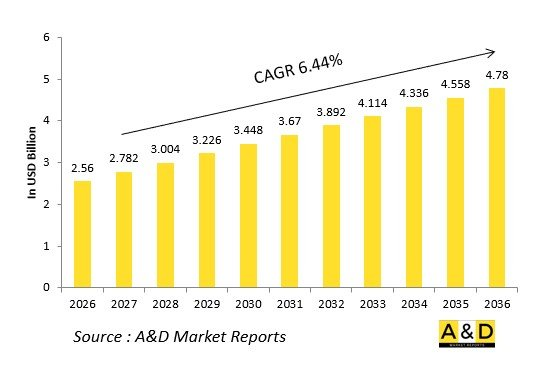
The Global 30 mm Medium Caliber Market is estimated at USD 2.56 billion in 2026, projected to grow to USD 4.78 billion by 2036 at a Compound Annual Growth Rate (CAGR) of 6.44% over the forecast period 2026-2036.
Introduction
The global 30mm medium caliber market supplies critical firepower for modern ground, air, and sea platforms, delivering balanced lethality between small arms and heavy artillery. These systems arm infantry fighting vehicles, attack helicopters, and close-in weapon stations with high-rate-of-fire autocannons and specialized munitions like fin-stabilized discarding sabot and airburst rounds. Adaptability across platforms drives widespread adoption.
Market expansion ties to defense modernization, where 30mm calibers excel in anti-armor, anti-personnel, and counter-UAS roles. Key offerings include insensitive munitions compliant propellants, tungsten penetrators, and programmable fuzes for precise effects against defilade targets. Manufacturers invest in research to counter evolving threats like unmanned systems and reactive armor.
Geopolitical tensions elevate procurement, with nations upgrading fleets for hybrid warfare. Interoperability standards facilitate exports, while open architectures enable seamless integration. Supply chains emphasize precision-guided variants and sustainable production. Competition features global primes developing dual-feed cannons for flexible loadouts.
This market embodies firepower evolution, enhancing tactical edges in maneuver-centric operations.
Technology Impact in 30mm Medium Caliber Market
Technological strides transform the 30mm medium caliber domain, boosting precision and versatility. Airburst munitions (ABM) with programmable fuzes detonate over or behind cover, maximizing effects against infantry via barrel-exit timing linked to fire control systems. Armor-piercing fin-stabilized discarding sabot (APFSDS) rounds employ tungsten alloy penetrators for deep armor defeat at extended ranges.
Insensitive munitions propellants enhance safety, resisting cook-off in fires or impacts. Smart fuzes incorporate dual-mode sensors for proximity or point detonation, adaptable to drones or soft targets. Additive manufacturing crafts complex sabots, reducing costs while improving aerodynamics.
Dual-feed autocannons switch seamlessly between penetrators and high-explosive rounds, suiting dynamic threats. Integration with vehicle sights enables fire-on-the-move accuracy, fusing laser rangefinders and ballistic computers. Counter-UAS variants deploy flechette or incendiary loads for swarm defense.
Naval adaptations ruggedize for shipboard vibration, while aviation clusters prioritize low recoil. Digital twins optimize propellant burns for consistent muzzle velocities. These innovations elevate 30mm systems to smart effectors, slashing engagement times and collateral risks in urban battles.
Key Drivers in 30mm Medium Caliber Market
Rising defense budgets for modernization propel the 30mm medium caliber market, as forces upgrade firepower against proliferating threats like drones and light armor. Versatile application across vehicles, aircraft, and vessels amplifies demand for standardized calibers.
Geopolitical tensions spur procurement, with hybrid warfare necessitating rapid, lethal suppression. Precision-guided munitions expand roles, offering standoff accuracy in cluttered environments. Insensitive munitions compliance mandates safer stockpiles, driving propellant innovations.
Platform integrations, like remote turrets on infantry carriers, favor high-volume fire rates. Export offsets encourage local production, bolstering supply resilience. Urban combat doctrines prioritize low-collateral airburst effects over area saturation.
Sustainability initiatives push eco-friendly primers and recyclable casings. Interoperability with NATO-standard guns facilitates coalition ops. Training economics favor combat-like rounds over pure practice ammo.
Evolving threats-reactive armor, UAVs-necessitate penetrator upgrades. These drivers position 30mm calibers as maneuver enablers, intertwining with active protection systems for survivable firepower.
Regional Trends in 30mm Medium Caliber Market
North America dominates via advanced platforms like Stryker upgrades, emphasizing programmable airburst for infantry carriers against urban and defilade foes. Robust R&D yields precision variants.
Europe advances dual-feed ABM cannons for IFVs like Puma, focusing on infantry defeat and light armor in high-threat corridors.
Asia-Pacific surges with indigenous production for regional tensions, tailoring APFSDS for tank-on-tank and island ops; China and India lead integrations.
Middle East adopts vehicle-mounted systems for asymmetric rocket defense, prioritizing reliability in desert conditions.
Russia develops penetrators for 2A42/2A72 guns, stressing armor defeat at oblique angles.
Latin America equips counter-narcotics vehicles with counter-UAS loads. Africa favors rugged, low-maintenance kits for peacekeeping.
Trends converge on modular ammo for multi-platform use, with supply chains shifting to Asia amid export controls.
Key 30mm Medium Caliber Market Programs
Stryker Infantry Carrier Vehicle upgrades integrate XM813 autocannons with XM1182 high-explosive airburst tracer rounds, mimicking heavy tank effects for anti-personnel lethality in open, defilade, or structures.
Puma IFV fields MK30-2 ABM cannons, dual-feeding APFSDS and programmable bursts for dismounted threats.
XM1182 HEAB-T programs enhance Stryker brigades with standoff programmable fuzes.
Russian 2A42/2A72 developments introduce cobalt-free tungsten APFSDS for enhanced penetration.
Naval close-in systems adapt 30mm for shipborne anti-drone roles. Aviation clusters arm attack helos with low-recoil AP loads.
Precision-guided 30mm initiatives fuse GPS/INS for moving targets. Insensitive munition certifications validate combat stockpiles.
Export packages bundle with turrets for offset deals. These programs redefine medium caliber as precision suppressors, boosting platform lethality.
Here's a structured set of content pieces on the global 5G in defense market, written without any numerical values. Tailored to your defense technology market expertise, these highlight connectivity's role in modern warfare using formal, analytical language for blogs or reports.
Table of Contents
30mm Medium Caliber Market - Table of Contents 30mm Medium Caliber Market Report Definition
30mm Medium Caliber Market Segmentation
By Region
By Type
By Platform
30mm Medium Caliber Market Analysis for next 10 Years
The 10-year 30mm medium caliber market analysis would give a detailed overview of 30mm medium caliber market growth, changing dynamics, technology adoption overviews and the overall market attractiveness is covered in this chapter.
Market Technologies of 30mm Medium Caliber Market
This segment covers the top 10 technologies that is expected to impact this market and the possible implications these technologies would have on the overall market.
Global 30mm Medium Caliber Market Forecast
The 10-year 30mm medium caliber market forecast of this market is covered in detailed across the segments which are mentioned above.
Regional 30mm Medium Caliber Market Trends & Forecast
The regional 30mm medium caliber market trends, drivers, restraints and Challenges of this market, the Political, Economic, Social and Technology aspects are covered in this segment. The market forecast and scenario analysis across regions are also covered in detailed in this segment. The last part of the regional analysis includes profiling of the key companies, supplier landscape and company benchmarking. The current market size is estimated based on the normal scenario.
North America
Drivers, Restraints and Challenges
PEST
Market Forecast & Scenario Analysis
Key Companies
Supplier Tier Landscape
Company Benchmarking
Europe
Middle East
APAC
South America
Country Analysis of 30mm Medium Caliber Market
This chapter deals with the key defense programs in this market, it also covers the latest news and patents which have been filed in this market. Country level 10 year market forecast and scenario analysis are also covered in this chapter.
US
Defense Programs
Latest News
Patents
Current levels of technology maturation in this market
Market Forecast & Scenario Analysis
Canada
Italy
France
Germany
Netherlands
Belgium
Spain
Sweden
Greece
Australia
South Africa
India
China
Russia
South Korea
Japan
Malaysia
Singapore
Brazil
Opportunity Matrix for Mortar Ammunition Market
The opportunity matrix helps the readers understand the high opportunity segments in this market.
Expert Opinions on Mortar Ammunition Market Report
Hear from our experts their opinion of the possible analysis for this market.
Conclusions
About Aviation and Defense Market Reports
List of Tables
- Table 1: 10 Year Market Outlook, 2026-2036
- Table 2: Drivers, Impact Analysis, North America
- Table 3: Restraints, Impact Analysis, North America
- Table 4: Challenges, Impact Analysis, North America
- Table 5: Drivers, Impact Analysis, Europe
- Table 6: Restraints, Impact Analysis, Europe
- Table 7: Challenges, Impact Analysis, Europe
- Table 8: Drivers, Impact Analysis, Middle East
- Table 9: Restraints, Impact Analysis, Middle East
- Table 10: Challenges, Impact Analysis, Middle East
- Table 11: Drivers, Impact Analysis, APAC
- Table 12: Restraints, Impact Analysis, APAC
- Table 13: Challenges, Impact Analysis, APAC
- Table 14: Drivers, Impact Analysis, South America
- Table 15: Restraints, Impact Analysis, South America
- Table 16: Challenges, Impact Analysis, South America
- Table 17: Scenario Analysis, Scenario 1, By Region, 2026-2036
- Table 18: Scenario Analysis, Scenario 1, By Platform, 2026-2036
- Table 19: Scenario Analysis, Scenario 1, By Type, 2026-2036
- Table 20: Scenario Analysis, Scenario 2, By Region, 2026-2036
- Table 21: Scenario Analysis, Scenario 2, By Platform, 2026-2036
- Table 22: Scenario Analysis, Scenario 2, By Type, 2026-2036
List of Figures
- Figure 1: Global 30 mm Medium Caliber Market Forecast, 2026-2036
- Figure 2: Global 30 mm Medium Caliber Market Forecast, By Region, 2026-2036
- Figure 3: Global 30 mm Medium Caliber Market Forecast, By Platform, 2026-2036
- Figure 4: Global 30 mm Medium Caliber Market Forecast, By Type, 2026-2036
- Figure 5: North America, 30 mm Medium Caliber Market, Forecast, 2026-2036
- Figure 6: Europe, 30 mm Medium Caliber Market, Forecast, 2026-2036
- Figure 7: Middle East, 30 mm Medium Caliber Market, Forecast, 2026-2036
- Figure 8: APAC, 30 mm Medium Caliber Market, Forecast, 2026-2036
- Figure 9: South America, 30 mm Medium Caliber Market, Forecast, 2026-2036
- Figure 10: United States, 30 mm Medium Caliber Market, Technology Maturation, 2026-2036
- Figure 11: United States, 30 mm Medium Caliber Market, Forecast, 2026-2036
- Figure 12: Canada, 30 mm Medium Caliber Market, Technology Maturation, 2026-2036
- Figure 13: Canada, 30 mm Medium Caliber Market, Forecast, 2026-2036
- Figure 14: Italy, 30 mm Medium Caliber Market, Technology Maturation, 2026-2036
- Figure 15: Italy, 30 mm Medium Caliber Market, Market Forecast, 2026-2036
- Figure 16: France, 30 mm Medium Caliber Market, Technology Maturation, 2026-2036
- Figure 17: France, 30 mm Medium Caliber Market, Market Forecast, 2026-2036
- Figure 18: Germany, 30 mm Medium Caliber Market, Technology Maturation, 2026-2036
- Figure 19: Germany, 30 mm Medium Caliber Market, Market Forecast, 2026-2036
- Figure 20: Netherlands, 30 mm Medium Caliber Market, Technology Maturation, 2026-2036
- Figure 21: Netherlands, 30 mm Medium Caliber Market, Market Forecast, 2026-2036
- Figure 22: Belgium, 30 mm Medium Caliber Market, Technology Maturation, 2026-2036
- Figure 23: Belgium, 30 mm Medium Caliber Market, Market Forecast, 2026-2036
- Figure 24: Spain, 30 mm Medium Caliber Market, Technology Maturation, 2026-2036
- Figure 25: Spain, 30 mm Medium Caliber Market, Market Forecast, 2026-2036
- Figure 26: Sweden, 30 mm Medium Caliber Market, Technology Maturation, 2026-2036
- Figure 27: Sweden, 30 mm Medium Caliber Market, Market Forecast, 2026-2036
- Figure 28: Brazil, 30 mm Medium Caliber Market, Technology Maturation, 2026-2036
- Figure 29: Brazil, 30 mm Medium Caliber Market, Market Forecast, 2026-2036
- Figure 30: Australia, 30 mm Medium Caliber Market, Technology Maturation, 2026-2036
- Figure 31: Australia, 30 mm Medium Caliber Market, Market Forecast, 2026-2036
- Figure 32: India, 30 mm Medium Caliber Market, Technology Maturation, 2026-2036
- Figure 33: India, 30 mm Medium Caliber Market, Market Forecast, 2026-2036
- Figure 34: China, 30 mm Medium Caliber Market, Technology Maturation, 2026-2036
- Figure 35: China, 30 mm Medium Caliber Market, Market Forecast, 2026-2036
- Figure 36: Saudi Arabia, 30 mm Medium Caliber Market, Technology Maturation, 2026-2036
- Figure 37: Saudi Arabia, 30 mm Medium Caliber Market, Market Forecast, 2026-2036
- Figure 38: South Korea, 30 mm Medium Caliber Market, Technology Maturation, 2026-2036
- Figure 39: South Korea, 30 mm Medium Caliber Market, Market Forecast, 2026-2036
- Figure 40: Japan, 30 mm Medium Caliber Market, Technology Maturation, 2026-2036
- Figure 41: Japan, 30 mm Medium Caliber Market, Market Forecast, 2026-2036
- Figure 42: Malaysia, 30 mm Medium Caliber Market, Technology Maturation, 2026-2036
- Figure 43: Malaysia, 30 mm Medium Caliber Market, Market Forecast, 2026-2036
- Figure 44: Singapore, 30 mm Medium Caliber Market, Technology Maturation, 2026-2036
- Figure 45: Singapore, 30 mm Medium Caliber Market, Market Forecast, 2026-2036
- Figure 46: United Kingdom, 30 mm Medium Caliber Market, Technology Maturation, 2026-2036
- Figure 47: United Kingdom, 30 mm Medium Caliber Market, Market Forecast, 2026-2036
- Figure 48: Opportunity Analysis, 30 mm Medium Caliber Market, By Region (Cumulative Market), 2026-2036
- Figure 49: Opportunity Analysis, 30 mm Medium Caliber Market, By Region (CAGR), 2026-2036
- Figure 50: Opportunity Analysis, 30 mm Medium Caliber Market, By Platform (Cumulative Market), 2026-2036
- Figure 51: Opportunity Analysis, 30 mm Medium Caliber Market, By Platform (CAGR), 2026-2036
- Figure 52: Opportunity Analysis, 30 mm Medium Caliber Market, By Type (Cumulative Market), 2026-2036
- Figure 53: Opportunity Analysis, 30 mm Medium Caliber Market, By Type (CAGR), 2026-2036
- Figure 54: Scenario Analysis, 30 mm Medium Caliber Market, Cumulative Market, 2026-2036
- Figure 55: Scenario Analysis, 30 mm Medium Caliber Market, Global Market, 2026-2036
- Figure 56: Scenario 1, 30 mm Medium Caliber Market, Total Market, 2026-2036
- Figure 57: Scenario 1, 30 mm Medium Caliber Market, By Region, 2026-2036
- Figure 58: Scenario 1, 30 mm Medium Caliber Market, By Platform, 2026-2036
- Figure 59: Scenario 1, 30 mm Medium Caliber Market, By Type, 2026-2036
- Figure 60: Scenario 2, 30 mm Medium Caliber Market, Total Market, 2026-2036
- Figure 61: Scenario 2, 30 mm Medium Caliber Market, By Region, 2026-2036
- Figure 62: Scenario 2, 30 mm Medium Caliber Market, By Platform, 2026-2036
- Figure 63: Scenario 2, 30 mm Medium Caliber Market, By Type, 2026-2036
- Figure 64: Company Benchmark, 30 mm Medium Caliber Market, 2026-2036

