
PUBLISHER: Global Market Insights Inc. | PRODUCT CODE: 1871129

PUBLISHER: Global Market Insights Inc. | PRODUCT CODE: 1871129
U.S. Automated Breast Ultrasound Systems Market Opportunity, Growth Drivers, Industry Trend Analysis, and Forecast 2025 - 2034
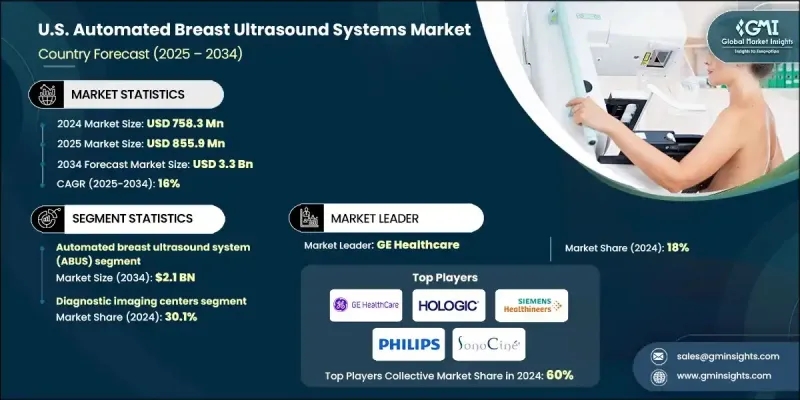
U.S. Automated Breast Ultrasound Systems Market was valued at USD 758.3 million in 2024 and is estimated to grow at a CAGR of 16% to reach USD 3.3 Billion by 2034.
The market is witnessing strong momentum due to the increasing number of breast cancer cases across the country, continuous advancements in imaging technologies, rising reimbursement coverage, and growing government initiatives promoting early diagnosis. Automated breast ultrasound systems (ABUS) are revolutionizing diagnostic imaging by offering high-resolution, 3D scans that improve the detection of lesions, particularly in patients with dense breast tissue. These systems deliver consistent, operator-independent results and provide a comfortable and non-invasive alternative to conventional screening methods. The shift toward patient-centric healthcare and the growing need for accurate, reproducible imaging are prompting hospitals and diagnostic facilities to adopt ABUS solutions. The rising awareness of breast cancer screening, combined with supportive policies and clinical acceptance, is further accelerating the adoption of automated systems nationwide. Increasing prevalence of invasive breast cancer continues to be a major factor propelling market growth, alongside the integration of advanced software and AI-driven imaging analysis in ABUS platforms.
| Market Scope | |
|---|---|
| Start Year | 2024 |
| Forecast Year | 2025-2034 |
| Start Value | $758.3 Million |
| Forecast Value | $3.3 Billion |
| CAGR | 16% |
The ABUS segment generated USD 482.3 million in 2024 and is expected to reach USD 2.1 Billion by 2034. The growth is largely supported by the growing preference for artificial intelligence-enhanced imaging technologies and greater accessibility of automated solutions in diagnostic centers and hospitals across the U.S. Automated breast volume scanners (ABVS) offer comprehensive three-dimensional visualization, enabling more precise identification of abnormalities in patients with dense breast tissue. Integration with digital and AI-based platforms further ensures faster image acquisition and improved diagnostic reliability, contributing to increased adoption across healthcare institutions.
The diagnostic imaging centers segment held 30.1% share and is projected to grow at a CAGR of 16.3% through 2034. This segment continues to lead market growth owing to its specialized imaging capabilities and the ability to provide high-accuracy diagnostic services. Diagnostic imaging centers play a crucial role in breast cancer detection programs, offering advanced automated imaging solutions that outperform conventional screening techniques, particularly for patients requiring high-clarity visualization and consistent reporting.
Key players actively shaping the U.S. Automated Breast Ultrasound Systems Market include Siemens Healthineers, QView Medical, Supersonic Imagine, MetriTrack, Seno Medical Instruments, Canon, Shantou Institute of Ultrasonic Instruments, Hitachi, Delphinus Medical Technologies, Hologic, CapeRay Medical, Koninklijke Philips, GE Healthcare, Theraclion, and SonoCine. Leading manufacturers are focusing on product innovation, digital integration, and strategic partnerships to enhance their market position. Companies are developing AI-powered imaging technologies to improve diagnostic precision and workflow efficiency. Investments in research and development are accelerating the creation of user-friendly and patient-centered systems. Collaborations with hospitals, imaging centers, and technology firms are helping expand clinical adoption and streamline regulatory compliance. Firms are also emphasizing product differentiation through ergonomic designs, cloud-based data management, and compatibility with existing imaging infrastructure. In addition, mergers, acquisitions, and regional expansion strategies are being leveraged to strengthen distribution networks and reinforce market leadership across the U.S. automated breast ultrasound systems landscape.
Table of Contents
Chapter 1 Methodology and Scope
- 1.1 Market scope and definition
- 1.2 Research design
- 1.2.1 Research approach
- 1.2.2 Data collection methods
- 1.3 Data mining sources
- 1.4 Base estimates and calculations
- 1.4.1 Base year calculation
- 1.4.2 Key trends for market estimation
- 1.5 Primary research and validation
- 1.5.1 Primary sources
- 1.6 Forecast model
- 1.7 Research assumptions and limitations
Chapter 2 Executive Summary
- 2.1 Industry 3600 synopsis
- 2.2 Key market trends
- 2.2.1 Product trends
- 2.2.2 End use trends
- 2.3 CXO perspectives: Strategic imperatives
- 2.3.1 Key decision points for industry executives
- 2.3.2 Critical success factors for market players
- 2.4 Future outlook and strategic recommendations
Chapter 3 Industry Insights
- 3.1 Industry ecosystem analysis
- 3.1.1 Supplier landscape
- 3.1.2 Value addition at each stage
- 3.1.3 Factor affecting the value chain
- 3.2 Industry impact forces
- 3.2.1 Growth drivers
- 3.2.1.1 Increasing prevalence of breast cancer in the U.S.
- 3.2.1.2 Growing technological innovation in automated breast ultrasound systems.
- 3.2.1.3 Rising reimbursement support from government agencies
- 3.2.1.4 Growing awareness and favorable government initiatives regarding breast cancer
- 3.2.2 Industry pitfalls and challenges
- 3.2.2.1 High cost of the automated breast ultrasound system
- 3.2.2.2 Stringent regulatory scenarios
- 3.2.3 Market opportunities
- 3.2.3.1 Rising adoption of AI-integrated ABUS for predictive breast cancer screening
- 3.2.1 Growth drivers
- 3.3 Growth potential analysis
- 3.4 Regulatory landscape
- 3.5 Technological advancements
- 3.5.1 Current technological trends
- 3.5.2 Emerging technologies
- 3.6 Supply chain analysis
- 3.7 Pricing analysis, 2024
- 3.8 Future market trends
- 3.9 Porter's analysis
- 3.10 PESTEL analysis
Chapter 4 Competitive Landscape, 2024
- 4.1 Introduction
- 4.2 Company market share analysis
- 4.3 Company matrix analysis
- 4.4 Competitive analysis of major market players
- 4.5 Competitive positioning matrix
- 4.6 Key developments
- 4.6.1 Mergers and acquisitions
- 4.6.2 Partnerships and collaborations
- 4.6.3 New product launches
- 4.6.4 Expansion plans
Chapter 5 Market Estimates and Forecast, By Product, 2021 - 2034 ($ Mn)
- 5.1 Key trends
- 5.2 Automated breast ultrasound system (ABUS)
- 5.3 Automated breast volume scanner (ABVS)
- 5.4 Other products
Chapter 6 Market Estimates and Forecast, By End Use, 2021 - 2034 ($ Mn)
- 6.1 Key trends
- 6.2 Hospitals
- 6.3 Diagnostic imaging centers
- 6.4 Specialty clinics
Chapter 7 Company Profiles
- 7.1 Canon
- 7.2 CapeRay Medical
- 7.3 Delphinus Medical Technologies
- 7.4 GE Healthcare
- 7.5 Hitachi
- 7.6 Hologic
- 7.7 Koninklijke Philips
- 7.8 MetriTrack
- 7.9 QView Medical
- 7.10 SonoCine
- 7.11 Supersonic Imagine
- 7.12 Siemens Healthineers
- 7.13 Seno Medical Instruments
- 7.14 Shantou Institute of Ultrasonic Instruments
- 7.15 Theraclion

