
PUBLISHER: Global Market Insights Inc. | PRODUCT CODE: 1876546

PUBLISHER: Global Market Insights Inc. | PRODUCT CODE: 1876546
Recycled Plastics Market Opportunity, Growth Drivers, Industry Trend Analysis, and Forecast 2025 - 2034
The Global Recycled Plastics Market was valued at USD 58.1 billion in 2024 and is estimated to grow at a CAGR of 8% to reach USD 125.7 billion by 2034.
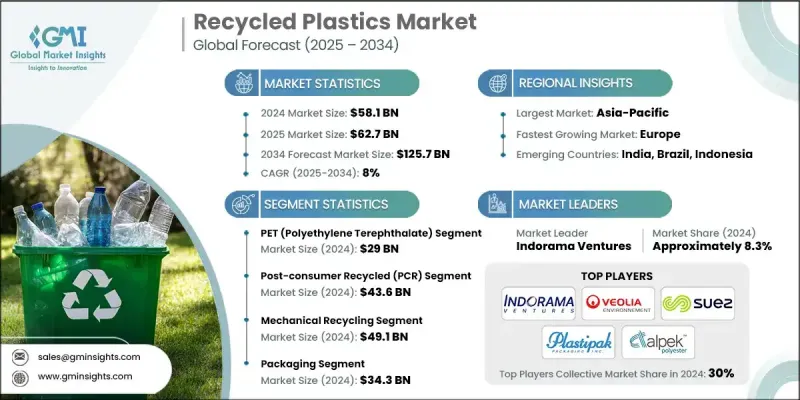
The industry is experiencing strong momentum as companies across major sectors are increasingly adopting recycled plastics to minimize carbon emissions and curb environmental waste. Rising crude oil prices and corporate sustainability targets are driving the transition from virgin resins to recycled alternatives. The focus is shifting toward chemical recycling methods such as depolymerization, as mechanical regrind often fails to achieve the required purity for films and multilayer applications. Large-scale projects and investments indicate growing confidence in recycling as a long-term solution to waste reduction and material circularity. Vertical integration is emerging as a leading competitive strategy, with many fast-moving consumer goods companies and fashion brands financing or acquiring recycling operations to secure feedstock and enhance material recovery capabilities. This trend underscores a market-wide shift toward building closed-loop systems that prioritize sustainability, efficiency, and reduced reliance on virgin polymers.
| Market Scope | |
|---|---|
| Start Year | 2024 |
| Forecast Year | 2025-2034 |
| Start Value | $58.1 Billion |
| Forecast Value | $125.7 Billion |
| CAGR | 8% |
The PET segment was valued at USD 29 billion in 2024 and is forecast to register a 7.9% CAGR between 2025 and 2034. PET continues to dominate due to increased demand from the beverage and textile sectors. The growing emphasis on recycled content mandates and upcycled textile production has accelerated bottle-to-bottle recycling systems. The fashion industry is further reinforcing demand as brands increasingly use rPET fibers, marking a significant transformation in raw material sourcing and creating strong growth opportunities for producers worldwide.
The packaging segment was valued at USD 34.3 billion in 2024 and is estimated to grow at a CAGR of 7.8% through 2034, accounting for a 59% share. Packaging applications consume more than half of global recycled polymer output and are adopting stricter quality and traceability standards. Food-grade rPET usage has surged following new regulatory requirements that enforce recyclate certification and traceability. Non-food applications such as personal care containers and household cleaner packaging are now specifying higher recycled content levels, further stimulating demand for odor-controlled recycled HDPE and PP grades across consumer goods manufacturing.
U.S. Recycled Plastics Market reached USD 8.8 billion in 2024 and is expected to record an 8% CAGR by 2034. The region is transitioning from fragmented recycling networks to vertically integrated systems that enhance feedstock availability and supply chain stability. Public-private collaborations are expanding access to high-quality recycled materials, particularly rPET and rHDPE, in regions such as California and the southeastern United States. Advancements in AI-enabled sorting technologies and the implementation of mass balance certification standards are significantly improving recyclate quality and consistency, especially in rigid packaging applications across Europe and North America.
Key players active in the Global Recycled Plastics Market include Veolia Environnement, Indorama Ventures, Alpek Polyester / DAK Americas, Plastipak Holdings (Clean Tech), and Suez SA. Leading companies in the Recycled Plastics Market are pursuing several strategic initiatives to enhance their market presence and competitiveness. They are investing heavily in chemical recycling technologies to achieve higher purity levels and to process mixed or contaminated waste streams. Strategic acquisitions and partnerships are being established to secure a consistent feedstock supply and expand recycling capacity. Firms are also developing closed-loop systems and vertically integrated production models to ensure material traceability and supply stability.
Table of Contents
Chapter 1 Methodology
- 1.1 Market scope and definition
- 1.2 Research design
- 1.2.1 Research approach
- 1.2.2 Data collection methods
- 1.3 Data mining sources
- 1.3.1 Global
- 1.3.2 Regional/Country
- 1.4 Base estimates and calculations
- 1.4.1 Base year calculation
- 1.4.2 Key trends for market estimation
- 1.5 Primary research and validation
- 1.5.1 Primary sources
- 1.6 Forecast model
- 1.7 Research assumptions and limitations
Chapter 2 Executive Summary
- 2.1 Industry 360° synopsis
- 2.2 Key market trends
- 2.2.1 Regional
- 2.2.2 Polymer Type
- 2.2.3 Source Type
- 2.2.4 Recycling Technology
- 2.2.5 End use
- 2.3 TAM Analysis, 2025-2034
- 2.4 CXO perspectives: Strategic imperatives
- 2.4.1 Executive decision points
- 2.4.2 Critical success factors
- 2.5 Future Outlook and Strategic Recommendations
Chapter 3 Industry Insights
- 3.1 Industry ecosystem analysis
- 3.1.1 Supplier Landscape
- 3.1.2 Profit Margin
- 3.1.3 Value addition at each stage
- 3.1.4 Factor affecting the value chain
- 3.1.5 Disruptions
- 3.2 Industry impact forces
- 3.2.1 Growth drivers
- 3.2.2 Industry pitfalls and challenges
- 3.2.3 Market opportunities
- 3.3 Growth potential analysis
- 3.4 Regulatory landscape
- 3.4.1 North America
- 3.4.2 Europe
- 3.4.3 Asia Pacific
- 3.4.4 Latin America
- 3.4.5 Middle East & Africa
- 3.5 Porter's analysis
- 3.6 PESTEL analysis
- 3.7 Price trends
- 3.7.1 By region
- 3.8 Future market trends
- 3.9 Technology and Innovation landscape
- 3.9.1 Current technological trends
- 3.9.2 Emerging technologies
- 3.10 Patent Landscape
- 3.11 Trade statistics (Note: the trade statistics will be provided for key countries only)
- 3.11.1 Major importing countries
- 3.11.2 Major exporting countries
- 3.12 Sustainability and Environmental Aspects
- 3.12.1 Sustainable Practices
- 3.12.2 Waste Reduction Strategies
- 3.12.3 Energy Efficiency in Production
- 3.12.4 Eco-friendly Initiatives
- 3.13 Carbon Footprint Considerations
Chapter 4 Competitive Landscape, 2024
- 4.1 Introduction
- 4.2 Company market share analysis
- 4.2.1 By region
- 4.2.1.1 North America
- 4.2.1.2 Europe
- 4.2.1.3 Asia Pacific
- 4.2.1.4 LATAM
- 4.2.1.5 MEA
- 4.2.1 By region
- 4.3 Company matrix analysis
- 4.4 Competitive analysis of major market players
- 4.5 Competitive positioning matrix
- 4.6 Key developments
- 4.6.1 Mergers & acquisitions
- 4.6.2 Partnerships & collaborations
- 4.6.3 New Product Launches
- 4.6.4 Expansion Plans
Chapter 5 Market Estimates and Forecast, By Polymer Type, 2025 - 2034 (USD Million, Kilo Tons)
- 5.1 Key trends
- 5.2 PET (Polyethylene terephthalate)
- 5.2.1 Bottle-to-bottle recycling
- 5.2.2 Textile fiber applications
- 5.3 HDPE (High-density polyethylene)
- 5.4 PP (Polypropylene)
- 5.5 LDPE (Low-density polyethylene)
- 5.6 PS (Polystyrene)
- 5.7 Others (PVC, ABS, PC)
Chapter 6 Market Estimates and Forecast, By Source Type, 2025 - 2034 (USD Million, Kilo Tons)
- 6.1 Key trends
- 6.2 Post-consumer recycled (PCR)
- 6.2.1 Municipal collection systems
- 6.2.2 Deposit-return schemes
- 6.2.3 Retail take-back programs
- 6.3 Post-industrial recycled (PIR)
Chapter 7 Market Estimates and Forecast, By Recycling Technology, 2025 - 2034 (USD Million, Kilo Tons)
- 7.1 Key trends
- 7.2 Mechanical recycling
- 7.3 Chemical recycling
- 7.3.1 Pyrolysis
- 7.3.2 Depolymerization
- 7.3.3 Gasification
- 7.4 Advanced recycling technologies
Chapter 8 Market Estimates and Forecast, By End use, 2025 - 2034 (USD Million, Kilo Tons)
- 8.1 Key trends
- 8.2 Packaging
- 8.2.1 Food-grade packaging
- 8.2.2 Non-food packaging
- 8.3 Automotive
- 8.3.1 Interior applications
- 8.3.2 Exterior applications
- 8.4 Construction and building
- 8.5 Textiles and apparel
- 8.6 Electronics and electrical
- 8.7 Others
Chapter 9 Market Estimates and Forecast, By Region, 2025 - 2034 (USD Million, Kilo Tons)
- 9.1 Key trends
- 9.2 North America
- 9.2.1 U.S.
- 9.2.2 Canada
- 9.3 Europe
- 9.3.1 Germany
- 9.3.2 UK
- 9.3.3 France
- 9.3.4 Italy
- 9.3.5 Spain
- 9.3.6 Rest of Europe
- 9.4 Asia Pacific
- 9.4.1 China
- 9.4.2 India
- 9.4.3 Japan
- 9.4.4 Australia
- 9.4.5 South Korea
- 9.4.6 Rest of Asia Pacific
- 9.5 Latin America
- 9.5.1 Brazil
- 9.5.2 Mexico
- 9.5.3 Argentina
- 9.5.4 Rest of Latin America
- 9.6 Middle East & Africa
- 9.6.1 Saudi Arabia
- 9.6.2 South Africa
- 9.6.3 UAE
- 9.6.4 Rest of Middle East & Africa
Chapter 10 Company Profiles
- 10.1 Indorama Ventures (IVL)
- 10.2 Veolia Environnement
- 10.3 Suez SA
- 10.4 Plastipak Holdings (Clean Tech)
- 10.5 Alpek Polyester / DAK Americas
- 10.6 Far Eastern New Century (FENC)
- 10.7 MBA Polymers
- 10.8 KW Plastics
- 10.9 Envision Plastics
- 10.10 Biffa plc
- 10.11 Evergreen (formerly CarbonLite)
- 10.12 Loop Industries
- 10.13 Waste Management (WM Recycle America)
- 10.14 PETCO (South Africa)
- 10.15 RPC bpi recycled products
- 10.16 Ultra-Poly Plastics
- 10.17 REMONDIS
- 10.18 ALPLA Recycling
- 10.19 TOMRA Recycling
- 10.20 PureCycle Technologies

