PUBLISHER: Global Market Insights Inc. | PRODUCT CODE: 1885786

PUBLISHER: Global Market Insights Inc. | PRODUCT CODE: 1885786
Chemical Recycling Catalysts Market Opportunity, Growth Drivers, Industry Trend Analysis, and Forecast 2025 - 2034
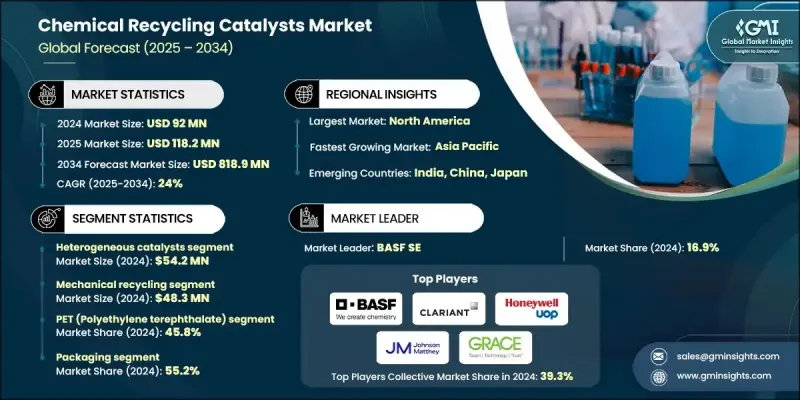
The Global Chemical Recycling Catalysts Market was valued at USD 92 million in 2024 and is estimated to grow at a CAGR of 24% to reach USD 818.9 million by 2034.
This market is expanding as these catalysts enable the conversion of discarded polymers and plastics into monomers or valuable chemical compounds through molecular-level transformations rather than physical processing. Chemical recycling differs from traditional mechanical methods because it restores material quality instead of producing downgraded products. The shift toward advanced recycling is fueled by rising environmental expectations, tighter regulations, and a growing emphasis on circular economic models. Chemical recycling catalysts lower the reaction energy needed to break polymer chains and support processes such as pyrolysis, hydrolysis, and depolymerization. Continued improvements in catalyst performance, along with global efforts to enhance waste recovery and material reuse, are playing a major role in shaping long-term adoption.
| Market Scope | |
|---|---|
| Start Year | 2024 |
| Forecast Year | 2025-2034 |
| Start Value | $92 Million |
| Forecast Value | $818.9 Million |
| CAGR | 24% |
The heterogeneous catalysts segment generated USD 54.2 million in 2024. Their widespread use is tied to their durability, cost efficiency, and straightforward separation after reactions. Homogeneous catalysts remain relevant due to their effectiveness in highly selective transformations, although their growth is limited by separation challenges and higher operational expenses compared with solid catalysts.
The catalysts for the PET segment held a 45.8% share in 2024. Demand continues to rise due to the broad use of PET in textiles and packaging and the growing movement to convert PET back into high-quality monomers. Processes such as glycolysis and hydrolysis rely on catalysts to break down PET under controlled conditions, enabling its reintegration into new materials. Catalysts for polyolefins, including polyethylene and polypropylene, also remain significant as new innovations help convert these plastic streams into reusable hydrocarbons and advance circularity goals.
U.S. Chemical Recycling Catalysts Market generated USD 18.3 million in 2024. Adoption continues to increase across North America as industries and research partners work together to boost recycling efficiency and move more pilot-level and commercial recycling programs forward. Supportive regulatory environments that encourage waste reduction and improved recycling systems indirectly contribute to higher catalyst demand and technological progress.
Key companies active in the Chemical Recycling Catalysts Market include Albemarle Corporation, BASF SE, Agilyx Corporation, Clariant AG, Carbios, Dow Inc., Haldor Topsoe A/S, Grace Catalysts Technologies (W.R. Grace & Co.), Eurecat, Honeywell UOP, Loop Industries, Johnson Matthey Plc, Ioniqa Technologies, SABIC, PETRONAS Chemicals Group Berhad, Shell Plc, TotalEnergies SE, Plastic Energy, Tosoh Corporation, ExxonMobil Corporation, Zeolyst International, and Pyrowave. Companies in the Chemical Recycling Catalysts Market are expanding their presence by focusing on technological advancement, long-term collaborations, and scaling production capabilities. Many players are investing heavily in R&D to develop catalysts that offer higher selectivity, faster reaction rates, and lower energy use. Strategic alliances between catalyst manufacturers, recycling facilities, and polymer producers are becoming more common to accelerate commercialization and secure reliable end-use channels. Firms are also enhancing pilot programs to validate process efficiency before broad deployment.
Table of Contents
Chapter 1 Methodology & Scope
- 1.1 Market scope and definition
- 1.2 Research design
- 1.2.1 Research approach
- 1.2.2 Data collection methods
- 1.3 Data mining sources
- 1.3.1 Global
- 1.3.2 Regional/Country
- 1.4 Base estimates and calculations
- 1.4.1 Base year calculation
- 1.4.2 Key trends for market estimation
- 1.5 Primary research and validation
- 1.5.1 Primary sources
- 1.6 Forecast model
- 1.7 Research assumptions and limitations
Chapter 2 Executive Summary
- 2.1 Industry 3600 synopsis
- 2.2 Key market trends
- 2.2.1 Catalyst type
- 2.2.2 Process
- 2.2.3 Polymer type
- 2.2.4 Application
- 2.2.5 Regional
- 2.3 TAM Analysis, 2025-2034
- 2.4 CXO perspectives: Strategic imperatives
- 2.4.1 Executive decision points
- 2.4.2 Critical success factors
- 2.5 Future outlook and strategic recommendations
Chapter 3 Industry Insights
- 3.1 Industry ecosystem analysis
- 3.1.1 Supplier landscape
- 3.1.2 Profit margin
- 3.1.3 Value addition at each stage
- 3.1.4 Factor affecting the value chain
- 3.1.5 Disruptions
- 3.2 Industry impact forces
- 3.2.1 Growth drivers
- 3.2.1.1 Rapid innovation in catalyst and recycling technologies
- 3.2.1.2 Expansion of polymer use in high growth end use sectors
- 3.2.1.3 Growing regulatory pressure and sustainability mandates across industries
- 3.2.2 Industry pitfalls and challenges
- 3.2.2.1 High capital and operational costs
- 3.2.2.2 Feedstock variability and contamination issues
- 3.2.3 Market opportunities
- 3.2.3.1 Development of multi-feedstock catalysts
- 3.2.3.2 Integration with renewable energy and green chemicals
- 3.2.3.3 Emerging markets with growing plastic consumption
- 3.2.1 Growth drivers
- 3.3 Growth potential analysis
- 3.4 Regulatory landscape
- 3.4.1 North America
- 3.4.2 Europe
- 3.4.3 Asia Pacific
- 3.4.4 Latin America
- 3.4.5 Middle East & Africa
- 3.5 Porter's analysis
- 3.6 PESTEL analysis
- 3.7 Technology and innovation landscape
- 3.7.1 Current technological trends
- 3.7.2 Emerging technologies
- 3.8 Price trends
- 3.8.1 By region
- 3.8.2 By product type
- 3.9 Future market trends
- 3.10 Patent landscape
- 3.11 Trade statistics (HS code) (Note: the trade statistics will be provided for key countries only)
- 3.11.1 Major importing countries
- 3.11.2 Major exporting countries
- 3.12 Sustainability and environmental aspects
- 3.12.1 Sustainable practices
- 3.12.2 Waste reduction strategies
- 3.12.3 Energy efficiency in production
- 3.12.4 Eco-friendly initiatives
- 3.13 Carbon footprint consideration
Chapter 4 Competitive Landscape, 2024
- 4.1 Introduction
- 4.2 Company market share analysis
- 4.2.1 By region
- 4.2.1.1 North America
- 4.2.1.2 Europe
- 4.2.1.3 Asia Pacific
- 4.2.1.4 LATAM
- 4.2.1.5 MEA
- 4.2.1 By region
- 4.3 Company matrix analysis
- 4.4 Competitive analysis of major market players
- 4.5 Competitive positioning matrix
- 4.6 Key developments
- 4.6.1 Mergers & acquisitions
- 4.6.2 Partnerships & collaborations
- 4.6.3 New product launches
- 4.6.4 Expansion plans
Chapter 5 Market Estimates and Forecast, By Catalyst Type, 2021-2034 (USD Million) (Kilo Tons)
- 5.1 Key trends
- 5.2 Heterogeneous catalysts
- 5.2.1 Zeolites (ZSM-5, USY, NaY, Beta)
- 5.2.2 FCC catalysts
- 5.2.3 Metal oxide catalysts
- 5.2.4 Supported metal catalysts (Pt, Pd, Rh, Ni, Fe, Co, Ru)
- 5.3 Homogeneous catalysts
- 5.3.1 Metal acetates & salts
- 5.3.2 Organometallic complexes
- 5.3.3 Ionic liquids
- 5.3.4 Organocatalysts
- 5.4 Enzymatic catalysts (biocatalysts)
- 5.4.1 PETases
- 5.4.2 Cutinases
- 5.4.3 Other esterases & lipases
Chapter 6 Market Estimates and Forecast, By Process, 2021-2034 (USD Million) (Kilo Tons)
- 6.1 Key trends
- 6.2 Pyrolysis catalysts
- 6.3 Depolymerization catalysts
- 6.4 Gasification catalysts
- 6.5 Solvolysis catalysts
Chapter 7 Market Estimates and Forecast, By Polymer Type, 2021-2034 (USD Million) (Kilo Tons)
- 7.1 Key trends
- 7.2 PET (polyethylene terephthalate) catalysts
- 7.3 Polyolefin (PE/PP) catalysts
- 7.4 Polystyrene (PS) catalysts
- 7.5 Mixed plastics catalysts
- 7.6 Specialty polymer catalysts
- 7.6.1 Nylon (polyamides)
- 7.6.2 Polycarbonate
- 7.6.3 Polyurethanes
- 7.6.4 PVC
Chapter 8 Market Estimates and Forecast, By Application, 2021-2034 (USD Million) (Kilo Tons)
- 8.1 Key trends
- 8.2 Packaging
- 8.3 Automotive
- 8.4 Textiles & apparel
- 8.5 Construction & building materials
- 8.6 Electronics & e-waste
- 8.7 Others
Chapter 9 Market Estimates and Forecast, By Region, 2021-2034 (USD Million) (Kilo Tons)
- 9.1 Key trends
- 9.2 North America
- 9.2.1 U.S.
- 9.2.2 Canada
- 9.2.3 Mexico
- 9.3 Europe
- 9.3.1 Germany
- 9.3.2 UK
- 9.3.3 France
- 9.3.4 Spain
- 9.3.5 Italy
- 9.3.6 Rest of Europe
- 9.4 Asia Pacific
- 9.4.1 China
- 9.4.2 India
- 9.4.3 Japan
- 9.4.4 Australia
- 9.4.5 South Korea
- 9.4.6 Rest of Asia Pacific
- 9.5 Latin America
- 9.5.1 Brazil
- 9.5.2 Mexico
- 9.5.3 Argentina
- 9.5.4 Rest of Latin America
- 9.6 Middle East and Africa
- 9.6.1 Saudi Arabia
- 9.6.2 South Africa
- 9.6.3 UAE
- 9.6.4 Rest of Middle East and Africa
Chapter 10 Company Profiles
- 10.1 Agilyx Corporation
- 10.2 Albemarle Corporation
- 10.3 BASF SE
- 10.4 Carbios
- 10.5 Clariant AG
- 10.6 Dow Inc.
- 10.7 Eurecat
- 10.8 Grace Catalysts Technologies (W.R. Grace & Co.)
- 10.9 Haldor Topsoe A/S
- 10.10 Honeywell UOP
- 10.11 Ioniqa Technologies
- 10.12 Johnson Matthey Plc
- 10.13 Loop Industries
- 10.14 PETRONAS Chemicals Group Berhad
- 10.15 Plastic Energy
- 10.16 SABIC
- 10.17 Shell Plc
- 10.18 TotalEnergies SE
- 10.19 Tosoh Corporation
- 10.20 ExxonMobil Corporation
- 10.21 Zeolyst International
- 10.22 Pyrowave

