
PUBLISHER: Global Market Insights Inc. | PRODUCT CODE: 1885887

PUBLISHER: Global Market Insights Inc. | PRODUCT CODE: 1885887
Food Waste Recycling Market Opportunity, Growth Drivers, Industry Trend Analysis, and Forecast 2025 - 2034
The Global Food Waste Recycling Market was valued at USD 77.6 billion in 2024 and is estimated to grow at a CAGR of 5.5% to reach USD 132.2 billion by 2034.
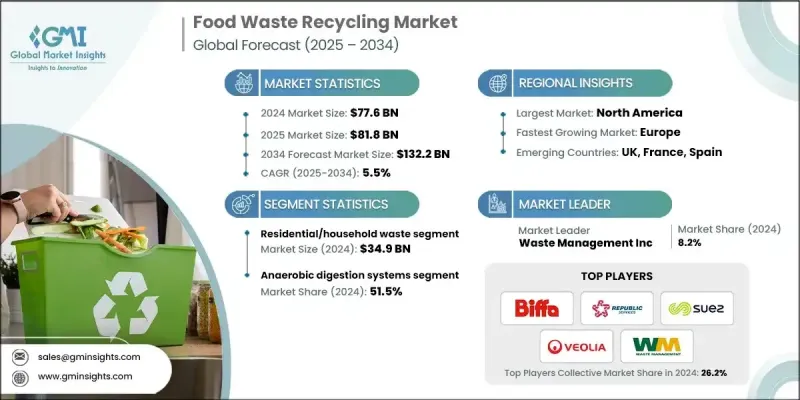
Rising awareness of the environmental impact of discarded food, including methane emissions from landfills and increasing pressure on waste systems, is accelerating the adoption of recycling solutions worldwide. Food waste recycling supports the conversion of organic waste into valuable outputs such as compost, biogas, and feed-grade products, helping reduce landfill use and advancing sustainable waste management practices. Governments across multiple regions continue to implement policies that encourage large-scale recycling programs, strengthening industry growth. North America maintains a leading position due to established infrastructure and strong regulatory backing, whereas Europe is expanding rapidly with stringent sustainability directives and rising investments in advanced waste-processing technologies. Developments in anaerobic digestion, composting, and renewable energy pathways are reshaping operational efficiency and improving the quality of recycled outputs. Automation and smart monitoring technologies driven by AI and IoT are enhancing scalability, reducing operational barriers, and supporting broader adoption across municipalities and private sectors. These factors collectively contribute to a strong global outlook for the food waste recycling industry.
| Market Scope | |
|---|---|
| Start Year | 2024 |
| Forecast Year | 2025-2034 |
| Start Value | $77.6 Billion |
| Forecast Value | $132.2 Billion |
| CAGR | 5.5% |
The residential and household segment generated USD 34.9 billion in 2024 and continues to dominate because of the high volume of food discarded at the consumer level. Growth in this category is supported by rising urban populations and expanding public awareness of sustainable living practices: community initiatives and government-backed programs encouraging household waste diversion further support widespread participation. The affordability and simplicity of residential recycling solutions also attract market participants looking to strengthen outreach in this segment.
The anaerobic digestion systems captured a 51.5% share in 2024. Their leading position is reinforced by the technology's ability to convert organic waste into renewable energy and nutrient-rich digestate. These systems help reduce greenhouse gas emissions and support environmental sustainability goals, making them favored across regions focused on lowering carbon footprints. Strong energy recovery potential continues to accelerate innovation and deployment in this category.
North America Food Waste Recycling Market is expected to grow at a CAGR of 5.5% between 2025 and 2034. Adoption rates are rising as businesses and consumers increasingly prioritize waste reduction and environmentally responsible behaviors. Demand is strengthening for modern recycling solutions capable of transforming food waste into marketable products such as organic fertilizers, bioenergy, and renewable power sources, reflecting a shift toward circular resource utilization.
Key companies active in the Food Waste Recycling Market include Waste Management Inc., SUEZ Group, Veolia, Ridan food waste composters, Republic Services, Clear Earth Recycling, Alfa Therm Limited, Skip Shapiro Enterprises LLC, Biffa, and FoodCycler. Companies in the Food Waste Recycling Market reinforce their competitive edge by expanding processing capacity, integrating advanced waste-to-resource technologies, and adopting sustainable operating models. Many focus on optimizing recycling efficiency through automation, real-time tracking tools, and digitally enabled waste management platforms. Diversification of service offerings, including bioenergy production, organic fertilizer solutions, and customized waste handling programs, supports long-term client partnerships. Firms also prioritize regulatory compliance and collaborate with municipalities to secure large-scale contracts and improve regional recycling rates.
Table of Contents
Chapter 1 Methodology & Scope
- 1.1 Market scope and definition
- 1.2 Research design
- 1.2.1 Research approach
- 1.2.2 Data collection methods
- 1.3 Data mining sources
- 1.3.1 Global
- 1.3.2 Regional/Country
- 1.4 Base estimates and calculations
- 1.4.1 Base year calculation
- 1.4.2 Key trends for market estimation
- 1.5 Primary research and validation
- 1.5.1 Primary sources
- 1.6 Forecast model
- 1.7 Research assumptions and limitations
Chapter 2 Executive Summary
- 2.1 Industry 360° synopsis
- 2.2 Key market trends
- 2.2.1 Feedstock source trends
- 2.2.2 Process trends
- 2.2.3 End Use trends
- 2.2.4 Regional trends
- 2.3 TAM Analysis, 2025-2034
- 2.4 CXO perspectives: strategic imperatives
- 2.4.1 Executive decision points
- 2.4.2 Critical success factors
- 2.5 Future outlook and strategic recommendations
Chapter 3 Industry Insights
- 3.1 Industry ecosystem analysis
- 3.1.1 Supplier landscape
- 3.1.2 Profit margin
- 3.1.3 Value addition at each stage
- 3.1.4 Factor affecting the value chain
- 3.1.5 Disruptions
- 3.2 Industry impact forces
- 3.2.1 Growth drivers
- 3.2.1.1 Rising landfill costs & restrictions
- 3.2.1.2 Regulatory mandates & policy support
- 3.2.1.3 Circular economy adoption
- 3.2.2 Industry pitfalls and challenges
- 3.2.2.1 Feedstock quality & contamination issues
- 3.2.2.2 Technology standardization gaps
- 3.2.3 Market opportunities
- 3.2.3.1 Digital platform development
- 3.2.3.2 Emerging technology integration
- 3.2.1 Growth drivers
- 3.3 Growth potential analysis
- 3.4 Regulatory landscape
- 3.4.1 North America
- 3.4.2 Europe
- 3.4.3 Asia Pacific
- 3.4.4 Latin America
- 3.4.5 Middle East & Africa
- 3.5 Porter's analysis
- 3.6 PESTEL analysis
- 3.7 Technology and Innovation landscape
- 3.7.1 Current technological trends
- 3.7.2 Emerging technologies
- 3.8 Price trends
- 3.8.1 By region
- 3.8.2 By feedstock source
- 3.9 Future market trends
- 3.10 Patent landscape
- 3.11 Trade statistics (HS code)( Note: the trade statistics will be provided for key countries only)
- 3.11.1 Major importing countries
- 3.11.2 Major exporting countries
- 3.12 Sustainability and environmental aspects
- 3.12.1 Sustainable practices
- 3.12.2 Waste reduction strategies
- 3.12.3 Energy efficiency in production
- 3.12.4 Eco-friendly initiatives
- 3.13 Carbon footprint consideration
Chapter 4 Competitive Landscape, 2024
- 4.1 Introduction
- 4.2 Company market share analysis
- 4.2.1 By region
- 4.2.1.1 North America
- 4.2.1.2 Europe
- 4.2.1.3 Asia Pacific
- 4.2.1.4 LATAM
- 4.2.1.5 MEA
- 4.2.1 By region
- 4.3 Company matrix analysis
- 4.4 Competitive analysis of major market players
- 4.5 Competitive positioning matrix
- 4.6 Key developments
- 4.6.1 Mergers & acquisitions
- 4.6.2 Partnerships & collaborations
- 4.6.3 New product launches
- 4.6.4 Expansion plans
Chapter 5 Market Estimates and Forecast, By Feedstock Source, 2021-2034 (USD Billion) (Kilo Tons)
- 5.1 Key trends
- 5.2 Residential/household waste
- 5.3 Commercial food service
- 5.3.1 Restaurants & cafeterias
- 5.3.2 Hotels & hospitality
- 5.3.3 Institutional kitchens
- 5.3.4 Catering services
- 5.4 Food retail
- 5.4.1 Grocery stores & supermarkets
- 5.4.2 Convenience stores
- 5.4.3 Farmers markets
- 5.5 Food processing & manufacturing
- 5.5.1 Fruit & vegetable processing
- 5.5.2 Meat & poultry processing
- 5.5.3 Dairy processing
- 5.5.4 Beverage manufacturing
- 5.6 Agricultural sources
- 5.6.1 On-farm crop residues
- 5.6.2 Livestock manure
- 5.6.3 Aquaculture waste
Chapter 6 Market Estimates and Forecast, By Process, 2021-2034 (USD Billion) (Kilo Tons)
- 6.1 Key trends
- 6.2 Anaerobic digestion systems
- 6.3 Composting system
- 6.4 Mechanical biological treatment
- 6.5 Others
Chapter 7 Market Estimates and Forecast, By End Use, 2021-2034 (USD Billion) (Kilo Tons)
- 7.1 Key trends
- 7.2 Energy products
- 7.2.1 Biogas & biomethane
- 7.2.2 Renewable natural gas (RNG)
- 7.2.3 Electricity generation
- 7.3 Soil amendment products
- 7.3.1 Compost
- 7.3.2 Digestate
- 7.3.3 Biochar
- 7.3.4 Liquid fertilizers
- 7.4 Feed & protein products
- 7.4.1 Insect protein meal
- 7.4.2 Animal feed
- 7.4.3 Aquaculture feed
- 7.5 Industrial products
- 7.5.1 Bioplastics & polymers
- 7.5.2 Biochemicals
- 7.5.3 Packaging materials
- 7.6 Others
Chapter 8 Market Estimates and Forecast, By Region, 2021-2034 (USD Billion) (Kilo Tons)
- 8.1 Key trends
- 8.2 North America
- 8.2.1 U.S.
- 8.2.2 Canada
- 8.3 Europe
- 8.3.1 Germany
- 8.3.2 UK
- 8.3.3 France
- 8.3.4 Spain
- 8.3.5 Italy
- 8.3.6 Rest of Europe
- 8.4 Asia Pacific
- 8.4.1 China
- 8.4.2 India
- 8.4.3 Japan
- 8.4.4 Australia
- 8.4.5 South Korea
- 8.4.6 Rest of Asia Pacific
- 8.5 Latin America
- 8.5.1 Brazil
- 8.5.2 Mexico
- 8.5.3 Argentina
- 8.5.4 Rest of Latin America
- 8.6 Middle East and Africa
- 8.6.1 Saudi Arabia
- 8.6.2 South Africa
- 8.6.3 UAE
- 8.6.4 Rest of Middle East and Africa
Chapter 9 Company Profiles
- 9.1 Alfa Therm Limited
- 9.2 Biffa
- 9.3 Clear Earth Recycling
- 9.4 FoodCycler
- 9.5 Republic Services
- 9.6 Ridan food waste composters
- 9.7 Skip Shapiro Enterprises, LLC
- 9.8 SUEZ Group
- 9.9 Veolia
- 9.10 Waste Management Inc.

