PUBLISHER: Global Market Insights Inc. | PRODUCT CODE: 1885898

PUBLISHER: Global Market Insights Inc. | PRODUCT CODE: 1885898
Perforating Gun Market Opportunity, Growth Drivers, Industry Trend Analysis, and Forecast 2025 - 2034
The Global Perforating Gun Market was valued at USD 2.2 billion in 2024 and is estimated to grow at a CAGR of 5.2% to reach USD 3.6 billion by 2034.
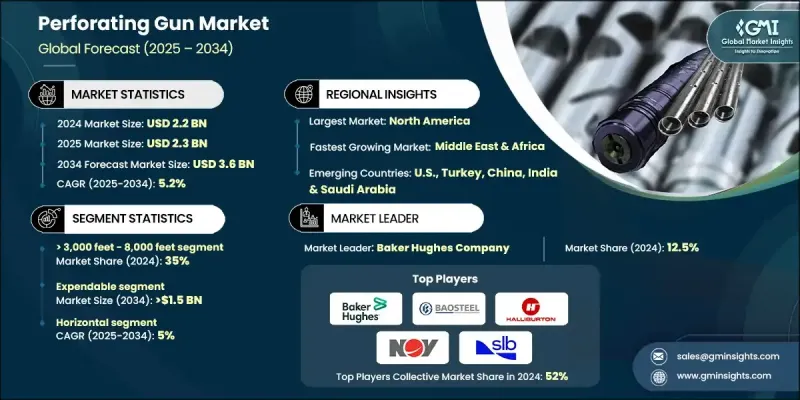
Growth is shaped by the rising need to create effective communication pathways between wellbores and hydrocarbon-bearing formations as completion programs become increasingly complex. Operators are prioritizing systems that deliver consistent perforation quality, reduced casing impact, and enhanced penetration in both unconventional and conventional developments. Progress in shaped charge engineering, improved carrier strength, and refined deployment practices are elevating overall well performance. Perforating guns remain central to completion workflows, as they are designed to form targeted channels through the casing, cement, and formation rock that allow reservoir fluids to move into the wellbore. These tools integrate specialized explosive charges configured to improve shot accuracy, perforation uniformity, and flow characteristics. Technology development is moving rapidly toward compact, modular systems that decrease rig time, simplify handling, and strengthen reliability in vertical and horizontal operations. Increasing interest in selective perforation is also guiding adoption trends, as operators seek enhanced control, higher shot densities, and oriented configurations to optimize fracture initiation and connectivity in tight rock environments.
| Market Scope | |
|---|---|
| Start Year | 2024 |
| Forecast Year | 2025-2034 |
| Start Value | $2.2 Billion |
| Forecast Value | $3.6 Billion |
| CAGR | 5.2% |
The <= 3,000 feet depth category is expected to reach USD 800 million by 2034, driven by expanding shallow-well intervention programs, increasing recompletions, and a resurgence of workover activity. Market momentum is supported by rising demand for compact gun systems suited to aging wells, growing acceptance of safer low-pressure deployment methods, and the spread of modular designs that enable swift tool changes. The integration of lightweight digital firing technologies is further advancing operational precision, reducing nonproductive time, and strengthening near-wellbore stimulation results.
The semi-expendable perforating systems segment generated USD 1 billion in 2024. Growth is encouraged by hybrid designs that lower debris, enhance carrier durability for repeated multi-stage applications, pressure-balanced firing mechanisms that support safer operations, and advanced digital initiation tools that streamline complex completion sequences.
U.S. Perforating Gun Market held 80% share in 2024 and generated USD 645.5 million. Longer laterals, higher stimulation requirements, and the push to shorten completion cycles are influencing national demand. Operators are increasingly turning to compact, high-density tools, reliable initiation technologies, and low-debris designs that support efficient multi-stage work in tight and shale reservoirs.
Major companies active in the Global Perforating Gun Market include Baker Hughes Company, Halliburton, Weatherford, SLB, NOV, VIGOR, DMC, DynaEnergetics, Promperforator, Baosteel, HUNTING, G&H Diversified Manufacturing, Shaanxi FYPE Rigid Machinery, ILJIN NTS, Repeat Precision, Core Laboratories, Oso Perforating, Tassaroli, WGO HOLDINGS, and ZAO NTF Perfotech. Companies in the Perforating Gun Market are strengthening their competitive positions through continued investment in debris-reduction technologies, advanced digital initiation systems, and robust carrier materials designed to withstand high-pressure, multi-stage operations. Many firms are expanding manufacturing of modular and quick-assembly systems that reduce rig time and improve logistics in remote or complex basins. Strategic partnerships with oilfield service companies and operators are helping improve tool compatibility across completion platforms.
Table of Contents
Chapter 1 Methodology & Scope
- 1.1 Research design
- 1.1.1 Research approach
- 1.1.2 Data collection methods
- 1.2 Base estimates and calculations
- 1.2.1 Base year calculation
- 1.2.2 Market estimates & forecast parameters
- 1.3 Forecast model
- 1.3.1 Key trends for market estimates
- 1.3.2 Quantified market impact analysis
- 1.3.2.1 Mathematical impact of growth parameters on forecast
- 1.3.3 Scenario analysis framework
- 1.4 Primary research and validation
- 1.4.1 Some of the primary sources (but not limited to)
- 1.5 Data mining sources
- 1.5.1 Paid Sources
- 1.5.2 Sources, by region
- 1.6 Research trail & scoring components
- 1.6.1 Research trail components
- 1.6.2 Scoring components
- 1.7 Research transparency addendum
- 1.7.1 Source attribution framework
- 1.7.2 Quality assurance metrics
- 1.7.3 Our commitment to trust
- 1.8 Market definitions
Chapter 2 Executive Summary
- 2.1 Industry synopsis, 2021 - 2034
- 2.1.1 Business trends
- 2.1.2 Well type trends
- 2.1.3 Depth trends
- 2.1.4 Technology trends
- 2.1.5 Application trends
- 2.1.6 Orientation trends
- 2.1.7 Pressure trends
- 2.1.8 Product trends
- 2.1.9 Regional trends
Chapter 3 Industry Insights
- 3.1 Industry ecosystem analysis
- 3.1.1 Raw material availability & sourcing analysis
- 3.1.2 Manufacturing capacity assessment
- 3.1.3 Supply chain resilience & risk factors
- 3.1.4 Distribution network analysis
- 3.2 Regulatory landscape
- 3.3 Industry impact forces
- 3.3.1 Growth drivers
- 3.3.2 Industry pitfalls & challenges
- 3.4 Growth potential analysis
- 3.5 Porter's analysis
- 3.5.1 Bargaining power of suppliers
- 3.5.2 Bargaining power of buyers
- 3.5.3 Threat of new entrants
- 3.5.4 Threat of substitutes
- 3.6 PESTEL analysis
- 3.6.1 Political factors
- 3.6.2 Economic factors
- 3.6.3 Social factors
- 3.6.4 Technological factors
- 3.6.5 Legal factors
- 3.6.6 Environmental factors
- 3.7 Cost structure analysis of perforating guns
- 3.8 Emerging opportunities & trends
- 3.9 Digitalization & IoT integration
- 3.10 Investment analysis & future outlook
Chapter 4 Competitive Landscape, 2025
- 4.1 Introduction
- 4.2 Company market share analysis, by region, 2024
- 4.2.1 North America
- 4.2.2 Europe
- 4.2.3 Asia Pacific
- 4.2.4 Middle East & Africa
- 4.2.5 Latin America
- 4.3 Strategic dashboard
- 4.4 Strategic initiatives
- 4.4.1 Key partnerships & collaborations
- 4.4.2 Major M&A activities
- 4.4.3 Product innovations & launches
- 4.4.4 Market expansion strategies
- 4.5 Competitive benchmarking
- 4.6 Innovation & sustainability landscape
Chapter 5 Market Size and Forecast, By Well Type, 2021 - 2034 (USD Million)
- 5.1 Key trends
- 5.2 Horizontal
- 5.3 Vertical
Chapter 6 Market Size and Forecast, By Depth, 2021 - 2034 (USD Million)
- 6.1 Key trends
- 6.2 ≤ 3,000 feet
- 6.3 > 3,000 feet - 8,000 feet
- 6.4 > 8,000 feet
Chapter 7 Market Size and Forecast, By Technology, 2021 - 2034 (USD Million)
- 7.1 Key trends
- 7.2 Expendable
- 7.3 Semi-expendable
- 7.4 Retrievable
Chapter 8 Market Size and Forecast, By Application, 2021 - 2034 (USD Million)
- 8.1 Key trends
- 8.2 Onshore
- 8.3 Offshore
Chapter 9 Market Size and Forecast, By Orientation, 2021 - 2034 (USD Million)
- 9.1 Key trends
- 9.2 Internal
- 9.3 External
Chapter 10 Market Size and Forecast, By Pressure, 2021 - 2034 (USD Million)
- 10.1 Key trends
- 10.2 High
- 10.3 Low
Chapter 11 Market Size and Forecast, By Product, 2021 - 2034 (USD Million)
- 11.1 Key trends
- 11.2 Through tubing hollow carrier system
- 11.3 Wireline conveyed casing system
- 11.4 Through tubing exposed gun system
- 11.5 Tubing conveyed the perforation system
Chapter 12 Market Size and Forecast, By Region, 2021 - 2034 (USD Million)
- 12.1 Key trends
- 12.2 North America
- 12.2.1 U.S.
- 12.2.2 Canada
- 12.3 Europe
- 12.3.1 Germany
- 12.3.2 Turkey
- 12.3.3 Romania
- 12.3.4 UK
- 12.3.5 Italy
- 12.3.6 Russia
- 12.3.7 Netherlands
- 12.3.8 Norway
- 12.4 Asia Pacific
- 12.4.1 China
- 12.4.2 Japan
- 12.4.3 Indonesia
- 12.4.4 India
- 12.4.5 Australia
- 12.4.6 Thailand
- 12.5 Middle East & Africa
- 12.5.1 Saudi Arabia
- 12.5.2 UAE
- 12.5.3 Qatar
- 12.5.4 Egypt
- 12.5.5 Algeria
- 12.5.6 Libya
- 12.5.7 Nigeria
- 12.5.8 Kuwait
- 12.5.9 Oman
- 12.6 Latin America
- 12.6.1 Brazil
- 12.6.2 Mexico
- 12.6.3 Argentina
Chapter 13 Company Profiles
- 13.1 Baker Hughes Company
- 13.2 Baosteel Co., Ltd.
- 13.3 Core Laboratories
- 13.4 DMC
- 13.5 DynaEnergetics
- 13.6 G&H Diversified Manufacturing, L.P.
- 13.7 Halliburton
- 13.8 HUNTING
- 13.9 ILJIN NTS CO., LTD.
- 13.10 NOV
- 13.11 Oso Perforating
- 13.12 Promperforator
- 13.13 Repeat Precision
- 13.14 Shaanxi FYPE Rigid Machinery Co., Ltd.
- 13.15 SLB
- 13.16 Tassaroli S.A.
- 13.17 VIGOR
- 13.18 Weatherford
- 13.19 XPRO HOLDINGS
- 13.20 ZAO NTF Perfotech

