PUBLISHER: Mordor Intelligence | PRODUCT CODE: 2125542

PUBLISHER: Mordor Intelligence | PRODUCT CODE: 2125542
Middle East And North Africa Perforating Gun - Market Share Analysis, Industry Trends & Statistics, Growth Forecasts (2026 - 2031)
According to Mordor Intelligence, the Middle East and North Africa perforating gun market size is projected to expand from USD 284.43 million in 2025 and USD 299.22 million in 2026 to USD 390.14 million by 2031, registering a CAGR of 5.45% between 2026 to 2031.
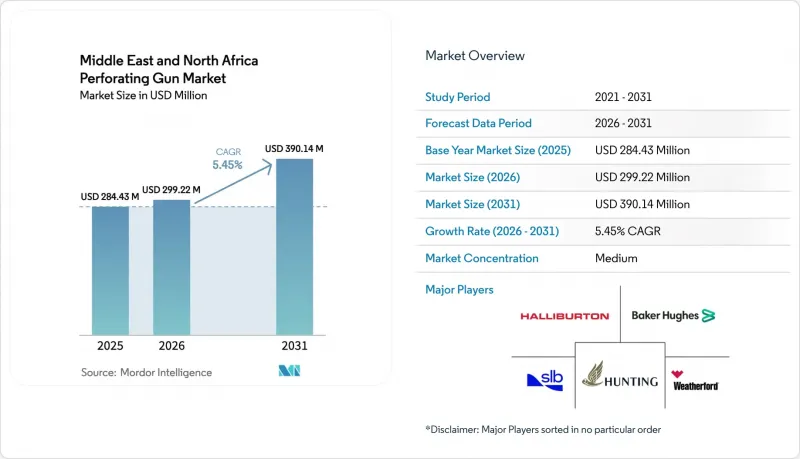
This report is Segmented by Carrier Type (Hollow Carrier, Fragmenting/Capsule, and More), Well Type (Horizontal and Deviated and Vertical), Conveyance Method (Wireline-Conveyed Casing Guns, Tubing-Conveyed Perforation, and Coiled-Tubing and Slickline Deployed), Application (Onshore and Offshore), and Geography (Saudi Arabia, United Arab Emirates, Qatar, Algeria, Egypt, and More).
Middle East And North Africa Perforating Gun Market Trends and Insights
Surge in Unconventional Horizontal Drilling Programs
Commercial production from Saudi Arabia's Jafurah shale in December 2025 marked a watershed for unconventional gas in the region, with 200 horizontal wells slated annually through 2031 and each well demanding 8-12 perforating stages. Similar tight-gas pilots in the UAE's Diyab and Bab formations and Oman's Mabrouk North East project reinforce the pull for high-shot-density gun strings. The switch to long laterals favors retrievable and fragmenting carriers that leave minimal debris and cut clean-out time. In parallel, local-content rules compel global vendors to co-manufacture shaped charges in the Gulf, reducing customs delays. Collectively, these trends lift per-well hardware intensity and anchor long-term demand across the Middle East & North Africa perforating gun market.
Accelerating Re-Perforation Campaigns in Mature MENA Fields
Selective re-perforation in Saudi Arabia's Ghawar, Kuwait's Burgan, and ADNOC's onshore blocks is delivering 15%-25% production uplifts at one-tenth the cost of drilling new wells. Coiled-tubing conveyance enables live-well interventions, avoiding costly workovers. Algeria and Egypt apply similar tactics in thin pay zones, extending field life by up to 10 years. Rapid payback, often under six months, encourages NOCs to earmark rising portions of well-services budgets for re-perforation, reinforcing a resilient aftermarket for the Middle East & North Africa perforating gun market.
Renewable-Energy CAPEX Diversion by Gulf Sovereign Funds
Saudi Arabia's Public Investment Fund now commits USD 10 billion annually to renewables, while the UAE targets USD 54 billion by 2030 through Masdar. Such commitments can cap upstream budgets, potentially trimming annual perforating-gun volumes by 8%-12% over a decade. Still, the projects that survive budget cuts often require higher-complexity completions, partly offsetting volume declines for the Middle East & North Africa perforating gun market.
Other drivers and restraints analyzed in the detailed report include:
- National Oil-Company Push for In-Country Perforating Manufacturing
- Adoption of Compact Fragmenting Guns to Cut Rig-less P&A Cost
- Steel and RDX/HMX Supply-Chain Volatility After Red Sea Disruptions
For complete list of drivers and restraints, kindly check the Table Of Contents.
Segment Analysis
Retrievable tubing guns claimed 30.2% of the Middle East & North Africa perforating gun market size in 2025, thanks to their ability to be redeployed across multiple zones, driving an 8.1% CAGR outlook through 2031. Hollow-carrier systems, still dominant at 40.6%, remain indispensable in high-pressure carbonates where full debris retrieval safeguards well integrity. Fragmenting guns, though smaller in share, are gaining ground in offshore P&A campaigns where eliminating retrieval trips slashes rig days. Semi-expendable strip guns fill a niche for through-tubing work in tight-clearance casings. Over the forecast horizon, mature fields that require several interventions favor retrievable carriers for total-cost-of-ownership advantages, while single-shot unconventional wells continue to lean on expendable designs that compress completion time. Service firms are accordingly broadening portfolios: Halliburton opened a USD 45 million plant in Dammam in October 2025 to manufacture both hollow and retrievable carriers, achieving 72% local content and cementing preferred-vendor status with Aramco.
Horizontal and deviated wells accounted for 64.9% of the Middle East & North Africa perforating gun market demand in 2025 and are forecast to expand at 6.5% through 2031. Each Jafurah lateral needs 8-12 stages, quadrupling gun consumption over a conventional vertical well. QatarEnergy's extended-reach offshore wells exceed 5,000 feet and rely on oriented shots to optimize fracture clusters. Vertical wells persist in Algeria and Egypt, where legacy infrastructure supports low-cost completions. Regulatory bodies such as the UAE Supreme Petroleum Council now encourage horizontal drilling to maximize reservoir contact, ensuring a sustained pull for high-shot-density systems. Consequently, tubing-conveyed and coiled-tubing conveyances outpace wireline in long laterals, reinforcing the lead of horizontal architecture within the Middle East & North Africa perforating gun market.
Complete Report Scope:
- By Carrier Type
- Hollow Carrier
- Fragmenting/Capsule (Expendable)
- Semi-Expendable Strip
- Retrievable Tubing Guns
- By Well Type
- Horizontal and Deviated
- Vertical
- By Conveyance Method
- Wireline-Conveyed Casing Guns
- Tubing-Conveyed Perforation (TCP)
- Coiled-Tubing and Slickline Deployed
- By Application
- Onshore
- Offshore
- By Geography
- Saudi Arabia
- United Arab Emirates
- Qatar
- Algeria
- Egypt
- Morocco
- Rest of Middle East and North Africa
List of Companies Covered in this Report:
- Schlumberger Ltd
- Halliburton Company
- Baker Hughes Co.
- Weatherford International plc
- Hunting plc
- NOV Inc.
- DynaEnergetics GmbH & Co. KG
- DMC Global Inc.
- Core Laboratories (Nov Completion/Owen)
- Nine Energy Service Inc.
- ADNOC Drilling
- Arabian Drilling Co.
- TAQA Well Services
- Saudi Aramco (Perforating Services)
- Sinopec Oilfield Service Corp.
- CNPC Greatwall Drilling Co.
- Promperforator LLC
- Tassaroli SA
- Geodynamics Inc.
- Titan Division - Yellow Jacket Oil Tools
- FHE USA LLC
- Shaanxi FYPE Rigid Machinery Co.
- Vigor Oil Tools Co.
Additional Benefits:
- The market estimate (ME) sheet in Excel format
- 3 months of analyst support
TABLE OF CONTENTS
1 Introduction
- 1.1 Study Assumptions & Market Definition
- 1.2 Scope of the Study
2 Research Methodology
3 Executive Summary
4 Market Landscape
- 4.1 Market Overview
- 4.2 Market Drivers
- 4.2.1 Surge in unconventional horizontal drilling programs
- 4.2.2 Accelerating re-perforation campaigns in mature MENA fields
- 4.2.3 National oil-company push for in-country perforating manufacturing
- 4.2.4 Adoption of compact fragmenting guns to cut rigless P&A cost
- 4.2.5 Rising rig-less well-intervention budgets post-2024 oil-price rebound
- 4.3 Market Restraints
- 4.3.1 Renewable-energy CAPEX diversion by Gulf sovereign funds
- 4.3.2 Steel & RDX/HMX supply-chain volatility after Red Sea disruptions
- 4.3.3 ESG-driven explosives-handling restrictions at onshore fields
- 4.4 Supply-Chain Analysis
- 4.5 Regulatory Landscape
- 4.6 Technological Outlook
- 4.7 Porter's Five Forces
- 4.7.1 Bargaining Power of Suppliers
- 4.7.2 Bargaining Power of Consumers
- 4.7.3 Threat of New Entrants
- 4.7.4 Threat of Substitute Products & Services
- 4.7.5 Intensity of Competitive Rivalry
5 Market Size & Growth Forecasts
- 5.1 By Carrier Type
- 5.1.1 Hollow Carrier
- 5.1.2 Fragmenting/Capsule (Expendable)
- 5.1.3 Semi-Expendable Strip
- 5.1.4 Retrievable Tubing Guns
- 5.2 By Well Type
- 5.2.1 Horizontal and Deviated
- 5.2.2 Vertical
- 5.3 By Conveyance Method
- 5.3.1 Wireline-Conveyed Casing Guns
- 5.3.2 Tubing-Conveyed Perforation (TCP)
- 5.3.3 Coiled-Tubing and Slickline Deployed
- 5.4 By Application
- 5.4.1 Onshore
- 5.4.2 Offshore
- 5.5 By Geography
- 5.5.1 Saudi Arabia
- 5.5.2 United Arab Emirates
- 5.5.3 Qatar
- 5.5.4 Algeria
- 5.5.5 Egypt
- 5.5.6 Morocco
- 5.5.7 Rest of Middle East and North Africa
6 Competitive Landscape
- 6.1 Market Concentration
- 6.2 Strategic Moves (M&A, Partnerships, PPAs)
- 6.3 Market Share Analysis (Market Rank/Share for key companies)
- 6.4 Company Profiles (includes Global level Overview, Market level overview, Core Segments, Financials as available, Strategic Information, Products & Services, and Recent Developments)
- 6.4.1 Schlumberger Ltd
- 6.4.2 Halliburton Company
- 6.4.3 Baker Hughes Co.
- 6.4.4 Weatherford International plc
- 6.4.5 Hunting plc
- 6.4.6 NOV Inc.
- 6.4.7 DynaEnergetics GmbH & Co. KG
- 6.4.8 DMC Global Inc.
- 6.4.9 Core Laboratories (Nov Completion/Owen)
- 6.4.10 Nine Energy Service Inc.
- 6.4.11 ADNOC Drilling
- 6.4.12 Arabian Drilling Co.
- 6.4.13 TAQA Well Services
- 6.4.14 Saudi Aramco (Perforating Services)
- 6.4.15 Sinopec Oilfield Service Corp.
- 6.4.16 CNPC Greatwall Drilling Co.
- 6.4.17 Promperforator LLC
- 6.4.18 Tassaroli SA
- 6.4.19 Geodynamics Inc.
- 6.4.20 Titan Division - Yellow Jacket Oil Tools
- 6.4.21 FHE USA LLC
- 6.4.22 Shaanxi FYPE Rigid Machinery Co.
- 6.4.23 Vigor Oil Tools Co.
7 Market Opportunities & Future Outlook
- 7.1 White-space & Unmet-Need Assessment

