PUBLISHER: Global Market Insights Inc. | PRODUCT CODE: 1892689

PUBLISHER: Global Market Insights Inc. | PRODUCT CODE: 1892689
Renewable Feedstock Chemicals Market Opportunity, Growth Drivers, Industry Trend Analysis, and Forecast 2025 - 2034
The Global Renewable Feedstock Chemicals Market was valued at USD 156 billion in 2024 and is estimated to grow at a CAGR of 13.6% to reach USD 556.7 billion by 2034.
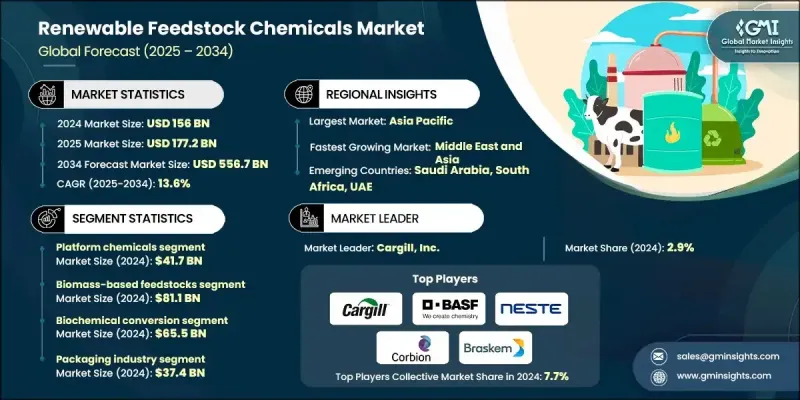
Renewable feedstock chemicals are derived from sustainable, non-fossil sources, including biomass, agricultural residues, organic waste, and bio-based intermediates. Unlike conventional petrochemical products, these chemicals are designed to lower carbon footprints, promote resource-efficient production, and meet global sustainability mandates. Innovations in biotechnological, biochemical, and thermochemical conversion methods have significantly boosted the market, with enzymatic conversion, precision fermentation, gasification, and waste-to-chemicals technologies enhancing yield and feedstock diversity. Rising demand from industries such as packaging, automotive, construction, textiles, and consumer goods is accelerating adoption. Companies are increasingly integrating drop-in bio-based materials into existing production lines to reduce emissions without operational disruption. Strong regulatory support, corporate ESG commitments, and shifting consumer preferences toward green products are further driving market growth and shaping the transition toward circular industrial value chains.
| Market Scope | |
|---|---|
| Start Year | 2024 |
| Forecast Year | 2025-2034 |
| Start Value | $156 Billion |
| Forecast Value | $556.7 Billion |
| CAGR | 13.6% |
The platform chemicals segment accounted for USD 41.7 billion in 2024, acting as essential building blocks for a wide range of downstream bio-based chemical products. Regulations favoring sustainable materials are accelerating the adoption of biopolymers and resins for packaging applications. Improved production efficiency and established pathways for renewable plastics have elevated the importance of bio-based aromatics, olefins, diols, and dicarboxylic acids in bio-polyester and value-added material production.
The biochemical conversion segment generated USD 65.5 billion in 2024, highlighting its role in producing high-value chemicals from biomass using fermentation and enzymatic pathways. Thermochemical conversion is gaining traction for its versatility in producing syngas, bio-oils, and advanced fuels from diverse feedstocks. Chemical conversion techniques enable precise molecular transformations, boosting product yield and performance.
U.S. Renewable Feedstock Chemicals Market accounted for USD 56.6 billion in 2024, leading North America's growth. The region benefits from ambitious sustainability targets, industrial transitions to bio-based materials, supportive regulations, and corporate decarbonization initiatives. Federal incentives, rising private-sector demand for biopolymers, renewable intermediates, and carbon-negative processes are positioning the U.S. as a key driver of market expansion in North America.
Major players operating in the Global Renewable Feedstock Chemicals Market include Amyris, Inc., Axens, Avantium N.V., BASF SE, Braskem S.A., Cargill, Incorporated, Corbion N.V., Covation Bio, DSM-Firmenich, Genomatica, Inc., India Glycols Limited, NatureWorks LLC, Neste Corporation, Novamont S.p.A., Qore (Cargill/HELM Joint Venture), Roquette, Toray Industries, and UPM Biochemicals. Companies in the Global Renewable Feedstock Chemicals Market are adopting strategies such as expanding production capacity, investing in R&D for novel feedstocks and conversion technologies, and forming strategic alliances to broaden distribution networks. They focus on developing drop-in bio-based alternatives compatible with existing infrastructure, enhancing product portfolio diversification, and emphasizing regulatory compliance and sustainability certifications. Firms are leveraging circular economy principles, optimizing process efficiencies, and utilizing digital solutions for supply chain traceability.
Table of Contents
Chapter 1 Methodology & Scope
- 1.1 Market scope and definition
- 1.2 Research design
- 1.2.1 Research approach
- 1.2.2 Data collection methods
- 1.3 Data mining sources
- 1.3.1 Global
- 1.3.2 Regional/Country
- 1.4 Base estimates and calculations
- 1.4.1 Base year calculation
- 1.4.2 Key trends for market estimation
- 1.5 Primary research and validation
- 1.5.1 Primary sources
- 1.6 Forecast model
- 1.7 Research assumptions and limitations
Chapter 2 Executive Summary
- 2.1 Industry 3600 synopsis
- 2.2 Key market trends
- 2.2.1 Product Type
- 2.2.2 Feedstock Type
- 2.2.3 Conversion Technology
- 2.2.4 End use Industry
- 2.2.5 Regional
- 2.3 TAM Analysis, 2025-2034
- 2.4 CXO perspectives: Strategic imperatives
- 2.4.1 Executive decision points
- 2.4.2 Critical success factors
- 2.5 Future outlook and strategic recommendations
Chapter 3 Industry Insights
- 3.1 Industry ecosystem analysis
- 3.1.1 Supplier landscape
- 3.1.2 Profit margin
- 3.1.3 Value addition at each stage
- 3.1.4 Factor affecting the value chain
- 3.1.5 Disruptions
- 3.2 Industry impact forces
- 3.2.1 Growth drivers
- 3.2.1.1 Growing adoption of bio-based polymers & drop-in chemicals
- 3.2.1.2 Advancements in biochemical & thermochemical technologies
- 3.2.1.3 Expanding availability of waste & residue feedstocks
- 3.2.2 Industry pitfalls and challenges
- 3.2.2.1 High production costs limit competitiveness
- 3.2.2.2 Inconsistent product quality
- 3.2.3 Market opportunities
- 3.2.3.1 Integration with circular economy solutions
- 3.2.3.2 Development of specialty bio-based chemicals
- 3.2.3.3 Leveraging digital traceability for premium products
- 3.2.1 Growth drivers
- 3.3 Growth potential analysis
- 3.4 Regulatory landscape
- 3.4.1 North America
- 3.4.2 Europe
- 3.4.3 Asia Pacific
- 3.4.4 Latin America
- 3.4.5 Middle East & Africa
- 3.5 Porter's analysis
- 3.6 PESTEL analysis
- 3.7 Technology and innovation landscape
- 3.7.1 Current technological trends
- 3.7.2 Emerging technologies
- 3.8 Price trends
- 3.8.1 By region
- 3.8.2 By product type
- 3.9 Future market trends
- 3.10 Technology and innovation landscape
- 3.10.1 Current technological trends
- 3.10.2 Emerging technologies
- 3.11 Patent landscape
- 3.12 Trade statistics (HS code) ( Note: the trade statistics will be provided for key countries only)
- 3.12.1 Major importing countries
- 3.12.2 Major exporting countries
- 3.13 Sustainability and environmental aspects
- 3.13.1 Sustainable practices
- 3.13.2 Waste reduction strategies
- 3.13.3 Energy efficiency in production
- 3.13.4 Eco-friendly initiatives
- 3.14 Carbon footprint consideration
Chapter 4 Competitive Landscape, 2024
- 4.1 Introduction
- 4.2 Company market share analysis
- 4.2.1 By region
- 4.2.1.1 North America
- 4.2.1.2 Europe
- 4.2.1.3 Asia Pacific
- 4.2.1.4 LATAM
- 4.2.1.5 MEA
- 4.2.1 By region
- 4.3 Company matrix analysis
- 4.4 Competitive analysis of major market players
- 4.5 Competitive positioning matrix
- 4.6 Key developments
- 4.6.1 Mergers & acquisitions
- 4.6.2 Partnerships & collaborations
- 4.6.3 New product launches
- 4.6.4 Expansion plans
Chapter 5 Market Estimates and Forecast, By Product Type, 2021-2034 (USD Billion) (Kilo Tons)
- 5.1 Key trends
- 5.2 Platform chemicals
- 5.2.1 Alcohols
- 5.2.1.1 Ethanol (bioethanol, cellulosic ethanol)
- 5.2.1.2 Methanol (bio-methanol)
- 5.2.1.3 Butanol (bio-butanol)
- 5.2.2 Organic acids
- 5.2.2.1 Lactic acid
- 5.2.2.2 Succinic acid
- 5.2.2.3 Citric acid
- 5.2.2.4 Itaconic acid
- 5.2.3 Glycerol & polyols
- 5.2.3.1 Glycerol (glycerin)
- 5.2.3.2 Sorbitol
- 5.2.3.3 Xylitol
- 5.2.1 Alcohols
- 5.3 Biopolymers & resins
- 5.3.1 Biodegradable polymers
- 5.3.1.1 Polylactic acid (PLA)
- 5.3.1.2 Polyhydroxyalkanoates (PHA)
- 5.3.1.3 Starch-based polymers
- 5.3.2 Drop-in biopolymers
- 5.3.2.1 Bio-polyethylene (Bio-PE, Bio-HDPE, Bio-LDPE)
- 5.3.2.2 Bio-polyethylene terephthalate (Bio-PET)
- 5.3.2.3 Bio-ethylene vinyl acetate (Bio-EVA)
- 5.3.2.4 Bio-based aromatics & olefins
- 5.3.3 Aromatics (BTX)
- 5.3.3.1 Bio-benzene
- 5.3.3.2 Bio-toluene
- 5.3.3.3 Bio-xylene (Bio-PX)
- 5.3.3.4 Aromatics from lignin
- 5.3.4 Olefins
- 5.3.4.1 Bio-ethylene
- 5.3.4.2 Bio-propylene
- 5.3.1 Biodegradable polymers
- 5.4 Diols & diacids
- 5.4.1 Diols
- 5.4.1.1 Monoethylene glycol (Bio-MEG)
- 5.4.1.2 propylene glycol (1,2-propanediol)
- 5.4.1.3 1,3-propanediol
- 5.4.1.4 1,4-butanediol (Bio-BDO)
- 5.4.1.5 Isosorbide
- 5.4.2 Diacids
- 5.4.2.1 Furandicarboxylic acid (FDCA)
- 5.4.2.2 Adipic acid
- 5.4.2.3 Sebacic acid
- 5.4.2.4 Azelaic acid
- 5.4.1 Diols
- 5.5 Fatty acids & derivatives
- 5.5.1 Fatty acids
- 5.5.2 Fatty acid derivatives
- 5.5.2.1 Dimer fatty acids
- 5.5.2.2 Fatty alcohols
- 5.5.2.3 Fatty acid esters (FAME, FAEE)
- 5.6 Specialty chemicals
- 5.6.1 Bio-solvents
- 5.6.2 Surfactants
- 5.6.3 Polyols for polyurethanes
- 5.6.4 Lubricants
- 5.7 Biointermediates
- 5.7.1 Liquid biointermediates (Biocrude, Bio-oil)
- 5.7.2 Gaseous biointermediates (Syngas, Biogas)
- 5.7.3 Solid/Semi-solid biointermediates (Sugars, FFA, Lactide)
Chapter 6 Market Estimates and Forecast, By Feedstock Type, 2021-2034 (USD Billion) (Kilo Tons)
- 6.1 Key trends
- 6.2 Biomass-based feedstocks
- 6.2.1 Agricultural feedstocks
- 6.2.1.1 Starch crops (Corn, Grain Sorghum, Barley)
- 6.2.1.2 Sugar crops (Sugarcane, Sugar Beets, Sweet Sorghum)
- 6.2.1.3 Oil crops (Soybean, Canola, Camelina, Palm)
- 6.2.2 Agricultural residues
- 6.2.2.1 Corn stover
- 6.2.2.2 Wheat straw
- 6.2.2.3 Bagasse & molasses
- 6.2.3 Forest-derived feedstocks
- 6.2.3.1 Logging residues
- 6.2.3.2 Mill residues (Sawdust, Bark, Black Liquor)
- 6.2.4 Dedicated energy crops
- 6.2.4.1 Switchgrass & miscanthus
- 6.2.4.2 Short-rotation woody crops
- 6.2.4.3 Algae & marine biomass
- 6.2.1 Agricultural feedstocks
- 6.3 Waste-derived feedstocks
- 6.3.1 Municipal & organic waste (MSW, Food Waste)
- 6.3.2 Industrial waste (UCO, Tallow, Distillers Oils)
- 6.3.3 Agricultural & animal waste (Manure, Litter)
- 6.3.4 Biogas (Landfill, Digesters)
- 6.4 Recycled carbon feedstocks
- 6.4.1 Mechanical recycling
- 6.4.2 Chemical recycling (pyrolysis, gasification)
- 6.5 Captured carbon feedstocks
- 6.5.1 Atmospheric/Direct air capture (DAC)
- 6.5.2 Industrial point sources (Flue Gases, Off-Gases)
- 6.5.3 Biogenic CO2 (Fermentation, Anaerobic Digestion)
Chapter 7 Market Estimates and Forecast, By Conversion Technology, 2021-2034 (USD Billion) (Kilo Tons)
- 7.1 Key trends
- 7.2 Biochemical conversion
- 7.2.1 Fermentation (Alcoholic, Lactic Acid, Advanced)
- 7.2.2 Enzymatic hydrolysis
- 7.2.3 Anaerobic digestion
- 7.3 Thermochemical conversion
- 7.3.1 Gasification
- 7.3.2 Pyrolysis (Fast, Slow)
- 7.3.3 Thermocatalytic conversion (BioTCat)
- 7.4 Chemical conversion
- 7.4.1 Transesterification
- 7.4.2 Hydrotreatment/hydrotreating
- 7.4.3 Fischer-tropsch synthesis
- 7.4.4 Dehydration
- 7.4.5 Methanol-to-olefins/Aromatics (MTO/MTA)
- 7.5 Electrochemical & CCU Processes
- 7.5.1 Electrolysis (Renewable hydrogen production)
- 7.5.2 Co2 electrochemical reduction
- 7.5.3 Co2 + h2 synthesis
- 7.6 Mechanical & physical processes
- 7.6.1 Mechanical recycling
- 7.6.2 Chemical recycling
Chapter 8 Market Estimates and Forecast, By End Use Industry, 2021-2034 (USD Billion) (Kilo Tons)
- 8.1 Key trends
- 8.2 Packaging industry
- 8.3 Automotive industry
- 8.4 Textile & apparel industry
- 8.5 Construction industry
- 8.6 Food & beverage industry
- 8.7 Pharmaceuticals & healthcare industry
- 8.8 Personal care & cosmetics industry
- 8.9 Paints & coatings industry
- 8.10 Agriculture industry
- 8.11 Chemical industry
- 8.12 Electronics industry
- 8.13 Oil & gas industry
Chapter 9 Market Estimates and Forecast, By Region, 2021-2034 (USD Billion) (Kilo Tons)
- 9.1 Key trends
- 9.2 North America
- 9.2.1 U.S.
- 9.2.2 Canada
- 9.2.3 Mexico
- 9.3 Europe
- 9.3.1 Germany
- 9.3.2 UK
- 9.3.3 France
- 9.3.4 Spain
- 9.3.5 Italy
- 9.3.6 Rest of Europe
- 9.4 Asia Pacific
- 9.4.1 China
- 9.4.2 India
- 9.4.3 Japan
- 9.4.4 Australia
- 9.4.5 South Korea
- 9.4.6 Rest of Asia Pacific
- 9.5 Latin America
- 9.5.1 Brazil
- 9.5.2 Mexico
- 9.5.3 Argentina
- 9.5.4 Rest of Latin America
- 9.6 Middle East and Africa
- 9.6.1 Saudi Arabia
- 9.6.2 South Africa
- 9.6.3 UAE
- 9.6.4 Rest of Middle East and Africa
Chapter 10 Company Profiles
- 10.1 Amyris, Inc.
- 10.2 Axens
- 10.3 Avantium N.V.
- 10.4 BASF SE
- 10.5 Braskem S.A.
- 10.6 Cargill, Incorporated
- 10.7 Corbion N.V.
- 10.8 Covation Bio
- 10.9 dsm-firmenich
- 10.10 Genomatica, Inc.
- 10.11 India Glycols Limited
- 10.12 NatureWorks LLC
- 10.13 Neste Corporation
- 10.14 Novamont S.p.A.
- 10.15 Qore - Cargill/HELM Joint Venture
- 10.16 Roquette
- 10.17 Toray Industries
- 10.18 UPM Biochemicals

