PUBLISHER: Global Market Insights Inc. | PRODUCT CODE: 1892716

PUBLISHER: Global Market Insights Inc. | PRODUCT CODE: 1892716
Sustainable Construction Chemicals Market Opportunity, Growth Drivers, Industry Trend Analysis, and Forecast 2025 - 2034
The Global Sustainable Construction Chemicals Market was valued at USD 72.1 billion in 2024 and is estimated to grow at a CAGR of 6.3% to reach USD 132.2 billion by 2034.
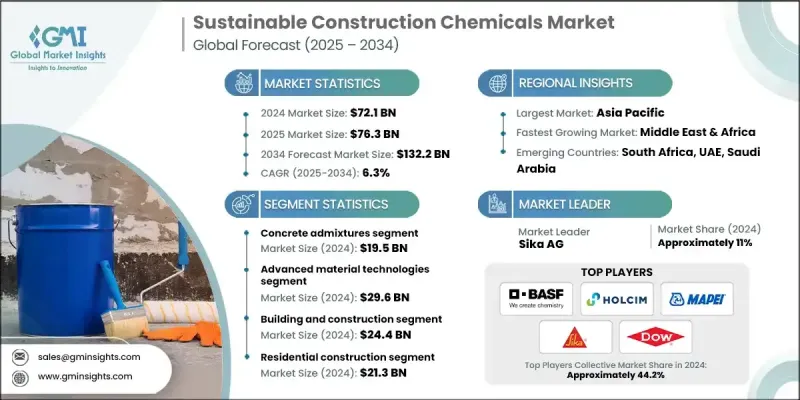
The market includes a wide array of products such as bio-based waterproofing coatings, eco-friendly adhesives and sealants, insulation materials, and specialty chemicals designed to enhance durability while reducing environmental impact. These products are helping the construction industry lower carbon footprints and extend material lifespans. Growth in this market is being fueled by stricter environmental regulations, rising demand for energy-efficient buildings, and greater awareness of sustainable construction practices. Across Europe, regulatory frameworks are compelling the industry to adopt low-carbon, recyclable materials and innovative chemical solutions. This combination of policy-driven demand and technological advancement is enabling the construction sector to deliver resilient, eco-conscious infrastructure while meeting evolving consumer expectations for sustainability.
| Market Scope | |
|---|---|
| Start Year | 2024 |
| Forecast Year | 2025-2034 |
| Start Value | $72.1 Billion |
| Forecast Value | $132.2 Billion |
| CAGR | 6.3% |
The concrete admixture segment held a 27% share in 2024. These admixtures enhance mechanical properties, durability, and environmental performance. Many products incorporate biobased or recycled components, effectively lowering the carbon footprint of concrete used in both infrastructure and commercial construction projects.
The advanced material technologies segment was valued at USD 29.6 billion in 2024 and is expected to grow at a CAGR of 2.2% from 2025 to 2034. Innovations in nanomaterials, self-healing coatings, and high-performance additives are improving building strength, resilience, and sustainability. These technologies allow the construction industry to develop low-maintenance structures while meeting modern standards for environmental performance and durability.
Europe Sustainable Construction Chemicals Market reached USD 17.5 billion in 2024. Regulations such as the Building Energy Act (GEG) and initiatives under the Climate Action Plan 2050 are driving manufacturers to innovate with low-impact raw materials and energy-efficient formulations. Companies are introducing products ranging from recycled-content admixtures to solvent-free coatings that deliver long-term performance without compromising ecological standards. Such regulatory frameworks are shaping market expectations regarding lifecycle sustainability and indoor environmental quality, encouraging investment in greener solutions.
Key players in the Global Sustainable Construction Chemicals Market include Sika AG, BASF SE, Holcim Ltd, MAPEI S.p.A., The Dow Chemical Company, and others. Companies in the Sustainable Construction Chemicals Market are employing several strategies to strengthen their presence. Many are investing in research and development to create eco-friendly, high-performance products, including recycled-content materials and solvent-free coatings. Strategic partnerships with distributors and construction firms expand market reach, while mergers and acquisitions help consolidate portfolios and enter new regions. Firms are also emphasizing sustainability certifications and eco-labels to meet regulatory requirements and attract environmentally conscious buyers.
Table of Contents
Chapter 1 Methodology
- 1.1 Market scope and definition
- 1.2 Research design
- 1.2.1 Research approach
- 1.2.2 Data collection methods
- 1.3 Data mining sources
- 1.3.1 Global
- 1.3.2 Regional/Country
- 1.4 Base estimates and calculations
- 1.4.1 Base year calculation
- 1.4.2 Key trends for market estimation
- 1.5 Primary research and validation
- 1.5.1 Primary sources
- 1.6 Forecast model
- 1.7 Research assumptions and limitations
Chapter 2 Executive Summary
- 2.1 Industry 360° synopsis
- 2.2 Key market trends
- 2.2.1 Regional
- 2.2.2 Product Type
- 2.2.3 Technology
- 2.2.4 Application
- 2.2.5 End use Industry
- 2.3 TAM Analysis, 2025-2034
- 2.4 CXO perspectives: Strategic imperatives
- 2.4.1 Executive decision points
- 2.4.2 Critical success factors
- 2.5 Future Outlook and Strategic Recommendations
Chapter 3 Industry Insights
- 3.1 Industry ecosystem analysis
- 3.1.1 Supplier Landscape
- 3.1.2 Profit Margin
- 3.1.3 Value addition at each stage
- 3.1.4 Factor affecting the value chain
- 3.1.5 Disruptions
- 3.2 Industry impact forces
- 3.2.1 Growth drivers
- 3.2.2 Industry pitfalls and challenges
- 3.2.3 Market opportunities
- 3.3 Growth potential analysis
- 3.4 Regulatory landscape
- 3.4.1 North America
- 3.4.2 Europe
- 3.4.3 Asia Pacific
- 3.4.4 Latin America
- 3.4.5 Middle East & Africa
- 3.5 Porter's analysis
- 3.6 PESTEL analysis
- 3.7 Price trends
- 3.7.1 By region
- 3.7.2 By product
- 3.8 Future market trends
- 3.9 Technology and Innovation landscape
- 3.9.1 Current technological trends
- 3.9.2 Emerging technologies
- 3.10 Patent Landscape
- 3.11 Trade statistics (Note: the trade statistics will be provided for key countries only)
- 3.11.1 Major importing countries
- 3.11.2 Major exporting countries
- 3.12 Sustainability and Environmental Aspects
- 3.12.1 Sustainable Practices
- 3.12.2 Waste Reduction Strategies
- 3.12.3 Energy Efficiency in Production
- 3.12.4 Eco-friendly Initiatives
- 3.13 Carbon Footprint Considerations
Chapter 4 Competitive Landscape, 2024
- 4.1 Introduction
- 4.2 Company market share analysis
- 4.2.1 By region
- 4.2.1.1 North America
- 4.2.1.2 Europe
- 4.2.1.3 Asia Pacific
- 4.2.1.4 LATAM
- 4.2.1.5 MEA
- 4.2.1 By region
- 4.3 Company matrix analysis
- 4.4 Competitive analysis of major market players
- 4.5 Competitive positioning matrix
- 4.6 Key developments
- 4.6.1 Mergers & acquisitions
- 4.6.2 Partnerships & collaborations
- 4.6.3 New Product Launches
- 4.6.4 Expansion Plans
Chapter 5 Market Estimates and Forecast, By Product Type, 2021- 2034 (USD Billion, Kilo Tons)
- 5.1 Key trends
- 5.2 Concrete admixtures
- 5.2.1 Superplasticizers and water reducers
- 5.2.2 Air-entraining agents
- 5.2.3 Accelerating and retarding agents
- 5.2.4 Specialty admixtures
- 5.3 Waterproofing and protective coatings
- 5.3.1 Membrane systems
- 5.3.2 Liquid applied coatings
- 5.3.3 Crystalline waterproofing
- 5.3.4 Bio-based protective solutions
- 5.4 Adhesives and sealants
- 5.4.1 Structural adhesives
- 5.4.2 Construction sealants
- 5.4.3 Bio-based adhesive systems
- 5.4.4 Low-voc formulations
- 5.5 Insulation materials
- 5.5.1 Bio-based insulation
- 5.5.2 Recycled content insulation
- 5.5.3 Phase change materials
- 5.5.4 Aerogel technologies
- 5.6 Specialty construction chemicals
- 5.6.1 Self-healing materials
- 5.6.2 Carbon-negative concrete
- 5.6.3 Geopolymer systems
- 5.6.4 Smart construction materials
Chapter 6 Market Estimates and Forecast, By Technology, 2021 - 2034 (USD Billion, Kilo Tons)
- 6.1 Key trends
- 6.2 Bio-based technologies
- 6.2.1 Plant-based raw materials
- 6.2.2 Microbial production systems
- 6.2.3 Enzymatic processes
- 6.2.4 Biotechnology applications
- 6.3 Recycled content technologies
- 6.3.1 Post-consumer recycled materials
- 6.3.2 Post-industrial waste utilization
- 6.3.3 Circular economy solutions
- 6.3.4 Waste-to-chemical processes
- 6.4 Low-carbon technologies
- 6.4.1 Carbon capture and utilization
- 6.4.2 Renewable energy integration
- 6.4.3 Energy-efficient production
- 6.4.4 Carbon-neutral formulations
- 6.5 Advanced material technologies
- 6.5.1 Nanotechnology applications
- 6.5.2 Smart material systems
- 6.5.3 Self-healing technologies
- 6.5.4 Phase change materials
Chapter 7 Market Estimates and Forecast, By Application, 2021 - 2034 (USD Billion, Kilo Tons)
- 7.1 Key trends
- 7.2 Residential construction
- 7.2.1 Single-family homes
- 7.2.2 Multi-family housing
- 7.2.3 Affordable housing projects
- 7.2.4 Green residential developments
- 7.3 Commercial construction
- 7.3.1 Office buildings
- 7.3.2 Retail spaces
- 7.3.3 Healthcare facilities
- 7.3.4 Educational buildings
- 7.4 Infrastructure development
- 7.4.1 Transportation infrastructure
- 7.4.2 Water and wastewater systems
- 7.4.3 Energy infrastructure
- 7.4.4 Smart city projects
- 7.5 Industrial construction
- 7.5.1 Manufacturing facilities
- 7.5.2 Warehouses and distribution centers
- 7.5.3 Data centers
- 7.5.4 Clean energy facilities
Chapter 8 Market Estimates and Forecast, By End use Industry, 2021 - 2034 (USD Billion, Kilo Tons)
- 8.1 Key trends
- 8.2 Building and construction
- 8.3 Infrastructure development
- 8.4 Industrial applications
- 8.5 Transportation sector
- 8.6 Energy and utilities
- 8.7 Marine and offshore
- 8.8 Mining and minerals
- 8.9 Agriculture and food processing
Chapter 9 Market Estimates and Forecast, By Region, 2021 - 2034 (USD Billion, Kilo Tons)
- 9.1 Key trends
- 9.2 North America
- 9.2.1 U.S.
- 9.2.2 Canada
- 9.3 Europe
- 9.3.1 Germany
- 9.3.2 UK
- 9.3.3 France
- 9.3.4 Italy
- 9.3.5 Spain
- 9.3.6 Rest of Europe
- 9.4 Asia Pacific
- 9.4.1 China
- 9.4.2 India
- 9.4.3 Japan
- 9.4.4 Australia
- 9.4.5 South Korea
- 9.4.6 Rest of Asia Pacific
- 9.5 Latin America
- 9.5.1 Brazil
- 9.5.2 Mexico
- 9.5.3 Argentina
- 9.5.4 Rest of Latin America
- 9.6 Middle East & Africa
- 9.6.1 Saudi Arabia
- 9.6.2 South Africa
- 9.6.3 UAE
- 9.6.4 Rest of Middle East & Africa
Chapter 10 Company Profiles
- 10.1 BASF SE (Master Builders Solutions)
- 10.2 Sika AG
- 10.3 Ashland
- 10.4 Holcim
- 10.5 Cemex
- 10.6 3M Company
- 10.7 Arkema S.A
- 10.8 Clariant AG
- 10.9 Evonik Industries AG
- 10.10 MAPEI S.p.A.
- 10.11 The Dow Chemical Company

