PUBLISHER: Global Market Insights Inc. | PRODUCT CODE: 1892690

PUBLISHER: Global Market Insights Inc. | PRODUCT CODE: 1892690
Electric Van Conversion Kits Market Opportunity, Growth Drivers, Industry Trend Analysis, and Forecast 2025 - 2034
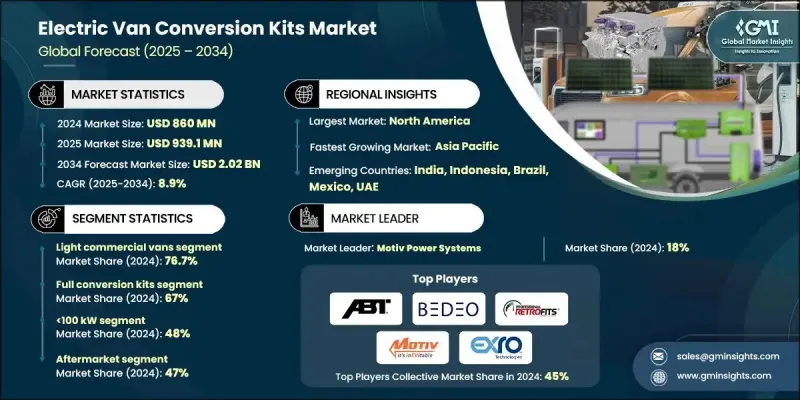
The Global Electric Van Conversion Kits Market was valued at USD 860 million in 2024 and is estimated to grow at a CAGR of 8.9% to reach USD 2.02 billion by 2034.
Advancements in telematics, IoT systems, and modern fleet-management software are enabling operators to optimize vehicle usage by improving route planning, battery utilization, and maintenance scheduling. Conversion kits themselves are becoming more advanced as technology evolves, supporting the shift toward flexible ownership models. Many fleet operators are moving from outright purchasing to subscription and pay-per-use options, allowing them to convert vans to electric power with minimal upfront capital. These financial models create more predictable monthly expenses and allow fleet operators, especially smaller businesses, to scale as operational needs change. The broader shift toward electric mobility is further supported by increasing integration between hardware providers and digital service platforms, giving operators greater access to turnkey electrification solutions. As the market accelerates, electric van conversions are becoming a practical and cost-effective pathway for organizations seeking lower emissions, higher efficiency, and improved operational control across urban and regional transport routes.
| Market Scope | |
|---|---|
| Start Year | 2024 |
| Forecast Year | 2025-2034 |
| Start Value | $860 Million |
| Forecast Value | $2.02 Billion |
| CAGR | 8.9% |
The light commercial vans segment held a 76.7% share in 2024 and is anticipated to grow at a 9.6% CAGR through 2025-2034. This dominance is supported by the alignment between typical light-commercial duty cycles and current battery-electric capabilities, with daily mileage requirements and payload needs fitting within contemporary electric van performance profiles. Expanding access to low-emission zones and favorable operating costs further strengthen adoption as the total cost of ownership continues to improve across key regions.
The full conversion kits segment held a 67% share in 2024 and is expected to grow at a CAGR of 10% from 2025 to 2034. Fully electric conversion packages are moving toward modular, platform-agnostic engineering that shortens installation times and broadens compatibility across various van models. Integrated battery and motor systems built around standardized high-voltage components, combined with telematics-supported diagnostics, are increasing utilization rates for fleets and enhancing the appeal of electrification for last-mile and urban delivery applications.
US Electric Van Conversion Kits Market reached USD 257.1 million in 2024. Strong corporate sustainability targets, paired with federal and state emissions requirements, are motivating fleets to adopt conversion kits as a cost-effective alternative to purchasing new electric vans. Government funding, tax incentives, and grants assist small and mid-sized organizations in transitioning quickly, prompting municipalities and logistics providers to rely more heavily on retrofitting to meet compliance timelines.
Key companies active in the Electric Van Conversion Kits Market include ABT e-Line, BEDEO, Contravans, E-Drive Retrofits, EV West, Motiv Power Systems, REE Automotive, Ricardo, and SEA Electric (Exro). Companies in the Electric Van Conversion Kits Market are strengthening their market position by developing modular, standardized platforms that work across multiple vehicle types, reducing installation complexity and shortening fleet downtime. Many firms are expanding service partnerships with fleet operators to offer bundled packages that include conversion hardware, software integration, maintenance, and telematics support. Subscriptions and leasing programs are becoming central strategies, allowing customers to adopt electrification with reduced upfront costs.
Table of Contents
Chapter 1 Methodology
- 1.1 Market scope and definition
- 1.2 Research design
- 1.2.1 Research approach
- 1.2.2 Data collection methods
- 1.3 Data mining sources
- 1.3.1 Global
- 1.3.2 Regional/Country
- 1.4 Base estimates and calculations
- 1.4.1 Base year calculation
- 1.4.2 Key trends for market estimation
- 1.5 Primary research and validation
- 1.5.1 Primary sources
- 1.6 Forecast model
- 1.7 Research assumptions and limitations
Chapter 2 Executive Summary
- 2.1 Industry 360° synopsis
- 2.2 Key market trends
- 2.2.1 Regional
- 2.2.2 Vehicle
- 2.2.3 Conversion
- 2.2.4 Propulsion
- 2.2.5 End Use
- 2.2.6 Sales channel
- 2.3 TAM analysis, 2025-2034
- 2.4 CXO perspectives: Strategic imperatives
- 2.4.1 Executive decision points
- 2.4.2 Critical success factors
- 2.5 Future outlook
- 2.6 Strategic recommendations
Chapter 3 Industry Insights
- 3.1 Industry ecosystem analysis
- 3.1.1 Supplier landscape
- 3.1.2 Profit margin
- 3.1.3 Cost structure
- 3.1.4 Value addition at each stage
- 3.1.5 Factor affecting the value chain
- 3.1.6 Disruptions
- 3.2 Industry impact forces
- 3.2.1 Growth drivers
- 3.2.1.1 Preference for flexible mobility over ownership
- 3.2.1.2 Growing EV adoption and fleet electrification
- 3.2.1.3 Rising corporate fleet demand
- 3.2.1.4 Connected vehicle and telematics advancements
- 3.2.2 Industry pitfalls and challenges
- 3.2.2.1 High capital investment
- 3.2.2.2 Regulatory and insurance challenges
- 3.2.3 Market opportunities
- 3.2.3.1 Expansion in emerging urban markets
- 3.2.3.2 Integration with smart cities and MaaS platforms
- 3.2.3.3 Bundled services with insurance and maintenance
- 3.2.3.4 Specialized EV and commercial vehicle solutions
- 3.2.1 Growth drivers
- 3.3 Growth potential analysis
- 3.4 Regulatory landscape
- 3.4.1 Global
- 3.4.1.1 EPA alternative fuel conversion regulations
- 3.4.1.2 NHTSA FMVSS standards (FMVSS 305a)
- 3.4.1.3 CARB certification requirements
- 3.4.1.4 Age-based certification pathways
- 3.4.2 North America
- 3.4.3 Europe
- 3.4.4 Asia Pacific
- 3.4.5 Latin America
- 3.4.6 Middle East & Africa
- 3.4.1 Global
- 3.5 Porter's analysis
- 3.6 PESTEL analysis
- 3.7 Technology and innovation landscape
- 3.7.1 Current technological trends
- 3.7.1.1 Battery technology evolution (NMC, LFP, solid-state roadmap)
- 3.7.1.2 Motor & inverter advancements (coil driver tech, efficiency gains)
- 3.7.1.3 Thermal management systems (passive vs active cooling)
- 3.7.2 Emerging technologies
- 3.7.2.1 Vehicle control unit (VCU) & software architecture
- 3.7.2.2 Regenerative braking optimization
- 3.7.2.3 Modular & scalable battery configurations
- 3.7.2.4 Integrated charging solutions (on-board charger integration)
- 3.7.1 Current technological trends
- 3.8 Pricing analysis
- 3.8.1 Conversion kit pricing by vehicle class
- 3.8.2 Battery pack cost trends
- 3.8.3 Installation labor cost structure
- 3.8.4 Charging infrastructure costs (Level 2 vs DC fast charging)
- 3.9 Cost breakdown analysis
- 3.10 Patent analysis
- 3.10.1 Powertrain integration patents
- 3.10.2 Battery packaging & thermal management patents
- 3.10.3 Electronic gearing & coil driver technology patents (Exro)
- 3.10.4 Charging interface & communication protocol patents
- 3.11 Sustainability and environmental aspects
- 3.11.1 Sustainable practices
- 3.11.2 Waste reduction strategies
- 3.11.3 Energy efficiency in production
- 3.11.4 Eco-friendly initiatives
- 3.11.5 Carbon footprint considerations
- 3.12 Use cases
- 3.13 Best case scenario
- 3.14 Investment & funding analysis
- 3.14.1 Federal infrastructure funding (NEVI, CFI programs)
- 3.14.2 IRA manufacturing incentives & OBBBA modifications
- 3.14.3 State & regional grant programs (HVIP, NYTVIP, Texas)
- 3.14.4 Private investment in conversion technology companies
- 3.15 Charging infrastructure integration
- 3.15.1 Depot charging design & site planning
- 3.15.2 Utility coordination & interconnection timelines
- 3.15.3 Managed charging strategies
- 3.15.4 Charger-vehicle compatibility (CCS, J1772, power levels)
- 3.16 Vehicle platform suitability & validation
- 3.16.1 Platform selection criteria
- 3.16.2 Ford Transit platform analysis
- 3.16.3 RAM ProMaster platform analysis
- 3.16.4 GM Express/Savana platform analysis
Chapter 4 Competitive Landscape, 2024
- 4.1 Introduction
- 4.2 Company market share analysis
- 4.2.1 North America
- 4.2.2 Europe
- 4.2.3 Asia Pacific
- 4.2.4 LATAM
- 4.2.5 MEA
- 4.3 Competitive analysis of major market players
- 4.4 Competitive positioning matrix
- 4.5 Strategic outlook matrix
- 4.6 Key developments
- 4.6.1 Mergers & acquisitions
- 4.6.2 Partnerships & collaborations
- 4.6.3 New product launches
- 4.6.4 Expansion plans and funding
- 4.7 Product and service benchmarking
- 4.8 R&D investment analysis
- 4.9 Vendor selection criteria
Chapter 5 Market Estimates & Forecast, By Vehicle, 2021 - 2034 ($Mn, Units)
- 5.1 Key trends
- 5.2 Light commercial vehicles
- 5.3 Medium commercial vehicles
- 5.4 Heavy commercial vehicles
Chapter 6 Market Estimates & Forecast, By Conversion, 2021 - 2034 ($Mn, Units)
- 6.1 Key trends
- 6.2 Fully electric conversion kits
- 6.3 Hybrid electric conversion kits
Chapter 7 Market Estimates & Forecast, By Propulsion, 2021 - 2034 ($Mn, Units)
- 7.1 Key trends
- 7.2 < 100 kW
- 7.3 100-200 kW
- 7.4 >200 kW
Chapter 8 Market Estimates & Forecast, By End Use, 2021 - 2034 ($Mn, Units)
- 8.1 Key trends
- 8.2 Commercial fleet operators
- 8.3 Logistics & delivery companies
- 8.4 Municipal authorities
- 8.5 Utility & service providers
- 8.6 Small & medium enterprises
Chapter 9 Market Estimates & Forecast, By Sales Channel, 2021 - 2034 ($Mn, Units)
- 9.1 Key trends
- 9.2 OEM conversion kits
- 9.3 Aftermarket conversion kits
- 9.4 Certified retrofitters
Chapter 10 Market Estimates & Forecast, By Region, 2021 - 2034 ($Mn, Units)
- 10.1 Key trends
- 10.2 North America
- 10.2.1 US
- 10.2.2 Canada
- 10.3 Europe
- 10.3.1 Germany
- 10.3.2 UK
- 10.3.3 France
- 10.3.4 Italy
- 10.3.5 Spain
- 10.3.6 Nordics
- 10.3.7 Russia
- 10.3.8 Poland
- 10.3.9 Romania
- 10.4 Asia Pacific
- 10.4.1 China
- 10.4.2 India
- 10.4.3 Japan
- 10.4.4 South Korea
- 10.4.5 ANZ
- 10.4.6 Vietnam
- 10.4.7 Indonesia
- 10.5 Latin America
- 10.5.1 Brazil
- 10.5.2 Mexico
- 10.5.3 Argentina
- 10.6 MEA
- 10.6.1 South Africa
- 10.6.2 Saudi Arabia
- 10.6.3 UAE
Chapter 11 Company Profiles
- 11.1 Global companies
- 11.1.1 ABT e-Line
- 11.1.2 BEDEO
- 11.1.3 Contravans
- 11.1.4 E-Drive Retrofits
- 11.1.5 EV West
- 11.1.6 Lightning eMotors
- 11.1.7 Motiv Power Systems
- 11.1.8 REE Automotive
- 11.1.9 Ricardo
- 11.1.10 SEA Electric (Exro)
- 11.2 Regional players
- 11.2.1 BisonEV Retrofits
- 11.2.2 Efficient Drivetrains Inc. (EDI)
- 11.2.3 Hyliion
- 11.2.4 Logan Bus Company
- 11.2.5 Odyne Systems
- 11.2.6 Optimal EV
- 11.2.7 Phoenix Motorcars
- 11.2.8 TransPower
- 11.2.9 Unique Electric Solutions
- 11.2.10 US Hybrid
- 11.3 Emerging players
- 11.3.1 Arrival
- 11.3.2 Bollinger Motors
- 11.3.3 Canoo
- 11.3.4 Chanje
- 11.3.5 Electric Last Mile Solutions (ELMS)
- 11.3.6 GreenPower Motor Company
- 11.3.7 Harbinger Motors
- 11.3.8 Proterra
- 11.3.9 Rivian (Commercial Van Division)
- 11.3.10 Vicinity Motor Corp

