PUBLISHER: Global Market Insights Inc. | PRODUCT CODE: 1892874

PUBLISHER: Global Market Insights Inc. | PRODUCT CODE: 1892874
Vans Market Opportunity, Growth Drivers, Industry Trend Analysis, and Forecast 2026 - 2035
The Global Vans Market was valued at USD 325.3 billion in 2025 and is estimated to grow at a CAGR of 7.3% to reach USD 650.1 billion by 2035.
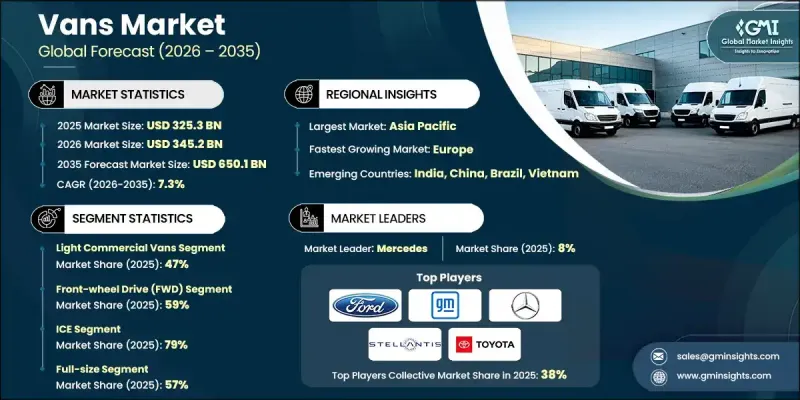
This market includes light commercial vans, cargo vans, and passenger vans that support a wide range of activities across logistics, healthcare, hospitality, government operations, and e-commerce. Businesses rely on these vehicles for flexible and cost-efficient mobility, and advancements in fleet telematics, connectivity, and data-driven management systems are reshaping operational performance. Although electric vans involve a higher initial investment, their lower energy and maintenance costs are making them an increasingly favorable option for fleets. Market evolution is being shaped by regulatory pressures, shifting customer expectations, and advances in vehicle technologies. Trends such as rapid electrification, growing integration of autonomous and connected systems, and the transformation of last-mile delivery networks are heavily influencing product development and fleet strategies. Sustainability goals, government incentives, and an emphasis on operational efficiency continue to accelerate the transition toward electric van platforms across global markets.
| Market Scope | |
|---|---|
| Start Year | 2025 |
| Forecast Year | 2026-2035 |
| Start Value | $325.3 Billion |
| Forecast Value | $650.1 Billion |
| CAGR | 7.3% |
The light commercial vans category held a 47% share in 2025 and is expected to grow at a CAGR of 7.6% from 2026 to 2035. These vans, typically within the 6,000 to 10,000-pound GVWR range, offer a practical mix of fuel economy, payload capabilities, and maneuverability suitable for dense urban corridors. Leading manufacturers, including Rivian, Ford Motor, Mercedes, and GM, are rolling out new electric designs built specifically for delivery and service applications, reinforcing the segment's strong shift toward electrification.
The front-wheel drive (FWD) vehicles segment held 59% share in 2025 and is forecast to grow at a rate of 7.2% through 2035. Their appeal stems from benefits such as reduced production costs, enhanced fuel efficiency, improved traction on paved streets, and optimized interior layouts that increase usable cargo space. These advantages make FWD configurations particularly well-suited for delivery fleets and service operators focused on cost control and efficient mobility in urban and suburban landscapes.
China Vans Market held a 39% share in 2025, supported by rising fleet demand, extensive domestic production capacity, and accelerating adoption of electric light commercial vehicles. The country's logistics, service, and delivery sectors are driving widespread use of versatile van models designed for both small business owners and large-scale fleet operators. Policy measures promoting cleaner vehicles, investment in charging networks, and stricter emission standards are speeding up fleet electrification and motivating companies to upgrade to low-emission vans.
Major companies active in the Global Vans Market include Ford Motor, Hyundai Motor, Nissan, SAIC Motor, Renault, Stellantis, Tata Motors, Toyota Motor, Mercedes, and General Motors. Companies in the Vans Market are strengthening their competitive position through a combination of strategic initiatives. Many automakers are accelerating investments in electric platforms to meet rising sustainability requirements and appeal to fleet operators seeking lower total cost of ownership. Firms are expanding their connected vehicle ecosystems, enabling real-time diagnostics, predictive maintenance, and performance optimization for large fleets. Collaborations with logistics providers and technology partners are helping companies integrate advanced driver-assistance systems and autonomous capabilities into van lineups.
Table of Contents
Chapter 1 Methodology
- 1.1 Market scope and definition
- 1.2 Research design
- 1.2.1 Research approach
- 1.2.2 Data collection methods
- 1.3 Data mining sources
- 1.3.1 Global
- 1.3.2 Regional/Country
- 1.4 Base estimates and calculations
- 1.4.1 Base year calculation
- 1.4.2 Key trends for market estimation
- 1.5 Primary research and validation
- 1.5.1 Primary sources
- 1.6 Forecast model
- 1.7 Research assumptions and limitations
Chapter 2 Executive Summary
- 2.1 Industry 360° synopsis, 2022 - 2035
- 2.2 Key market trends
- 2.2.1 Regional
- 2.2.2 Vehicle
- 2.2.3 Propulsion
- 2.2.4 Size
- 2.2.5 Drive
- 2.2.6 End Use
- 2.3 TAM Analysis, 2026-2035
- 2.4 CXO perspectives: Strategic imperatives
- 2.4.1 Executive decision points
- 2.4.2 Critical success factors
- 2.5 Future outlook and strategic recommendations
Chapter 3 Industry Insights
- 3.1 Industry ecosystem analysis
- 3.1.1 Supplier landscape
- 3.1.2 Profit margin analysis
- 3.1.3 Cost structure
- 3.1.4 Value addition at each stage
- 3.1.5 Factor affecting the value chain
- 3.1.6 Disruptions
- 3.2 Industry impact forces
- 3.2.1.1 Growth drivers
- 3.2.1.2 Rising e-commerce and last-mile delivery demand
- 3.2.1.3 Urbanization and improved infrastructure
- 3.2.1.4 Shift towards electric and low-emission vans
- 3.2.1.5 Growth of small and medium enterprises (SMEs)
- 3.2.1.6 Technological advancements in fleet management and safety
- 3.2.2 Industry pitfalls and challenges
- 3.2.2.1 High upfront costs of electric and advanced vans
- 3.2.2.2 Complex regulations across regions
- 3.2.3 Market opportunities
- 3.2.3.1 Growth in electric van adoption
- 3.2.3.2 Rising demand from e-commerce deliveries
- 3.2.3.3 Expansion in emerging markets
- 3.2.3.4 Use of smart fleet management technologies
- 3.3 Growth potential analysis
- 3.4 Regulatory landscape
- 3.4.1 North America
- 3.4.1.1 US: Federal Motor Vehicle Safety Standards (FMVSS)
- 3.4.1.2 Canada: Canada Motor Vehicle Safety Standards (CMVSS)
- 3.4.2 Europe
- 3.4.2.1 Germany: EU Type Approval Regulation (EU) 2018/858
- 3.4.2.2 UK: GB Type Approval (Post-Brexit UNECE Regulations)
- 3.4.2.3 France: EU CO2 Emission Performance Standards for Vans (Regulation EU 2019/631)
- 3.4.2.4 Italy: EU Whole Vehicle Type Approval (WVTA) Framework
- 3.4.3 Asia Pacific
- 3.4.3.1 China: China Compulsory Certification (CCC) - GB Standards
- 3.4.3.2 India: Bharat Stage (BS) VI Emission Standards
- 3.4.3.3 Japan: Ministry of Land, Infrastructure, Transport and Tourism (MLIT) Type Approval
- 3.4.3.4 South Korea: Korea Motor Vehicle Safety Standards (KMVSS)
- 3.4.4 Latin America
- 3.4.4.1 Brazil: CONTRAN Vehicle Homologation (Environmental & Technical Analysis)
- 3.4.4.2 Mexico: NOM (Norma Oficial Mexicana) Safety & Emissions Standards
- 3.4.5 MEA
- 3.4.5.1 Saudi Arabia: SASO (Saudi Standards, Metrology and Quality Organization) Technical Regulations
- 3.4.1 North America
- 3.5 Porter's analysis
- 3.6 PESTEL analysis
- 3.7 Technology and innovation landscape
- 3.7.1 Current technological trends
- 3.7.2 Emerging technologies
- 3.8 Price trends
- 3.8.1 By region
- 3.8.2 By product
- 3.9 Production statistics
- 3.9.1 Production hubs
- 3.9.2 Consumption hubs
- 3.9.3 Export and import
- 3.10 Cost breakdown analysis
- 3.10.1 Manufacturing cost structure
- 3.10.2 R&D cost analysis
- 3.10.3 Regulatory compliance costs
- 3.10.4 Distribution & logistics costs
- 3.10.5 Marketing & sales costs
- 3.11 Patent analysis
- 3.12 Sustainability and environmental aspects
- 3.12.1 Sustainable practices
- 3.12.2 Waste reduction strategies
- 3.12.3 Energy efficiency in production
- 3.12.4 Eco-friendly Initiatives
- 3.12.5 Carbon footprint considerations
- 3.13 Future outlook and opportunities
Chapter 4 Competitive Landscape, 2025
- 4.1 Introduction
- 4.2 Company market share analysis
- 4.2.1 North America
- 4.2.2 Europe
- 4.2.3 Asia Pacific
- 4.2.4 LATAM
- 4.2.5 MEA
- 4.3 Competitive analysis of major market players
- 4.4 Competitive positioning matrix
- 4.5 Strategic outlook matrix
- 4.6 Key developments
- 4.6.1 Mergers & acquisitions
- 4.6.2 Partnerships & collaborations
- 4.6.3 New Product Launches
- 4.6.4 Expansion Plans and funding
Chapter 5 Market Estimates & Forecast, By Vehicle, 2022 2035 (USD Bn, Units)
- 5.1 Key trends
- 5.2 Light commercial vans
- 5.3 Passenger vans
- 5.4 Cargo vans
Chapter 6 Market Estimates & Forecast, By Propulsion, 2022 - 2035 (USD Bn, Units)
- 6.1 Key trends
- 6.2 ICE
- 6.3 Electric
- 6.4 Hybrid
Chapter 7 Market Estimates & Forecast, By Size, 2022 - 2035 (USD Bn, Units)
- 7.1 Key trends
- 7.2 Compact
- 7.3 Mid-size
- 7.4 Full-size
Chapter 8 Market Estimates & Forecast, By Drive, 2022 - 2035 (USD Bn, Units)
- 8.1 Key trends
- 8.2 Front-wheel drive (FWD)
- 8.3 Rear-wheel drive (RWD)
- 8.4 All-wheel drive (AWD) / 4x4
Chapter 9 Market Estimates & Forecast, By End Use, 2022 - 2035 (USD Bn, Units)
- 9.1 Key trends
- 9.2 Logistics & transportation
- 9.3 Ecommerce & retail
- 9.4 Public sector
- 9.5 Healthcare
- 9.6 Hospitality
- 9.7 Others
Chapter 10 Market Estimates & Forecast, By Region, 2022 - 2035 (USD Mn, Units)
- 10.1 Key trends
- 10.2 North America
- 10.2.1 US
- 10.2.2 Canada
- 10.3 Europe
- 10.3.1 Germany
- 10.3.2 UK
- 10.3.3 France
- 10.3.4 Italy
- 10.3.5 Spain
- 10.3.6 Russia
- 10.3.7 Nordics
- 10.3.8 Benelux
- 10.4 Asia Pacific
- 10.4.1 China
- 10.4.2 India
- 10.4.3 Japan
- 10.4.4 Australia
- 10.4.5 South Korea
- 10.4.6 Singapore
- 10.4.7 Thailand
- 10.4.8 Indonesia
- 10.4.9 Vietnam
- 10.5 Latin America
- 10.5.1 Brazil
- 10.5.2 Mexico
- 10.5.3 Argentina
- 10.5.4 Colombia
- 10.6 MEA
- 10.6.1 South Africa
- 10.6.2 Saudi Arabia
- 10.6.3 UAE
Chapter 11 Company Profiles
- 11.1 Global Players
- 11.1.1 Ford Motor
- 11.1.2 General Motors
- 11.1.3 Hyundai Motor Company
- 11.1.4 Mercedes-Benz
- 11.1.5 Nissan
- 11.1.6 Renault
- 11.1.7 SAIC Motor
- 11.1.8 Stellantis
- 11.1.9 Tata Motors
- 11.1.10 Toyota Motor
- 11.2 Regional Players
- 11.2.1 Ashok Leyland
- 11.2.2 Foton Motor
- 11.2.3 Isuzu
- 11.2.4 Iveco
- 11.2.5 JMC
- 11.2.6 Mahindra & Mahindra
- 11.2.7 Maxus
- 11.2.8 Rivian
- 11.3 Emerging Technology Innovators
- 11.3.1 Arrival
- 11.3.2 BYD
- 11.3.3 Canoo
- 11.3.4 Wuling Motors

