PUBLISHER: Global Market Insights Inc. | PRODUCT CODE: 1892731

PUBLISHER: Global Market Insights Inc. | PRODUCT CODE: 1892731
U.S. Wearable Bioelectronic Skin Patches Market Opportunity, Growth Drivers, Industry Trend Analysis, and Forecast 2025 - 2034
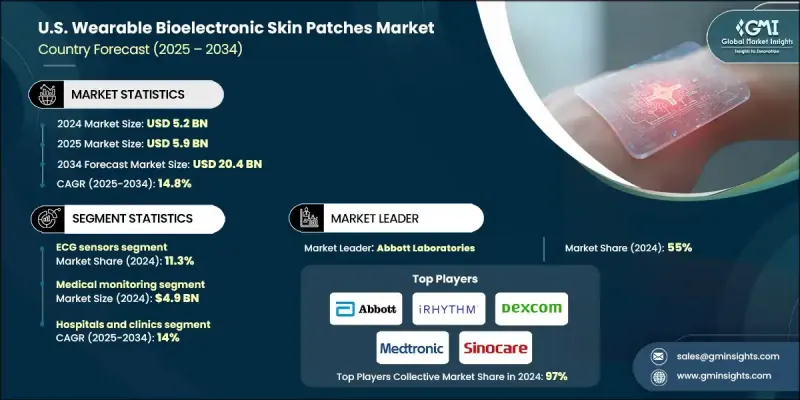
U.S. Wearable Bioelectronic Skin Patches Market was valued at USD 5.2 billion in 2024 and is estimated to grow at a CAGR of 14.8% to reach USD 20.4 billion by 2034.
The market is witnessing steady growth due to the rising prevalence of chronic diseases, increasing health and fitness awareness, and rapid technological innovations in wearable bioelectronic devices. The growing demand for non-invasive health monitoring solutions is a key driver, particularly in managing conditions such as diabetes. These wearable skin patches allow continuous, real-time monitoring of glucose levels and other vital signs, supporting early detection of irregularities and improving disease management. Consumer focus on proactive health monitoring is driving adoption beyond traditional fitness tracking devices. Advanced features like smartphone integration, wireless connectivity, and cloud-based data sharing enable remote patient monitoring and telehealth solutions. Additionally, AI and machine learning capabilities in these patches provide predictive analytics, allowing personalized care recommendations and early identification of potential health issues. Leading companies are accelerating market growth by introducing innovative products that combine accuracy, convenience, and seamless connectivity.
| Market Scope | |
|---|---|
| Start Year | 2024 |
| Forecast Year | 2025-2034 |
| Start Value | $5.2 Billion |
| Forecast Value | $20.4 Billion |
| CAGR | 14.8% |
The ECG sensors segment held an 11.3% share in 2024 and is projected to grow at a CAGR of 14.4% through 2034. Rising cardiovascular disease prevalence is driving the adoption of ECG sensors in wearable patches. These sensors offer non-invasive, continuous cardiac monitoring, capturing electrical heart signals and providing precise insights into heart rhythm and arrhythmia detection.
The medical monitoring segment generated USD 4.9 billion in 2024 and is expected to grow at a CAGR of 14.8% during 2025-2034. This segment dominates due to its ability to monitor vital health parameters continuously, including glucose, ECG, hydration, and stress indicators. Real-time monitoring enables early identification of anomalies, reducing the risk of severe complications.
The hospitals and clinics segment is projected to grow at a CAGR of 14% during 2025-2034. These facilities play a critical role in adopting and integrating wearable bioelectronic patches into patient care. Equipped to manage high patient volumes and complex monitoring requirements, hospitals seamlessly implement these devices for routine and emergency care, enhancing both patient safety and clinical efficiency.
Key companies operating in the U.S. Wearable Bioelectronic Skin Patches Market include Abbott Laboratories, Dexcom, Medtronic, VitalConnect, iRhythm Technologies, 2M Engineering, Baxter International, Epicore Biosystems, LifeSignals, GE Healthcare Technologies, Boston Scientific, GENTAG, SmartCardia, Biolinq, Insulet Corporation, VivaLNK, Sinocare, and Koninklijke Philips. Market players are employing multiple strategies to strengthen their presence. Companies are investing heavily in R&D to develop highly accurate, user-friendly, and AI-enabled patches. They are expanding product portfolios to address both medical monitoring and wellness applications. Strategic collaborations with hospitals, clinics, and telehealth providers enhance product adoption and market reach. Geographic expansion into urban and underserved regions allows broader customer access. Firms are also focusing on supply chain optimization, technical support, and training programs, which improve customer loyalty, operational efficiency, and long-term market positioning.
Table of Contents
Chapter 1 Methodology and Scope
- 1.1 Market scope and definition
- 1.2 Research design
- 1.2.1 Research approach
- 1.2.2 Data collection methods
- 1.3 Data mining sources
- 1.4 Base estimates and calculations
- 1.4.1 Base year calculation
- 1.4.2 Key trends for market estimation
- 1.5 Primary research and validation
- 1.5.1 Primary sources
- 1.6 Forecast model
- 1.7 Research assumptions and limitations
Chapter 2 Executive Summary
- 2.1 Industry 3600 synopsis
- 2.2 Key market trends
- 2.2.1 Type trends
- 2.2.2 Application trends
- 2.2.3 End use trends
- 2.3 CXO perspectives: Strategic imperatives
- 2.3.1 Key decision points for industry executives
- 2.3.2 Critical success factors for market players
- 2.4 Future outlook and strategic recommendations
Chapter 3 Industry Insights
- 3.1 Industry ecosystem analysis
- 3.1.1 Supplier landscape
- 3.1.2 Value addition at each stage
- 3.1.3 Factor affecting the value chain
- 3.2 Industry impact forces
- 3.2.1 Growth drivers
- 3.2.1.1 Rising prevalence of chronic diseases in U.S.
- 3.2.1.2 Increasing technological advancements in wearable bioelectronic skin patches
- 3.2.1.3 Growing fitness and wellness awareness
- 3.2.1.4 Rising demand for non-invasive health monitoring
- 3.2.2 Industry pitfalls and challenges
- 3.2.2.1 Data privacy and security concerns
- 3.2.2.2 Stringent regulatory scenario
- 3.2.3 Market opportunities
- 3.2.3.1 Integration with telehealth and remote patient monitoring
- 3.2.1 Growth drivers
- 3.3 Growth potential analysis
- 3.4 Regulatory landscape
- 3.5 Technological advancements
- 3.5.1 Current technological trends
- 3.5.2 Emerging technologies
- 3.6 Future market trends
- 3.7 Patent analysis
- 3.8 Porter's analysis
- 3.9 PESTEL analysis
Chapter 4 Competitive Landscape, 2024
- 4.1 Introduction
- 4.2 Company market share analysis
- 4.3 Company matrix analysis
- 4.4 Competitive analysis of major market players
- 4.5 Competitive positioning matrix
- 4.6 Key developments
- 4.6.1 Mergers and acquisitions
- 4.6.2 Partnerships and collaborations
- 4.6.3 New product launches
- 4.6.4 Expansion plans
Chapter 5 Market Estimates and Forecast, By Type, 2021 - 2034 ($ Mn)
- 5.1 Key trends
- 5.2 Electrochemical sensors
- 5.3 ECG sensors
- 5.4 Temperature sensors
- 5.5 EMG sensors
- 5.6 Other types
Chapter 6 Market Estimates and Forecast, By Application, 2021 - 2034 ($ Mn)
- 6.1 Key trends
- 6.2 Fitness and wellness
- 6.3 Medical monitoring
- 6.4 Other applications
Chapter 7 Market Estimates and Forecast, By End Use, 2021 - 2034 ($ Mn)
- 7.1 Key trends
- 7.2 Hospitals and clinics
- 7.3 Home care settings
- 7.4 Other end use
Chapter 8 Company Profiles
- 8.1 2M Engineering
- 8.2 Abbott Laboratories
- 8.3 Biolinq
- 8.4 Baxter International
- 8.5 Boston Scientific
- 8.6 Dexcom
- 8.7 Epicore Biosystems
- 8.8 GE Healthcare Technologies
- 8.9 GENTAG
- 8.10 Insulet Corporation
- 8.11 iRhythm Technologies
- 8.12 Koninklijke Philips
- 8.13 LifeSignals
- 8.14 Medtronic
- 8.15 Sinocare
- 8.16 SmartCardia
- 8.17 VitalConnect
- 8.18 VivaLNK

