
PUBLISHER: Global Market Insights Inc. | PRODUCT CODE: 1892742

PUBLISHER: Global Market Insights Inc. | PRODUCT CODE: 1892742
U.S. Urology Supplements Market Opportunity, Growth Drivers, Industry Trend Analysis, and Forecast 2026 - 2035
U.S. Urology Supplements Market was valued at USD 843.4 million in 2025 and is estimated to grow at a CAGR of 6.5% to reach USD 1.6 billion by 2035.
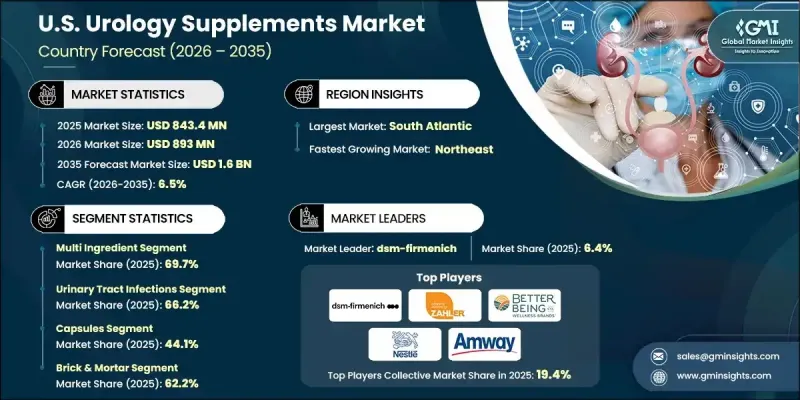
Growth continues to accelerate as more consumers seek proactive solutions for urinary wellness, prostate function, and kidney support. Rising cases of urinary tract infections, kidney complications, and prostate health concerns across a broad age range are fueling demand for science-backed supplement formulations. The aging population contributes significantly as individuals over 50 face increased risks of benign prostatic hyperplasia and persistent urinary symptoms, driving interest in long-term nutritional support. Consumers are steadily favoring natural, research-driven ingredients, including botanical blends, probiotics, D-mannose, antioxidants, and specialized nutrient combinations as alternatives to traditional drug-based approaches. Expanding e-commerce access and greater public emphasis on preventive health are helping the market grow rapidly, supported by product innovation and improved clinical validation within the supplement space. This shift toward tailored, non-prescription options has strengthened the positioning of urology supplements as part of a broader lifestyle and wellness movement.
| Market Scope | |
|---|---|
| Start Year | 2025 |
| Forecast Year | 2026-2035 |
| Start Value | $843.4 Million |
| Forecast Value | $1.6 Billion |
| CAGR | 6.5% |
The multi-ingredient category held 69.7% share in 2025, driven by rising interest in all-in-one formulations that target several urinary and prostate concerns at once. These combinations of minerals, amino acids, herbal extracts, and vitamins provide synergistic effects and greater convenience, improving overall user compliance.
The kidney health segment generated USD 43.3 million in 2025 and is projected to grow at a 6.9% CAGR through 2035. Demand continues to grow as chronic kidney disease, diabetes, and hypertension remain key contributors to declining kidney function. Consumers are increasingly selecting supplements formulated with minerals, antioxidants, and plant-based extracts designed to support healthy detoxification and reduce oxidative stress. Educational initiatives and clinical guidance are reinforcing early prevention and the adoption of supplements.
South Atlantic Urology Supplements Market held a 19.4% share in 2025. A large aging population and heightened exposure to urinary and prostate-related conditions have boosted demand for urology-focused supplements. Strong healthcare infrastructure and widespread access to pharmacies and specialty clinics further support product availability in both urban and suburban areas.
Major companies active in the U.S. Urology Supplements Market include Amway, Better Being, DSM-Firmenich, Garden of Life, Himalaya Wellness Company, Himalayan Organics, Natrol, Nestle, NOW Foods, Pure Encapsulations, Solaray, Szio+, Theralogix, Uqora, and Zahler. Companies in the U.S. Urology Supplements Market are strengthening their market presence by investing heavily in clinically validated formulations and incorporating high-quality botanical extracts, probiotics, and nutrient blends supported by scientific research. Many brands are expanding their portfolios to address specific conditions such as urinary balance, prostate comfort, and kidney support through targeted, multi-ingredient products. Digital retail strategies, including subscription models, direct-to-consumer platforms, and online education campaigns, help broaden customer reach and increase long-term engagement. Manufacturers are also prioritizing transparent labeling, clean-label claims, and third-party testing to build consumer trust.
Table of Contents
Chapter 1 Methodology and Scope
- 1.1 Market scope and definitions
- 1.2 Research design
- 1.2.1 Research approach
- 1.2.2 Data collection methods
- 1.3 Data mining sources
- 1.3.1 Zonal/country
- 1.4 Base estimates and calculations
- 1.4.1 Base year calculation
- 1.4.2 Key trends for market estimation
- 1.5 Primary research and validation
- 1.5.1 Primary sources
- 1.6 Forecast model
- 1.7 Research assumptions and limitations
Chapter 2 Executive Summary
- 2.1 Industry 3600 synopsis
- 2.2 Key market trends
- 2.2.1 Zonal trends
- 2.2.2 Type trends
- 2.2.3 Application trends
- 2.2.4 Formulation trends
- 2.2.5 Distribution channel trends
- 2.3 CXO perspectives: Strategic imperatives
- 2.3.1 Key decision points for industry executives
- 2.3.2 Critical success factors for market players
- 2.4 Future outlook and strategic recommendations
Chapter 3 Industry Insights
- 3.1 Industry ecosystem analysis
- 3.2 Industry impact forces
- 3.2.1 Growth drivers
- 3.2.1.1 Rising prevalence of urological disorders
- 3.2.1.2 Advancements in product formulations and delivery systems
- 3.2.1.3 Increasing emphasis on preventive healthcare
- 3.2.2 Industry pitfalls and challenges
- 3.2.2.1 Potential interactions and side effects
- 3.2.3 Market opportunities
- 3.2.3.1 Expansion of personalized and condition-specific formulations
- 3.2.3.2 Growth of e-commerce and subscription-based models
- 3.2.1 Growth drivers
- 3.3 Growth potential analysis
- 3.4 Regulatory landscape
- 3.5 Technological advancements
- 3.5.1 Current technological trends
- 3.5.1.1 High-bioavailability formulations
- 3.5.1.2 Targeted urinary health ingredients
- 3.5.1.3 Personalized supplement recommendations
- 3.5.2 Emerging technologies
- 3.5.2.1 AI-driven formulation design
- 3.5.2.2 Digital health monitoring integration
- 3.5.2.3 Smart delivery systems and nutraceutical devices
- 3.5.1 Current technological trends
- 3.6 Gap analysis
- 3.7 Porter's analysis
- 3.8 PESTEL analysis
- 3.9 Future market trends
- 3.9.1 Personalized and precision nutrition supplements
- 3.9.2 Clinically validated, bioactive ingredient formulations
- 3.9.3 AI-driven digital health and e-commerce platforms
Chapter 4 Competitive Landscape, 2025
- 4.1 Introduction
- 4.2 Company matrix analysis
- 4.3 Company market share analysis
- 4.4 Competitive positioning matrix
- 4.5 Competitive analysis of major market players
- 4.6 Key developments
- 4.6.1 Mergers & acquisitions
- 4.6.2 Partnerships & collaborations
- 4.6.3 New supplement launches
- 4.6.4 Expansion plans
Chapter 5 Market Estimates and Forecast, By Type, 2022 - 2035 ($ Mn)
- 5.1 Key trends
- 5.2 Multi ingredient
- 5.3 Single ingredient
Chapter 6 Market Estimates and Forecast, By Application, 2022 - 2035 ($ Mn)
- 6.1 Key trends
- 6.2 Urinary tract infections
- 6.3 Prostate health
- 6.4 Kidney health
- 6.5 Bladder health
Chapter 7 Market Estimates and Forecast, By Formulation, 2022 - 2035 ($ Mn)
- 7.1 Key trends
- 7.2 Capsules
- 7.3 Softgels
- 7.4 Tablets
- 7.5 Powder
- 7.6 Other formulations
Chapter 8 Market Estimates and Forecast, By Distribution Channel, 2022 - 2035 ($ Mn)
- 8.1 Key trends
- 8.2 Brick & mortar
- 8.3 E-commerce
Chapter 9 Market Estimates and Forecast, By Zone, 2022 - 2034 ($ Mn)
- 9.1 Key trends
- 9.1.1 East North Central
- 9.1.2 Illinois
- 9.1.3 Indiana
- 9.1.4 Michigan
- 9.1.5 Ohio
- 9.1.6 Wisconsin
- 9.2 West South Central
- 9.2.1 Arkansas
- 9.2.2 Louisiana
- 9.2.3 Oklahoma
- 9.2.4 Texas
- 9.3 South Atlantic
- 9.3.1 Delaware
- 9.3.2 Florida
- 9.3.3 Georgia
- 9.3.4 Maryland
- 9.3.5 North Carolina
- 9.3.6 South Carolina
- 9.3.7 Virginia
- 9.3.8 West Virginia
- 9.3.9 Washington, D.C.
- 9.4 Northeast
- 9.4.1 Connecticut
- 9.4.2 Maine
- 9.4.3 Massachusetts
- 9.4.4 New Hampshire
- 9.4.5 Rhode Island
- 9.4.6 Vermont
- 9.4.7 New Jersey
- 9.4.8 New York
- 9.4.9 Pennsylvania
- 9.5 East South Central
- 9.5.1 Alabama
- 9.5.2 Kentucky
- 9.5.3 Mississippi
- 9.5.4 Tennessee
- 9.6 West North Central
- 9.6.1 Iowa
- 9.6.2 Kansas
- 9.6.3 Minnesota
- 9.6.4 Missouri
- 9.6.5 Nebraska
- 9.6.6 North Dakota
- 9.6.7 South Dakota
- 9.7 Pacific Central
- 9.7.1 Alaska
- 9.7.2 California
- 9.7.3 Hawaii
- 9.7.4 Oregon
- 9.7.5 Washington
- 9.8 Mountain States
- 9.8.1 Arizona
- 9.8.2 Colorado
- 9.8.3 Utah
- 9.8.4 Nevada
- 9.8.5 New Mexico
- 9.8.6 Idaho
- 9.8.7 Montana
- 9.8.8 Wyoming
Chapter 10 Company Profiles
- 10.1 Amway
- 10.2 Better Being
- 10.3 dsm-firmenich
- 10.4 Garden of Life
- 10.5 Himalaya Wellness Company
- 10.6 Himalayan Organics
- 10.7 Natrol
- 10.8 Nestle
- 10.9 NOW Foods
- 10.10 Pure Encapsulations
- 10.11 Solaray
- 10.12 Szio+
- 10.13 Theralogix
- 10.14 Uqora
- 10.15 Zahler

