PUBLISHER: Global Market Insights Inc. | PRODUCT CODE: 1892776

PUBLISHER: Global Market Insights Inc. | PRODUCT CODE: 1892776
White Oil Market Opportunity, Growth Drivers, Industry Trend Analysis, and Forecast 2026 - 2035
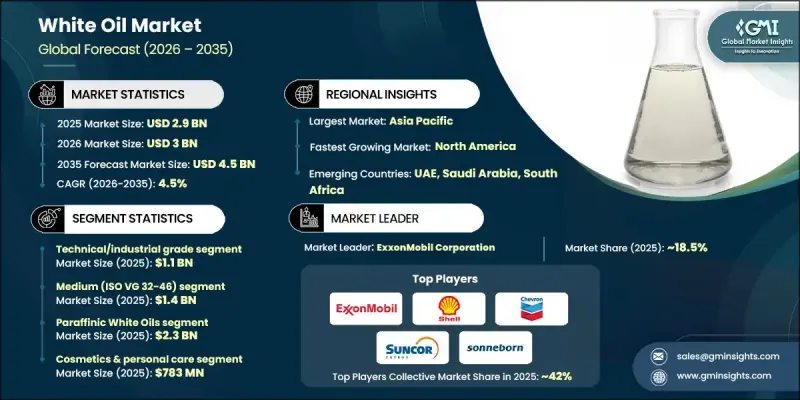
The Global White Oil Market was valued at USD 2.9 billion in 2025 and is estimated to grow at a CAGR of 4.5% to reach USD 4.5 billion by 2035.
White oils are highly refined mineral oils that are colorless, odorless, and tasteless, offering exceptional chemical stability and non-toxic properties. These characteristics make them ideal for sensitive applications across industries where safety and regulatory compliance are crucial. White oils undergo advanced hydrogenation and refining processes to remove aromatic compounds, sulfur, and nitrogen impurities, resulting in products with varying purity levels and viscosity grades. The oils find applications in pharmaceuticals, cosmetics, food processing, and industrial manufacturing, where consistent quality is essential. Recent technological advancements in hydrotreatment and catalytic dewaxing have enabled the production of ultra-pure oils with improved oxidation stability, longer shelf life, and compliance with international standards. Additionally, the development of synthetic and bio-based alternatives is addressing sustainability demands while maintaining performance standards required for critical uses.
| Market Scope | |
|---|---|
| Start Year | 2025 |
| Forecast Year | 2026-2035 |
| Start Value | $2.9 Billion |
| Forecast Value | $4.5 Billion |
| CAGR | 4.5% |
The technical and industrial-grade white oils segment generated USD 1.1 billion in 2025. This segment maintains steady demand due to its versatility and cost-effectiveness in plastics processing, polymer production, adhesives, and other industrial applications. Continuous improvements in refining techniques and the expansion of manufacturing in emerging economies are further driving demand for these grades.
The medium viscosity grades (ISO VG 32-46) segment reached USD 1.4 billion in 2025. Their balanced performance, adaptability, and ability to serve a wide range of industries, including plastics and industrial manufacturing, make them highly preferred. These grades account for nearly 48% of total white oil consumption, reflecting broad applicability across technical and consumer applications.
U.S. White Oil Market accounted for USD 638 million in 2025, supported by robust pharmaceutical manufacturing, advanced cosmetics production, and stringent food safety regulations. The country's demand is fueled by the need for high-purity oils in pharmaceuticals, personal care products, food-grade applications, and industrial polymer processing. The presence of leading pharmaceutical and cosmetics companies, along with sophisticated food processing infrastructure, ensures continued demand for USP-grade and food-grade white oils that comply with FDA and regulatory standards.
Key players operating in the Global White Oil Market include ExxonMobil Corporation, Royal Dutch Shell plc, Chevron Corporation, Petro-Canada/Suncor Energy, Sonneborn LLC, H&R Group (Hansen & Rosenthal KG), FUCHS Petrolub SE, APAR Industries Limited, Savita Oil Technologies Ltd., Panama Petrochem Ltd., Raj Petro Specialities Pvt. Ltd., Lodha Petro, SEOJIN Chemical Co., Ltd., and JX Nippon Oil & Energy Corporation. Companies in the Global White Oil Market strengthen their market presence through a combination of strategies. They invest heavily in research and development to enhance refining technologies, produce ultra-pure and specialty viscosity grades, and innovate synthetic and bio-based alternatives. Strategic partnerships, mergers, and acquisitions expand geographic reach and distribution networks. Firms also focus on regulatory compliance and product standardization to ensure global acceptance.
Table of Contents
Chapter 1 Methodology & Scope
- 1.1 Market scope and definition
- 1.2 Research design
- 1.2.1 Research approach
- 1.2.2 Data collection methods
- 1.3 Data mining sources
- 1.3.1 Global
- 1.3.2 Regional/Country
- 1.4 Base estimates and calculations
- 1.4.1 Base year calculation
- 1.4.2 Key trends for market estimation
- 1.5 Primary research and validation
- 1.5.1 Primary sources
- 1.6 Forecast model
- 1.7 Research assumptions and limitations
Chapter 2 Executive Summary
- 2.1 Industry 360° synopsis
- 2.2 Key market trends
- 2.2.1 Product Grade
- 2.2.2 Viscosity
- 2.2.3 Base Oil Type
- 2.2.4 Application
- 2.2.5 Regional
- 2.3 TAM Analysis, 2025-2035
- 2.4 CXO perspectives: Strategic imperatives
- 2.4.1 Executive decision points
- 2.4.2 Critical success factors
- 2.5 Future outlook and strategic recommendations
Chapter 3 Industry Insights
- 3.1 Industry ecosystem analysis
- 3.1.1 Supplier landscape
- 3.1.2 Profit margin
- 3.1.3 Value addition at each stage
- 3.1.4 Factor affecting the value chain
- 3.1.5 Disruptions
- 3.2 Industry impact forces
- 3.2.1 Growth drivers
- 3.2.2 Industry pitfalls and challenges
- 3.2.3 Market opportunities
- 3.3 Growth potential analysis
- 3.4 Regulatory landscape
- 3.4.1 North America
- 3.4.2 Europe
- 3.4.3 Asia Pacific
- 3.4.4 Latin America
- 3.4.5 Middle East & Africa
- 3.5 Porter's analysis
- 3.6 PESTEL analysis
- 3.7 Technology and innovation landscape
- 3.7.1 Current technological trends
- 3.7.2 Emerging technologies
- 3.8 Price trends
- 3.8.1 By region
- 3.8.2 By product grade
- 3.9 Future market trends
- 3.10 Patent landscape
- 3.11 Trade statistics (HS code)( Note: the trade statistics will be provided for key countries only)
- 3.11.1 Major importing countries
- 3.11.2 Major exporting countries
- 3.12 Sustainability and environmental aspects
- 3.12.1 Sustainable practices
- 3.12.2 Waste reduction strategies
- 3.12.3 Energy efficiency in production
- 3.12.4 Eco-friendly initiatives
- 3.13 Carbon footprint consideration
Chapter 4 Competitive Landscape, 2025
- 4.1 Introduction
- 4.2 Company market share analysis
- 4.2.1 By region
- 4.2.1.1 North America
- 4.2.1.2 Europe
- 4.2.1.3 Asia Pacific
- 4.2.1.4 LATAM
- 4.2.1.5 MEA
- 4.2.1 By region
- 4.3 Company matrix analysis
- 4.4 Competitive analysis of major market players
- 4.5 Competitive positioning matrix
- 4.6 Key developments
- 4.6.1 Mergers & acquisitions
- 4.6.2 Partnerships & collaborations
- 4.6.3 New product launches
- 4.6.4 Expansion plans
Chapter 5 Market Estimates and Forecast, By Product Grade, 2022-2035 (USD Billion) (Kilo Tons)
- 5.1 Key trends
- 5.2 Technical/industrial grade
- 5.3 Food grade
- 5.4 Pharmaceutical/USP grade
- 5.5 Cosmetic grade
Chapter 6 Market Estimates and Forecast, By Viscosity, 2022-2035 (USD Billion) (Kilo Tons)
- 6.1 Key trends
- 6.2 Light (ISO VG 7-15)
- 6.3 Medium (ISO VG 32-46)
- 6.4 Heavy (ISO VG 68-100+)
Chapter 7 Market Estimates and Forecast, By Base Oil Type, 2022-2035 (USD Billion) (Kilo Tons)
- 7.1 Key trends
- 7.2 Paraffinic white oils
- 7.3 Naphthenic white oils
Chapter 8 Market Estimates and Forecast, By Application, 2022-2035 (USD Billion) (Kilo Tons)
- 8.1 Key trends
- 8.2 Pharmaceutical applications
- 8.3 Cosmetics & personal care
- 8.4 Plastics & polymers
- 8.5 Food processing
- 8.6 Adhesives & sealants
- 8.7 Textiles & leather
- 8.8 Agricultural applications
- 8.9 Metalworking & industrial
- 8.10 Animal nutrition & veterinary
Chapter 9 Market Estimates and Forecast, By Region, 2022-2035 (USD Billion) (Kilo Tons)
- 9.1 Key trends
- 9.2 North America
- 9.2.1 U.S.
- 9.2.2 Canada
- 9.3 Europe
- 9.3.1 Germany
- 9.3.2 UK
- 9.3.3 France
- 9.3.4 Spain
- 9.3.5 Italy
- 9.3.6 Rest of Europe
- 9.4 Asia Pacific
- 9.4.1 China
- 9.4.2 India
- 9.4.3 Japan
- 9.4.4 Australia
- 9.4.5 South Korea
- 9.4.6 Rest of Asia Pacific
- 9.5 Latin America
- 9.5.1 Brazil
- 9.5.2 Mexico
- 9.5.3 Argentina
- 9.5.4 Rest of Latin America
- 9.6 Middle East and Africa
- 9.6.1 Saudi Arabia
- 9.6.2 South Africa
- 9.6.3 UAE
- 9.6.4 Rest of Middle East and Africa
Chapter 10 Company Profiles
- 10.1 ExxonMobil Corporation
- 10.2 Royal Dutch Shell plc
- 10.3 Chevron Corporation
- 10.4 Petro-Canada/Suncor Energy
- 10.5 Sonneborn LLC
- 10.6 H&R Group (Hansen & Rosenthal KG)
- 10.7 FUCHS Petrolub SE
- 10.8 APAR Industries Limited
- 10.9 Savita Oil Technologies Ltd.
- 10.10 Panama Petrochem Ltd.
- 10.11 Raj Petro Specialities Pvt. Ltd.
- 10.12 Lodha Petro
- 10.13 SEOJIN Chemical Co., Ltd.
- 10.14 JX Nippon Oil & Energy Corporation

