
PUBLISHER: Global Market Insights Inc. | PRODUCT CODE: 1892818

PUBLISHER: Global Market Insights Inc. | PRODUCT CODE: 1892818
Potato Protein Market Opportunity, Growth Drivers, Industry Trend Analysis, and Forecast 2026 - 2035
The Global Potato Protein Market was valued at USD 205.9 million in 2025 and is estimated to grow at a CAGR of 5.1% to reach USD 355 million by 2035.
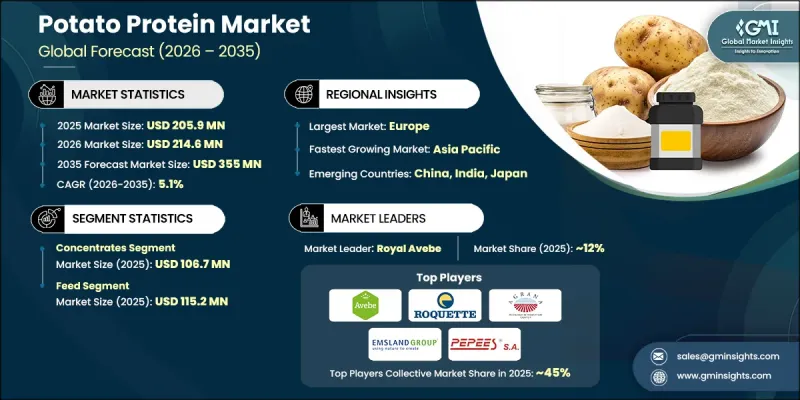
Market growth is supported by rising demand for plant-based, high-quality protein ingredients across food, nutrition, and feed industries. Potato protein is derived from potato tubers through advanced industrial extraction and purification processes that produce concentrates and isolates with strong nutritional and functional performance. These proteins are recognized for balanced amino acid composition, digestibility levels above 95%, and low allergenic potential, which supports broader consumer acceptance. Ongoing advancements in processing efficiency and protein recovery have improved yield while preserving native protein functionality. Modern filtration systems and optimized processing conditions enable manufacturers to deliver high-purity products with consistent quality. Continuous innovation in processing techniques has expanded the functional versatility of potato protein, allowing it to perform effectively across diverse formulations. Sustainability considerations and improved resource utilization further strengthen market appeal. Enhanced drying and particle engineering technologies have improved dispersibility, stability, and rehydration performance, supporting wider adoption. Together, these factors position potato protein as a reliable and scalable solution for manufacturers seeking clean-label, plant-derived protein ingredients.
| Market Scope | |
|---|---|
| Start Year | 2025 |
| Forecast Year | 2026-2035 |
| Start Value | $205.9 Million |
| Forecast Value | $355 Million |
| CAGR | 5.1% |
The isolates segment generated USD 94.7 million in 2025 and is expected to grow steadily due to demand from specialized nutrition and premium food categories. These products are designed with precise functional and solubility characteristics and minimal additives to meet strict nutritional standards. High purity and digestibility requirements support premium pricing, with isolates typically priced 40% to 60% higher than concentrates due to advanced processing complexity.
The feed applications segment reached USD 115.2 million in 2025. This segment benefits from consistent demand for highly digestible protein sources in specialized animal nutrition, supporting stable long-term consumption.
U.S. Potato Protein Market was valued at USD 48.3 million in 2025. Strong domestic demand is supported by advanced food processing infrastructure, a well-established plant-based sector, and high adoption of clean-label and allergen-free ingredients across the food and animal nutrition industries.
Key companies operating in the Global Potato Protein Market include Roquette Freres, Royal Avebe, Emsland Group, KMC Ingredients, AGRANA Group, AKV AMBA, Kemin Industries, PEPEES Group, Bioriginal Food and Science Corporation, Finnamyl, PPZ Niechlow S.A., Nutragreenlife Biotechnology Co., Ltd., and Hongjiu Biotech Co., Ltd. Companies in the Global Potato Protein Market are strengthening their competitive position through continuous investment in processing innovation, sustainability initiatives, and capacity expansion. Manufacturers focus on improving extraction efficiency and protein functionality to meet evolving customer specifications. Strategic partnerships with food and feed producers help secure long-term supply agreements and expand application reach. Many players emphasize clean-label positioning and traceable sourcing to align with regulatory and consumer expectations.
Table of Contents
Chapter 1 Methodology & Scope
- 1.1 Market scope and definition
- 1.2 Research design
- 1.2.1 Research approach
- 1.2.2 Data collection methods
- 1.3 Data mining sources
- 1.3.1 Global
- 1.3.2 Regional/Country
- 1.4 Base estimates and calculations
- 1.4.1 Base year calculation
- 1.4.2 Key trends for market estimation
- 1.5 Primary research and validation
- 1.5.1 Primary sources
- 1.6 Forecast model
- 1.7 Research assumptions and limitations
Chapter 2 Executive Summary
- 2.1 Industry 3600 synopsis
- 2.2 Key market trends
- 2.2.1 Type
- 2.2.2 Application
- 2.2.3 Regional
- 2.3 TAM Analysis, 2025-2035
- 2.4 CXO perspectives: Strategic imperatives
- 2.4.1 Executive decision points
- 2.4.2 Critical success factors
- 2.5 Future outlook and strategic recommendations
Chapter 3 Industry Insights
- 3.1 Industry ecosystem analysis
- 3.1.1 Supplier landscape
- 3.1.2 Profit margin
- 3.1.3 Value addition at each stage
- 3.1.4 Factor affecting the value chain
- 3.1.5 Disruptions
- 3.2 Industry impact forces
- 3.2.1 Growth drivers
- 3.2.2 Industry pitfalls and challenges
- 3.2.3 Market opportunities
- 3.3 Growth potential analysis
- 3.4 Regulatory landscape
- 3.4.1 North America
- 3.4.2 Europe
- 3.4.3 Asia Pacific
- 3.4.4 Latin America
- 3.4.5 Middle East & Africa
- 3.5 Porter's analysis
- 3.6 PESTEL analysis
- 3.7 Technology and innovation landscape
- 3.7.1 Current technological trends
- 3.7.2 Emerging technologies
- 3.8 Price trends
- 3.8.1 By region
- 3.8.2 By type
- 3.9 Future market trends
- 3.10 Technology and innovation landscape
- 3.10.1 Current technological trends
- 3.10.2 Emerging technologies
- 3.11 Patent landscape
- 3.12 Trade statistics (HS code) (Note: the trade statistics will be provided for key countries only)
- 3.12.1 Major importing countries
- 3.12.2 Major exporting countries
- 3.13 Sustainability and environmental aspects
- 3.13.1 Sustainable practices
- 3.13.2 Waste reduction strategies
- 3.13.3 Energy efficiency in production
- 3.13.4 Eco-friendly initiatives
- 3.14 Carbon footprint consideration
Chapter 4 Competitive Landscape, 2025
- 4.1 Introduction
- 4.2 Company market share analysis
- 4.2.1 By region
- 4.2.1.1 North America
- 4.2.1.2 Europe
- 4.2.1.3 Asia Pacific
- 4.2.1.4 LATAM
- 4.2.1.5 MEA
- 4.2.1 By region
- 4.3 Company matrix analysis
- 4.4 Competitive analysis of major market players
- 4.5 Competitive positioning matrix
- 4.6 Key developments
- 4.6.1 Mergers & acquisitions
- 4.6.2 Partnerships & collaborations
- 4.6.3 New product launches
- 4.6.4 Expansion plans
Chapter 5 Market Estimates and Forecast, By Type, 2022-2035 (USD Million) (Kilo Tons)
- 5.1 Key trends
- 5.2 Isolates
- 5.3 Concentrates
- 5.4 Others
Chapter 6 Market Estimates and Forecast, By Application, 2022-2035 (USD Million) (Kilo Tons)
- 6.1 Key trends
- 6.2 Food & Beverages
- 6.2.1 Meat Analogue
- 6.2.2 Dairy-free
- 6.2.3 Confectionery
- 6.2.4 Bakery
- 6.2.5 Processed foods
- 6.2.6 Typical foods
- 6.2.7 Others
- 6.3 Feed
Chapter 7 Market Estimates and Forecast, By Region, 2022-2035 (USD Million) (Kilo Tons)
- 7.1 Key trends
- 7.2 North America
- 7.2.1 U.S.
- 7.2.2 Canada
- 7.3 Europe
- 7.3.1 Germany
- 7.3.2 UK
- 7.3.3 France
- 7.3.4 Spain
- 7.3.5 Italy
- 7.3.6 Rest of Europe
- 7.4 Asia Pacific
- 7.4.1 China
- 7.4.2 India
- 7.4.3 Japan
- 7.4.4 Australia
- 7.4.5 South Korea
- 7.4.6 Rest of Asia Pacific
- 7.5 Latin America
- 7.5.1 Brazil
- 7.5.2 Mexico
- 7.5.3 Argentina
- 7.5.4 Rest of Latin America
- 7.6 Middle East and Africa
- 7.6.1 Saudi Arabia
- 7.6.2 South Africa
- 7.6.3 UAE
- 7.6.4 Rest of Middle East and Africa
Chapter 8 Company Profiles
- 8.1 Royal Avebe
- 8.2 Emsland Group
- 8.3 Roquette Freres
- 8.4 KMC Ingredients
- 8.5 AKV AMBA
- 8.6 PEPEES Group
- 8.7 Kemin Industries
- 8.8 Bioriginal Food and Science Corporation
- 8.9 AGRANA Group
- 8.10 PPZ Niechlow S.A.
- 8.11 Finnamyl
- 8.12 Nutragreenlife Biotechnology Co., Ltd.
- 8.13 Hongjiu Biotech Co., Ltd.

