
PUBLISHER: Global Market Insights Inc. | PRODUCT CODE: 1913408

PUBLISHER: Global Market Insights Inc. | PRODUCT CODE: 1913408
Lubricants Market Opportunity, Growth Drivers, Industry Trend Analysis, and Forecast 2026 - 2035
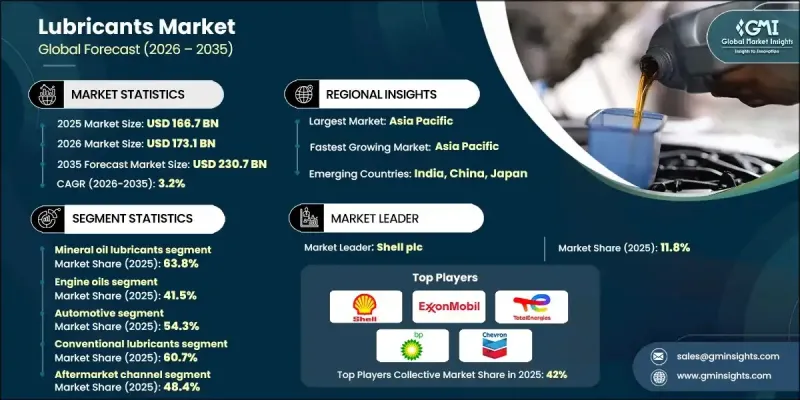
The Global Lubricants Market was valued at USD 166.7 billion in 2025 and is estimated to grow at a CAGR of 3.2% to reach USD 230.7 billion by 2035.
Lubricants are not only essential for reducing friction and wear in machinery but also provide thermal stability, corrosion resistance, and compatibility with increasingly advanced equipment designs. Technological innovation is driving market growth, with new synthetic blends, bio-based formulations, and hybrid lubricants setting higher performance benchmarks while meeting stricter environmental standards. Sustainability is now a global priority, encouraging manufacturers to develop biodegradable and less toxic lubricants. Operational efficiency remains a major demand driver, as industries seek products that extend equipment life, reduce maintenance, and improve energy consumption. Emerging trends such as bio-lubricants, smart lubrication systems, and multifunctional formulations are further expanding market potential and shaping the future of industrial and automotive applications worldwide.
| Market Scope | |
|---|---|
| Start Year | 2025 |
| Forecast Year | 2026-2035 |
| Start Value | $166.7 Billion |
| Forecast Value | $230.7 Billion |
| CAGR | 3.2% |
The engine oils segment held 41.5% share in 2025 and is expected to grow at a CAGR of 2.6% through 2035. These oils are vital for marine and automotive engines, protecting components against wear, heat, and contaminants, while transmission fluids support smooth gear shifting and thermal stability, particularly in advanced transmission systems operating under extreme conditions.
The automotive segment held 54.3% share in 2025 and is anticipated to grow at a CAGR of 2.4% by 2035. Lubricants in this segment ensure engine longevity, fuel efficiency, and compliance with emission standards, with growing demand for specialized formulations tailored to hybrid and electric vehicles.
Europe Lubricants Market accounted for USD 30.9 billion in 2025, emerging as a key growth region due to stringent environmental regulations, advanced industrial infrastructure, and strong adoption of premium synthetic and bio-based lubricants driven by sustainability initiatives.
Major players in the Global Lubricants Market include Chevron Corporation, FUCHS Group, Shell plc, Valvoline Inc, BP plc (Castrol), ENEOS Corporation, Lukoil, TotalEnergies SE, Sinopec Lubricant Company, Indian Oil Corporation Limited (IOCL), PetroChina Company Limited, Kluber Lubrication (Freudenberg Group), and Petronas Lubricants International. Companies in the Global Lubricants Market are employing multiple strategies to strengthen their market presence and maintain competitiveness. Key approaches include continuous innovation in synthetic, bio-based, and hybrid lubricants to meet performance and environmental standards. Firms are expanding global production capacities and investing in advanced R&D for high-performance applications. Strategic partnerships with OEMs and industrial clients secure long-term supply agreements, while sustainability initiatives promote eco-friendly formulations to align with regulatory trends.
Table of Contents
Chapter 1 Methodology & Scope
- 1.1 Market scope and definition
- 1.2 Research design
- 1.2.1 Research approach
- 1.2.2 Data collection methods
- 1.3 Data mining sources
- 1.3.1 Global
- 1.3.2 Regional/Country
- 1.4 Base estimates and calculations
- 1.4.1 Base year calculation
- 1.4.2 Key trends for market estimation
- 1.5 Primary research and validation
- 1.5.1 Primary sources
- 1.6 Forecast model
- 1.7 Research assumptions and limitations
Chapter 2 Executive Summary
- 2.1 Industry 360° synopsis
- 2.2 Key market trends
- 2.2.1 Regional
- 2.2.2 Base Oil Type
- 2.2.3 Product Type
- 2.2.4 Application
- 2.2.5 Technology Type
- 2.2.6 Distribution Channel
- 2.3 TAM Analysis, 2025-2035
- 2.4 CXO perspectives: Strategic imperatives
- 2.4.1 Executive decision points
- 2.4.2 Critical success factors
- 2.5 Future Outlook and Strategic Recommendations
Chapter 3 Industry Insights
- 3.1 Industry ecosystem analysis
- 3.1.1 Supplier landscape
- 3.1.2 Profit margin
- 3.1.3 Value addition at each stage
- 3.1.4 Factor affecting the value chain
- 3.1.5 Disruptions
- 3.2 Industry impact forces
- 3.2.1 Growth drivers
- 3.2.1.1 Growing automotive production & vehicle part
- 3.2.1.2 Industrial manufacturing expansion
- 3.2.1.3 Stringent emission regulations driving synthetic adoption
- 3.2.2 Industry pitfalls and challenges
- 3.2.2.1 Volatility in crude oil & base oil prices
- 3.2.2.2 Shift toward electric vehicles reducing lubricant demand
- 3.2.3 Market opportunities
- 3.2.3.1 Bio-based & biodegradable lubricants growth
- 3.2.3.2 Re-refined & circular economy lubricants
- 3.2.1 Growth drivers
- 3.3 Growth potential analysis
- 3.4 Regulatory landscape
- 3.4.1 North America
- 3.4.2 Europe
- 3.4.3 Asia Pacific
- 3.4.4 Latin America
- 3.4.5 Middle East & Africa
- 3.5 Porter's analysis
- 3.6 PESTEL analysis
- 3.7 Price trends
- 3.7.1 By region
- 3.7.2 By Base Oil Type
- 3.8 Future market trends
- 3.9 Technology and Innovation landscape
- 3.9.1 Current technological trends
- 3.9.2 Emerging technologies
- 3.10 Patent Landscape
- 3.11 Trade statistics (HS code) ( Note: the trade statistics will be provided for key countries only)
- 3.11.1 Major importing countries
- 3.11.2 Major exporting countries
- 3.12 Sustainability and environmental aspects
- 3.12.1 Sustainable practices
- 3.12.2 Waste reduction strategies
- 3.12.3 Energy efficiency in production
- 3.12.4 Eco-friendly initiatives
- 3.13 Carbon footprint consideration
Chapter 4 Competitive Landscape, 2025
- 4.1 Introduction
- 4.2 Company market share analysis
- 4.2.1 By region
- 4.2.1.1 North America
- 4.2.1.2 Europe
- 4.2.1.3 Asia Pacific
- 4.2.1.4 LATAM
- 4.2.1.5 MEA
- 4.2.1 By region
- 4.3 Company matrix analysis
- 4.4 Competitive analysis of major market players
- 4.5 Competitive positioning matrix
- 4.6 Key developments
- 4.6.1 Mergers & acquisitions
- 4.6.2 Partnerships & collaborations
- 4.6.3 New Product Launches
- 4.6.4 Expansion Plans
Chapter 5 Market Estimates and Forecast, By Base Oil Type, 2022-2035 (USD Billion) (Kilo Tons)
- 5.1 Key trends
- 5.2 Mineral oil lubricants
- 5.2.1 Group i (solvent-refined)
- 5.2.2 Group ii (hydroprocessed)
- 5.2.3 Group iii (severely hydroprocessed)
- 5.3 Synthetic lubricants
- 5.3.1 Group iv - polyalphaolefins (pao)
- 5.3.2 Group v - synthetic esters
- 5.3.3 Polyalkylene glycols (pag)
- 5.3.4 Silicone-based lubricants
- 5.4 Semi-synthetic/blends
- 5.5 Bio-based/renewable lubricants
- 5.5.1 Vegetable oil-based
- 5.5.2 Animal fat-based
- 5.5.3 Synthetic esters from renewable sources
Chapter 6 Market Estimates and Forecast, By Product Type, 2022-2035 (USD Billion) (Kilo Tons)
- 6.1 Key trends
- 6.2 Engine Oils
- 6.2.1 Passenger Car Motor Oils (PCMO)
- 6.2.2 Heavy-Duty Engine Oils (HDEO)
- 6.2.3 Two-Stroke Engine Oils
- 6.2.4 Marine Engine Oils
- 6.3 Transmission Fluids
- 6.3.1 Automatic Transmission Fluids (ATF)
- 6.3.2 Manual Transmission Fluids
- 6.3.3 Electric Vehicle Transmission Fluids
- 6.4 Hydraulic Fluids
- 6.4.1 Mineral Oil-Based Hydraulic Fluids
- 6.4.2 Fire-Resistant Hydraulic Fluids
- 6.4.3 Biodegradable Hydraulic Fluids
- 6.4.4 Aviation Hydraulic Fluids
- 6.5 Gear Oils
- 6.5.1 Automotive Gear Oils
- 6.5.2 Industrial Gear Oils
- 6.5.3 Open Gear Compounds
- 6.6 Greases
- 6.6.1 Lithium/Lithium Complex Greases
- 6.6.2 Calcium/Calcium Complex Greases
- 6.6.3 Polyurea Greases
- 6.6.4 Aluminum Complex Greases
- 6.6.5 Other Thickener Types
- 6.7 Metalworking Fluids
- 6.7.1 Cutting Fluids
- 6.7.2 Forming/Drawing Fluids
- 6.7.3 Grinding Fluids
- 6.7.4 Neat Cutting Oils
- 6.8 Process Oils
- 6.8.1 Rubber Process Oils
- 6.8.2 Textile Oils
- 6.8.3 White Oils
- 6.9 Specialty Lubricants
- 6.9.1 Compressor Oils
- 6.9.2 Turbine Oils
- 6.9.3 Refrigeration Oils
- 6.9.4 Other Specialty Lubricants
Chapter 7 Market Estimates and Forecast, By Application, 2022-2035 (USD Billion) (Kilo Tons)
- 7.1 Key trends
- 7.2 Automotive
- 7.3 Industrial manufacturing
- 7.4 Marine
- 7.5 Aerospace & defense
- 7.6 Power generation
- 7.7 Mining & construction
- 7.8 Agriculture & off-highway
- 7.9 Food & beverage processing
- 7.10 Other industrial applications
Chapter 8 Market Estimates and Forecast, By Technology Type, 2022-2035 (USD Billion) (Kilo Tons)
- 8.1 Key trends
- 8.2 Conventional lubricants
- 8.3 High-performance/fully synthetic
- 8.4 Bio-based/biodegradable
- 8.5 Re-refined/recycled
- 8.6 Advanced technology
Chapter 9 Market Estimates and Forecast, By Distribution Channel, 2022-2035 (USD Billion) (Kilo Tons)
- 9.1 Key trends
- 9.2 OEM/direct channel
- 9.2.1 Factory-fill lubricants
- 9.2.2 Oem-branded products
- 9.2.3 Direct industrial supply contracts
- 9.3 Aftermarket channel
- 9.3.1 Retail
- 9.3.2 Wholesale
- 9.4 Industrial distributors
- 9.4.1 Industrial distributors
- 9.4.2 Mro suppliers
- 9.4.3 Specialty industrial distributors
Chapter 10 Market Estimates and Forecast, By Region, 2022-2035 (USD Billion) (Kilo Tons)
- 10.1 Key trends
- 10.2 North America
- 10.2.1 U.S.
- 10.2.2 Canada
- 10.3 Europe
- 10.3.1 Germany
- 10.3.2 UK
- 10.3.3 France
- 10.3.4 Spain
- 10.3.5 Italy
- 10.3.6 Rest of Europe
- 10.4 Asia Pacific
- 10.4.1 China
- 10.4.2 India
- 10.4.3 Japan
- 10.4.4 Australia
- 10.4.5 South Korea
- 10.4.6 Rest of Asia Pacific
- 10.5 Latin America
- 10.5.1 Brazil
- 10.5.2 Mexico
- 10.5.3 Argentina
- 10.5.4 Rest of Latin America
- 10.6 Middle East and Africa
- 10.6.1 Saudi Arabia
- 10.6.2 South Africa
- 10.6.3 UAE
- 10.6.4 Rest of Middle East and Africa
Chapter 11 Company Profiles
- 11.1 Shell plc
- 11.2 ExxonMobil Corporation
- 11.3 TotalEnergies SE
- 11.4 BP plc (Castrol)
- 11.5 Chevron Corporation
- 11.6 FUCHS Group
- 11.7 Valvoline Inc
- 11.8 PetroChina Company Limited
- 11.9 Sinopec Lubricant Company
- 11.10 Indian Oil Corporation Limited (IOCL)
- 11.11 ENEOS Corporation
- 11.12 Petronas Lubricants International
- 11.13 Lukoil
- 11.14 Kluber Lubrication (Freudenberg Group)

