
PUBLISHER: Global Market Insights Inc. | PRODUCT CODE: 1913433

PUBLISHER: Global Market Insights Inc. | PRODUCT CODE: 1913433
Titanium Dioxide Market Opportunity, Growth Drivers, Industry Trend Analysis, and Forecast 2026 - 2035
The Global Titanium Dioxide Market was valued at USD 22 billion in 2025 and is estimated to grow at a CAGR of 4.9% to reach USD 35.8 billion by 2035.
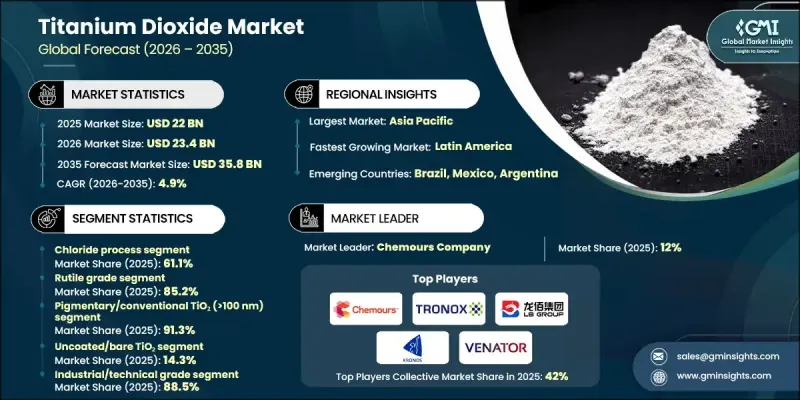
The market is reshaped by a strong focus on sustainability, performance enhancement, and strategic portfolio upgrades across end-use industries. Demand recovery, stabilization in automotive manufacturing, and rising interest in cosmetics and specialty-grade applications have helped offset pressures created by regulatory tightening and trade-related challenges. Producers are increasingly prioritizing higher-value product grades, regional balance, and operational efficiency to reduce exposure to price volatility while maintaining competitiveness. Mature markets are driving demand for specialty and performance-focused applications, while emerging economies continue to support base-level consumption across construction, coatings, packaging, and consumer goods. Niche areas, including nanoscale materials and application-tailored surface treatments, are gaining momentum and supporting value growth that, in some segments, is outpacing volume expansion. Industry consolidation and disciplined capacity management have reduced cyclical instability, while innovation in premium grades and chloride-based production remains central to competitive positioning and long-term market stability.
| Market Scope | |
|---|---|
| Start Year | 2025 |
| Forecast Year | 2026-2035 |
| Start Value | $22 Billion |
| Forecast Value | $35.8 Billion |
| CAGR | 4.9% |
The chloride process segment accounted for 61.1% share in 2025 owing to its ability to deliver consistent quality and meet regulatory standards. This process converts high-purity feedstock into pigment through chlorination and oxidation at elevated temperatures, producing rutile pigments with a refractive index near 2.71 and uniform particle distribution that are favored for demanding coating applications.
The rutile-grade titanium dioxide segment held an 85.2% share in 2025 and is expected to grow at a CAGR of 5% from 2026 to 2035. Its superior durability, color stability, and opacity continue to make it the preferred choice for high-performance architectural and automotive coatings. The higher refractive index of rutile compared to anatase provides enhanced light-scattering efficiency, supporting its dominance across large-volume applications.
North America Titanium Dioxide Market accounted for 21.7% share in 2025. The region benefits from advanced manufacturing infrastructure and regulatory frameworks that promote safety, sustainability, and long-term material performance. These conditions drive strong demand for titanium dioxide solutions that enhance durability, UV resistance, and opacity across construction, transportation, and industrial applications.
Key companies operating in the Global Titanium Dioxide Market include Tronox Holdings plc, Chemours Company, Kronos Worldwide Inc, Lomon Billions Group, Venator Materials PLC, Ishihara Sangyo Kaisha Ltd, CNNC Hua Yuan Titanium Dioxide Co Ltd, Tayca Corporation, Grupa Azoty ZAK SA, Kerala Minerals & Metals Limited, Cristal Pigment Australia Ltd, and Precheza AS. Companies in the Global Titanium Dioxide Market are strengthening their market position through product differentiation, operational efficiency, and targeted geographic expansion. Leading producers are investing in advanced production technologies to improve consistency, reduce environmental impact, and increase output of premium-grade materials. Portfolio optimization toward specialty and high-performance applications is being used to improve margins and reduce exposure to commodity price swings. Strategic capacity management and selective expansion help maintain supply discipline.
Table of Contents
Chapter 1 Methodology & Scope
- 1.1 Market scope and definition
- 1.2 Research design
- 1.2.1 Research approach
- 1.2.2 Data collection methods
- 1.3 Data mining sources
- 1.3.1 Global
- 1.3.2 Regional/Country
- 1.4 Base estimates and calculations
- 1.4.1 Base year calculation
- 1.4.2 Key trends for market estimation
- 1.5 Primary research and validation
- 1.5.1 Primary sources
- 1.6 Forecast model
- 1.7 Research assumptions and limitations
Chapter 2 Executive Summary
- 2.1 Industry 360° synopsis
- 2.2 Key market trends
- 2.2.1 Regional
- 2.2.2 Manufacturing Process
- 2.2.3 Grade
- 2.2.4 Particle Size
- 2.2.5 Surface Treatment & Coating
- 2.2.6 Regulatory Grade
- 2.2.7 Application
- 2.3 TAM Analysis, 2025-2035
- 2.4 CXO perspectives: Strategic imperatives
- 2.4.1 Executive decision points
- 2.4.2 Critical success factors
- 2.5 Future Outlook and Strategic Recommendations
Chapter 3 Industry Insights
- 3.1 Industry ecosystem analysis
- 3.1.1 Supplier landscape
- 3.1.2 Profit margin
- 3.1.3 Value addition at each stage
- 3.1.4 Factor affecting the value chain
- 3.1.5 Disruptions
- 3.2 Industry impact forces
- 3.2.1 Growth drivers
- 3.2.1.1 Paints & coatings demand
- 3.2.1.2 Construction and infrastructure expansion
- 3.2.1.3 Automotive and lightweighting.
- 3.2.2 Industry pitfalls and challenges
- 3.2.2.1 Environmental compliance costs and emissions reporting
- 3.2.2.2 EU food-grade TiO2 ban (E171) and global reformulations
- 3.2.3 Market opportunities
- 3.2.3.1 Nanoscale UV & photocatalysis
- 3.2.3.2 Sustainability & circularity demand
- 3.2.1 Growth drivers
- 3.3 Growth potential analysis
- 3.4 Regulatory landscape
- 3.4.1 North America
- 3.4.2 Europe
- 3.4.3 Asia Pacific
- 3.4.4 Latin America
- 3.4.5 Middle East & Africa
- 3.5 Porter's analysis
- 3.6 PESTEL analysis
- 3.7 Price trends
- 3.7.1 By region
- 3.7.2 By Manufacturing Process
- 3.8 Future market trends
- 3.9 Technology and Innovation landscape
- 3.9.1 Current technological trends
- 3.9.2 Emerging technologies
- 3.10 Patent Landscape
- 3.11 Trade statistics (HS code)
( Note: the trade statistics will be provided for key countries only)
- 3.11.1 Major importing countries
- 3.11.2 Major exporting countries
- 3.12 Sustainability and environmental aspects
- 3.12.1 Sustainable practices
- 3.12.2 Waste reduction strategies
- 3.12.3 Energy efficiency in production
- 3.12.4 Eco-friendly initiatives
- 3.13 Carbon footprint consideration
Chapter 4 Competitive Landscape, 2025
- 4.1 Introduction
- 4.2 Company market share analysis
- 4.2.1 By region
- 4.2.1.1 North America
- 4.2.1.2 Europe
- 4.2.1.3 Asia Pacific
- 4.2.1.4 LATAM
- 4.2.1.5 MEA
- 4.2.1 By region
- 4.3 Company matrix analysis
- 4.4 Competitive analysis of major market players
- 4.5 Competitive positioning matrix
- 4.6 Key developments
- 4.6.1 Mergers & acquisitions
- 4.6.2 Partnerships & collaborations
- 4.6.3 New Product Launches
- 4.6.4 Expansion Plans
Chapter 5 Market Estimates and Forecast, By Manufacturing Process, 2022-2035 (USD Billion) (Kilo Tons)
- 5.1 Key trends
- 5.2 Chloride process
- 5.3 Sulfate process
Chapter 6 Market Estimates and Forecast, By Grade, 2022-2035 (USD Billion) (Kilo Tons)
- 6.1 Key trends
- 6.2 Rutile grade
- 6.3 Anatase grade
- 6.4 Mixed phase (rutile-anatase)
Chapter 7 Market Estimates and Forecast, By Particle Size, 2022-2035 (USD Billion) (Kilo Tons)
- 7.1 Key trends
- 7.2 Pigmentary/conventional TiO2 (>100 nm)
- 7.3 Ultrafine/nanoscale TiO2 (≤100 nm)
- 7.4 Composite TiO2 products (<80% TiO2 content)
Chapter 8 Market Estimates and Forecast, By Surface Treatment & Coating, 2022-2035 (USD Billion) (Kilo Tons)
- 8.1 Key trends
- 8.2 Uncoated/bare TiO2
- 8.3 Inorganic coated TiO2
- 8.3.1 Silica-coated TiO2
- 8.3.2 Alumina-coated TiO2
- 8.3.3 Zirconia-coated TiO2
- 8.3.4 Mixed oxide coatings
- 8.4 Organic coated TiO2
- 8.4.1 Siloxane-treated TiO2
- 8.4.2 Alkyl-silane-treated TiO2
- 8.4.3 Polymer-coated TiO2
- 8.5 Doped TiO2
Chapter 9 Market Estimates and Forecast, By Regulatory Grade, 2022-2035 (USD Billion) (Kilo Tons)
- 9.1 Key trends
- 9.2 Food grade
- 9.3 Pharmaceutical/drug grade
- 9.4 Cosmetic grade
- 9.5 Medical device grade
- 9.6 Industrial/technical grade
Chapter 10 Market Estimates and Forecast, By Application, 2022-2035 (USD Billion) (Kilo Tons)
- 10.1 Key trends
- 10.2 Paints & coatings
- 10.2.1 Architectural paints
- 10.2.2 Industrial coatings
- 10.2.3 Automotive coatings
- 10.2.4 Marine coatings
- 10.2.5 Powder coatings
- 10.2.6 Wood coatings
- 10.3 Plastics & rubber
- 10.3.1 Polyolefins (pe, pp)
- 10.3.2 Pvc
- 10.4 Paper & pulp
- 10.4.1 Coated paper
- 10.4.2 Uncoated paper
- 10.4.3 Specialty papers
- 10.5 Printing inks
- 10.5.1 Publication inks
- 10.5.2 Packaging inks
- 10.5.3 Commercial printing inks
- 10.6 Cosmetics & personal care
- 10.6.1 Sunscreens & uv blockers
- 10.6.2 Color cosmetics
- 10.6.3 Eye makeup
- 10.6.4 Lip products
- 10.6.5 Skincare products
- 10.7 Food products
- 10.7.1 Bakery items
- 10.7.2 Confectionery
- 10.7.3 Other food applications
- 10.8 Textiles & fibers
- 10.8.1 Delustering of synthetic fibers
- 10.8.2 Textile coatings & finishes
- 10.9 Photocatalytic applications
- 10.9.1 Self-cleaning surfaces
- 10.9.2 Air purification
- 10.9.3 Water treatment
- 10.9.4 Antimicrobial coatings
- 10.10 Electronics & energy
- 10.10.1 Solar cells (dye-sensitized)
- 10.10.2 Sensors
- 10.10.3 Capacitors
- 10.10.4 Battery materials
Chapter 11 Market Estimates and Forecast, By Region, 2022-2035 (USD Billion) (Kilo Tons)
- 11.1 Key trends
- 11.2 North America
- 11.2.1 U.S.
- 11.2.2 Canada
- 11.3 Europe
- 11.3.1 Germany
- 11.3.2 UK
- 11.3.3 France
- 11.3.4 Spain
- 11.3.5 Italy
- 11.3.6 Rest of Europe
- 11.4 Asia Pacific
- 11.4.1 China
- 11.4.2 India
- 11.4.3 Japan
- 11.4.4 Australia
- 11.4.5 South Korea
- 11.4.6 Rest of Asia Pacific
- 11.5 Latin America
- 11.5.1 Brazil
- 11.5.2 Mexico
- 11.5.3 Argentina
- 11.5.4 Rest of Latin America
- 11.6 Middle East and Africa
- 11.6.1 Saudi Arabia
- 11.6.2 South Africa
- 11.6.3 UAE
- 11.6.4 Rest of Middle East and Africa
Chapter 12 Company Profiles
- 12.1 Chemours Company
- 12.2 Tronox Holdings plc
- 12.3 Lomon Billions Group
- 12.4 Kronos Worldwide Inc
- 12.5 Venator Materials PLC
- 12.6 CNNC Hua Yuan Titanium Dioxide Co Ltd
- 12.7 Ishihara Sangyo Kaisha Ltd
- 12.8 Tayca Corporation
- 12.9 Grupa Azoty ZAK SA
- 12.10 Kerala Minerals & Metals Limited (KMML)
- 12.11 Cristal Pigment Australia Ltd
- 12.12 Precheza AS

