
PUBLISHER: Global Market Insights Inc. | PRODUCT CODE: 1928881

PUBLISHER: Global Market Insights Inc. | PRODUCT CODE: 1928881
Zero Liquid Discharge (ZLD) Systems Market Opportunity, Growth Drivers, Industry Trend Analysis, and Forecast 2026 - 2035
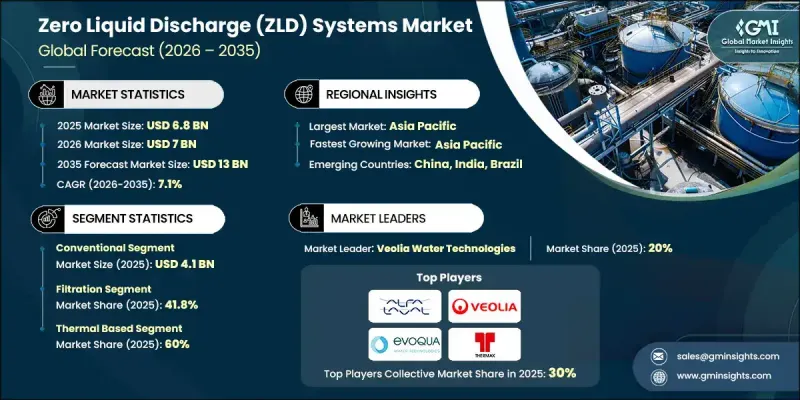
The Global Zero Liquid Discharge (ZLD) Systems Market was valued at USD 6.8 billion in 2025 and is estimated to grow at a CAGR of 7.1% to reach USD 13 billion by 2035.
Market momentum is strengthening as industries increasingly prioritize water stewardship, regulatory compliance, and long-term sustainability goals. Organizations across manufacturing sectors are adopting zero liquid discharge solutions to minimize wastewater disposal risks, support environmental responsibility, and ensure consistent access to reusable water resources. This transition is particularly strong in regions facing mounting water stress, where dependable water recovery systems are essential for operational continuity. As companies work to lower waste generation and improve resilience, ZLD technologies are becoming an integral part of broader sustainability and efficiency strategies. Ongoing improvements in membrane separation, evaporation, and crystallization are enhancing system performance and reliability, making ZLD more practical for long-term industrial use. Both conventional and hybrid system configurations are gaining attention as industries seek solutions that balance proven performance with operational flexibility. Sectors such as chemicals, pharmaceuticals, and power generation are accelerating adoption, viewing ZLD investments to meet environmental expectations while reinforcing supply security and operational stability.
| Market Scope | |
|---|---|
| Start Year | 2025 |
| Forecast Year | 2026-2035 |
| Start Value | $6.8 Billion |
| Forecast Value | $13 Billion |
| CAGR | 7.1% |
In 2025, the conventional systems generated USD 4.1 billion. Their leadership is supported by long-standing industrial familiarity with established thermal processes that deliver consistent and predictable outcomes. Many organizations continue to favor these systems due to their proven reliability and ease of integration into existing water treatment infrastructure.
The thermal-based solutions accounted for 60% share in 2025. These systems remain the preferred option for treating highly saline and complex industrial effluents, as they can recover water effectively even under challenging conditions. Their ability to handle extreme wastewater compositions supports continued demand from heavy industrial users.
United States Zero Liquid Discharge (ZLD) Systems Market held 88% share generating USD 1.25 billion. The region benefits from strict environmental oversight and heightened focus on sustainable wastewater management across industrial sectors, which continues to encourage adoption of advanced ZLD technologies.
Key companies active in the Global Zero Liquid Discharge (ZLD) Systems Market include Veolia Water Technologies, Aquatech International, Alfa Laval, GEA Group, Thermax, Toshiba, IDE Water Technologies, Evoqua Water Technologies, Saltworks Technologies, Mitsubishi Power, Praj Industries, Petro Sep Corporation, Aquarion, SafBon Water Technology, and H2O. Companies in the Global Zero Liquid Discharge (ZLD) Systems Market are strengthening their market position by investing in technology innovation to improve energy efficiency and reduce operational costs. Many players are developing modular and hybrid system designs to address diverse industrial wastewater profiles. Strategic partnerships with industrial clients help tailor solutions and secure long-term service contracts. Firms are also expanding regional footprints to serve water-stressed markets more effectively. Emphasis on lifecycle services, digital monitoring, and predictive maintenance enhances system reliability and customer retention.
Table of Contents
Chapter 1 Methodology and Scope
- 1.1 Market scope and definition
- 1.2 Research design
- 1.2.1 Research approach
- 1.2.2 Data collection methods
- 1.3 Data mining sources
- 1.3.1 Global
- 1.3.2 Regional/Country
- 1.4 Base estimates and calculations
- 1.4.1 Base year calculation
- 1.4.2 Key trends for market estimation
- 1.5 Primary research and validation
- 1.5.1 Primary sources
- 1.6 Forecast model
- 1.7 Research assumptions and limitations
Chapter 2 Executive Summary
- 2.1 Industry 360° synopsis
- 2.2 Key market trends
- 2.2.1 By Regional
- 2.2.2 By System type
- 2.2.3 By Technology
- 2.2.4 By Process
- 2.2.5 By End user industry
- 2.2.6 By Distribution channel
- 2.3 CXO perspectives: Strategic imperatives
- 2.3.1 Key decision points for industry executives
- 2.3.2 Critical success factors for market players
- 2.4 Future outlook and strategic recommendations
Chapter 3 Industry Insights
- 3.1 Industry ecosystem analysis
- 3.1.1 Supplier landscape
- 3.1.2 Profit margin
- 3.1.3 Value addition at each stage
- 3.1.4 Factor affecting the value chain
- 3.2 Industry impact forces
- 3.2.1 Growth drivers
- 3.2.1.1 Increasing Focus on Water Conservation and Resource Efficiency
- 3.2.1.2 Stricter Environmental Regulations and Compliance Mandates
- 3.2.1.3 Growing Industry Shift Toward Sustainable Wastewater Management
- 3.2.2 Industry pitfalls & challenges
- 3.2.2.1 High Capital Investment Requirements
- 3.2.2.2 High Operational and Maintenance Costs
- 3.2.3 Opportunities
- 3.2.3.1 Advancements in Membrane and Thermal Technologies
- 3.2.3.2 Expansion in Emerging Economies Driven by Sustainability Priorities
- 3.2.1 Growth drivers
- 3.3 Growth potential analysis
- 3.4 Major market trends and disruptions
- 3.5 Future market trends
- 3.6 Risk and mitigation Analysis
- 3.7 Technology and innovation landscape
- 3.7.1 Current technological trends
- 3.7.2 Emerging technologies
- 3.8 Price trends
- 3.8.1 By Region
- 3.9 Regulatory landscape
- 3.9.1 North America
- 3.9.2 Europe
- 3.9.3 Asia-Pacific
- 3.9.4 Middle East and Africa
- 3.9.5 Latin America
- 3.10 Porter';s analysis
- 3.11 PESTEL analysis
Chapter 4 Competitive Landscape, 2025
- 4.1 Introduction
- 4.2 Company market share analysis
- 4.2.1 By region
- 4.2.1.1 North America
- 4.2.1.2 Europe
- 4.2.1.3 Asia Pacific
- 4.2.1.4 Latin America
- 4.2.1.5 Middle East and Africa
- 4.2.1 By region
- 4.3 Company matrix analysis
- 4.4 Competitive analysis of major market players
- 4.5 Competitive positioning matrix
- 4.6 Key developments
- 4.6.1 Mergers & acquisitions
- 4.6.2 Partnerships & collaborations
- 4.6.3 New product launches
- 4.6.4 Expansion plans
Chapter 5 Market Estimates & Forecast, By System Type, 2022-2035 (USD Billion) (Thousand Units)
- 5.1 Key trends
- 5.2 Conventional
- 5.3 Smart
Chapter 6 Market Estimates & Forecast, By Technology, 2022-2035 (USD Billion) (Thousand Units)
- 6.1 Key trends
- 6.2 Thermal Based
- 6.3 Membrane Based
Chapter 7 Market Estimates & Forecast, By Process, 2022-2035 (USD Billion) (Thousand Units)
- 7.1 Key trends
- 7.2 Pre-treatment
- 7.3 Filtration
- 7.4 Evaporation/crystallization
Chapter 8 Market Estimates & Forecast, By End Use Industry, 2022-2035 (USD Billion) (Thousand Units)
- 8.1 Key trends
- 8.2 Oil and Gas
- 8.3 Pharmaceutical
- 8.4 Energy and Power
- 8.5 Chemicals and Petrochemicals
- 8.6 Others
Chapter 9 Market Estimates & Forecast, By Distribution Channel, 2022-2035 (USD Billion) (Thousand Units)
- 9.1 Key trends
- 9.2 Direct sales
- 9.3 Indirect sales
Chapter 10 Market Estimates and Forecast, By Region, 2022 - 2035 (USD Billion) (Thousand Units)
- 10.1 Key trends
- 10.2 North America
- 10.2.1 U.S.
- 10.2.2 Canada
- 10.3 Europe
- 10.3.1 Germany
- 10.3.2 UK
- 10.3.3 France
- 10.3.4 Italy
- 10.3.5 Spain
- 10.3.6 Turkey
- 10.4 Asia Pacific
- 10.4.1 China
- 10.4.2 Japan
- 10.4.3 India
- 10.4.4 Australia
- 10.4.5 South Korea
- 10.5 Latin America
- 10.5.1 Brazil
- 10.5.2 Mexico
- 10.5.3 Argentina
- 10.6 Middle East and Africa
- 10.6.1 South Africa
- 10.6.2 Saudi Arabia
- 10.6.3 UAE
Chapter 11 Company Profiles
- 11.1 Alfa Laval
- 11.2 Aquarion
- 11.3 Aquatech International
- 11.4 Evoqua Water Technologies
- 11.5 GEA Group
- 11.6 H2O
- 11.7 IDE Water Technologies
- 11.8 Mitsubishi Power
- 11.9 Petro Sep Corporation
- 11.10 Praj Industries
- 11.11 SafBon Water Technology
- 11.12 Saltworks Technologies
- 11.13 Thermax
- 11.14 Toshiba
- 11.15 Veolia Water Technologies

