
PUBLISHER: MarketsandMarkets | PRODUCT CODE: 2059332
PUBLISHER: MarketsandMarkets | PRODUCT CODE: 2059332
Zero Liquid Discharge Systems Market by Process (Evaporation/Crystallization, Filtration), Capacity, Application, System, End-use industry (Energy & Power, Chemicals & Petrochemicals, Food & Beverage), and Region - Global Forecast to 2031
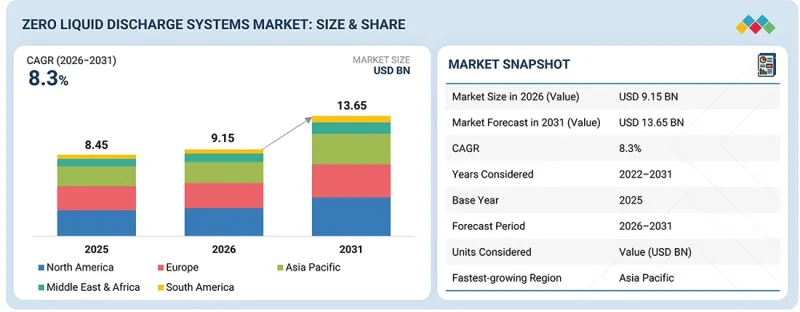
The ZLD systems market is projected to grow from USD 9.15 billion in 2026 to USD 13.65 billion by 2031, at a CAGR of 8.3% during the forecast period.
| Scope of the Report | |
|---|---|
| Years Considered for the Study | 2022-2031 |
| Base Year | 2025 |
| Forecast Period | 2026-2031 |
| Units Considered | Value (USD Million), Volume (Unit) |
| Segments | By Process, Capacity, Application, System, End-Use Industry, and Region |
| Regions covered | Europe, North America, Asia Pacific, Middle East & Africa, and South America |
The ZLD systems market is expected to see significant growth during the forecast period, particularly in hybrid ZLD systems. These systems enhance performance while reducing energy consumption and operational costs. By combining membrane technologies like reverse osmosis with thermal processes such as evaporation and crystallization, hybrid systems achieve higher water recovery rates and improved overall performance. The integrated design of these systems minimizes energy demand on thermal units, resulting in lower operational costs and greater environmental sustainability. Companies across various industrial sectors are increasingly adopting hybrid solutions to reduce carbon emissions and meet environmental regulations. Hybrid ZLD systems also offer flexible implementation options, enabling companies across industries such as power generation, chemicals, pharmaceuticals, and electronics to better adapt to varying wastewater compositions. This adaptability is expected to drive significant business growth throughout the forecast period.
''Based on end-use industry, pharmaceuticals is the fastest-growing segment in the ZLD systems market, in terms of value, during the forecast period.''
The pharmaceuticals sector is the fastest-growing segment of the ZLD systems market and is expected to continue this trend through the end of the forecast period. This growth is primarily due to the high-strength wastewater generated, which contains active pharmaceutical ingredients, solvents, and organic compounds. To comply with strict environmental regulations regarding effluent discharge and to address concerns about antibiotic and chemical pollution, pharmaceutical manufacturers must implement advanced wastewater treatment systems alongside ZLD technologies. The demand for these systems is increasing as production facilities expand rapidly across the Asia Pacific, North America, and Europe. The industry is investing in advanced ZLD systems as companies prioritize sustainability and water reuse while also meeting regulatory requirements. Pharmaceutical treatment systems require sophisticated operational capabilities to achieve high water recovery rates, thereby enhancing their overall value. This is particularly important given the complex testing methods required to treat wastewater in this industry.
"Based on process, filtration is the second-fastest-growing process, in terms of value, during the forecast period."
Filtration is the second-fastest-growing segment in the ZLD systems market during the forecast period. This growth is driven by its crucial role in enhancing plant performance while reducing costs for subsequent treatment processes. Filtration technologies, including ultrafiltration (UF), nanofiltration (NF), and reverse osmosis (RO), effectively remove suspended solids, dissolved salts, and contaminants from wastewater before it undergoes thermal evaporation. The system's performance and operational reliability improve by minimizing scaling, fouling, and energy consumption in both evaporators and crystallizers. Industries are increasing their investments in advanced membrane systems due to rising regulatory requirements mandating 100% water reclamation and zero facility discharge. The ongoing development of membrane systems that enhance durability through automation and anti-fouling features further increases their economic value over time. The growing adoption of filtration systems across power generation, chemicals, pharmaceuticals, and electronics is driving significant market expansion for ZLD filtration processes.
"Based on region, the Middle East & Africa is the second-fastest-growing market for ZLD systems, in terms of value, during the forecast period."
The Middle East and Africa region is rapidly becoming the second fastest-growing market for ZLD systems, driven by significant industrial growth and critical water shortages. The region faces severe freshwater scarcity, prompting businesses to adopt advanced water-recycling systems and comprehensive waste-management practices. Major investments are being made in sectors such as oil and gas, petrochemicals, mining, and power generation, driving strong demand for ZLD systems. These systems help companies comply with environmental regulations and operate sustainably. Governments are enacting stricter environmental regulations while supporting water recycling initiatives to reduce reliance on desalination and groundwater extraction. The Gulf countries are particularly pushing market expansion through rapid infrastructure development and industrial growth initiatives. As a result, the Middle East and Africa has emerged as a key development area for ZLD systems, as large industrial ZLD systems can yield substantial financial returns, further driving market growth in this region.
The ZLD systems market has been validated through primary interviews with industry experts globally. These primary sources have been divided into the following three categories:
- By Company Type: Tier 1 - 60%, Tier 2 - 20%, and Tier 3 - 20%
- By Designation: C-level - 33%, Director Level - 33%, and Managers - 34%
- By Region: North America - 30%, Europe - 20%, Asia Pacific - 35%, Middle East & Africa - 5%, and South America - 10%
The report provides a comprehensive analysis of company profiles:
Prominent companies include Alfa Laval (Sweden), Aquarion AG (Switzerland), Veolia (France), Aquatech (US), GEA Group (Germany), Praj Industries (India), H2O GmbH (Germany), Thermax Limited (India), Mitsubishi Chemical Corporation (Japan), and Andritz (Austria).
Research Coverage
This research report categorizes the ZLD systems market by process (pre-treatment, filtration, and evaporation/crystallization), capacity (small scale, medium scale, and large scale), application (brine disposal, chemical waste, food & beverage waste, electronics, and other applications), system (conventional ZLD system and hybrid ZLD system), end-use industry (energy & powder, chemicals & petrochemicals, food & beverages, pharmaceuticals, textiles, semiconductors & electronics, and other end-use industries), and region (North America, Europe, Asia Pacific, Middle East & Africa, and South America). The scope of the report includes detailed information on the major factors influencing the growth of the ZLD systems market, including drivers, restraints, challenges, and opportunities. A thorough examination of the key industry players has been conducted to provide insights into their business overview, solutions and services, key strategies, contracts, partnerships, and agreements. Product launches, mergers and acquisitions, and recent developments in the ZLD systems market are all covered. This report includes a competitive analysis of upcoming startups in the ZLD systems market ecosystem.
Reasons to buy this report:
The report will help market leaders/new entrants in this market by providing revenue estimates for the overall ZLD systems market and its subsegments. This report will help stakeholders understand the competitive landscape and gain deeper insights to better position their businesses and plan suitable go-to-market strategies. The report also helps stakeholders understand the pulse of the market and provides them with information on key market drivers, restraints, challenges, and opportunities.
The report provides insights on the following pointers:
- Analysis of key drivers (stringent environmental regulations and discharge norms, rising water scarcity, and increasing industrial water reuse requirements), restraints (high capital and operating costs, complex system design, and maintenance requirements), opportunities (technological advancements in energy-efficient and modular ZLD solutions and growing industrial expansion in emerging economies), and challenges (high energy consumption and carbon footprint concerns, limited technical expertise, and skilled workforce availability).
- Product Development/Innovation: Detailed insights on upcoming technologies, research & development activities, and service launches in the ZLD systems market.
- Market Development: Comprehensive information about lucrative markets - the report analyses the ZLD systems market across varied regions.
- Market Diversification: Exhaustive information about services, untapped geographies, recent developments, and investments in the ZLD systems market.
- Competitive Assessment: In-depth assessment of market shares, growth strategies, and service offerings of leading players like Alfa Laval (Sweden), Aquarion AG (Switzerland), Veolia (France), Aquatech (US), GEA Group (Germany), Praj Industries (India), H2O GmbH (Germany), Thermax Limited (India), Mitsubishi Chemical Corporation (Japan), and Andritz (Austria), among others, in the ZLD systems market.
TABLE OF CONTENTS
1 INTRODUCTION
- 1.1 STUDY OBJECTIVES
- 1.2 MARKET DEFINITION
- 1.3 MARKET SCOPE
- 1.3.1 ZERO LIQUID DISCHARGE SYSTEMS MARKET SEGMENTATION
- 1.3.2 INCLUSIONS AND EXCLUSIONS
- 1.3.3 YEARS CONSIDERED
- 1.3.4 CURRENCY CONSIDERED
- 1.3.5 UNITS CONSIDERED
- 1.4 STAKEHOLDERS
- 1.5 SUMMARY OF CHANGES
2 EXECUTIVE SUMMARY
- 2.1 KEY INSIGHTS AND MARKET HIGHLIGHTS
- 2.2 KEY MARKET PARTICIPANTS: MAPPING OF STRATEGIC DEVELOPMENTS
- 2.3 DISRUPTIVE TRENDS IN ZERO LIQUID DISCHARGE SYSTEMS MARKET
- 2.4 HIGH GROWTH SEGMENTS
- 2.5 REGIONAL SNAPSHOT: MARKET SIZE, GROWTH RATE, AND FORECAST
3 PREMIUM INSIGHTS
- 3.1 ATTRACTIVE OPPORTUNITIES FOR PLAYERS IN ZERO LIQUID DISCHARGE SYSTEMS MARKET
- 3.2 ZERO LIQUID DISCHARGE SYSTEMS MARKET, BY CAPACITY AND REGION
- 3.3 ZERO LIQUID DISCHARGE SYSTEMS MARKET, BY SYSTEM
- 3.4 ZERO LIQUID DISCHARGE SYSTEMS MARKET, BY END-USE INDUSTRY
- 3.5 ZERO LIQUID DISCHARGE SYSTEMS MARKET, BY COUNTRY
4 MARKET OVERVIEW
- 4.1 INTRODUCTION
- 4.2 MARKET DYNAMICS
- 4.2.1 DRIVERS
- 4.2.1.1 Stringent environmental regulations, industrial expansion, and increasing water scarcity in Asia Pacific
- 4.2.1.2 Uptrend in desalination equipment costs
- 4.2.1.3 Implementation of stringent water treatment regulations
- 4.2.1.4 Sustainability initiatives by various organizations
- 4.2.1.5 Increasing water scarcity across various regions
- 4.2.2 RESTRAINTS
- 4.2.2.1 High initial investment and complexity of systems
- 4.2.2.2 Availability of substitutes for water treatment
- 4.2.3 OPPORTUNITIES
- 4.2.3.1 Growing public concern about water scarcity and environment degradation
- 4.2.3.2 Increasing adoption in emerging economies of Asia Pacific
- 4.2.4 CHALLENGES
- 4.2.4.1 Operational cost and high maintenance
- 4.2.4.2 Controlling water loss during operation
- 4.2.1 DRIVERS
- 4.3 INTERCONNECTED MARKETS AND CROSS-SECTOR OPPORTUNITIES
- 4.3.1 INTERCONNECTED MARKETS
- 4.3.2 CROSS-SECTOR OPPORTUNITIES
- 4.4 STRATEGIC MOVES BY TIER-1/2/3 PLAYERS
- 4.4.1 KEY MOVES AND STRATEGIC FOCUS
- 4.5 PORTER'S FIVE FORCES ANALYSIS
- 4.5.1 THREAT OF SUBSTITUTES
- 4.5.2 BARGAINING POWER OF BUYERS
- 4.5.3 THREAT OF NEW ENTRANTS
- 4.5.4 BARGAINING POWER OF SUPPLIERS
- 4.5.5 INTENSITY OF COMPETITIVE RIVALRY
- 4.6 VALUE CHAIN ANALYSIS
- 4.6.1 RAW MATERIAL SUPPLIERS
- 4.6.2 MANUFACTURERS
- 4.6.3 SUPPLIERS/DISTRIBUTORS
- 4.6.4 END-USE INDUSTRIES
- 4.7 ECOSYSTEM MAPPING
- 4.8 PRICING ANALYSIS
- 4.8.1 AVERAGE SELLING PRICE, BY REGION
- 4.8.2 AVERAGE SELLING PRICE OF ZERO LIQUID DISCHARGE SYSTEMS AMONG KEY PLAYERS, BY TYPE
- 4.8.3 AVERAGE SELLING PRICE OF ZERO LIQUID DISCHARGE SYSTEMS AMONG KEY PLAYERS, BY APPLICATION
- 4.9 MACROECONOMIC INDICATORS
- 4.9.1 GLOBAL GDP TRENDS
- 4.10 IMPACT OF 2025 US TARIFFS ON ZERO LIQUID DISCHARGE SYSTEMS MARKET
- 4.10.1 INTRODUCTION
- 4.10.2 KEY TARIFF RATES
- 4.10.3 PRICE IMPACT ANALYSIS
- 4.10.4 IMPACT ON COUNTRIES/REGIONS
- 4.10.4.1 US
- 4.10.4.2 Europe
- 4.10.4.3 Asia Pacific
- 4.10.5 IMPACT ON END-USE INDUSTRIES
- 4.11 TRADE ANALYSIS
- 4.11.1 EXPORT SCENARIO
- 4.11.2 IMPORT SCENARIO
- 4.12 TRENDS/DISRUPTIONS IMPACTING CUSTOMER BUSINESS
- 4.13 INVESTMENT AND FUNDING SCENARIO
- 4.14 CASE STUDY ANALYSIS
- 4.14.1 ZERO LIQUID DISCHARGE AT PEARL GTL PLANT
- 4.14.2 WASTEWATER RECYCLE AND ZERO LIQUID DISCHARGE FOR CTX INDUSTRY IN CHINA
- 4.14.3 ZERO LIQUID DISCHARGE IN WASTEWATER TREATMENT
- 4.15 KEY CONFERENCES & EVENTS IN 2026-2027
5 TECHNOLOGICAL ADVANCEMENTS, AI-DRIVEN IMPACT, PATENTS, INNOVATIONS, AND FUTURE APPLICATIONS
- 5.1 TECHNOLOGY ANALYSIS
- 5.1.1 KEY TECHNOLOGIES
- 5.1.1.1 Membrane Technology
- 5.1.2 COMPLEMENTARY TECHNOLOGIES
- 5.1.2.1 Ultrafiltration Technology
- 5.1.2.2 Falling Film Evaporators
- 5.1.3 ADJACENT TECHNOLOGIES
- 5.1.3.1 Forward Osmosis
- 5.1.1 KEY TECHNOLOGIES
- 5.2 TECHNOLOGY/PRODUCT ROADMAP
- 5.2.1 SHORT TERM (2025-2027) | FOUNDATION & EARLY COMMERCIALIZATION
- 5.2.2 MID-TERM (2027-2030) | EXPANSION & STANDARDIZATION
- 5.2.3 LONG TERM (2030-2035+) | MASS COMMERCIALIZATION & DISRUPTION
- 5.3 PATENT ANALYSIS
- 5.3.1 LEGAL STATUS OF PATENTS
- 5.3.2 JURISDICTION ANALYSIS
- 5.4 FUTURE APPLICATIONS
- 5.4.1 INDUSTRIAL WATER REUSE & CIRCULAR MANUFACTURING
- 5.4.2 AI-ENABLED SMART ZERO LIQUID DISCHARGE PLANTS
- 5.4.3 SEMICONDUCTOR & BATTERY MANUFACTURING
- 5.4.4 RESOURCE RECOVERY & CIRCULAR ECONOMY
- 5.4.5 RENEWABLE ENERGY & GREEN HYDROGEN PROJECTS
- 5.5 IMPACT OF AI/GEN AI ON ZERO LIQUID DISCHARGE SYSTEMS MARKET
- 5.5.1 TOP USE CASES AND MARKET POTENTIAL
- 5.5.2 BEST PRACTICES IN ZERO LIQUID DISCHARGE SYSTEMS
- 5.5.3 CASE STUDIES OF AI IMPLEMENTATION IN ZERO LIQUID DISCHARGE SYSTEMS MARKET
- 5.5.4 INTERCONNECTED ADJACENT ECOSYSTEM AND IMPACT ON MARKET PLAYERS
- 5.5.5 CLIENTS' READINESS TO ADOPT GENERATIVE AI IN ZERO LIQUID DISCHARGE SYSTEMS MARKET
- 5.6 REGULATORY LANDSCAPE
- 5.6.1 REGULATIONS
- 5.6.1.1 Europe
- 5.6.1.2 Asia Pacific
- 5.6.1.3 North America
- 5.6.2 STANDARDS
- 5.6.2.1 United States Pharmacopeia (USP) Class VI
- 5.6.3 REGULATORY BODIES, GOVERNMENT BODIES, AND OTHER AGENCIES
- 5.6.1 REGULATIONS
6 CUSTOMER LANDSCAPE & BUYER BEHAVIOR
- 6.1 INTRODUCTION
- 6.2 DECISION-MAKING PROCESS
- 6.3 KEY STAKEHOLDERS AND BUYING CRITERIA
- 6.3.1 KEY STAKEHOLDERS IN BUYING PROCESS
- 6.3.2 BUYING CRITERIA
- 6.4 ADOPTION BARRIERS & INTERNAL CHALLENGES
- 6.5 UNMET NEEDS IN VARIOUS END-USE INDUSTRIES
7 ZERO LIQUID DISCHARGE SYSTEMS MARKET, BY PROCESS
- 7.1 INTRODUCTION
- 7.2 ZERO LIQUID DISCHARGE PROCESSES
- 7.2.1 PRETREATMENT
- 7.2.1.1 Increasing complexity of industrial wastewater driving demand for advanced pretreatment systems
- 7.2.2 FILTRATION
- 7.2.2.1 Rising Focus on Energy-Efficient Water Recovery Accelerating Filtration Technology Adoption
- 7.2.3 EVAPORATION/CRYSTALLIZATION
- 7.2.3.1 Stringent zero-discharge regulations boosting adoption of thermal zero liquid discharge technologies
- 7.2.1 PRETREATMENT
8 ZERO LIQUID DISCHARGE SYSTEMS MARKET, BY CAPACITY
- 8.1 INTRODUCTION
- 8.2 SMALL SCALE
- 8.2.1 RISING REGULATORY PRESSURE ON SMES DRIVING ADOPTION OF COMPACT ZERO LIQUID DISCHARGE SYSTEMS
- 8.3 MEDIUM SCALE
- 8.3.1 EXPANDING INDUSTRIAL MANUFACTURING ACTIVITIES SUPPORTING MEDIUM-SCALE ZERO LIQUID DISCHARGE ADOPTION
- 8.4 LARGE SCALE
- 8.4.1 STRINGENT ENVIRONMENTAL COMPLIANCE REQUIREMENTS DRIVING LARGE-SCALE ZERO LIQUID DISCHARGE INVESTMENTS
9 ZERO LIQUID DISCHARGE SYSTEMS MARKET, BY APPLICATION
- 9.1 INTRODUCTION
- 9.2 BRINE DISPOSAL
- 9.2.1 INCREASING ENVIRONMENTAL CONCERNS OVER SALINITY DISCHARGE DRIVING BRINE MANAGEMENT SOLUTIONS
- 9.3 CHEMICAL WASTE
- 9.3.1 STRINGENT HAZARDOUS WASTEWATER REGULATIONS ACCELERATING ZERO LIQUID DISCHARGE ADOPTION IN CHEMICAL INDUSTRIES
- 9.4 FOOD & BEVERAGE WASTE
- 9.4.1 GROWING FOCUS ON WATER SUSTAINABILITY DRIVING ZERO LIQUID DISCHARGE DEPLOYMENT IN FOOD PROCESSING FACILITIES
- 9.5 ELECTRONICS
- 9.5.1 RISING DEMAND FOR ULTRA-PURE WATER SUPPORTING ZERO LIQUID DISCHARGE GROWTH IN SEMICONDUCTOR MANUFACTURING
- 9.6 OTHER APPLICATIONS
10 ZERO LIQUID DISCHARGE SYSTEMS MARKET, BY SYSTEM
- 10.1 INTRODUCTION
- 10.2 CONVENTIONAL
- 10.2.1 PROVEN RELIABILITY AND REGULATORY COMPLIANCE SUSTAINING DEMAND FOR CONVENTIONAL SYSTEMS
- 10.3 HYBRID
- 10.3.1 RISING DEMAND FOR ENERGY-EFFICIENT WASTEWATER TREATMENT ACCELERATING HYBRID ZERO LIQUID DISCHARGE ADOPTION
11 ZERO LIQUID DISCHARGE SYSTEMS MARKET, BY END-USE INDUSTRY
- 11.1 INTRODUCTION
- 11.2 ENERGY & POWER
- 11.2.1 STRINGENT ENVIRONMENTAL REGULATIONS AND WATER REUSE NEEDS DRIVING ZERO LIQUID DISCHARGE ADOPTION IN POWER PLANTS
- 11.2.2 POWER GENERATION
- 11.2.3 OIL & GAS
- 11.3 CHEMICALS & PETROCHEMICALS
- 11.3.1 RISING REGULATORY COMPLIANCE AND RESOURCE RECOVERY SUPPORTING ZERO LIQUID DISCHARGE DEMAND IN CHEMICAL PROCESSING
- 11.4 FOOD & BEVERAGES
- 11.4.1 GROWING WATER SCARCITY AND SUSTAINABILITY COMMITMENTS ACCELERATING ZERO LIQUID DISCHARGE ADOPTION IN FOOD PROCESSING
- 11.5 TEXTILES
- 11.5.1 STRICT TEXTILE WASTEWATER REGULATIONS DRIVING ZERO LIQUID DISCHARGE INVESTMENTS ACROSS MANUFACTURING CLUSTERS
- 11.6 PHARMACEUTICALS
- 11.6.1 INCREASING ENVIRONMENTAL SCRUTINY AND ANTIBIOTIC WASTE MANAGEMENT FUELING ZERO LIQUID DISCHARGE DEMAND
- 11.7 SEMICONDUCTORS & ELECTRONICS
- 11.7.1 SEMICONDUCTOR EXPANSION AND ULTRA-PURE WATER REQUIREMENTS SUPPORTING ZERO LIQUID DISCHARGE DEPLOYMENT
- 11.8 OTHER END-USE INDUSTRIES
12 ZERO LIQUID DISCHARGE SYSTEMS MARKET, BY REGION
- 12.1 INTRODUCTION
- 12.2 NORTH AMERICA
- 12.2.1 US
- 12.2.1.1 Rapid growth of energy & power and chemicals & petrochemicals end-use industries to drive market
- 12.2.2 CANADA
- 12.2.2.1 Industrial expansion to enhance market demand
- 12.2.3 MEXICO
- 12.2.3.1 Scarcity of fresh water and increased investments in manufacturing sector to drive growth
- 12.2.1 US
- 12.3 EUROPE
- 12.3.1 GERMANY
- 12.3.1.1 Strong manufacturing base to drive market growth
- 12.3.2 FRANCE
- 12.3.2.1 Large chemical industry to drive market
- 12.3.3 SPAIN
- 12.3.3.1 Chemicals & petrochemicals, energy & power, and pharmaceuticals sectors to drive demand
- 12.3.4 UK
- 12.3.4.1 Government policies to drive market
- 12.3.5 ITALY
- 12.3.5.1 Healthcare and pharmaceutical industries to drive demand
- 12.3.6 REST OF EUROPE
- 12.3.1 GERMANY
- 12.4 ASIA PACIFIC
- 12.4.1 CHINA
- 12.4.1.1 Power and wastewater treatment sectors to propel market
- 12.4.2 JAPAN
- 12.4.2.1 Technological innovations in water treatment to propel market
- 12.4.3 INDIA
- 12.4.3.1 Urbanization and industrialization to propel market growth
- 12.4.4 SOUTH KOREA
- 12.4.4.1 Food & beverage industry to create demand
- 12.4.5 REST OF ASIA PACIFIC
- 12.4.1 CHINA
- 12.5 MIDDLE EAST & AFRICA
- 12.5.1 GCC COUNTRIES
- 12.5.1.1 Growth in end-use industries to fuel market
- 12.5.1.2 Saudi Arabia
- 12.5.1.2.1 Economic diversification to enhance market growth
- 12.5.1.3 UAE
- 12.5.1.3.1 Rising oil production to boost market
- 12.5.1.4 Rest of GCC countries
- 12.5.2 SOUTH AFRICA
- 12.5.2.1 Large chemical industry to propel demand
- 12.5.3 REST OF MIDDLE EAST & AFRICA
- 12.5.1 GCC COUNTRIES
- 12.6 SOUTH AMERICA
- 12.6.1 BRAZIL
- 12.6.1.1 Chemical processing, pharmaceutical, oil & gas processing, and food & beverage industries to drive market
- 12.6.2 ARGENTINA
- 12.6.2.1 Investment in sanitation services boosts market growth
- 12.6.3 REST OF SOUTH AMERICA
- 12.6.1 BRAZIL
13 COMPETITIVE LANDSCAPE
- 13.1 OVERVIEW
- 13.2 KEY PLAYERS' STRATEGIES/RIGHT TO WIN
- 13.3 REVENUE ANALYSIS
- 13.4 COMPANY VALUATION AND FINANCIAL METRICS
- 13.5 BRAND/PRODUCT COMPARISON
- 13.6 COMPANY EVALUATION MATRIX: KEY PLAYERS, 2025
- 13.6.1 STARS
- 13.6.2 EMERGING LEADERS
- 13.6.3 PERVASIVE PLAYERS
- 13.6.4 PARTICIPANTS
- 13.6.4.1 COMPANY FOOTPRINT
- 13.6.4.2 Region footprint
- 13.6.4.3 System footprint
- 13.6.4.4 Process footprint
- 13.6.4.5 End-use industry footprint
- 13.7 COMPANY EVALUATION MATRIX: STARTUPS/SMES, 2025
- 13.7.1 PROGRESSIVE COMPANIES
- 13.7.2 RESPONSIVE COMPANIES
- 13.7.3 DYNAMIC COMPANIES
- 13.7.4 STARTING BLOCKS
- 13.7.5 COMPETITIVE BENCHMARKING
- 13.8 COMPETITIVE SCENARIO AND TRENDS
- 13.8.1 PRODUCT LAUNCHES
- 13.8.2 EXPANSIONS
- 13.8.3 DEALS
14 COMPANY PROFILES
- 14.1 KEY PLAYERS
- 14.1.1 ALFA LAVAL
- 14.1.1.1 Business overview
- 14.1.1.2 Products/Solutions/Services offered
- 14.1.1.3 Recent developments
- 14.1.1.3.1 Expansions
- 14.1.1.4 MnM view
- 14.1.1.4.1 Key strengths
- 14.1.1.4.2 Strategic choices
- 14.1.1.4.3 Weaknesses and competitive threats
- 14.1.2 AQUARION AG
- 14.1.2.1 Business overview
- 14.1.2.2 Products/Solutions/Services offered
- 14.1.2.3 Recent developments
- 14.1.2.3.1 Deals
- 14.1.2.3.2 Expansions
- 14.1.2.4 MnM view
- 14.1.2.4.1 Key strengths
- 14.1.2.4.2 Strategic choices
- 14.1.2.4.3 Weaknesses and competitive threats
- 14.1.3 VEOLIA
- 14.1.3.1 Business overview
- 14.1.3.2 Products/Solutions/Services offered
- 14.1.3.3 Recent developments
- 14.1.3.3.1 Product launches
- 14.1.3.3.2 Deals
- 14.1.3.3.3 Expansions
- 14.1.3.4 MnM view
- 14.1.3.4.1 Key strengths
- 14.1.3.4.2 Strategic choices
- 14.1.3.4.3 Weaknesses and competitive threats
- 14.1.4 AQUATECH
- 14.1.4.1 Business overview
- 14.1.4.2 Products/Solutions/Services offered
- 14.1.4.3 Recent developments
- 14.1.4.3.1 Deals
- 14.1.4.4 MnM view
- 14.1.4.4.1 Key strengths
- 14.1.4.4.2 Strategic choices
- 14.1.4.4.3 Weaknesses and competitive threats
- 14.1.5 GEA GROUP
- 14.1.5.1 Business overview
- 14.1.5.2 Products/Solutions/Services offered
- 14.1.5.3 Recent developments
- 14.1.5.3.1 Expansions
- 14.1.5.4 MnM view
- 14.1.5.4.1 Key strengths
- 14.1.5.4.2 Strategic choices
- 14.1.5.4.3 Weaknesses and competitive threats
- 14.1.6 PRAJ INDUSTRIES
- 14.1.6.1 Business overview
- 14.1.6.2 Products/Solutions/Services offered
- 14.1.6.3 MnM view
- 14.1.7 H2O GMBH
- 14.1.7.1 Business overview
- 14.1.7.2 Products/Solutions/Services offered
- 14.1.7.3 MnM view
- 14.1.8 THERMAX LTD
- 14.1.8.1 Business overview
- 14.1.8.2 Products/Solutions/Services offered
- 14.1.8.3 Recent developments
- 14.1.8.3.1 Deals
- 14.1.8.3.2 Expansions
- 14.1.8.4 MnM view
- 14.1.9 MITSUBISHI CHEMICAL CORPORATION
- 14.1.9.1 Business overview
- 14.1.9.2 Products/Solutions/Services offered
- 14.1.9.3 MnM view
- 14.1.10 ANDRITZ
- 14.1.10.1 Business overview
- 14.1.10.2 Products/Solutions/Services offered
- 14.1.10.3 MnM view
- 14.1.11 TOSHIBA INFRASTRUCTURE SYSTEMS & SOLUTIONS
- 14.1.11.1 Business overview
- 14.1.11.2 Products/Solutions/Services offered
- 14.1.11.3 MnM view
- 14.1.12 ION EXCHANGE
- 14.1.12.1 Business overview
- 14.1.12.2 Products/Solutions/Services offered
- 14.1.12.3 MnM view
- 14.1.13 CONDORCHEM ENVIRO SOLUTIONS
- 14.1.13.1 Business overview
- 14.1.13.2 Products/Solutions/Services offered
- 14.1.13.3 MnM view
- 14.1.14 KURITA WATER INDUSTRIES LTD
- 14.1.14.1 Business overview
- 14.1.14.2 Products/Solutions/Services offered
- 14.1.14.3 MnM view
- 14.1.15 EVOQUA WATER TECHNOLOGIES (XYLEM)
- 14.1.15.1 Business overview
- 14.1.15.2 Products/Solutions/Services offered
- 14.1.15.3 Recent developments
- 14.1.15.3.1 Deals
- 14.1.15.3.2 Expansions
- 14.1.15.4 MnM view
- 14.1.1 ALFA LAVAL
- 14.2 OTHER PLAYERS
- 14.2.1 PETRO SEP CORPORATION
- 14.2.2 FLUENCE CORPORATION LIMITED
- 14.2.3 ARVIND ENVISOL LIMITED
- 14.2.4 SAMCO TECHNOLOGIES, INC
- 14.2.5 LENNTECH B.V.
- 14.2.6 SHIVA GLOBAL ENVIRONMENTAL PRIVATE LIMITED
- 14.2.7 GMM PFAUDLER
- 14.2.8 IDE WATER TECHNOLOGIES
- 14.2.9 SALTWORKS TECHNOLOGIES INC
- 14.2.10 ENCON EVAPORATORS
- 14.2.11 SCALEBAN EQUIPMENTS PVT.LTD
- 14.2.12 MEMSIFT INNOVATIONS PTE LTD.
- 14.2.13 GRUNDFOS
- 14.2.14 U.S. WATER SERVICES CORPORATION
15 RESEARCH METHODOLOGY
- 15.1 RESEARCH DATA
- 15.1.1 SECONDARY DATA
- 15.1.1.1 Key secondary sources
- 15.1.1.2 Key data from secondary sources
- 15.1.2 PRIMARY DATA
- 15.1.2.1 Key data from primary sources
- 15.1.2.2 Key industry insights
- 15.1.2.3 Breakdown of interviews with experts
- 15.1.1 SECONDARY DATA
- 15.2 MARKET SIZE ESTIMATION
- 15.2.1 BOTTOM-UP APPROACH
- 15.2.2 TOP-DOWN APPROACH
- 15.3 DATA TRIANGULATION
- 15.4 RESEARCH ASSUMPTIONS
- 15.5 FACTOR ANALYSIS
- 15.6 GROWTH FORECAST
- 15.6.1 SUPPLY SIDE
- 15.6.2 DEMAND SIDE
- 15.7 RESEARCH LIMITATIONS
- 15.8 RISK ASSESSMENT
16 APPENDIX
- 16.1 DISCUSSION GUIDE
- 16.2 KNOWLEDGESTORE: MARKETSANDMARKETS' SUBSCRIPTION PORTAL
- 16.3 CUSTOMIZATION OPTIONS
- 16.4 RELATED REPORTS
- 16.5 AUTHOR DETAILS
List of Tables
- TABLE 1 ZERO LIQUID DISCHARGE SYSTEMS MARKET: INCLUSIONS AND EXCLUSIONS
- TABLE 2 DESALINATION PLANTS COST ACCORDING TO REGIONS
- TABLE 3 WATER STRESS RANKINGS
- TABLE 4 ZERO LIQUID DISCHARGE SYSTEMS MARKET: IMPACT OF PORTER'S FIVE FORCES
- TABLE 5 ZERO LIQUID DISCHARGE SYSTEMS: ECOSYSTEM
- TABLE 6 AVERAGE SELLING PRICE OF ZERO LIQUID DISCHARGE SYSTEMS AMONG KEY PLAYERS, BY TYPE (USD/UNIT)
- TABLE 7 AVERAGE SELLING PRICES OF ZERO LIQUID DISCHARGE SYSTEMS AMONG KEY PLAYERS, BY APPLICATION (USD/UNIT)
- TABLE 8 PROJECTED REAL GDP GROWTH (ANNUAL PERCENT CHANGE) OF KEY COUNTRIES, 2021-2029
- TABLE 9 US-ADJUSTED RECIPROCAL TARIFF RATES
- TABLE 10 EXPORT TRADE DATA OF ZERO LIQUID DISCHARGE SYSTEMS FOR TOP COUNTRIES, 2022-2025 (USD THOUSAND)
- TABLE 11 IMPORT TRADE DATA OF ZERO LIQUID DISCHARGE SYSTEMS FOR TOP COUNTRIES, 2022-2025 (USD THOUSAND)
- TABLE 12 ZERO LIQUID DISCHARGE SYSTEMS MARKET: DETAILED LIST OF CONFERENCES & EVENTS
- TABLE 13 TOP USE CASES AND MARKET POTENTIAL
- TABLE 14 BEST PRACTICES: NOTABLE INDUSTRY PRACTICES BY LEADING COMPANIES
- TABLE 15 ZERO LIQUID DISCHARGE SYSTEMS MARKET: CASE STUDIES RELATED TO AI IMPLEMENTATION
- TABLE 16 INTERCONNECTED ADJACENT ECOSYSTEM AND IMPACT ON MARKET PLAYERS
- TABLE 17 EUROPE: REGULATORY BODIES, GOVERNMENT BODIES, AND OTHER AGENCIES
- TABLE 18 ASIA PACIFIC: REGULATORY BODIES, GOVERNMENT BODIES, AND OTHER AGENCIES
- TABLE 19 NORTH AMERICA: REGULATORY BODIES, GOVERNMENT AGENCIES, AND OTHER AGENCIES
- TABLE 20 INFLUENCE OF STAKEHOLDERS ON BUYING PROCESS FOR KEY END-USE INDUSTRY (%)
- TABLE 21 ZERO LIQUID DISCHARGE SYSTEMS MARKET: UNMET NEEDS IN KEY END-USE INDUSTRIES
- TABLE 22 ZERO LIQUID DISCHARGE SYSTEMS MARKET, BY PROCESS, 2022-2025 (USD MILLION)
- TABLE 23 ZERO LIQUID DISCHARGE SYSTEMS MARKET, BY PROCESS, 2026-2031 (USD MILLION)
- TABLE 24 ZERO LIQUID DISCHARGE SYSTEMS MARKET, BY CAPACITY, 2022-2025 (USD MILLION)
- TABLE 25 ZERO LIQUID DISCHARGE SYSTEMS MARKET, BY CAPACITY, 2026-2031 (USD MILLION)
- TABLE 26 ZERO LIQUID DISCHARGE SYSTEMS MARKET, BY CAPACITY, 2022-2025 (UNIT)
- TABLE 27 ZERO LIQUID DISCHARGE SYSTEMS MARKET, BY CAPACITY, 2026-2031 (UNIT)
- TABLE 28 ZERO LIQUID DISCHARGE SYSTEMS MARKET, BY APPLICATION, 2022-2025 (USD MILLION)
- TABLE 29 ZERO LIQUID DISCHARGE SYSTEMS MARKET, BY APPLICATION, 2026-2031 (USD MILLION)
- TABLE 30 ZERO LIQUID DISCHARGE SYSTEMS MARKET, BY SYSTEM, 2022-2025 (USD MILLION)
- TABLE 31 ZERO LIQUID DISCHARGE SYSTEMS MARKET, BY SYSTEM, 2026-2031 (USD MILLION)
- TABLE 32 ZERO LIQUID DISCHARGE SYSTEMS MARKET, BY SYSTEM, 2022-2025 (UNIT)
- TABLE 33 ZERO LIQUID DISCHARGE SYSTEMS MARKET, BY SYSTEM, 2026-2031 (UNIT)
- TABLE 34 ZERO LIQUID DISCHARGE SYSTEMS MARKET, BY END-USE INDUSTRY, 2022-2025 (USD MILLION)
- TABLE 35 ZERO LIQUID DISCHARGE SYSTEMS MARKET, BY END-USE INDUSTRY, 2026-2031 (USD MILLION)
- TABLE 36 ZERO LIQUID DISCHARGE SYSTEMS MARKET, BY END-USE INDUSTRY, 2022-2025 (UNIT)
- TABLE 37 ZERO LIQUID DISCHARGE SYSTEMS MARKET, BY END-USE INDUSTRY, 2026-2031 (UNIT)
- TABLE 38 ZERO LIQUID DISCHARGE SYSTEMS MARKET, BY REGION, 2022-2025 (USD MILLION)
- TABLE 39 ZERO LIQUID DISCHARGE SYSTEMS MARKET, BY REGION, 2026-2031 (USD MILLION)
- TABLE 40 ZERO LIQUID DISCHARGE SYSTEMS MARKET, BY REGION, 2022-2025 (UNIT)
- TABLE 41 ZERO LIQUID DISCHARGE SYSTEMS MARKET, BY REGION, 2026-2031 (UNIT)
- TABLE 42 NORTH AMERICA: ZERO LIQUID DISCHARGE SYSTEMS MARKET, BY COUNTRY, 2022-2025 (USD MILLION)
- TABLE 43 NORTH AMERICA: ZERO LIQUID DISCHARGE SYSTEMS MARKET, BY COUNTRY, 2026-2031 (USD MILLION)
- TABLE 44 NORTH AMERICA: ZERO LIQUID DISCHARGE SYSTEMS MARKET, BY COUNTRY, 2022-2025 (UNIT)
- TABLE 45 NORTH AMERICA: ZERO LIQUID DISCHARGE SYSTEMS MARKET, BY COUNTRY, 2026-2031(UNIT)
- TABLE 46 NORTH AMERICA: ZERO LIQUID DISCHARGE SYSTEMS MARKET, BY SYSTEM, 2022-2025 (USD MILLION)
- TABLE 47 NORTH AMERICA: ZERO LIQUID DISCHARGE SYSTEMS MARKET, BY SYSTEM, 2026-2031 (USD MILLION)
- TABLE 48 NORTH AMERICA: ZERO LIQUID DISCHARGE SYSTEMS MARKET, BY SYSTEM, 2022-2025 (UNIT)
- TABLE 49 NORTH AMERICA: ZERO LIQUID DISCHARGE SYSTEMS MARKET, BY SYSTEM, 2026-2031 (UNIT)
- TABLE 50 NORTH AMERICA: ZERO LIQUID DISCHARGE SYSTEMS MARKET, BY PROCESS, 2022-2025 (USD MILLION)
- TABLE 51 NORTH AMERICA: ZERO LIQUID DISCHARGE SYSTEMS MARKET, BY PROCESS, 2026-2031 (USD MILLION)
- TABLE 52 NORTH AMERICA: ZERO LIQUID DISCHARGE SYSTEMS MARKET, BY END-USE INDUSTRY, 2022-2025 (USD MILLION)
- TABLE 53 NORTH AMERICA: ZERO LIQUID DISCHARGE SYSTEMS MARKET, BY END-USE INDUSTRY, 2026-2031 (USD MILLION)
- TABLE 54 NORTH AMERICA: ZERO LIQUID DISCHARGE SYSTEMS MARKET, BY END-USE INDUSTRY, 2022-2025 (UNIT)
- TABLE 55 NORTH AMERICA: ZERO LIQUID DISCHARGE SYSTEMS MARKET, BY END-USE INDUSTRY, 2026-2031(UNIT)
- TABLE 56 US: ZERO LIQUID DISCHARGE SYSTEMS MARKET, BY END-USE INDUSTRY, 2022-2025 (USD MILLION)
- TABLE 57 US: ZERO LIQUID DISCHARGE SYSTEMS MARKET, BY END-USE INDUSTRY, 2026-2031 (USD MILLION)
- TABLE 58 US: ZERO LIQUID DISCHARGE SYSTEMS MARKET, BY END-USE INDUSTRY, 2022-2025 (UNIT)
- TABLE 59 US: ZERO LIQUID DISCHARGE SYSTEMS MARKET, BY END-USE INDUSTRY, 2026-2031(UNIT)
- TABLE 60 CANADA: ZERO LIQUID DISCHARGE SYSTEMS MARKET, BY END-USE INDUSTRY, 2022-2025 (USD MILLION)
- TABLE 61 CANADA: ZERO LIQUID DISCHARGE SYSTEMS MARKET, BY END-USE INDUSTRY, 2026-2031 (USD MILLION)
- TABLE 62 CANADA: ZERO LIQUID DISCHARGE SYSTEMS MARKET, BY END-USE INDUSTRY, 2022-2025 (UNIT)
- TABLE 63 CANADA: ZERO LIQUID DISCHARGE SYSTEMS MARKET, BY END-USE INDUSTRY, 2026-2031(UNIT)
- TABLE 64 MEXICO: ZERO LIQUID DISCHARGE SYSTEMS MARKET, BY END-USE INDUSTRY, 2022-2025 (USD MILLION)
- TABLE 65 MEXICO: ZERO LIQUID DISCHARGE SYSTEMS MARKET, BY END-USE INDUSTRY, 2026-2031 (USD MILLION)
- TABLE 66 MEXICO: ZERO LIQUID DISCHARGE SYSTEMS MARKET, BY END-USE INDUSTRY, 2022-2025 (UNIT)
- TABLE 67 MEXICO: ZERO LIQUID DISCHARGE SYSTEMS MARKET, BY END-USE INDUSTRY, 2026-2031(UNIT)
- TABLE 68 EUROPE: ZERO LIQUID DISCHARGE SYSTEMS MARKET, BY COUNTRY, 2022-2025 (USD MILLION)
- TABLE 69 EUROPE: ZERO LIQUID DISCHARGE SYSTEMS MARKET, BY COUNTRY, 2026-2031 (USD MILLION)
- TABLE 70 EUROPE: ZERO LIQUID DISCHARGE SYSTEMS MARKET, BY COUNTRY, 2022-2025 (UNIT)
- TABLE 71 EUROPE: ZERO LIQUID DISCHARGE SYSTEMS MARKET, BY COUNTRY, 2026-2031(UNIT)
- TABLE 72 EUROPE: ZERO LIQUID DISCHARGE SYSTEMS MARKET, BY SYSTEM, 2022-2025 (USD MILLION)
- TABLE 73 EUROPE: ZERO LIQUID DISCHARGE SYSTEMS MARKET, BY SYSTEM, 2026-2031 (USD MILLION)
- TABLE 74 EUROPE: ZERO LIQUID DISCHARGE SYSTEMS MARKET, BY SYSTEM, 2022-2025 (UNIT)
- TABLE 75 EUROPE: ZERO LIQUID DISCHARGE SYSTEMS MARKET, BY SYSTEM, 2026-2031 (UNIT)
- TABLE 76 EUROPE: ZERO LIQUID DISCHARGE SYSTEMS MARKET, BY PROCESS, 2022-2025 (USD MILLION)
- TABLE 77 EUROPE: ZERO LIQUID DISCHARGE SYSTEMS MARKET, BY PROCESS, 2026-2031 (USD MILLION)
- TABLE 78 EUROPE: ZERO LIQUID DISCHARGE SYSTEMS MARKET, BY END-USE INDUSTRY, 2022-2025 (USD MILLION)
- TABLE 79 EUROPE: ZERO LIQUID DISCHARGE SYSTEMS MARKET, BY END-USE INDUSTRY, 2026-2031 (USD MILLION)
- TABLE 80 EUROPE: ZERO LIQUID DISCHARGE SYSTEMS MARKET, BY END-USE INDUSTRY, 2022-2025 (UNIT)
- TABLE 81 EUROPE: ZERO LIQUID DISCHARGE SYSTEMS MARKET, BY END-USE INDUSTRY, 2026-2031(UNIT)
- TABLE 82 GERMANY: ZERO LIQUID DISCHARGE SYSTEMS MARKET, BY END-USE INDUSTRY, 2022-2025 (USD MILLION)
- TABLE 83 GERMANY: ZERO LIQUID DISCHARGE SYSTEMS MARKET, BY END-USE INDUSTRY, 2026-2031 (USD MILLION)
- TABLE 84 GERMANY: ZERO LIQUID DISCHARGE SYSTEMS MARKET, BY END-USE INDUSTRY, 2022-2025 (UNIT)
- TABLE 85 GERMANY: ZERO LIQUID DISCHARGE SYSTEMS MARKET, BY END-USE INDUSTRY, 2026-2031(UNIT)
- TABLE 86 FRANCE: ZERO LIQUID DISCHARGE SYSTEMS MARKET, BY END-USE INDUSTRY, 2022-2025 (USD MILLION)
- TABLE 87 FRANCE: ZERO LIQUID DISCHARGE SYSTEMS MARKET, BY END-USE INDUSTRY, 2026-2031 (USD MILLION)
- TABLE 88 FRANCE: ZERO LIQUID DISCHARGE SYSTEMS MARKET, BY END-USE INDUSTRY, 2022-2025 (UNIT)
- TABLE 89 FRANCE: ZERO LIQUID DISCHARGE SYSTEMS MARKET, BY END-USE INDUSTRY, 2026-2031(UNIT)
- TABLE 90 SPAIN: ZERO LIQUID DISCHARGE SYSTEMS MARKET, BY END-USE INDUSTRY, 2022-2025 (USD MILLION)
- TABLE 91 SPAIN: ZERO LIQUID DISCHARGE SYSTEMS MARKET, BY END-USE INDUSTRY, 2026-2031 (USD MILLION)
- TABLE 92 SPAIN: ZERO LIQUID DISCHARGE SYSTEMS MARKET, BY END-USE INDUSTRY, 2022-2025 (UNIT)
- TABLE 93 SPAIN: ZERO LIQUID DISCHARGE SYSTEMS MARKET, BY END-USE INDUSTRY, 2026-2031(UNIT)
- TABLE 94 UK: ZERO LIQUID DISCHARGE SYSTEMS MARKET, BY END-USE INDUSTRY, 2022-2025 (USD MILLION)
- TABLE 95 UK: ZERO LIQUID DISCHARGE SYSTEMS MARKET, BY END-USE INDUSTRY, 2026-2031 (USD MILLION)
- TABLE 96 UK: ZERO LIQUID DISCHARGE SYSTEMS MARKET, BY END-USE INDUSTRY, 2022-2025 (UNIT)
- TABLE 97 UK: ZERO LIQUID DISCHARGE SYSTEMS MARKET, BY END-USE INDUSTRY, 2026-2031(UNIT)
- TABLE 98 ITALY: ZERO LIQUID DISCHARGE SYSTEMS MARKET, BY END-USE INDUSTRY, 2022-2025 (USD MILLION)
- TABLE 99 ITALY: ZERO LIQUID DISCHARGE SYSTEMS MARKET, BY END-USE INDUSTRY, 2026-2031 (USD MILLION)
- TABLE 100 ITALY: ZERO LIQUID DISCHARGE SYSTEMS MARKET, BY END-USE INDUSTRY, 2022-2025 (UNIT)
- TABLE 101 ITALY: ZERO LIQUID DISCHARGE SYSTEMS MARKET, BY END-USE INDUSTRY, 2026-2031(UNIT)
- TABLE 102 REST OF EUROPE: ZERO LIQUID DISCHARGE SYSTEMS MARKET, BY END-USE INDUSTRY, 2022-2025 (USD MILLION)
- TABLE 103 REST OF EUROPE: ZERO LIQUID DISCHARGE SYSTEMS MARKET, BY END-USE INDUSTRY, 2026-2031 (USD MILLION)
- TABLE 104 REST OF EUROPE: ZERO LIQUID DISCHARGE SYSTEMS MARKET, BY END-USE INDUSTRY, 2022-2025 (UNIT)
- TABLE 105 REST OF EUROPE: ZERO LIQUID DISCHARGE SYSTEMS MARKET, BY END-USE INDUSTRY, 2026-2031(UNIT)
- TABLE 106 ASIA PACIFIC: ZERO LIQUID DISCHARGE SYSTEMS MARKET, BY COUNTRY, 2022-2025 (USD MILLION)
- TABLE 107 ASIA PACIFIC: ZERO LIQUID DISCHARGE SYSTEMS MARKET, BY COUNTRY, 2026-2031 (USD MILLION)
- TABLE 108 ASIA PACIFIC: ZERO LIQUID DISCHARGE SYSTEMS MARKET, BY COUNTRY, 2022-2025 (UNIT)
- TABLE 109 ASIA PACIFIC: ZERO LIQUID DISCHARGE SYSTEMS MARKET, BY COUNTRY, 2026-2031(UNIT)
- TABLE 110 ASIA PACIFIC: ZERO LIQUID DISCHARGE SYSTEMS MARKET, BY SYSTEM, 2022-2025 (USD MILLION)
- TABLE 111 ASIA PACIFIC: ZERO LIQUID DISCHARGE SYSTEMS MARKET, BY SYSTEM, 2026-2031 (USD MILLION)
- TABLE 112 ASIA PACIFIC: ZERO LIQUID DISCHARGE SYSTEMS MARKET, BY SYSTEM, 2022-2025 (UNIT)
- TABLE 113 ASIA PACIFIC: ZERO LIQUID DISCHARGE SYSTEMS MARKET, BY SYSTEM, 2026-2031 (UNIT)
- TABLE 114 ASIA PACIFIC: ZERO LIQUID DISCHARGE SYSTEMS MARKET, BY PROCESS, 2022-2025 (USD MILLION)
- TABLE 115 ASIA PACIFIC: ZERO LIQUID DISCHARGE SYSTEMS MARKET, BY PROCESS, 2026-2031 (USD MILLION)
- TABLE 116 ASIA PACIFIC: ZERO LIQUID DISCHARGE SYSTEMS MARKET, BY END-USE INDUSTRY, 2022-2025 (USD MILLION)
- TABLE 117 ASIA PACIFIC: ZERO LIQUID DISCHARGE SYSTEMS MARKET, BY END-USE INDUSTRY, 2026-2031 (USD MILLION)
- TABLE 118 ASIA PACIFIC: ZERO LIQUID DISCHARGE SYSTEMS MARKET, BY END-USE INDUSTRY, 2022-2025 (UNIT)
- TABLE 119 ASIA PACIFIC: ZERO LIQUID DISCHARGE SYSTEMS MARKET, BY END-USE INDUSTRY, 2026-2031(UNIT)
- TABLE 120 CHINA: ZERO LIQUID DISCHARGE SYSTEMS MARKET, BY END-USE INDUSTRY, 2022-2025 (USD MILLION)
- TABLE 121 CHINA: ZERO LIQUID DISCHARGE SYSTEMS MARKET, BY END-USE INDUSTRY, 2026-2031 (USD MILLION)
- TABLE 122 CHINA: ZERO LIQUID DISCHARGE SYSTEMS MARKET, BY END-USE INDUSTRY, 2022-2025 (UNIT)
- TABLE 123 CHINA: ZERO LIQUID DISCHARGE SYSTEMS MARKET, BY END-USE INDUSTRY, 2026-2031(UNIT)
- TABLE 124 JAPAN: ZERO LIQUID DISCHARGE SYSTEMS MARKET, BY END-USE INDUSTRY, 2022-2025 (USD MILLION)
- TABLE 125 JAPAN: ZERO LIQUID DISCHARGE SYSTEMS MARKET, BY END-USE INDUSTRY, 2026-2031 (USD MILLION)
- TABLE 126 JAPAN: ZERO LIQUID DISCHARGE SYSTEMS MARKET, BY END-USE INDUSTRY, 2022-2025 (UNIT)
- TABLE 127 JAPAN: ZERO LIQUID DISCHARGE SYSTEMS MARKET, BY END-USE INDUSTRY, 2026-2031(UNIT)
- TABLE 128 INDIA: ZERO LIQUID DISCHARGE SYSTEMS MARKET, BY END-USE INDUSTRY, 2022-2025 (USD MILLION)
- TABLE 129 INDIA: ZERO LIQUID DISCHARGE SYSTEMS MARKET, BY END-USE INDUSTRY, 2026-2031 (USD MILLION)
- TABLE 130 INDIA: ZERO LIQUID DISCHARGE SYSTEMS MARKET, BY END-USE INDUSTRY, 2022-2025 (UNIT)
- TABLE 131 INDIA: ZERO LIQUID DISCHARGE SYSTEMS MARKET, BY END-USE INDUSTRY, 2026-2031(UNIT)
- TABLE 132 SOUTH KOREA: ZERO LIQUID DISCHARGE SYSTEMS MARKET, BY END-USE INDUSTRY, 2022-2025 (USD MILLION)
- TABLE 133 SOUTH KOREA: ZERO LIQUID DISCHARGE SYSTEMS MARKET, BY END-USE INDUSTRY, 2026-2031 (USD MILLION)
- TABLE 134 SOUTH KOREA: ZERO LIQUID DISCHARGE SYSTEMS MARKET, BY END-USE INDUSTRY, 2022-2025 (UNIT)
- TABLE 135 SOUTH KOREA: ZERO LIQUID DISCHARGE SYSTEMS MARKET, BY END-USE INDUSTRY, 2026-2031(UNIT)
- TABLE 136 REST OF ASIA PACIFIC: ZERO LIQUID DISCHARGE SYSTEMS MARKET, BY END-USE INDUSTRY, 2022-2025 (USD MILLION)
- TABLE 137 REST OF ASIA PACIFIC: ZERO LIQUID DISCHARGE SYSTEMS MARKET, BY END-USE INDUSTRY, 2026-2031 (USD MILLION)
- TABLE 138 REST OF ASIA PACIFIC: ZERO LIQUID DISCHARGE SYSTEMS MARKET, BY END-USE INDUSTRY, 2022-2025 (UNIT)
- TABLE 139 REST OF ASIA PACIFIC: ZERO LIQUID DISCHARGE SYSTEMS MARKET, BY END-USE INDUSTRY, 2026-2031(UNIT)
- TABLE 140 MIDDLE EAST & AFRICA: ZERO LIQUID DISCHARGE SYSTEMS MARKET, BY COUNTRY, 2022-2025 (USD MILLION)
- TABLE 141 MIDDLE EAST & AFRICA: ZERO LIQUID DISCHARGE SYSTEMS MARKET, BY COUNTRY, 2026-2031 (USD MILLION)
- TABLE 142 MIDDLE EAST & AFRICA: ZERO LIQUID DISCHARGE SYSTEMS MARKET, BY COUNTRY, 2022-2025 (UNIT)
- TABLE 143 MIDDLE EAST & AFRICA: ZERO LIQUID DISCHARGE SYSTEMS MARKET, BY COUNTRY, 2026-2031(UNIT)
- TABLE 144 MIDDLE EAST & AFRICA: ZERO LIQUID DISCHARGE SYSTEMS MARKET, BY SYSTEM, 2022-2025 (USD MILLION)
- TABLE 145 MIDDLE EAST & AFRICA: ZERO LIQUID DISCHARGE SYSTEMS MARKET, BY SYSTEM, 2026-2031 (USD MILLION)
- TABLE 146 MIDDLE EAST & AFRICA: ZERO LIQUID DISCHARGE SYSTEMS MARKET, BY SYSTEM, 2022-2025 (UNIT)
- TABLE 147 MIDDLE EAST & AFRICA: ZERO LIQUID DISCHARGE SYSTEMS MARKET, BY SYSTEM, 2026-2031 (UNIT)
- TABLE 148 MIDDLE EAST & AFRICA: ZERO LIQUID DISCHARGE SYSTEMS MARKET, BY PROCESS, 2022-2025 (USD MILLION)
- TABLE 149 MIDDLE EAST & AFRICA: ZERO LIQUID DISCHARGE SYSTEMS MARKET, BY PROCESS, 2026-2031 (USD MILLION)
- TABLE 150 MIDDLE EAST & AFRICA: ZERO LIQUID DISCHARGE SYSTEMS MARKET, BY END-USE INDUSTRY, 2022-2025 (USD MILLION)
- TABLE 151 MIDDLE EAST & AFRICA: ZERO LIQUID DISCHARGE SYSTEMS MARKET, BY END-USE INDUSTRY, 2026-2031 (USD MILLION)
- TABLE 152 MIDDLE EAST & AFRICA: ZERO LIQUID DISCHARGE SYSTEMS MARKET, BY END-USE INDUSTRY, 2022-2025 (UNIT)
- TABLE 153 MIDDLE EAST & AFRICA: ZERO LIQUID DISCHARGE SYSTEMS MARKET, BY END-USE INDUSTRY, 2026-2031(UNIT)
- TABLE 154 SAUDI ARABIA: ZERO LIQUID DISCHARGE SYSTEMS MARKET, BY END-USE INDUSTRY, 2022-2025 (USD MILLION)
- TABLE 155 SAUDI ARABIA: ZERO LIQUID DISCHARGE SYSTEMS MARKET, BY END-USE INDUSTRY, 2026-2031 (USD MILLION)
- TABLE 156 SAUDI ARABIA: ZERO LIQUID DISCHARGE SYSTEMS MARKET, BY END-USE INDUSTRY, 2022-2025 (UNIT)
- TABLE 157 SAUDI ARABIA: ZERO LIQUID DISCHARGE SYSTEMS MARKET, BY END-USE INDUSTRY, 2026-2031 (UNIT)
- TABLE 158 UAE: ZERO LIQUID DISCHARGE SYSTEMS MARKET, BY END-USE INDUSTRY, 2022-2025 (USD MILLION)
- TABLE 159 UAE: ZERO LIQUID DISCHARGE SYSTEMS MARKET, BY END-USE INDUSTRY, 2026-2031 (USD MILLION)
- TABLE 160 UAE: ZERO LIQUID DISCHARGE SYSTEMS MARKET, BY END-USE INDUSTRY, 2022-2025 (UNIT)
- TABLE 161 UAE: ZERO LIQUID DISCHARGE SYSTEMS MARKET, BY END-USE INDUSTRY, 2026-2031 (UNIT)
- TABLE 162 REST OF GCC COUNTRIES: ZERO LIQUID DISCHARGE SYSTEMS MARKET, BY END-USE INDUSTRY, 2022-2025 (USD MILLION)
- TABLE 163 REST OF GCC COUNTRIES: ZERO LIQUID DISCHARGE SYSTEMS MARKET, BY END-USE INDUSTRY, 2026-2031 (USD MILLION)
- TABLE 164 REST OF GCC COUNTRIES: ZERO LIQUID DISCHARGE SYSTEMS MARKET, BY END-USE INDUSTRY, 2022-2025 (UNIT)
- TABLE 165 REST OF GCC COUNTRIES: ZERO LIQUID DISCHARGE SYSTEMS MARKET, BY END-USE INDUSTRY, 2026-2031 (UNIT)
- TABLE 166 SOUTH AFRICA: ZERO LIQUID DISCHARGE SYSTEMS MARKET, BY END-USE INDUSTRY, 2022-2025 (USD MILLION)
- TABLE 167 SOUTH AFRICA: ZERO LIQUID DISCHARGE SYSTEMS MARKET, BY END-USE INDUSTRY, 2026-2031 (USD MILLION)
- TABLE 168 SOUTH AFRICA: ZERO LIQUID DISCHARGE SYSTEMS MARKET, BY END-USE INDUSTRY, 2022-2025 (UNIT)
- TABLE 169 SOUTH AFRICA: ZERO LIQUID DISCHARGE SYSTEMS MARKET, BY END-USE INDUSTRY, 2026-2031 (UNIT)
- TABLE 170 REST OF MIDDLE EAST & AFRICA: ZERO LIQUID DISCHARGE SYSTEMS MARKET, BY END-USE INDUSTRY, 2022-2025 (USD MILLION)
- TABLE 171 REST OF MIDDLE EAST & AFRICA: ZERO LIQUID DISCHARGE SYSTEMS MARKET, BY END-USE INDUSTRY, 2026-2031 (USD MILLION)
- TABLE 172 REST OF MIDDLE EAST & AFRICA: ZERO LIQUID DISCHARGE SYSTEMS MARKET, BY END-USE INDUSTRY, 2022-2025 (UNIT)
- TABLE 173 REST OF MIDDLE EAST & AFRICA: ZERO LIQUID DISCHARGE SYSTEMS MARKET, BY END-USE INDUSTRY, 2026-2031 (UNIT)
- TABLE 174 SOUTH AMERICA: ZERO LIQUID DISCHARGE SYSTEMS MARKET, BY COUNTRY, 2022-2025 (USD MILLION)
- TABLE 175 SOUTH AMERICA: ZERO LIQUID DISCHARGE SYSTEMS MARKET, BY COUNTRY, 2026-2031 (USD MILLION)
- TABLE 176 SOUTH AMERICA: ZERO LIQUID DISCHARGE SYSTEMS MARKET, BY COUNTRY, 2022-2025 (UNIT)
- TABLE 177 SOUTH AMERICA: ZERO LIQUID DISCHARGE SYSTEMS MARKET, BY COUNTRY, 2026-2031 (UNIT)
- TABLE 178 SOUTH AMERICA: ZERO LIQUID DISCHARGE SYSTEMS MARKET, BY SYSTEM, 2022-2025 (USD MILLION)
- TABLE 179 SOUTH AMERICA: ZERO LIQUID DISCHARGE SYSTEMS MARKET, BY SYSTEM, 2026-2031 (USD MILLION)
- TABLE 180 SOUTH AMERICA: ZERO LIQUID DISCHARGE SYSTEMS MARKET, BY SYSTEM, 2022-2025 (UNIT)
- TABLE 181 SOUTH AMERICA: ZERO LIQUID DISCHARGE SYSTEMS MARKET, BY SYSTEM, 2026-2031 (UNIT)
- TABLE 182 SOUTH AMERICA: ZERO LIQUID DISCHARGE SYSTEMS MARKET, BY PROCESS, 2022-2025 (USD MILLION)
- TABLE 183 SOUTH AMERICA: ZERO LIQUID DISCHARGE SYSTEMS MARKET, BY PROCESS, 2026-2031 (USD MILLION)
- TABLE 184 SOUTH AMERICA: ZERO LIQUID DISCHARGE SYSTEMS MARKET, BY END-USE INDUSTRY, 2022-2025 (USD MILLION)
- TABLE 185 SOUTH AMERICA: ZERO LIQUID DISCHARGE SYSTEMS MARKET, BY END-USE INDUSTRY, 2026-2031 (USD MILLION)
- TABLE 186 SOUTH AMERICA: ZERO LIQUID DISCHARGE SYSTEMS MARKET, BY END-USE INDUSTRY, 2022-2025 (UNIT)
- TABLE 187 SOUTH AMERICA: ZERO LIQUID DISCHARGE SYSTEMS MARKET, BY END-USE INDUSTRY, 2026-2031(UNIT)
- TABLE 188 BRAZIL: ZERO LIQUID DISCHARGE SYSTEMS MARKET, BY END-USE INDUSTRY, 2022-2025 (USD MILLION)
- TABLE 189 BRAZIL: ZERO LIQUID DISCHARGE SYSTEMS MARKET, BY END-USE INDUSTRY, 2026-2031 (USD MILLION)
- TABLE 190 BRAZIL: ZERO LIQUID DISCHARGE SYSTEMS MARKET, BY END-USE INDUSTRY, 2022-2025 (UNIT)
- TABLE 191 BRAZIL: ZERO LIQUID DISCHARGE SYSTEMS MARKET, BY END-USE INDUSTRY, 2026-2031(UNIT)
- TABLE 192 ARGENTINA: ZERO LIQUID DISCHARGE SYSTEMS MARKET, BY END-USE INDUSTRY, 2022-2025 (USD MILLION)
- TABLE 193 ARGENTINA: ZERO LIQUID DISCHARGE SYSTEMS MARKET, BY END-USE INDUSTRY, 2026-2031 (USD MILLION)
- TABLE 194 ARGENTINA: ZERO LIQUID DISCHARGE SYSTEMS MARKET, BY END-USE INDUSTRY, 2022-2025 (UNIT)
- TABLE 195 ARGENTINA: ZERO LIQUID DISCHARGE SYSTEMS MARKET, BY END-USE INDUSTRY, 2026-2031(UNIT)
- TABLE 196 REST OF SOUTH AMERICA: ZERO LIQUID DISCHARGE SYSTEMS MARKET, BY END-USE INDUSTRY, 2022-2025 (USD MILLION)
- TABLE 197 REST OF SOUTH AMERICA: ZERO LIQUID DISCHARGE SYSTEMS MARKET, BY END-USE INDUSTRY, 2026-2031 (USD MILLION)
- TABLE 198 REST OF SOUTH AMERICA: ZERO LIQUID DISCHARGE SYSTEMS MARKET, BY END-USE INDUSTRY, 2022-2025 (UNIT)
- TABLE 199 REST OF SOUTH AMERICA: ZERO LIQUID DISCHARGE SYSTEMS MARKET, BY END-USE INDUSTRY, 2026-2031(UNIT)
- TABLE 200 OVERVIEW OF STRATEGIES ADOPTED BY KEY PLAYERS IN ZERO LIQUID DISCHARGE SYSTEMS MARKET BETWEEN JANUARY 2020 AND MAY 2026
- TABLE 201 ZERO LIQUID DISCHARGE SYSTEMS MARKET: DEGREE OF COMPETITION
- TABLE 202 ZERO LIQUID DISCHARGE SYSTEMS MARKET: REGION FOOTPRINT
- TABLE 203 ZERO LIQUID DISCHARGE SYSTEMS MARKET: SYSTEM FOOTPRINT
- TABLE 204 ZERO LIQUID DISCHARGE SYSTEMS MARKET: PROCESS FOOTPRINT
- TABLE 205 ZERO LIQUID DISCHARGE SYSTEMS MARKET: END-USE INDUSTRY FOOTPRINT
- TABLE 206 ZERO LIQUID DISCHARGE SYSTEMS: KEY STARTUPS/SMES
- TABLE 207 ZERO LIQUID DISCHARGE SYSTEMS MARKET: COMPETITIVE BENCHMARKING OF STARTUPS/SMES
- TABLE 208 ZERO LIQUID DISCHARGE SYSTEMS MARKET: PRODUCT LAUNCHES, JANUARY 2020-MAY 2026
- TABLE 209 ZERO LIQUID DISCHARGE SYSTEMS MARKET: EXPANSIONS, JANUARY 2020-MAY 2026
- TABLE 210 ZERO LIQUID DISCHARGE SYSTEMS MARKET: DEALS, JANUARY 2020-MAY 2026
- TABLE 211 ALFA LAVAL: COMPANY OVERVIEW
- TABLE 212 ALFA LAVAL: PRODUCTS/SOLUTIONS/SERVICES OFFERED
- TABLE 213 ALFA LAVAL: EXPANSIONS
- TABLE 214 AQUARION AG: COMPANY OVERVIEW
- TABLE 215 AQUARION AG: PRODUCTS/SOLUTIONS/SERVICES OFFERED
- TABLE 216 AQUARION AG: DEALS
- TABLE 217 AQUARION AG: EXPANSIONS
- TABLE 218 VEOLIA: COMPANY OVERVIEW
- TABLE 219 VEOLIA: PRODUCTS/SOLUTIONS/SERVICES OFFERED
- TABLE 220 VEOLIA: PRODUCT LAUNCHES
- TABLE 221 VEOLIA: DEALS
- TABLE 222 VEOLIA: EXPANSIONS
- TABLE 223 AQUATECH: COMPANY OVERVIEW
- TABLE 224 AQUATECH: PRODUCTS/SOLUTIONS/SERVICES OFFERED
- TABLE 225 AQUATECH: DEALS
- TABLE 226 GEA GROUP: COMPANY OVERVIEW
- TABLE 227 GEA GROUP: PRODUCTS/SOLUTIONS/SERVICES OFFERED
- TABLE 228 GEA GROUP: EXPANSIONS
- TABLE 229 PRAJ INDUSTRIES: COMPANY OVERVIEW
- TABLE 230 PRAJ INDUSTRIES: PRODUCTS/SOLUTIONS/SERVICES OFFERED
- TABLE 231 H2O GMBH: COMPANY OVERVIEW
- TABLE 232 H2O GMBH: PRODUCTS/SOLUTIONS/SERVICES OFFERED
- TABLE 233 THERMAX LTD: COMPANY OVERVIEW
- TABLE 234 THERMAX LTD: PRODUCTS/SOLUTIONS/SERVICES OFFERED
- TABLE 235 THERMAX LTD: DEALS
- TABLE 236 THERMAX LTD: EXPANSIONS
- TABLE 237 MITSUBISHI CHEMICAL CORPORATION: COMPANY OVERVIEW
- TABLE 238 MITSUBISHI CHEMICAL CORPORATION: PRODUCTS/ SOLUTIONS/SERVICES OFFERED
- TABLE 239 ANDRITZ: COMPANY OVERVIEW
- TABLE 240 ANDRITZ: PRODUCTS/SOLUTIONS/SERVICES OFFERED
- TABLE 241 TOSHIBA INFRASTRUCTURE SYSTEMS & SOLUTIONS: COMPANY OVERVIEW
- TABLE 242 TOSHIBA INFRASTRUCTURE SYSTEMS & SOLUTIONS: PRODUCTS/SOLUTIONS/SERVICES OFFERED
- TABLE 243 ION EXCHANGE: COMPANY OVERVIEW
- TABLE 244 ION EXCHANGE: PRODUCTS/SOLUTIONS/SERVICES OFFERED
- TABLE 245 CONDORCHEM ENVIRO SOLUTIONS: COMPANY OVERVIEW
- TABLE 246 CONDORCHEM ENVIRO SOLUTIONS: PRODUCTS/SOLUTIONS/SERVICES OFFERED
- TABLE 247 KURITA WATER INDUSTRIES LTD: COMPANY OVERVIEW
- TABLE 248 KURITA WATER INDUSTRIES LTD: PRODUCTS/SOLUTIONS/SERVICES OFFERED
- TABLE 249 EVOQUA WATER TECHNOLOGIES (XYLEM): COMPANY OVERVIEW
- TABLE 250 EVOQUA WATER TECHNOLOGIES (XYLEM): PRODUCTS/ SOLUTIONS/SERVICES OFFERED
- TABLE 251 EVOQUA WATER TECHNOLOGIES (XYLEM): DEALS
- TABLE 252 EVOQUA WATER TECHNOLOGIES (XYLEM): EXPANSIONS
- TABLE 253 PETRO SEP CORPORATION: COMPANY OVERVIEW
- TABLE 254 FLUENCE CORPORATION LIMITED: COMPANY OVERVIEW
- TABLE 255 ARVIND ENVISOL LIMITED: COMPANY OVERVIEW
- TABLE 256 SAMCO TECHNOLOGIES, INC: COMPANY OVERVIEW
- TABLE 257 LENNTECH B.V.: COMPANY OVERVIEW
- TABLE 258 SHIVA GLOBAL ENVIRONMENTAL PRIVATE LIMITED: COMPANY OVERVIEW
- TABLE 259 GMM PFAUDLER: COMPANY OVERVIEW
- TABLE 260 IDE WATER TECHNOLOGIES: COMPANY OVERVIEW
- TABLE 261 SALTWORKS TECHNOLOGIES INC: COMPANY OVERVIEW
- TABLE 262 ENCON EVAPORATORS: COMPANY OVERVIEW
- TABLE 263 SCALEBAN EQUIPMENTS PVT.LTD: COMPANY OVERVIEW
- TABLE 264 MEMSIFT INNOVATIONS PTE LTD.: COMPANY OVERVIEW
- TABLE 265 GRUNDFOS: COMPANY OVERVIEW
- TABLE 266 U.S. WATER SERVICES CORPORATION: COMPANY OVERVIEW
- TABLE 267 INTERVIEWS WITH EXPERTS - DEMAND AND SUPPLY SIDES
List of Figures
- FIGURE 1 ZERO LIQUID DISCHARGE SYSTEMS MARKET SEGMENTATION
- FIGURE 2 KEY INSIGHTS AND MARKET HIGHLIGHTS
- FIGURE 3 ZERO LIQUID DISCHARGE SYSTEMS MARKET, 2026-2031
- FIGURE 4 MAJOR STRATEGIES ADOPTED BY KEY PLAYERS IN ZERO LIQUID DISCHARGE SYSTEMS MARKET, 2020-2026
- FIGURE 5 DISRUPTIONS INFLUENCING GROWTH OF ZERO LIQUID DISCHARGE SYSTEMS MARKET
- FIGURE 6 HIGH-GROWTH SEGMENTS IN ZERO LIQUID DISCHARGE SYSTEMS MARKET, 2026-2031
- FIGURE 7 ASIA PACIFIC TO REGISTER HIGHEST CAGR IN ZERO LIQUID DISCHARGE SYSTEMS MARKET DURING FORECAST PERIOD
- FIGURE 8 ASIA PACIFIC TO OFFER LUCRATIVE OPPORTUNITIES IN ZERO LIQUID DISCHARGE SYSTEMS MARKET DURING FORECAST PERIOD
- FIGURE 9 SMALL SCALE SEGMENT ACCOUNTED FOR LARGEST MARKET SHARE IN 2025
- FIGURE 10 CONVENTIONAL SYSTEM SEGMENT DOMINATED ZERO LIQUID DISCHARGE SYSTEMS MARKET IN 2025
- FIGURE 11 ENERGY & POWER ACCOUNTED FOR LARGEST MARKET SHARE IN 2025
- FIGURE 12 INDIA TO REGISTER HIGHEST CAGR DURING FORECAST PERIOD
- FIGURE 13 ZERO LIQUID DISCHARGE SYSTEMS MARKET: DRIVERS, RESTRAINTS, OPPORTUNITIES, AND CHALLENGES
- FIGURE 14 ZERO LIQUID DISCHARGE SYSTEMS MARKET: PORTER'S FIVE FORCES ANALYSIS
- FIGURE 15 OVERVIEW OF ZERO LIQUID DISCHARGE SYSTEMS VALUE CHAIN
- FIGURE 16 ZERO LIQUID DISCHARGE SYSTEMS: ECOSYSTEM ANALYSIS
- FIGURE 17 AVERAGE SELLING PRICE, BY REGION, USD/UNIT
- FIGURE 18 COUNTRY-WISE EXPORT TRADE VALUE (USD THOUSAND)
- FIGURE 19 COUNTRY-WISE IMPORT TRADE VALUE (USD THOUSAND)
- FIGURE 20 GROWING DEMAND IN VARIOUS END-USE INDUSTRIES TO INFLUENCE ZERO LIQUID DISCHARGE SYSTEMS MARKET
- FIGURE 21 PATENTS APPLIED AND GRANTED, 2015-2025
- FIGURE 22 PATENT ANALYSIS, BY LEGAL STATUS
- FIGURE 23 TOP JURISDICTION, BY DOCUMENT
- FIGURE 24 ZERO LIQUID DISCHARGE SYSTEMS MARKET: DECISION-MAKING FACTORS
- FIGURE 25 INFLUENCE OF STAKEHOLDERS ON BUYING PROCESS OF KEY END-USE INDUSTRIES
- FIGURE 26 KEY BUYING CRITERIA FOR TOP 3 END-USE INDUSTRIES
- FIGURE 27 ADOPTION BARRIERS & INTERNAL CHALLENGES
- FIGURE 28 PRETREATMENT TO BE LARGEST PROCESS DURING FORECAST PERIOD
- FIGURE 29 MEDIUM SCALE TO BE LARGEST CAPACITY SEGMENT OF ZERO LIQUID DISCHARGE SYSTEMS MARKET DURING FORECAST PERIOD
- FIGURE 30 BRINE DISPOSALS TO BE LARGEST APPLICATION OF ZERO LIQUID DISCHARGE SYSTEMS DURING FORECAST PERIOD
- FIGURE 31 CONVENTIONAL SYSTEM TO ACCOUNT FOR LARGER MARKET SHARE DURING FORECAST PERIOD
- FIGURE 32 ENERGY & POWER TO BE LARGEST END-USE INDUSTRY OF ZERO LIQUID DISCHARGE SYSTEMS MARKET
- FIGURE 35 EUROPE: ZERO LIQUID DISCHARGE SYSTEMS MARKET SNAPSHOT
- FIGURE 36 ASIA PACIFIC: ZERO LIQUID DISCHARGE SYSTEMS MARKET SNAPSHOT
- FIGURE 37 REVENUE ANALYSIS OF KEY COMPANIES IN ZERO LIQUID DISCHARGE SYSTEMS MARKET, 2023-2025
- FIGURE 38 SHARE OF LEADING COMPANIES IN ZERO LIQUID DISCHARGE SYSTEMS MARKET, 2025
- FIGURE 39 COMPANY VALUATION OF KEY COMPANIES IN ZERO LIQUID DISCHARGE SYSTEMS MARKET, 2025
- FIGURE 40 FINANCIAL METRICS OF KEY COMPANIES IN ZERO LIQUID DISCHARGE SYSTEMS MARKET, 2025
- FIGURE 41 ZERO LIQUID DISCHARGE SYSTEMS MARKET: BRAND/PRODUCT COMPARISON
- FIGURE 42 ZERO LIQUID DISCHARGE SYSTEMS MARKET: COMPANY EVALUATION MATRIX (KEY PLAYERS), 2025
- FIGURE 43 ZERO LIQUID DISCHARGE SYSTEMS MARKET: COMPANY FOOTPRINT
- FIGURE 44 ZERO LIQUID DISCHARGE SYSTEMS MARKET: COMPANY EVALUATION MATRIX (STARTUPS/SMES), 2023
- FIGURE 45 ALFA LAVAL: COMPANY SNAPSHOT
- FIGURE 46 VEOLIA: COMPANY SNAPSHOT
- FIGURE 47 GEA GROUP: COMPANY SNAPSHOT
- FIGURE 48 PRAJ INDUSTRIES: COMPANY SNAPSHOT
- FIGURE 49 THERMAX LTD: COMPANY SNAPSHOT
- FIGURE 50 MITSUBISHI CHEMICAL CORPORATION: COMPANY SNAPSHOT
- FIGURE 51 ANDRITZ: COMPANY SNAPSHOT
- FIGURE 52 TOSHIBA INFRASTRUCTURE SYSTEMS & SOLUTIONS: COMPANY SNAPSHOT
- FIGURE 53 ION EXCHANGE: COMPANY SNAPSHOT
- FIGURE 54 KURITA WATER INDUSTRIES LTD: COMPANY SNAPSHOT
- FIGURE 55 EVOQUA WATER TECHNOLOGIES (XYLEM): COMPANY SNAPSHOT
- FIGURE 56 ZERO LIQUID DISCHARGE SYSTEMS MARKET: RESEARCH DESIGN
- FIGURE 57 MARKET SIZE ESTIMATION APPROACH: DEMAND SIDE
- FIGURE 58 MARKET SIZE ESTIMATION: BOTTOM-UP APPROACH
- FIGURE 59 MARKET SIZE ESTIMATION: TOP-DOWN APPROACH
- FIGURE 60 ZERO LIQUID DISCHARGE SYSTEMS MARKET: DATA TRIANGULATION

