PUBLISHER: Global Market Insights Inc. | PRODUCT CODE: 1928998

PUBLISHER: Global Market Insights Inc. | PRODUCT CODE: 1928998
Railway Management Systems Market Opportunity, Growth Drivers, Industry Trend Analysis, and Forecast 2026 - 2035
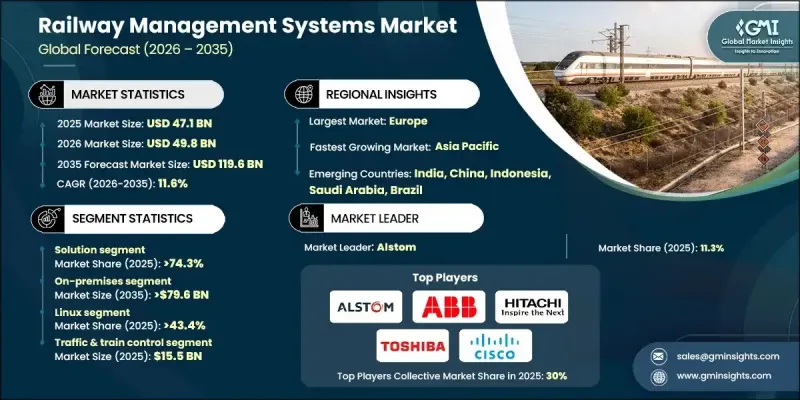
The Global Railway Management Systems Market was valued at USD 47.1 billion in 2025 and is estimated to grow at a CAGR of 11.6% to reach USD 119.6 billion by 2035.
Market growth is driven by rapid urbanization and increasing population density, which are putting pressure on public transportation systems and intensifying the need for efficient and sustainable railway operations. Cities require advanced railway management solutions to handle growing commuter volumes, reduce road congestion, and optimize freight transportation. Operators are investing in automation, real-time monitoring, and data-driven decision-making to enhance operational efficiency and safety. The adoption of digital technologies, IoT devices, and AI-enabled systems is enabling predictive maintenance, automated scheduling, and improved asset management. These innovations not only boost operational efficiency but also contribute to more sustainable railway networks by optimizing energy use and ensuring timely responses to operational disruptions.
| Market Scope | |
|---|---|
| Start Year | 2025 |
| Forecast Year | 2026-2035 |
| Start Value | $47.1 Billion |
| Forecast Value | $119.6 Billion |
| CAGR | 11.6% |
In 2025, the on-premises segment captured 68.2% share and is expected to reach USD 79.6 billion by 2035. On-premises systems remain crucial for national rail networks and legacy systems as they allow operators to retain full control, comply with regulatory requirements, and maintain data sovereignty. This environment provides reliability, operational security, and customization options essential for managing complex railway operations efficiently.
The Linux segment accounted for 43.4% share in 2025, valued at USD 20.5 billion. Linux dominates due to its open-source flexibility, high security, and cost-effectiveness. Its adaptability allows operators to develop customized solutions for traffic management, predictive maintenance, and real-time monitoring. The platform's resilience against cyber threats and stable performance ensure uninterrupted railway operations, a critical requirement for maintaining efficiency across both passenger and freight networks.
U.S. Railway Management Systems Market was valued at USD 9.85 billion in 2025. The growth is supported by extensive freight rail infrastructure, modernization initiatives, and demand for advanced software applications to manage long-haul freight traffic efficiently. The sector emphasizes network optimization, asset monitoring, and traffic management to enhance operational reliability and reduce delays across the nation's rail network.
Major players operating in the Global Railway Management Systems Market include Thales, Alstom, Hitachi Rail, IBM, Huawei Technologies, ABB, Cisco Systems, Siemens Mobility, Toshiba, and Indra Sistemas. Companies in the Railway Management Systems Market are strengthening their positions by investing in research and development to enhance software solutions, integrating AI and IoT for predictive analytics, and expanding automation capabilities. Strategic collaborations with rail operators and technology providers enable broader deployment and faster adoption of advanced systems. Firms are also focusing on cybersecurity solutions to protect critical infrastructure and maintain trust. Geographic expansion into high-growth regions, acquisition of complementary technology companies, and development of modular, scalable systems allow companies to cater to diverse operational requirements.
Table of Contents
Chapter 1 Methodology
- 1.1 Research approach
- 1.2 Quality commitments
- 1.2.1 GMI AI policy & data integrity commitment
- 1.3 Research trail & confidence scoring
- 1.3.1 Research trail components
- 1.3.2 Scoring components
- 1.4 Data collection
- 1.4.1 Partial list of primary sources
- 1.5 Data mining sources
- 1.5.1 Paid sources
- 1.6 Base estimates and calculations
- 1.6.1 Base year calculation
- 1.7 Forecast
- 1.8 Research transparency addendum
Chapter 2 Executive Summary
- 2.1 Industry 360° synopsis, 2022 - 2035
- 2.2 Key market trends
- 2.2.1 Regional
- 2.2.2 Component
- 2.2.3 Deployment Model
- 2.2.4 Operating System
- 2.3 TAM Analysis, 2025-2034
- 2.4 CXO perspectives: Strategic imperatives
- 2.4.1 Executive decision points
- 2.4.2 Critical success factors
- 2.5 Future outlook & strategic recommendations
Chapter 3 Industry Insights
- 3.1 Industry ecosystem analysis
- 3.1.1 Supplier landscape
- 3.1.2 Profit margin analysis
- 3.1.3 Cost structure
- 3.1.4 Value addition at each stage
- 3.1.5 Factor affecting the value chain
- 3.1.6 Disruptions
- 3.2 Industry impact forces
- 3.2.1 Growth drivers
- 3.2.1.1 Rapid urbanization and demographic growth
- 3.2.1.2 Rising digitalization in the railway industry
- 3.2.1.3 Growing trend of smart cities across the globe
- 3.2.1.4 Increasing adoption of AI & cloud-based services
- 3.2.1.5 Surge in government fundings & investments in railway sector
- 3.2.2 Industry pitfalls & challenges
- 3.2.2.1 High initial investments
- 3.2.2.2 Maintenance challenges
- 3.2.3 Market opportunities
- 3.2.3.1 Emerging Market Infrastructure Development
- 3.2.3.2 Public-Private Partnership Models
- 3.2.1 Growth drivers
- 3.3 Growth potential analysis
- 3.4 Regulatory landscape
- 3.4.1 North America
- 3.4.1.1 United States: FRA Positive Train Control (PTC) and Rail Safety Regulations
- 3.4.1.2 Canada: Transport Canada Railway Safety Management System (SMS) Regulations
- 3.4.2 Europe
- 3.4.2.1 United Kingdom: RSSB Standards and ETCS Compliance
- 3.4.2.2 Germany: EN 50126/50128/50129 Functional Safety Standards
- 3.4.2.3 France: ERTMS and ETCS Interoperability Framework
- 3.4.2.4 Italy: ISO 9001 Quality Management Systems for Rail Solutions
- 3.4.3 Asia Pacific
- 3.4.3.1 China: National Railway Administration (NRA) Signaling and Control Standards
- 3.4.3.2 Japan: Functional Safety Standards for Railway Control Systems
- 3.4.3.3 India: RDSO and Indian Railway Safety Standards
- 3.4.4 Latin America
- 3.4.4.1 Brazil: ABNT Railway Signaling and Control Standards
- 3.4.4.2 Mexico: NOM Railway Safety and Operational Standards
- 3.4.4.3 Argentina: ISO 9001 Quality Management Systems for Rail Components
- 3.4.5 Middle East & Africa
- 3.4.5.1 United Arab Emirates: EN and IEC Railway Safety Standards
- 3.4.5.2 South Africa: Functional Safety Standards for Railway Signaling
- 3.4.1 North America
- 3.5 Porter';s analysis
- 3.6 PESTEL analysis
- 3.7 Technology and innovation landscape
- 3.7.1 Current technological trends
- 3.7.2 Emerging technologies
- 3.8 Cost breakdown analysis
- 3.9 Patent analysis
- 3.10 Sustainability and environmental aspects
- 3.10.1 Sustainable practices
- 3.10.2 Waste reduction strategies
- 3.10.3 Energy efficiency in production
- 3.10.4 Eco-friendly Initiatives
- 3.11 Use cases
- 3.12 Total Cost of Ownership (TCO) & ROI by operator type
- 3.13 Pricing, commercial & contracting models
- 3.14 Hardware-Software-Service cost & revenue mix
- 3.15 Deployment economics & implementation risk
Chapter 4 Competitive Landscape, 2025
- 4.1 Introduction
- 4.2 Company market share analysis
- 4.2.1 North America
- 4.2.2 Europe
- 4.2.3 Asia Pacific
- 4.2.4 LATAM
- 4.2.5 MEA
- 4.3 Competitive analysis of major market players
- 4.4 Competitive positioning matrix
- 4.5 Strategic outlook matrix
- 4.6 Key developments
- 4.6.1 Mergers & acquisitions
- 4.6.2 Partnerships & collaborations
- 4.6.3 New Product Launches
- 4.6.4 Expansion Plans and funding
Chapter 5 Market Estimates & Forecast, By Component, 2022 - 2035 ($Bn)
- 5.1 Key trends
- 5.2 Solution
- 5.2.1 Rail operation management system
- 5.2.1.1 Facility management solution
- 5.2.1.2 Revenue management solution
- 5.2.1.3 Ticketing management solution
- 5.2.1.4 Workforce management solution
- 5.2.1.5 Rail automation management solution
- 5.2.2 Rail traffic management system
- 5.2.2.1 Intelligent signaling solution
- 5.2.2.2 Real-time train planning and route scheduling solution
- 5.2.2.3 Centralized traffic control solution
- 5.2.3 Rail asset management system
- 5.2.3.1 Train information solution
- 5.2.3.2 Track monitoring solution
- 5.2.4 Rail control system
- 5.2.4.1 Positive train control solution
- 5.2.4.2 Communication-based train control solution
- 5.2.4.3 Integrated control system
- 5.2.5 Rail maintenance management system
- 5.2.5.1 Vehicle maintenance scheduling solution
- 5.2.5.2 Predictive analytics for maintenance management solution
- 5.2.6 Passenger information system (PIS)
- 5.2.7 Rail security
- 5.2.8 Others
- 5.2.1 Rail operation management system
- 5.3 Service
- 5.3.1 Training & consulting
- 5.3.2 System integration & deployment
- 5.3.3 Support & maintenance
Chapter 6 Market Estimates & Forecast, By Deployment Model, 2022 - 2035 ($Bn)
- 6.1 Key trends
- 6.2 On-premises
- 6.3 Cloud
Chapter 7 Market Estimates & Forecast, By Operating System, 2022 - 2035 ($Bn)
- 7.1 Key trends
- 7.2 QNX
- 7.3 Linux
- 7.4 VxWorks
- 7.5 Others
Chapter 8 Market Estimates & Forecast, By Region, 2022 - 2035 ($Bn)
- 8.1 Key trends
- 8.2 North America
- 8.2.1 US
- 8.2.2 Canada
- 8.3 Europe
- 8.3.1 Germany
- 8.3.2 UK
- 8.3.3 France
- 8.3.4 Italy
- 8.3.5 Spain
- 8.3.6 Russia
- 8.3.7 Nordics
- 8.3.8 Portugal
- 8.3.9 Croatia
- 8.3.10 Benelux
- 8.4 Asia Pacific
- 8.4.1 China
- 8.4.2 India
- 8.4.3 Japan
- 8.4.4 Australia
- 8.4.5 South Korea
- 8.4.6 Singapore
- 8.4.7 Thailand
- 8.4.8 Indonesia
- 8.4.9 Vietnam
- 8.5 Latin America
- 8.5.1 Brazil
- 8.5.2 Mexico
- 8.5.3 Argentina
- 8.5.4 Colombia
- 8.6 MEA
- 8.6.1 South Africa
- 8.6.2 Saudi Arabia
- 8.6.3 UAE
- 8.6.4 Turkey
Chapter 9 Company Profiles
- 9.1 Global Players
- 9.1.1 ABB
- 9.1.2 Alstom
- 9.1.3 Amadeus IT
- 9.1.4 Atos
- 9.1.5 Cisco Systems
- 9.1.6 Fujitsu
- 9.1.7 General Electric (GE Transportation)
- 9.1.8 Hexagon
- 9.1.9 Hitachi Rail
- 9.1.10 Huawei Technologies
- 9.1.11 IBM
- 9.1.12 Thales
- 9.2 Regional Players
- 9.2.1 Indra Sistemas
- 9.2.2 Mitsubishi Electric
- 9.2.3 Siemens Mobility
- 9.2.4 Trimble
- 9.2.5 CAF
- 9.2.6 Stadler Rail
- 9.2.7 Kyosan Electric
- 9.3 Emerging / Disruptor Players
- 9.3.1 GAO RFID
- 9.3.2 Wabtec
- 9.3.3 Toshiba
- 9.3.4 Passio Technologies
- 9.3.5 Rayhawk

