PUBLISHER: Global Market Insights Inc. | PRODUCT CODE: 1936537

PUBLISHER: Global Market Insights Inc. | PRODUCT CODE: 1936537
Seaweed Flavor Market Opportunity, Growth Drivers, Industry Trend Analysis, and Forecast 2026 - 2035
The Global Seaweed Flavor Market was valued at USD 280.5 million in 2025 and is estimated to grow at a CAGR of 8.3% to reach USD 650.3 million by 2035.
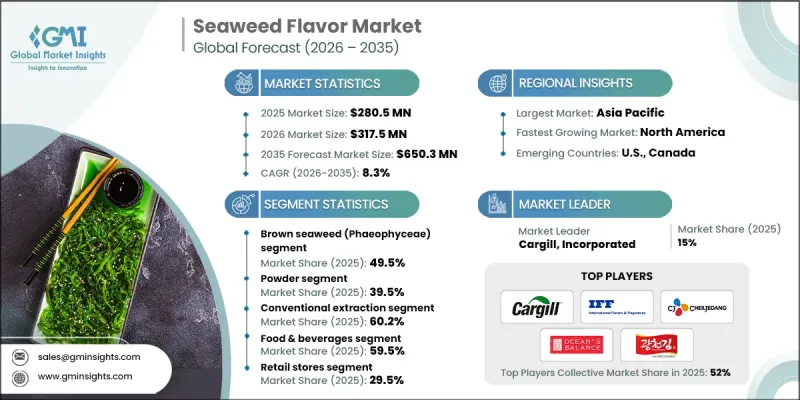
The market's growth is driven by the rising focus on health and wellness, as seaweed is naturally nutrient-rich while remaining low in calories, appealing strongly to health-conscious consumers. Clean-label trends favor minimally processed, natural flavoring agents, positioning seaweed as a preferred alternative to synthetic flavors. Plant-based diets are gaining traction, and seaweed flavor is increasingly used in innovative food applications, enhancing the savory profile of soups, sauces, snacks, and ready-to-eat meals while contributing functional benefits like iodine and antioxidants. Environmentally sustainable and naturally complex in flavor, seaweed is being adopted in seasonings, condiments, and alternative protein products. Asia-Pacific leads the market due to cultural familiarity and culinary use, Europe is experiencing uptake for its natural and sustainable appeal, and North America benefits from fusion cuisine trends and the plant-based food movement.
| Market Scope | |
|---|---|
| Start Year | 2025 |
| Forecast Year | 2026-2035 |
| Start Value | $280.5 Million |
| Forecast Value | $650.3 Million |
| CAGR | 8.3% |
The brown seaweed (Phaeophyceae) segment held a 49.5% share and is projected to grow at a CAGR of 8% by 2035. Brown seaweed is favored for its rich umami taste and mineral content, making it highly suitable for savory applications like soups, sauces, and seasonings. Its flavor depth and consistent performance have established it as the go-to choice for many food manufacturers seeking natural savory enhancement.
The powdered seaweed flavor segment held a share of 39.5% in 2025 and is expected to grow at a CAGR of 7.9% through 2035. Powdered seaweed is highly versatile, offering stability and ease of blending into dry mixes, snacks, and seasonings where uniform flavor and extended shelf life are critical. Liquid extracts are preferred in beverages and sauces for quick solubility and concentrated flavor delivery, while solid extracts are ideal for premium functional foods, providing dense nutrition and strong taste.
North America Seaweed Flavor Market accounted for a 20.4% share in 2025, and its growth is accelerating. Consumer adoption of plant-based and clean-label products, combined with advancements in food technology, is driving demand. The region's advanced manufacturing capabilities and regulatory emphasis on sustainable solutions are encouraging the production of eco-friendly and innovative flavor offerings, positioning North America as a significant market for seaweed flavor products.
Key players in the Global Seaweed Flavor Market include CJ CheilJedang / bibigo, Ocean Organics, Cargill, Incorporated, Green Fresh (Fujian) Foodstuff Co., Ltd., Mara Seaweed, KwangcheonKim Co., Ltd., Ocean's Balance, Seaweed & Co., Nagai Nori Co., Ltd., Seagarden AS, This is Seaweed Ltd., The Seaweed Company, Marusan, Wild Irish Seaweeds, and Hispanagar. Companies in the seaweed flavor market strengthen their position through product innovation, introducing new forms like powders, liquids, and solid extracts to cater to diverse applications. They focus on sustainability by sourcing eco-friendly seaweed and promoting traceability to appeal to conscious consumers. Strategic collaborations with food and beverage manufacturers enable tailored flavor solutions, while R&D investments enhance umami and functional profiles. Geographic expansion, marketing campaigns emphasizing natural and clean-label benefits, and partnerships with culinary professionals help increase visibility and adoption.
Table of Contents
Chapter 1 Methodology & Scope
- 1.1 Market scope and definition
- 1.2 Research design
- 1.2.1 Research approach
- 1.2.2 Data collection methods
- 1.3 Data mining sources
- 1.3.1 Global
- 1.3.2 Regional/Country
- 1.4 Base estimates and calculations
- 1.4.1 Base year calculation
- 1.4.2 Key trends for market estimation
- 1.5 Primary research and validation
- 1.5.1 Primary sources
- 1.6 Forecast model
- 1.7 Research assumptions and limitations
Chapter 2 Executive Summary
- 2.1 Industry 360° synopsis
- 2.2 Key market trends
- 2.2.1 Regional
- 2.2.2 Type
- 2.2.3 Form
- 2.2.4 Processing technology
- 2.2.5 Application
- 2.2.6 Distribution channel
- 2.3 TAM Analysis, 2026-2035
- 2.4 CXO perspectives: Strategic imperatives
- 2.4.1 Executive decision points
- 2.4.2 Critical success factors
- 2.5 Future Outlook and Strategic Recommendations
Chapter 3 Industry Insights
- 3.1 Industry ecosystem analysis
- 3.1.1 Supplier landscape
- 3.1.2 Profit margin
- 3.1.3 Value addition at each stage
- 3.1.4 Factor affecting the value chain
- 3.1.5 Disruptions
- 3.2 Industry impact forces
- 3.2.1 Growth drivers
- 3.2.1.1 Plant-based food revolution
- 3.2.1.2 Salt reduction mandates & health consciousness
- 3.2.1.3 Sustainability & regenerative agriculture narrative
- 3.2.2 Industry pitfalls and challenges
- 3.2.2.1 Heavy metal & iodine contamination concerns
- 3.2.2.2 Fragmented organic certification standards
- 3.2.3 Market opportunities
- 3.2.3.1 Biorefinery commercialization
- 3.2.3.2 North American & European production expansion
- 3.2.1 Growth drivers
- 3.3 Growth potential analysis
- 3.4 Regulatory landscape
- 3.4.1 North America
- 3.4.2 Europe
- 3.4.3 Asia Pacific
- 3.4.4 Latin America
- 3.4.5 Middle East & Africa
- 3.5 Porter's analysis
- 3.6 PESTEL analysis
- 3.7 Price trends
- 3.7.1 By region
- 3.7.2 By type
- 3.8 Future market trends
- 3.9 Technology and Innovation landscape
- 3.9.1 Current technological trends
- 3.9.2 Emerging technologies
- 3.10 Patent Landscape
- 3.11 Trade statistics (HS code)
- 3.11.1 Major importing countries
- 3.11.2 Major exporting countries
- 3.12 Sustainability and environmental aspects
- 3.12.1 Sustainable practices
- 3.12.2 Waste reduction strategies
- 3.12.3 Energy efficiency in production
- 3.12.4 Eco-friendly initiatives
- 3.13 Carbon footprint consideration
Chapter 4 Competitive Landscape, 2025
- 4.1 Introduction
- 4.2 Company market share analysis
- 4.2.1 By region
- 4.2.1.1 North America
- 4.2.1.2 Europe
- 4.2.1.3 Asia Pacific
- 4.2.1.4 LATAM
- 4.2.1.5 MEA
- 4.2.1 By region
- 4.3 Company matrix analysis
- 4.4 Competitive analysis of major market players
- 4.5 Competitive positioning matrix
- 4.6 Key developments
- 4.6.1 Mergers & acquisitions
- 4.6.2 Partnerships & collaborations
- 4.6.3 New Product Launches
- 4.6.4 Expansion Plans
Chapter 5 Market Estimates and Forecast, By Type, 2022-2035 (USD Million) (Kilo Tons)
- 5.1 Key trends
- 5.2 Brown seaweeds (Phaeophyceae)
- 5.2.1 Kombu (laminaria spp., saccharina spp.)
- 5.2.2 Wakame (Undaria pinnatifida)
- 5.2.3 Ascophyllum nodosum
- 5.2.4 Other brown seaweeds (macrocystis, fucus)
- 5.3 Red seaweeds (Rhodophyceae)
- 5.3.1 Nori (Porphyra/Pyropia spp.)
- 5.3.2 Dulse (Palmaria palmata)
- 5.3.3 Carrageenan-producing seaweeds (Eucheuma, Kappaphycus, Gracilaria)
- 5.3.4 Other red seaweeds
- 5.4 Green seaweeds (Chlorophyceae)
- 5.4.1 Sea lettuce (Ulva spp.)
- 5.4.2 Other green seaweeds
Chapter 6 Market Estimates and Forecast, By Form, 2022-2035 (USD Million) (Kilo Tons)
- 6.1 Key trends
- 6.2 Powder
- 6.3 Liquid extract
- 6.4 Solid extract
- 6.5 Flakes
- 6.6 Sheets & wraps
- 6.7 Whole-leaf
Chapter 7 Market Estimates and Forecast, By Processing Technology, 2022-2035 (USD Million) (Kilo Tons)
- 7.1 Key trends
- 7.2 Conventional extraction
- 7.2.1 Alkaline extraction
- 7.2.2 Water-based extraction
- 7.3 Advanced extraction technologies
- 7.3.1 Enzyme-assisted extraction (EAE)
- 7.3.2 Supercritical fluid extraction (SFE)
- 7.3.3 Microwave-assisted & ultrasound extraction
- 7.3.4 Pulsed electric fields (PEF)
- 7.4 Biorefinery & cascade processing
Chapter 8 Market Estimates and Forecast, By Application, 2022-2035 (USD Million) (Kilo Tons)
- 8.1 Key trends
- 8.2 Food & beverages
- 8.2.1 Plant-based meat alternatives
- 8.2.2 Functional beverages
- 8.2.3 Snacks
- 8.2.4 Seasonings & condiments
- 8.2.5 Soups, broths & dashi
- 8.2.6 Bakery & confectionery
- 8.2.7 Dairy & dairy alternatives
- 8.3 Culinary ingredients (food service)
- 8.4 Nutraceuticals & dietary supplements
- 8.5 Animal feed & pet food
- 8.6 Cosmetics & personal care
Chapter 9 Market Estimates and Forecast, By Distribution Channel, 2022-2035 (USD Million) (Kilo Tons)
- 9.1 Key trends
- 9.2 Retail stores
- 9.3 Online retail
- 9.4 Food service & hospitality
- 9.5 Wholesale distributors
Chapter 10 Market Estimates and Forecast, By Region, 2022-2035 (USD Million) (Kilo Tons)
- 10.1 Key trends
- 10.2 North America
- 10.2.1 U.S.
- 10.2.2 Canada
- 10.3 Europe
- 10.3.1 Germany
- 10.3.2 UK
- 10.3.3 France
- 10.3.4 Spain
- 10.3.5 Italy
- 10.3.6 Rest of Europe
- 10.4 Asia Pacific
- 10.4.1 China
- 10.4.2 India
- 10.4.3 Japan
- 10.4.4 Australia
- 10.4.5 South Korea
- 10.4.6 Rest of Asia Pacific
- 10.5 Latin America
- 10.5.1 Brazil
- 10.5.2 Mexico
- 10.5.3 Argentina
- 10.5.4 Rest of Latin America
- 10.6 Middle East and Africa
- 10.6.1 Saudi Arabia
- 10.6.2 South Africa
- 10.6.3 UAE
- 10.6.4 Rest of Middle East and Africa
Chapter 11 Company Profiles
- 11.1 Cargill, Incorporated
- 11.2 IFF (International Flavors & Fragrances Inc.)
- 11.3 CJ CheilJedang / bibigo
- 11.4 Ocean's Balance (Formerly Maine Coast Sea Vegetables)
- 11.5 KwangcheonKim Co., Ltd.
- 11.6 Nagai Nori Co., Ltd.
- 11.7 Seaweed & Co.
- 11.8 Mara Seaweed
- 11.9 This is Seaweed Ltd.
- 11.10 Wild Irish Seaweeds
- 11.11 Hispanagar
- 11.12 Seagarden AS
- 11.13 The Seaweed Company
- 11.14 Green Fresh (Fujian) Foodstuff Co., Ltd.
- 11.15 Marusan
- 11.16 Ocean Organics

