PUBLISHER: Global Market Insights Inc. | PRODUCT CODE: 1936543

PUBLISHER: Global Market Insights Inc. | PRODUCT CODE: 1936543
Brown Commercial Seaweed Market Opportunity, Growth Drivers, Industry Trend Analysis, and Forecast 2026 - 2035
The Global Brown Commercial Seaweed Market was valued at USD 20.1 billion in 2025 and is estimated to grow at a CAGR of 8% to reach USD 44.1 billion by 2035.
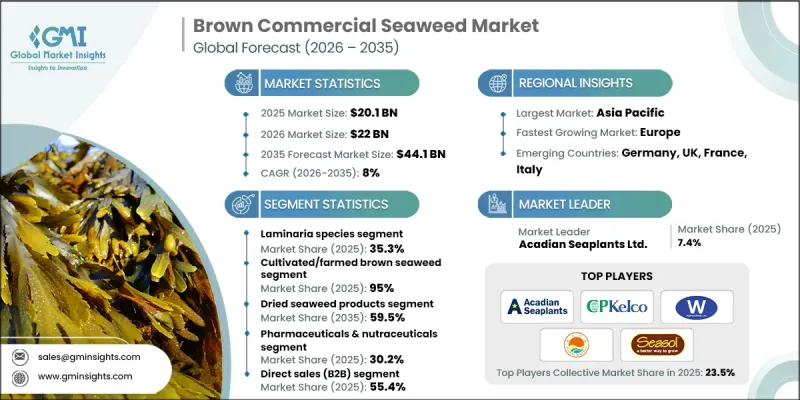
The market is expanding due to rising demand from pharmaceuticals, food, agriculture, and other industries. Brown seaweed species such as Laminaria, Ascophyllum, and Fucus are particularly valued for their rich nutrients and bioactive compounds, which are widely used across multiple sectors. Consumers are increasingly preferring natural, plant-based, and sustainable ingredients, which is fueling the adoption of brown seaweed products. In agriculture, brown seaweeds function as biofertilizers and soil conditioners, enhancing crop yields, promoting plant growth, and increasing resistance to environmental stresses through naturally occurring hormones like cytokinins and auxins. In food applications, their high dietary fiber, mineral content, and antioxidants make brown seaweed an attractive addition to health foods, functional beverages, and snacks. Bioactive compounds extracted from brown seaweed are also widely used in pharmaceuticals and cosmetics due to their antioxidant, anti-inflammatory, and anti-aging properties. The multifunctional, renewable, and eco-friendly nature of brown seaweed, combined with trends toward plant-based and natural products, continues to drive robust market growth worldwide.
| Market Scope | |
|---|---|
| Start Year | 2025 |
| Forecast Year | 2026-2035 |
| Start Value | $20.1 Billion |
| Forecast Value | $44.1 Billion |
| CAGR | 8% |
The laminaria species segment held 35.3% share in 2025 and is anticipated to grow at a CAGR of 8.3% through 2035. Laminaria and Saccharina species remain the most sought-after varieties due to their high alginate content, which drives strong demand from the food, pharmaceutical, and industrial sectors. As consumers increasingly prioritize health and wellness, products derived from Laminaria and Saccharina, such as dietary supplements and functional foods, are becoming more popular globally.
The cultivated or farmed brown seaweed segment held 95% in 2025 and is projected to grow at a CAGR of 8.1% during 2026-2035. Growth is fueled by advancements in aquaculture technology, the rising demand for consistent product quality, and lower environmental impact compared to wild-harvested seaweed. Cultivated seaweed provides higher yields, superior quality, and aligns with sustainability trends, while emerging farm-gate and direct-to-consumer models further support adoption in key markets.
North America Brown Commercial Seaweed Market accounted for 13.3% share in 2025. The region is driven by rising consumer awareness of health benefits and increasing preference for plant-based and sustainable products. Established food, nutraceutical, and cosmetic industries are actively incorporating seaweed ingredients, prompting manufacturers to focus on innovative product launches. Additionally, North America's emphasis on clean-label and sustainable products is encouraging further inclusion of seaweed across multiple applications.
Key players operating in the Global Brown Commercial Seaweed Market include Pacific Harvest, CP Kelco, Acadian Seaplants Ltd., W Hydrocolloids, Inc., Algea, Mara Seaweed, Marcel Carrageenan, Seasol International, Qingdao Seawin Biotech Group Co., Ltd., and Indigrow Ltd. Companies in the brown commercial seaweed market are employing multiple strategies to strengthen their market position and expand their global footprint. They are investing heavily in R&D to develop high-value bioactive extracts and new formulations for food, pharmaceutical, and cosmetic applications. Strategic partnerships with aquaculture farms, research institutions, and distributors are formed to ensure a consistent supply and expand geographic reach. Companies are also focusing on sustainability initiatives, such as eco-friendly harvesting and cultivation practices, to meet consumer demand for natural and plant-based products.
Table of Contents
Chapter 1 Methodology & Scope
- 1.1 Market scope and definition
- 1.2 Research design
- 1.2.1 Research approach
- 1.2.2 Data collection methods
- 1.3 Data mining sources
- 1.3.1 Global
- 1.3.2 Regional/Country
- 1.4 Base estimates and calculations
- 1.4.1 Base year calculation
- 1.4.2 Key trends for market estimation
- 1.5 Primary research and validation
- 1.5.1 Primary sources
- 1.6 Forecast model
- 1.7 Research assumptions and limitations
Chapter 2 Executive Summary
- 2.1 Industry 3600 synopsis
- 2.2 Key market trends
- 2.2.1 Regional
- 2.2.2 Species type
- 2.2.3 Cultivation type
- 2.2.4 Form
- 2.2.5 Application
- 2.2.6 Distribution channel
- 2.3 TAM Analysis, 2026-2035
- 2.4 CXO perspectives: Strategic imperatives
- 2.4.1 Executive decision points
- 2.4.2 Critical success factors
- 2.5 Future Outlook and Strategic Recommendations
Chapter 3 Industry Insights
- 3.1 Industry ecosystem analysis
- 3.1.1 Supplier landscape
- 3.1.2 Profit margin
- 3.1.3 Value addition at each stage
- 3.1.4 Factor affecting the value chain
- 3.1.5 Disruptions
- 3.2 Industry impact forces
- 3.2.1 Growth drivers
- 3.2.2 Industry pitfalls and challenges
- 3.2.3 Market opportunities
- 3.3 Growth potential analysis
- 3.4 Regulatory landscape
- 3.4.1 North America
- 3.4.2 Europe
- 3.4.3 Asia Pacific
- 3.4.4 Latin America
- 3.4.5 Middle East & Africa
- 3.5 Porter's analysis
- 3.6 PESTEL analysis
- 3.7 Price trends
- 3.7.1 By region
- 3.7.2 By type
- 3.8 Future market trends
- 3.9 Technology and Innovation landscape
- 3.9.1 Current technological trends
- 3.9.2 Emerging technologies
- 3.10 Patent Landscape
- 3.11 Trade statistics (HS code) (Note: the trade statistics will be provided for key countries only)
- 3.11.1 Major importing countries
- 3.11.2 Major exporting countries
- 3.12 Sustainability and environmental aspects
- 3.12.1 Sustainable practices
- 3.12.2 Waste reduction strategies
- 3.12.3 Energy efficiency in production
- 3.12.4 Eco-friendly initiatives
- 3.13 Carbon footprint consideration
Chapter 4 Competitive Landscape, 2025
- 4.1 Introduction
- 4.2 Company market share analysis
- 4.2.1 By region
- 4.2.1.1 North America
- 4.2.1.2 Europe
- 4.2.1.3 Asia Pacific
- 4.2.1.4 LATAM
- 4.2.1.5 MEA
- 4.2.1 By region
- 4.3 Company matrix analysis
- 4.4 Competitive analysis of major market players
- 4.5 Competitive positioning matrix
- 4.6 Key developments
- 4.6.1 Mergers & acquisitions
- 4.6.2 Partnerships & collaborations
- 4.6.3 New Product Launches
- 4.6.4 Expansion Plans
Chapter 5 Market Estimates and Forecast, By Species Type, 2022-2035 (USD Billion) (Kilo Tons)
- 5.1 Key trends
- 5.2 Laminaria Species
- 5.3 Saccharina Species
- 5.4 Undaria pinnatifida
- 5.5 Ascophyllum nodosum
- 5.6 Fucus Species
- 5.7 Sargassum Species
- 5.8 Other Species
Chapter 6 Market Estimates and Forecast, By Cultivation Type, 2022-2035 (USD Billion) (Kilo Tons)
- 6.1 Key trends
- 6.2 Wild-harvested brown seaweed
- 6.3 Cultivated/farmed brown seaweed
Chapter 7 Market Estimates and Forecast, By Form, 2022-2035 (USD Billion) (Kilo Tons)
- 7.1 Key trends
- 7.2 Dried seaweed products
- 7.3 Fresh seaweed
- 7.4 Liquid extracts
- 7.5 Purified/refined extracts & derivatives
Chapter 8 Market Estimates and Forecast, By Application, 2022-2035 (USD Billion) (Kilo Tons)
- 8.1 Key trends
- 8.2 Pharmaceuticals & nutraceuticals
- 8.3 Animal feed & aquaculture
- 8.3.1 Poultry feed
- 8.3.2 Swine feed
- 8.3.3 Aquaculture feed
- 8.3.4 Pet food
- 8.3.5 Ruminant feed
- 8.4 Industrial applications
- 8.4.1 Biofuels
- 8.4.2 Bioplastics & biodegradable packaging
- 8.4.3 Biochemicals
- 8.4.4 Biorefineries
- 8.4.5 Water treatment & industrial processes
- 8.5 Agriculture
- 8.5.1 Organic fertilizers
- 8.5.2 Biostimulants
- 8.5.3 Soil amendments & conditioners
- 8.5.4 Seed treatments
- 8.5.5 Biopesticides
- 8.6 Food & beverages
- 8.6.1 Direct food consumption
- 8.6.2 Food ingredients
- 8.6.3 Food additives
- 8.7 Cosmetics & personal care
- 8.7.1 Skincare
- 8.7.2 Haircare
- 8.7.3 Active ingredients
Chapter 9 Market Estimates and Forecast, By Distribution Channel, 2022-2035 (USD Billion) (Kilo Tons)
- 9.1 Key trends
- 9.2 Direct sales (B2B)
- 9.3 Distributors & wholesalers
- 9.4 Online B2B platforms
- 9.5 Retail & direct-to-consumer
Chapter 10 Market Estimates and Forecast, By Region, 2022-2035 (USD Billion) (Kilo Tons)
- 10.1 Key trends
- 10.2 North America
- 10.2.1 U.S.
- 10.2.2 Canada
- 10.3 Europe
- 10.3.1 Germany
- 10.3.2 UK
- 10.3.3 France
- 10.3.4 Spain
- 10.3.5 Italy
- 10.3.6 Rest of Europe
- 10.4 Asia Pacific
- 10.4.1 China
- 10.4.2 India
- 10.4.3 Japan
- 10.4.4 Australia
- 10.4.5 South Korea
- 10.4.6 Rest of Asia Pacific
- 10.5 Latin America
- 10.5.1 Brazil
- 10.5.2 Mexico
- 10.5.3 Argentina
- 10.5.4 Rest of Latin America
- 10.6 Middle East and Africa
- 10.6.1 Saudi Arabia
- 10.6.2 South Africa
- 10.6.3 UAE
- 10.6.4 Rest of Middle East and Africa
Chapter 11 Company Profiles
- 11.1 Marcel Carrageenan
- 11.2 W Hydrocolloids, Inc.
- 11.3 Seasol International
- 11.4 Algea
- 11.5 Acadian Seaplants Ltd.
- 11.6 CP Kelco
- 11.7 Qingdao Seawin Biotech Group Co., Ltd.
- 11.8 Mara Seaweed
- 11.9 Pacific Harvest
- 11.10 Indigrow Ltd.

