PUBLISHER: Global Market Insights Inc. | PRODUCT CODE: 1936542

PUBLISHER: Global Market Insights Inc. | PRODUCT CODE: 1936542
Wet Wipes Market Opportunity, Growth Drivers, Industry Trend Analysis, and Forecast 2026 - 2035
The Global Wet Wipes Market was valued at USD 5.1 billion in 2025 and is estimated to grow at a CAGR of 5.8% to reach USD 8.9 billion by 2035.
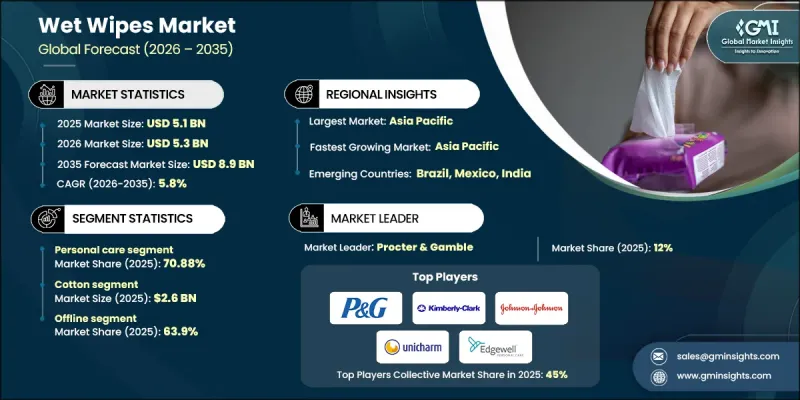
The market is undergoing a notable transformation as manufacturers respond to rising environmental awareness, tighter regulations, and changing consumer expectations. Brands are increasingly shifting toward plastic-free materials, skin-friendly formulations, and sustainability-focused product designs. Traditional synthetic nonwovens and harsh preservatives are gradually being replaced by plant-based and biodegradable fibers, along with gentler lotions that prioritize skin compatibility and safety testing. Demand has remained resilient due to heightened hygiene awareness, convenient product formats, and growing adoption of subscription-based and online purchasing models. At the same time, regulatory pressure in several regions is pushing companies to rethink material choices, labeling practices, and waste responsibility. Growing consumer understanding of proper disposal methods and sustainable consumption is accelerating the adoption of compostable materials and environmentally responsible packaging. Continuous advancements in nonwoven manufacturing are elevating wet wipes from simple disposable products to engineered solutions that balance softness, durability, absorbency, and biodegradability.
| Market Scope | |
|---|---|
| Start Year | 2025 |
| Forecast Year | 2026-2035 |
| Start Value | $5.1 Billion |
| Forecast Value | $8.9 Billion |
| CAGR | 5.8% |
The personal care applications segment accounted for 70.88% share in 2025. This segment leads because wipes are deeply integrated into everyday hygiene routines. Consumers increasingly rely on these products for quick, efficient cleansing, driving consistent demand across multiple age groups and lifestyles. The emphasis on convenience, portability, and gentle formulations continues to reinforce the dominance of personal care wipes worldwide.
In 2025, the cotton-based wipes segment held a 51% share and generated USD 2.6 billion. Cotton remains a preferred material for consumers seeking natural, soft, and biodegradable options, particularly in products designed for sensitive skin. Its premium perception and comfort characteristics support widespread use in applications where mildness and material quality are critical, while woven alternatives remain limited to specialized use cases.
United States Wet Wipes Market accounted for 85% share in 2025, making it the leading regional market. Strong demand is supported by high daily usage across household, personal hygiene, and infant care categories. Consumers are increasingly drawn to formulations positioned around skin balance and wellness, encouraging brands to diversify offerings beyond standard hygiene products and address more specialized personal care needs across the U.S. and Canada.
Key companies operating in the Global Wet Wipes Market include Procter & Gamble, Kimberly-Clark Corporation, Unilever, Johnson & Johnson, Unicharm Corporation, The Honest Company, Natracare, Organyc, Cora, Playtex, Lola, Veeda, L. Organic, Cottons, and Lil-Lets. Companies in the wet wipes market strengthen their market position through sustainability-driven innovation, portfolio diversification, and strong consumer engagement. Many players invest in biodegradable substrates, cleaner formulations, and eco-conscious packaging to align with regulatory expectations and consumer values. Product differentiation through targeted use cases helps brands expand beyond traditional hygiene categories. Firms also enhance their digital presence through direct-to-consumer platforms and subscription models to build loyalty. Strategic pricing, premium positioning, and transparent labeling improve brand trust. Ongoing investment in material science and manufacturing efficiency enables companies to balance performance, cost, and environmental responsibility while maintaining a competitive foothold.
Table of Contents
Chapter 1 Methodology and Scope
- 1.1 Market scope and definition
- 1.2 Research design
- 1.2.1 Research approach
- 1.2.2 Data collection methods
- 1.3 Data mining sources
- 1.3.1 Global
- 1.3.2 Regional/Country
- 1.4 Base estimates and calculations
- 1.4.1 Base year calculation
- 1.4.2 Key trends for market estimation
- 1.5 Primary research and validation
- 1.5.1 Primary sources
- 1.6 Forecast model
- 1.7 Research assumptions and limitations
Chapter 2 Executive Summary
- 2.1 Industry 360° synopsis
- 2.2 Key market trends
- 2.2.1 Regional
- 2.2.2 Product Type
- 2.2.3 Material
- 2.2.4 Price Range
- 2.2.5 Packaging Size
- 2.2.6 End User,
- 2.2.7 Distribution Channel
- 2.3 CXO perspectives: Strategic imperatives
- 2.3.1 Key decision points for industry executives
- 2.3.2 Critical success factors for market players
- 2.4 Future outlook and strategic recommendations
Chapter 3 Industry Insights
- 3.1 Industry ecosystem analysis
- 3.1.1 Supplier landscape
- 3.1.2 Profit margin
- 3.1.3 Value addition at each stage
- 3.1.4 Factor affecting the value chain
- 3.2 Industry impact forces
- 3.2.1 Growth drivers
- 3.2.1.1 Shift to Plastic-Free, Biodegradable
- 3.2.1.2 Acceleration of consumer demand
- 3.2.2 Industry pitfalls & challenges
- 3.2.2.1 Environmental burden & sewer blockages
- 3.2.2.2 Regulatory Hurdles
- 3.2.3 Opportunities
- 3.2.3.1 Plastic Free & Biodegradable Nonwovens
- 3.2.3.2 Travel-friendly & "On-the-go"
- 3.2.1 Growth drivers
- 3.3 Growth potential analysis
- 3.4 Future market trends
- 3.5 Technology and innovation landscape
- 3.5.1 Current technological trends
- 3.5.2 Emerging technologies
- 3.6 Price trends
- 3.6.1 By region
- 3.6.2 By type
- 3.7 Regulatory landscape
- 3.7.1 Standards and compliance requirements
- 3.7.2 Regional regulatory frameworks
- 3.7.3 Certification standards
- 3.8 Porter's analysis
- 3.9 PESTEL analysis
Chapter 4 Competitive Landscape, 2025
- 4.1 Introduction
- 4.2 Company market share analysis
- 4.2.1 By region
- 4.2.1.1 North America
- 4.2.1.2 Europe
- 4.2.1.3 Asia Pacific
- 4.2.1.4 Latin America
- 4.2.1.5 Middle East and Africa
- 4.2.1 By region
- 4.3 Company matrix analysis
- 4.4 Competitive analysis of major market players
- 4.5 Competitive positioning matrix
- 4.6 Key developments
- 4.6.1 Mergers & acquisitions
- 4.6.2 Partnerships & collaborations
- 4.6.3 New product launches
- 4.6.4 Expansion plans
Chapter 5 Market Estimates & Forecast, By Product Type, 2022 - 2035, (USD Billion)
- 5.1 Key trends
- 5.2 Personal care wet wipes
- 5.2.1 Face wipes
- 5.2.2 Body wipes
- 5.2.3 Intimate wipes
- 5.2.4 Baby wipes
- 5.2.5 Others
- 5.3 Household wet wipes
Chapter 6 Market Estimates & Forecast, By Material, 2022 - 2035, (USD Billion)
- 6.1 Key trends
- 6.2 Cotton
- 6.3 Non-woven fabrics
- 6.4 Woven fabrics
Chapter 7 Market Estimates & Forecast, By Price Range, 2022 - 2035, (USD Billion)
- 7.1 Key trends
- 7.2 Low
- 7.3 Medium
- 7.4 High
Chapter 8 Market Estimates & Forecast, By Packaging Size, 2022 - 2035, (USD Billion)
- 8.1 Key trends
- 8.2 Upto 50 wipes
- 8.3 50-100 wipes
- 8.4 More than 100 wipes
Chapter 9 Market Estimates & Forecast, By End User, 2022 - 2035, (USD Billion)
- 9.1 Key trends
- 9.2 Individual
- 9.3 Commercial
Chapter 10 Market Estimates & Forecast, By Distribution Channel, 2022 - 2035, (USD Billion)
- 10.1 Key trends
- 10.2 Online channels
- 10.2.1 E-commerce
- 10.2.2 Company websites
- 10.3 Offline channels
- 10.3.1 Mega Retail Store
- 10.3.2 Specialty stores
- 10.3.3 Others
Chapter 11 Market Estimates and Forecast, By Region, 2022 - 2035 (USD Billion)
- 11.1 Key trends
- 11.2 North America
- 11.2.1 U.S.
- 11.2.2 Canada
- 11.3 Europe
- 11.3.1 Germany
- 11.3.2 UK
- 11.3.3 France
- 11.3.4 Italy
- 11.3.5 Spain
- 11.4 Asia Pacific
- 11.4.1 China
- 11.4.2 Japan
- 11.4.3 India
- 11.4.4 Australia
- 11.4.5 South Korea
- 11.5 Latin America
- 11.5.1 Brazil
- 11.5.2 Mexico
- 11.5.3 Argentina
- 11.6 Middle East and Africa
- 11.6.1 South Africa
- 11.6.2 Saudi Arabia
- 11.6.3 UAE
Chapter 12 Company Profiles
- 12.1 Cora
- 12.2 Cottons
- 12.3 Johnson & Johnson
- 12.4 Kimberly-Clark Corporation
- 12.5 L. Organic
- 12.6 Lil-Lets
- 12.7 Lola
- 12.8 Natracare
- 12.9 Organyc
- 12.10 Playtex
- 12.11 Procter & Gamble
- 12.12 Unilever
- 12.13 The Honest Company
- 12.14 Unicharm Corporation
- 12.15 Veeda

