PUBLISHER: Global Market Insights Inc. | PRODUCT CODE: 1936650

PUBLISHER: Global Market Insights Inc. | PRODUCT CODE: 1936650
Virtual Power Plant Market Opportunity, Growth Drivers, Industry Trend Analysis, and Forecast 2026 - 2035
The Global Virtual Power Plant Market was valued at USD 5.5 billion in 2025 and is estimated to grow at a CAGR of 21.9% to reach USD 39.5 billion by 2035.
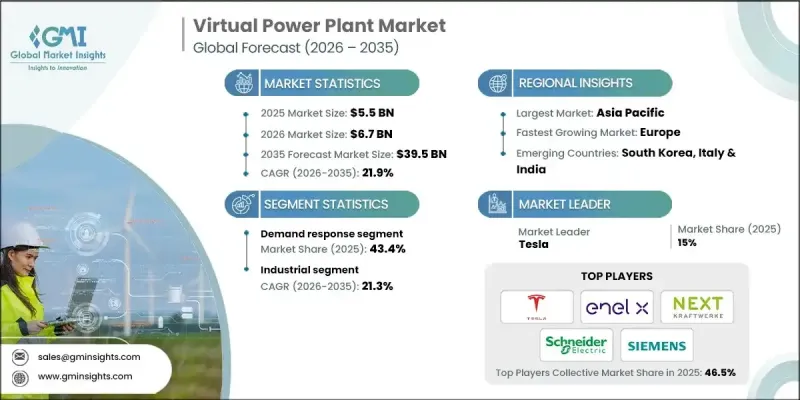
Virtual power plants (VPPs) are driving the evolution of modern energy systems by combining decentralized energy resources such as solar panels, wind turbines, batteries, and demand-response mechanisms into a single, intelligently managed network. By aggregating generation, storage, and consumption, VPPs optimize energy dispatch, improve grid reliability, and enable higher penetration of renewable energy while reducing carbon emissions. The rapid adoption of advanced energy storage systems, particularly lithium-ion batteries, allows operators to store excess power during low-demand periods and release it when needed, supporting grid stability and efficiency. Integration of machine learning, advanced communication technologies, and real-time analytics further enhances operational performance, predictive maintenance, and cost optimization. VPPs are increasingly essential as utilities and consumers seek flexible, resilient, and sustainable energy solutions.
| Market Scope | |
|---|---|
| Start Year | 2025 |
| Forecast Year | 2026-2035 |
| Start Value | $5.5 Billion |
| Forecast Value | $39.5 Billion |
| CAGR | 21.9% |
The mixed assets segment is projected to grow at a CAGR of 22.1% through 2035, driven by the integration of varied distributed energy resources such as solar panels, wind turbines, battery storage systems, and controllable loads. By aggregating these diverse resources, virtual power plants can balance intermittent energy generation with fluctuating demand, enhance grid reliability, and optimize energy dispatch in real time. This multi-resource approach also enables utilities and operators to manage peak loads more effectively, reduce reliance on conventional power generation, and support large-scale renewable adoption while maintaining grid stability.
The residential segment is expected to grow at a CAGR of 22.5% through 2026-2035, propelled by increasing adoption of rooftop solar installations, home battery storage, and electric vehicle chargers. Homeowners are actively participating in VPP programs to optimize energy usage, cut electricity expenses, and generate additional revenue by selling excess power to the grid. The combination of rising consumer awareness of sustainability, incentives for clean energy adoption, and smart home integration is accelerating the integration of residential distributed energy resources into VPP networks.
U.S. Virtual Power Plant Market held 87.9% share and is expected to generate USD 11.5 billion by 2035. Market expansion is driven by challenges related to grid reliability caused by aging infrastructure, extreme weather events, and rising electricity demand. VPPs provide critical flexibility by leveraging distributed resources to stabilize the grid during peak loads. Supportive government measures, including federal grants and tax incentives for renewable energy and energy storage, are further encouraging deployment and adoption of virtual power plant solutions.
Key players in the Global Virtual Power Plant Market include AGL Energy, Bosch Global, Enbala Power Networks, Enel X, EnergyHub, ENGIE, Flexitricity, Hitachi, Lumenaza, Next Kraftwerke, Schneider Electric, Shell, Siemens, Statkraft, Sunrun, Sunnova Energy International, Tesla, Tiko Energy Solutions, Toshiba Corporation, and Virtual Peaker. Companies in the virtual power plant market are focusing on expanding their footprint by developing integrated software platforms for energy management, forming strategic partnerships with utilities and energy providers, and investing in advanced analytics and predictive maintenance solutions. They are diversifying product portfolios to include both residential and commercial applications, enhancing scalability, and improving interoperability across distributed energy resources. Key strategies also include acquiring startups or smaller technology providers to gain innovative solutions, collaborating with regulators to ensure compliance, and offering flexible financing models to accelerate customer adoption of VPP solutions.
Table of Contents
Chapter 1 Methodology & Scope
- 1.1 Research design
- 1.2 Quality commitment
- 1.2.1 GMI AI policy & data integrity commitment
- 1.2.1.1 Source consistency protocol
- 1.2.1 GMI AI policy & data integrity commitment
- 1.3 Research Trail & Confidence Scoring
- 1.3.1 Research Trail Components
- 1.3.2 Scoring Components
- 1.4 Data Collection
- 1.4.1 Partial list of primary sources
- 1.5 Data mining sources
- 1.5.1 Paid sources
- 1.5.1.1 Sources, by region
- 1.5.1 Paid sources
- 1.6 Base estimates and calculations
- 1.6.1 Base year calculation for any one approach
- 1.7 Forecast model
- 1.8 Research transparency addendum
- 1.8.1 Source attribution framework
- 1.8.2 Quality assurance metrics
- 1.8.3 Our commitment to trust
- 1.9 Market definitions
Chapter 2 Executive Summary
- 2.1 Industry synopsis, 2022 - 2035
- 2.2 Business trends
- 2.3 Technology trends
- 2.4 End use trends
- 2.5 Regional trends
Chapter 3 Industry Insights
- 3.1 Industry ecosystem
- 3.1.1 Raw material availability & sourcing analysis
- 3.1.2 Manufacturing capacity assessment
- 3.1.3 Supply chain resilience & risk factors
- 3.1.4 Distribution network analysis
- 3.2 Regulatory landscape
- 3.3 Industry impact forces
- 3.3.1 Growth drivers
- 3.3.2 Industry pitfalls & challenges
- 3.4 Growth potential analysis
- 3.5 Cost structure analysis
- 3.6 Porter's analysis
- 3.6.1 Bargaining power of suppliers
- 3.6.2 Bargaining power of buyers
- 3.6.3 Threat of new entrants
- 3.6.4 Threat of substitutes
- 3.7 PESTEL analysis
- 3.7.1 Political factors
- 3.7.2 Economic factors
- 3.7.3 Social factors
- 3.7.4 Technological factors
- 3.7.5 Legal factors
- 3.7.6 Environmental factors
- 3.8 Emerging opportunities & trends
- 3.8.1 Digitalization & IoT integration
- 3.8.2 Emerging market penetration
- 3.9 Investment analysis and future outlook
Chapter 4 Competitive landscape, 2025
- 4.1 Introduction
- 4.2 Company market share analysis, by region, 2025
- 4.2.1 North America
- 4.2.2 Europe
- 4.2.3 Asia Pacific
- 4.2.4 Rest of world
- 4.3 Strategic dashboard
- 4.4 Strategic initiatives
- 4.5 Company benchmarking
- 4.6 Innovation & technology landscape
Chapter 5 Market Size and Forecast, By Technology, 2022 - 2035 (USD Billion)
- 5.1 Key trends
- 5.2 Distributed energy resource
- 5.3 Demand response
- 5.4 Mixed asset
Chapter 6 Market Size and Forecast, By End Use, 2022 - 2035 (USD Billion)
- 6.1 Key trends
- 6.2 Residential
- 6.3 Industrial
- 6.4 Commercial
Chapter 7 Market Size and Forecast, By Region, 2022 - 2035 (USD Billion)
- 7.1 Key trends
- 7.2 North America
- 7.2.1 U.S.
- 7.2.2 Canada
- 7.3 Europe
- 7.3.1 Germany
- 7.3.2 France
- 7.3.3 UK
- 7.3.4 Italy
- 7.4 Asia Pacific
- 7.4.1 China
- 7.4.2 Japan
- 7.4.3 South Korea
- 7.4.4 India
- 7.5 Rest of world
Chapter 8 Company Profiles
- 8.1 AGL Energy
- 8.2 Bosch Global
- 8.3 Enbala Power Networks
- 8.4 Enel X
- 8.5 EnergyHub
- 8.6 ENGIE
- 8.7 Flexitricity
- 8.8 Hitachi
- 8.9 Lumenaza
- 8.10 Next Kraftwerke
- 8.11 Schneider Electric
- 8.12 Shell
- 8.13 Siemens
- 8.14 Statkraft
- 8.15 Sunrun
- 8.16 Sunnova Energy International
- 8.17 Tesla
- 8.18 Tiko Energy Solutions
- 8.19 Toshiba Corporation
- 8.20 Virtual Peaker

