PUBLISHER: Global Market Insights Inc. | PRODUCT CODE: 1959332

PUBLISHER: Global Market Insights Inc. | PRODUCT CODE: 1959332
Asia Pacific Kitchenware Market Opportunity, Growth Drivers, Industry Trend Analysis, and Forecast 2026 - 2035
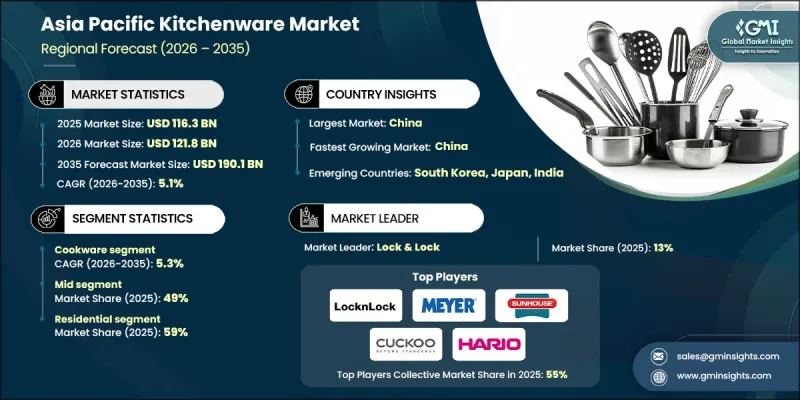
Asia Pacific Kitchenware Market was valued at USD 116.3 billion in 2025 and is estimated to grow at a CAGR of 5.1% to reach USD 190.1 billion by 2035.
Growth is supported by rapid changes in regional manufacturing capabilities, increasing innovation in sustainable and safe materials, and a broader range of products designed to match modern cooking requirements. Consumers are increasingly prioritizing durability, food safety, and environmental responsibility, which has accelerated demand for eco-conscious kitchenware solutions. Rising awareness around health and sustainability is encouraging the adoption of non-toxic coatings, food-grade metals, silicone, glass, and plant-based materials, signaling a gradual shift away from low-quality plastics and inferior alloys. While stainless steel and aluminum continue to hold a strong position, manufacturers are actively incorporating recyclable, biodegradable, and long-lasting materials to align with tightening food safety standards and sustainability expectations set by governments and organized retail channels.
| Market Scope | |
|---|---|
| Start Year | 2025 |
| Forecast Year | 2026-2035 |
| Start Value | $116.3 Billion |
| Forecast Value | $190.1 Billion |
| CAGR | 5.1% |
The expanding influence of digital food platforms, home-based cooking trends, and health-focused diets is driving demand for specialized kitchen products designed for convenience and versatility. Consumers are increasingly purchasing induction-compatible cookware, multi-purpose cooking vessels, accessories for modern appliances, and storage solutions suited for varied food preparation methods. The continued preference for home-prepared meals has also reinforced long-term demand for kitchenware used in daily cooking, baking, and food preservation.
The cookware segment generated USD 47.2 billion in 2025 and is anticipated to grow at a CAGR of 5.3% from 2026 to 2035. The segment is witnessing a strong shift toward sustainable product development as consumers seek safer and longer-lasting cookware options that align with health-conscious lifestyles and environmental responsibility.
The mid-priced segment accounted for a 49% share in 2025 and is expected to maintain steady growth through 2035. Consumers favor this category for its balance between affordability and quality, as these products typically offer improved materials, enhanced durability, and attractive designs without the higher cost associated with premium brands.
Asia Pacific Kitchenware Market is forecast to grow at a CAGR of 5.1% through 2035. Growth is underpinned by accelerating urbanization, rising disposable income levels, and favorable demographic trends. Major economies such as Japan, India, China, and South Korea continue to drive demand across cookware, bakeware, food storage, and modular kitchen solutions. The region benefits from large-scale manufacturing capacity, a broad consumer base, and the rapid expansion of modern retail and e-commerce channels, which improve product availability and pricing. Competition remains intense among domestic and global brands, with innovation focused on material safety, sustainability, durability, and value-driven offerings designed for diverse cooking habits and climatic conditions.
Key companies operating in the Asia Pacific Kitchenware Market include Zojirushi, Breville Group, Lock & Lock, Tiger Corporation, Pearl Metal, Yoshikawa, Cuckoo Electronics, HARIO, Meyer Thailand, Myrex Thailand, Wahei Freiz, Noda Horo, Sunhouse Group, Satien Stainless Steel, and PT Kedaung Indah Can. Companies in the Asia Pacific kitchenware market are strengthening their market position through material innovation, cost optimization, and product diversification. Manufacturers are investing in sustainable and food-safe materials to meet regulatory standards and evolving consumer expectations. Expanding mid-range product portfolios allows brands to capture value-driven buyers while maintaining quality differentiation. Strategic partnerships with retailers and e-commerce platforms help improve regional reach and visibility. Firms are also enhancing manufacturing efficiency and local sourcing to control costs and ensure supply stability.
Table of Contents
Chapter 1 Methodology and Scope
- 1.1 Market scope and definition
- 1.2 Research design
- 1.2.1 Research approach
- 1.2.2 Data collection methods
- 1.3 Data mining sources
- 1.3.1 Country
- 1.4 Base estimates and calculations
- 1.4.1 Base year calculation
- 1.4.2 Key trends for market estimation
- 1.5 Primary research and validation
- 1.5.1 Primary sources
- 1.6 Forecast model
- 1.7 Research assumptions and limitations
Chapter 2 Executive Summary
- 2.1 Industry 360° synopsis
- 2.2 Key market trends
- 2.2.1 Regional
- 2.2.2 Type
- 2.2.3 Price Range
- 2.2.4 End Use
- 2.2.5 Distribution Channel
- 2.3 CXO perspectives: Strategic imperatives
- 2.3.1 Key decision points for industry executives
- 2.3.2 Critical success factors for market players
- 2.4 Future outlook and strategic recommendations
Chapter 3 Industry Insights
- 3.1 Industry ecosystem analysis
- 3.1.1 Supplier landscape
- 3.1.2 Profit margin
- 3.1.3 Value addition at each stage
- 3.1.4 Factor affecting the value chain
- 3.2 Industry impact forces
- 3.2.1 Growth drivers
- 3.2.1.1 Urbanization & rising disposable income
- 3.2.1.2 Growth of home cooking & health-focused lifestyles
- 3.2.1.3 Sustainability & food safety awareness
- 3.2.2 Industry pitfalls & challenges
- 3.2.2.1 Raw material price volatility
- 3.2.2.2 Price sensitivity in developing markets
- 3.2.3 Opportunities
- 3.2.3.1 E-commerce & omnichannel retail expansion
- 3.2.3.2 Modular, space-saving & multi-functional kitchenware
- 3.2.1 Growth drivers
- 3.3 Growth potential analysis
- 3.4 Future market trends
- 3.5 Technology and innovation landscape
- 3.5.1 Current technological trends
- 3.5.2 Emerging technologies
- 3.6 Price trends
- 3.6.1 By region
- 3.6.2 By type
- 3.7 Regulatory landscape
- 3.7.1 Standards and compliance requirements
- 3.7.2 Regional regulatory frameworks
- 3.7.3 Certification standards
- 3.8 Porter’s analysis
- 3.9 PESTEL analysis
Chapter 4 Competitive Landscape, 2025
- 4.1 Introduction
- 4.2 Company market share analysis
- 4.2.1 By Country
- 4.2.1.1 China
- 4.2.1.2 Japan
- 4.2.1.3 India
- 4.2.1.4 Australia
- 4.2.1.5 South Korea
- 4.2.1 By Country
- 4.3 Company matrix analysis
- 4.4 Competitive analysis of major market players
- 4.5 Competitive positioning matrix
- 4.6 Key developments
- 4.6.1 Mergers & acquisitions
- 4.6.2 Partnerships & collaborations
- 4.6.3 New product launches
- 4.6.4 Expansion plans
Chapter 5 Market Estimates & Forecast, By Product, 2022-2035 (USD Billion) (Million Units)
- 5.1 Key trends
- 5.2 Cookware
- 5.2.1 Pan
- 5.2.2 Fry pan
- 5.2.3 Saute pan
- 5.2.4 Saucepan
- 5.2.5 Roasting pan
- 5.2.6 Others
- 5.3 Pots
- 5.3.1 Brazier
- 5.3.2 Sauce pot
- 5.3.3 Dutch oven/ cocotte pots
- 5.3.4 Fryer pot
- 5.3.5 Others
- 5.4 Bakeware
- 5.4.1 Bread and loaf pan
- 5.4.2 Sheet pan
- 5.4.3 Cake pans
- 5.4.4 Muffin pans
- 5.4.5 Others
- 5.5 Tableware
- 5.5.1 Cooking tools & utensils
- 5.5.2 Knives
- 5.5.3 Cutlery
- 5.5.4 Scrapper
- 5.5.5 Skimmer
- 5.5.6 Tongs
- 5.5.7 Others
- 5.6 Appliances
- 5.6.1 Large kitchen appliances
- 5.6.1.1 Refrigerator
- 5.6.1.2 Mixer & grinders
- 5.6.1.3 Dishwasher
- 5.6.1.4 Dough kneader
- 5.6.1.5 Others (grills, griddles etc.)
- 5.6.2 Small kitchen appliances
- 5.6.2.1 Cookers
- 5.6.2.2 Coffee makers
- 5.6.2.3 Blenders
- 5.6.2.4 Food processors
- 5.6.2.5 Juicer
- 5.6.2.6 Ice dispenser
- 5.6.2.7 Toaster
- 5.6.2.8 Other (microwave, oven, air fryers, etc.)
- 5.6.1 Large kitchen appliances
- 5.7 Other kitchen essentials (storage boxes, towels, racks, bins, home essentials)
Chapter 6 Market Estimates & Forecast, By Price Range, 2022-2035 (USD Billion) (Million Units)
- 6.1 Key trends
- 6.2 Low
- 6.3 Mid
- 6.4 High
Chapter 7 Market Estimates & Forecast, By End-use, 2022-2035 (USD Billion) (Million Units)
- 7.1 Key trends
- 7.2 Residential
- 7.3 Commercial
- 7.3.1 Hotels
- 7.3.2 Restaurants
- 7.3.3 Others
Chapter 8 Market Estimates & Forecast, By Distribution Channel, 2022-2035 (USD Billion) (Million Units)
- 8.1 Key trends
- 8.2 Online
- 8.2.1 E-commerce websites
- 8.2.2 Brand-owned websites
- 8.3 Offline
- 8.3.1 Supermarkets/hypermarkets
- 8.3.2 Specialty stores
- 8.3.3 Department stores
Chapter 9 Market Estimates and Forecast, By Country, 2022 - 2035 (USD Billion)
- 9.1 Key trends
- 9.2 Asia Pacific
- 9.2.1 China
- 9.2.2 Japan
- 9.2.3 India
- 9.2.4 Australia
- 9.2.5 South Korea
Chapter 10 Company Profiles
- 10.1 Breville Group
- 10.2 Cuckoo Electronics
- 10.3 HARIO
- 10.4 Lock & Lock
- 10.5 Meyer Thailand
- 10.6 Myrex Thailand
- 10.7 Noda Horo
- 10.8 Pearl Metal
- 10.9 PT Kedaung Indah Can
- 10.10 Satien Stainless Steel
- 10.11 Sunhouse Group
- 10.12 Tiger Corporation
- 10.13 Wahei Freiz
- 10.14 Yoshikawa
- 10.15 Zojirushi

