PUBLISHER: Global Market Insights Inc. | PRODUCT CODE: 2027489

PUBLISHER: Global Market Insights Inc. | PRODUCT CODE: 2027489
Kitchenware Market Opportunity, Growth Drivers, Industry Trend Analysis, and Forecast 2026 - 2035
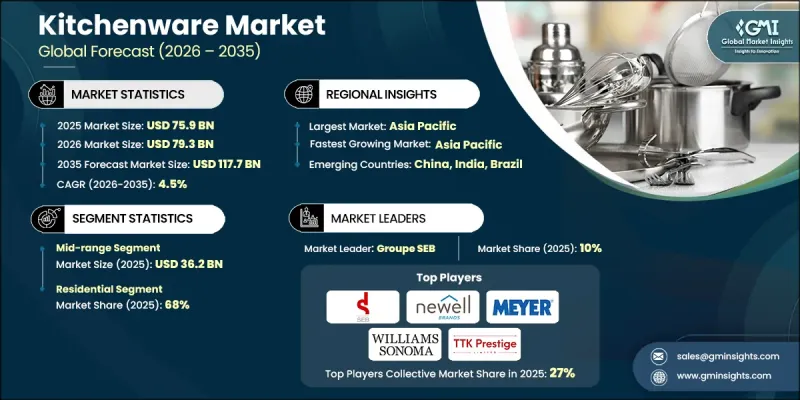
The Global Kitchenware Market was valued at USD 75.9 billion in 2025 and is estimated to grow at a CAGR of 4.5% to reach USD 117.7 billion by 2035.
The market's growth is fueled by a rising global interest in home cooking, healthier eating habits, and well-designed living spaces. Consumers are increasingly motivated to prepare meals at home, influenced by cooking shows, online tutorials, and social media content that highlight convenience, efficiency, and creativity in cooking. Modern households are seeking products that combine durability, functionality, and style, driving demand for premium cookware, utensils, and storage solutions. Technological integration in kitchenware, such as smart appliances and app-enabled tools, is reshaping consumer expectations by offering precision, convenience, and long-term usability. Sustainability also plays a key role, with consumers showing a preference for environmentally responsible materials, responsibly sourced components, and products that reduce waste while maintaining performance. These factors collectively position the kitchenware market for steady and long-term growth.
| Market Scope | |
|---|---|
| Start Year | 2025 |
| Forecast Year | 2026-2035 |
| Start Value | $75.9 Billion |
| Forecast Value | $117.7 Billion |
| CAGR | 4.5% |
The mid-range segment reached USD 36.2 billion in 2025. Consumers are increasingly drawn to mid-priced kitchenware that balances quality, aesthetics, and practicality without high cost. As disposable incomes rise, buyers often upgrade from entry-level products while remaining price-conscious, making the mid-tier segment highly attractive. These products offer durability, ease of use, and alignment with health-focused cooking trends, supporting daily home meal preparation and enhancing the overall cooking experience.
The residential segment held a 68% share in 2025. Rising awareness of home cooking, healthier eating, and personalized kitchen design has boosted demand for high-quality, functional, and visually appealing cookware and utensils. Home cooks now prioritize products that offer long-term durability, versatility, and convenience, with many seeking curated kitchen collections over single-use items. The growing culture of home-prepared meals has strengthened the residential market, as consumers focus on making their kitchens both efficient and enjoyable spaces for cooking.
U.S. Kitchenware Market has around 77% share, generating USD 15 billion in 2025. Strong home cooking habits, rising interest in healthier lifestyles, and steady disposable incomes have fueled growth. Consumers favor practical, stylish products that save time while enhancing convenience. The popularity of cooking shows, online influencers, and recipe experimentation has encouraged demand for mid-range and premium cookware. Mature e-commerce platforms have expanded accessibility, enabling consumers to explore and invest in high-quality, durable kitchenware solutions that complement modern kitchen aesthetics and everyday cooking needs.
Key players in the Global Kitchenware Market include Lodge Manufacturing Company, Le Creuset, TTK Prestige Limited, Joseph Joseph Ltd., Scanpan International, Williams-Sonoma Inc., Breville Group Limited, Helen of Troy Limited, Werhahn KG, Fissler GmbH, Groupe SEB, Newell Brands, Meyer Corporation, Mauviel 1830, and Whirlpool Corporation. Companies in the Kitchenware Market strengthen their position by innovating product designs that merge functionality with modern aesthetics, targeting mid- and premium-tier consumers seeking durability and style. They expand their portfolio with smart, app-enabled, and multi-functional tools, responding to tech-savvy households. Sustainable manufacturing practices, including eco-friendly materials and responsible sourcing, are increasingly emphasized to meet consumer demand for environmentally conscious products. Strategic partnerships with e-commerce platforms and retail chains enhance visibility and accessibility. Marketing initiatives focus on influencer collaborations, lifestyle content, and educational campaigns that promote home cooking culture. Companies also invest in R&D for ergonomic, user-friendly products, ensuring customer satisfaction, brand loyalty, and long-term revenue growth across competitive global markets.
Table of Contents
Chapter 1 Research Methodology
- 1.1 Research approach
- 1.2 Quality Commitments
- 1.2.1 GMI AI policy & data integrity commitment
- 1.2.1.1 Source consistency protocol
- 1.2.1 GMI AI policy & data integrity commitment
- 1.3 Research Trail & Confidence Scoring
- 1.3.1 Research Trail Components
- 1.3.2 Scoring Components
- 1.4 Data Collection
- 1.4.1 Partial list of primary sources
- 1.5 Data mining sources
- 1.5.1 Paid sources
- 1.5.1.1 Sources, by region
- 1.5.1 Paid sources
- 1.6 Base estimates and calculations
- 1.6.1 Base year calculation for any one approach
- 1.7 Forecast model
- 1.7.1 Quantified market impact analysis
- 1.7.1.1 Mathematical impact of growth parameters on forecast
- 1.7.1 Quantified market impact analysis
- 1.8 Research transparency addendum
- 1.8.1 Source attribution framework
- 1.8.2 Quality assurance metrics
- 1.8.3 Our commitment to trust
Chapter 2 Executive Summary
- 2.1 Industry synopsis, 2022-2035
- 2.2 Key Trends
- 2.2.1 Region
- 2.2.2 Product
- 2.2.3 Price range
- 2.2.4 Material
- 2.2.5 End use
- 2.2.6 Distribution channel
Chapter 3 Industry Insights
- 3.1 Industry ecosystem analysis
- 3.1.1 Raw material suppliers
- 3.1.2 Manufacturers and OEMs
- 3.1.3 Distributors and wholesalers
- 3.1.4 Retailers and e-commerce platforms
- 3.1.5 End users
- 3.1.6 Profit margin analysis by value chain stage
- 3.2 Impact forces
- 3.2.1 Growth drivers
- 3.2.1.1 Rising home-cooking culture and health-focused lifestyles
- 3.2.1.2 Increasing disposable income and urban lifestyle shifts
- 3.2.1.3 Expansion of e-commerce and digital reach
- 3.2.2 Industry pitfalls & challenges
- 3.2.2.1 Intense competition and market saturation
- 3.2.2.2 Fluctuating raw material prices
- 3.2.3 Opportunities
- 3.2.3.1 Growing demand for smart and multifunctional kitchenware
- 3.2.3.2 Rising preference for sustainable and eco-friendly products
- 3.2.1 Growth drivers
- 3.3 Growth potential analysis
- 3.4 Technological landscape
- 3.5 Pricing analysis (driven by primary research)
- 3.5.1 Historical price trend analysis
- 3.5.2 Pricing strategy by player type (premium, value, cost-plus)
- 3.5.3 Impact of raw material price fluctuations on retail pricing
- 3.6 Regulatory landscape
- 3.7 Consumer buying behavior analysis
- 3.7.1 Demographic trends
- 3.7.2 Factors affecting buying decisions
- 3.7.3 Product Preference
- 3.7.4 Preferred price range
- 3.7.5 Preferred distribution channel
- 3.8 Porter’s analysis
- 3.9 PESTEL analysis
- 3.10 Trade data analysis (driven by paid database)
- 3.10.1 Import/export volume and value trends
- 3.10.2 Key trade corridors and tariff impact
- 3.10.3 Anti-dumping measures and trade policy implications
- 3.11 Impact of AI and generative AI on the market
- 3.11.1 AI driven disruption of existing business models
- 3.11.2 GenAI use cases and adopt roadmaps by segment
- 3.11.2.1 AI powered product design and personalization
- 3.11.2.2 Smart kitchen appliances with voice/AI integration
- 3.11.2.3 AI enhanced supply chain optimization
- 3.11.2.4 GenAI in marketing and consumer engagement
- 3.11.3 Risks, limitations and regulatory considerations
Chapter 4 Competitive Landscape, 2025
- 4.1 Introduction
- 4.2 Company market share analysis
- 4.2.1 North America
- 4.2.2 Europe
- 4.2.3 Asia Pacific
- 4.2.4 Latin America
- 4.2.5 Middle East and Africa
- 4.3 Company matrix analysis
- 4.4 Competitive analysis of major market players
- 4.5 Competitive positioning matrix
- 4.6 Key developments
- 4.6.1 Mergers & acquisitions
- 4.6.2 Partnerships & collaborations
- 4.6.3 New product launches
- 4.6.4 Expansion plans
Chapter 5 Market Estimates & Forecast, By Product, 2022-2035 (USD Billion) (Million Units)
- 5.1 Key trends
- 5.2 Cookware
- 5.2.1 Pots
- 5.2.2 Pans
- 5.2.3 Pressure cookers
- 5.2.4 Specialty cookware
- 5.3 Bakeware
- 5.3.1 Bread and loaf pans
- 5.3.2 Sheet pans and baking trays
- 5.3.3 Cake pans and muffin tins
- 5.3.4 Specialty bakeware
- 5.4 Cooking utensils & tools
- 5.4.1 Cutting and preparation tools
- 5.4.2 Mixing and measuring tools
- 5.4.3 Serving utensils
- 5.4.4 Specialty tools
- 5.5 Cutlery & knives
- 5.5.1 Chef knives
- 5.5.2 Utility and paring knives
- 5.5.3 Specialty knives
- 5.5.4 Knife sets and blocks
- 5.6 Tableware
- 5.6.1 Serving dishes and platters
- 5.6.2 Bowls and serving accessories
- 5.6.3 Drinkware and glassware
- 5.7 Small kitchen appliances
- 5.7.1 Blenders and food processors
- 5.7.2 Coffee makers and espresso machines
- 5.7.3 Toasters and toaster ovens
- 5.7.4 Countertop cooking appliances
- 5.7.5 Mixers and grinders
- 5.7.6 Juicers and extractors
- 5.7.7 Storage & organization
- 5.7.7.1 Food storage containers
- 5.7.7.2 Kitchen organizers and racks
- 5.7.7.3 Bins and canisters
Chapter 6 Market Estimates & Forecast, By Price Range, 2022-2035 (USD Billion) (Million Units)
- 6.1 Key trends
- 6.2 Economy/value
- 6.3 Mid-range
- 6.4 Premium/luxury
Chapter 7 Market Estimates & Forecast, By Material, 2022-2035 (USD Billion) (Million Units)
- 7.1 Key trends
- 7.2 Stainless steel
- 7.3 Aluminum
- 7.4 Cast iron
- 7.5 Ceramic & glass
- 7.6 Silicone & non-stick coated
- 7.7 Others
Chapter 8 Market Estimates & Forecast, By End Use, 2022-2035 (USD Billion) (Million Units)
- 8.1 Key trends
- 8.2 Residential
- 8.3 Commercial
- 8.3.1 Hotels & hospitality
- 8.3.2 Restaurants & cafes
- 8.3.3 Institutional kitchens
- 8.3.4 Catering services
Chapter 9 Market Estimates & Forecast, By Distribution Channel, 2022-2035 (USD Billion) (Million Units)
- 9.1 Key trends
- 9.2 Online
- 9.2.1 E-commerce websites
- 9.2.2 Brand-owned websites
- 9.3 Offline
- 9.3.1 Supermarkets/hypermarkets
- 9.3.2 Specialty stores
- 9.3.3 Department stores
Chapter 10 Market Estimates & Forecast, By Region, 2022-2035 (USD Billion) (Million Units)
- 10.1 Key trends
- 10.2 North America
- 10.2.1 U.S.
- 10.2.2 Canada
- 10.3 Europe
- 10.3.1 UK
- 10.3.2 Germany
- 10.3.3 France
- 10.3.4 Italy
- 10.3.5 Spain
- 10.3.6 Russia
- 10.4 Asia Pacific
- 10.4.1 China
- 10.4.2 India
- 10.4.3 Japan
- 10.4.4 South Korea
- 10.4.5 Australia
- 10.5 Latin America
- 10.5.1 Brazil
- 10.5.2 Mexico
- 10.6 MEA
- 10.6.1 UAE
- 10.6.2 Saudi Arabia
- 10.6.3 South Africa
Chapter 11 Company Profiles
- 11.1 Breville Group Limited
- 11.2 Fissler GmbH
- 11.3 Groupe SEB
- 11.4 Helen of Troy Limited
- 11.5 Joseph Joseph Ltd.
- 11.6 Le Creuset
- 11.7 Lodge Manufacturing Company
- 11.8 Mauviel 1830
- 11.9 Meyer Corporation
- 11.10 Newell Brands
- 11.11 Scanpan International
- 11.12 TTK Prestige Limited
- 11.13 Werhahn KG
- 11.14 Whirlpool Corporation
- 11.15 Williams-Sonoma Inc.

